
Maximize your score with these resources:
- Albert.io AP® Calculus question banks
- Free AP® Calculus cheat sheets
- Free AP® Calculus score calculator
What We Review
What is the Lagrange Error Bound?
The Lagrange Error Bound provides a maximum error when approximating a function using a Taylor polynomial. On the AP® Calculus BC exam, this is a high-yield topic for both multiple-choice and free-response questions. The Lagrange error bound tells you how far off your approximation could be in the worst-case scenario.
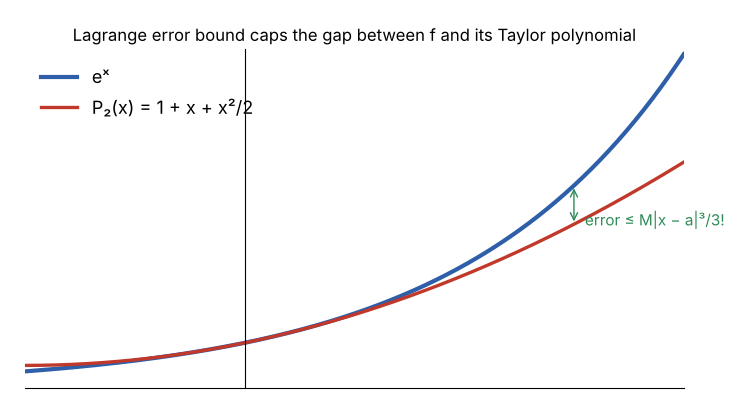
When you approximate a function \(f(x)\) with a Taylor polynomial \(P_n(x)\) centered at \(x = a\), the error is:
\(R_n(x) = f(x) – P_n(x)\)The Lagrange Error Bound guarantees:
\(|R_n(x)| \leq \frac{M}{(n+1)!}|x – a|^{n+1}\)where \(M\) is the maximum value of \(|f^{(n+1)}(t)|\) between \(a\) and \(x\).
Key Components Explained
- M (Maximum derivative value): Find the largest absolute value of the \((n+1)\)-th derivative on the interval. This is often the hardest step.
- (n+1)!: Factorial grows very quickly. This rapidly shrinks the error as \(n\) increases.
- \(|x – a|^{n+1}\): Distance from center, raised to power \(n+1\). Smaller intervals = smaller error.
Finding M: The Critical Step
Finding \(M\) is where most students struggle. You need:
- Calculate the (n+1)-th derivative. For \(f(x) = e^x\), all derivatives are \(e^x\). For \(\sin(x)\) or \(\cos(x)\), derivatives cycle with max value 1.
- Evaluate on your interval. If the interval is \([0, 0.5]\), evaluate at the endpoint farthest from \(a\).
- Take absolute value. Use the largest absolute value you find.
| Function | n-th Derivative Pattern | Max |Derivative| |
|---|---|---|
| \(e^x\) | \(e^x\) (all orders) | \(e^b\) (evaluate at right endpoint) |
| \(\sin(x)\) | Cycles: \(\cos, -\sin, -\cos, \sin\) | 1 |
| \(\cos(x)\) | Cycles: \(-\sin, -\cos, \sin, \cos\) | 1 |
| \(\ln(x)\) | \(\frac{(-1)^{n+1}(n-1)!}{x^n}\) | Evaluate at the smallest \(x\) in the interval (left endpoint) |
Step-by-Step Example
Problem: Approximate \(e^{0.2}\) using a Taylor polynomial of degree 2 centered at \(x = 0\). Find the maximum error.
Solution:
For \(f(x) = e^x\), the 3rd derivative is \(f^{(3)}(x) = e^x\).
On \([0, 0.2]\), the maximum of \(e^x\) is \(e^{0.2} \approx 1.22\), so \(M = 1.22\).
Apply the bound:
\(|R_2(0.2)| \leq \frac{1.22}{3!}|0.2 – 0|^3 = \frac{1.22}{6}(0.008) = 0.00163\)This means your approximation is off by at most 0.00163.
Common Pitfalls on the AP Exam
- Wrong derivative order: If you use degree \(n\) polynomial, you need the \((n+1)\)-th derivative, not the \(n\)-th.
- Forgetting absolute value: The bound uses \(|x – a|\). Distance is always positive.
- Not simplifying M: Sometimes exam problems give you \(M\) directly. Read carefully.
- Confusing interval endpoints: If centered at \(a = 1\) and \(x = 1.5\), then \(|x – a| = 0.5\), not 1.5.
Cross-Topic Connections
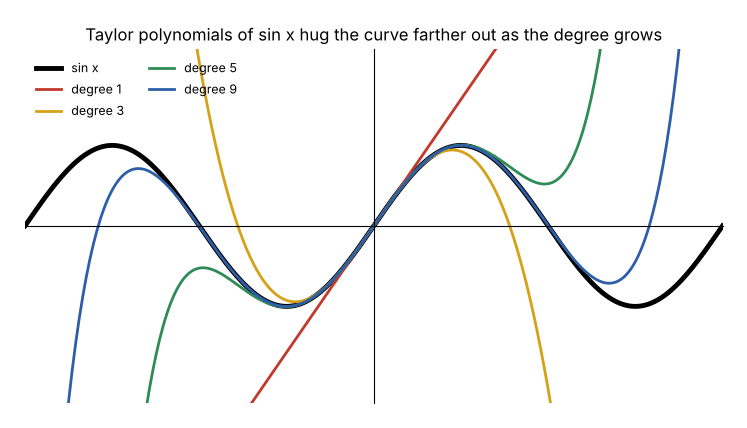
Taylor Series Convergence: As \(n \to \infty\) and \(|x – a|\) is fixed, the Lagrange bound shrinks. This connects to radius of convergence—within the radius, Taylor polynomials approximate better with higher degree.
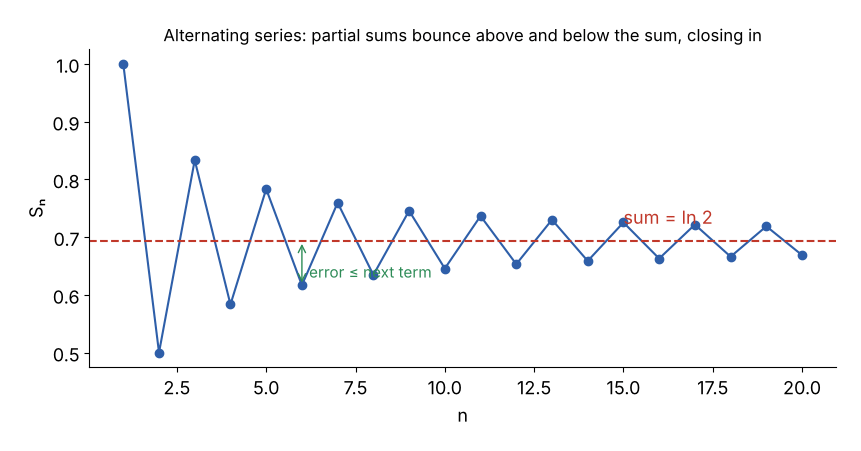
Alternating Series Error: If you use an alternating series to approximate a function, the error is bounded by the first omitted term. Lagrange error bound is more general and applies to any Taylor polynomial, not just alternating series.
Integral Approximations: Trapezoid rule and Simpson’s rule errors also use bounds similar to Lagrange error—they depend on derivatives and interval width.
AP Exam Question Formats
Multiple Choice Format
Type 1 – Direct Calculation: “If \(P_3(x)\) approximates \(\ln(x)\) near \(x = 1\), and \(|f^{(4)}(x)| \leq 5\) on \([0.9, 1.1]\), find the maximum error at \(x = 1.05\).”
Strategy: Plug into formula. \(|R_3(1.05)| \leq \frac{5}{4!}(0.05)^4\).
Type 2 – Comparative: “Which polynomial approximates \(f\) with error less than \(10^{-4}\) on \([-0.1, 0.1]\)?”
Strategy: Test each option’s degree \(n\). Higher degree = smaller error.
Free Response Format
Part (a): Find Taylor polynomial \(P_n(x)\).
Part (b): Verify Lagrange error bound. Show your calculation of \(M\) explicitly.
Part (c): Use error bound to justify convergence or accuracy claim.
Time Management Tips for Exam Day
- Estimate M quickly: On \(e^x\) problems, \(e^x\) is increasing, so evaluate at the right endpoint. On \(\sin/\cos\), max is always 1.
- Use factorials strategically: Know that \(3! = 6, 4! = 24, 5! = 120\). Large factorials kill the error fast.
- Check your power: Use \((n+1)\) consistently. If you see degree 2, that’s \(n = 2\), so use 3rd derivative and \(3! = 6\).
- Round conservatively: If \(M \approx 1.22\), you can use \(M = 1.23\) or \(M = 1.3\) for mental math, then verify reasonableness at the end.
Student Mistakes to Avoid
| Mistake | Why It’s Wrong | Correct Approach |
|---|---|---|
| Using \(n\)-th derivative instead of \((n+1)\)-th | Formula requires next derivative after polynomial degree | If \(P_2(x)\), find \(f^{(3)}(x)\) |
| Forgetting to take absolute value of \((x – a)\) | Distance must be positive; error is always positive | Always use \(|x – a|\), even if \(x < a\) |
| Evaluating M at wrong endpoint | Different functions peak at different places | For \(e^x\), evaluate at larger endpoint; for \(\ln(x)\), at smaller |
| Confusing “degree” with “order of derivative” | Degree is \(n\); derivative order for error is \(n+1\) | Write \(P_n\) explicitly and reference \(f^{(n+1)}\) |
Practice Problem
Problem: Let \(f(x) = \cos(x)\). A student uses \(P_4(x)\) to approximate \(f\) near \(x = 0\). On the interval \([-0.3, 0.3]\), find the maximum error using the Lagrange error bound.
Solution Steps:
1. Identify \(n = 4\), so we need \(f^{(5)}(x)\).
Derivatives of \(\cos(x)\): \(-\sin(x), -\cos(x), \sin(x), \cos(x), -\sin(x)\).
So \(f^{(5)}(x) = -\sin(x)\).
2. Find \(M = \max|f^{(5)}(x)|\) on \([-0.3, 0.3]\).
\(|{-\sin(x)}| = |\sin(x)| \leq \sin(0.3) \approx 0.295\). Use \(M = 0.3\) (or more precisely, 0.295).3. Apply bound for \(x = 0.3\):
\(|R_4(0.3)| \leq \frac{0.3}{5!}(0.3)^5 = \frac{0.3}{120}(0.00243) \approx 0.0000061\)Answer: Maximum error ≈ \(6.1 \times 10^{-6}\).
Test-Taking Strategies
Mnemonic: “DNA”
- D: Determine the derivative order needed (\(n+1\), not \(n\)).
- N: Nail down \(M\)—the maximum absolute value on your interval.
- A: Apply formula: \(\frac{M}{(n+1)!}|x – a|^{n+1}\).
Cross-Topic Thinking
Lagrange error connects three major BC topics:
- Taylor Series: Error bound determines series accuracy.
- Convergence Tests: The alternating series error bound is a related but separate error estimate.
- Improper Integrals & Bounds: Similar bound-finding techniques apply to other approximations.
Common FRQ Patterns
Pattern 1: “Justify that \(P_3(x)\) approximates \(f(x)\) with error less than 0.01 on the interval.” → Calculate Lagrange bound and compare.
Pattern 2: “Find the minimum degree \(n\) such that error is less than \(10^{-5}\) on a given interval.” → Set up inequality, solve for \(n\).
Pattern 3: “Use your Taylor polynomial to estimate \(f(0.1)\) and state the maximum error.” → Compute \(P_n(0.1)\), then give error bound.
Time-Saving Shortcuts
- On sine/cosine: Immediately write \(M = 1\). No computation needed.
- On \(e^x\): Round \(e^x\) up to one decimal place so \(M\) is not too small. \(e^{0.5} \lt 1.7, e^1 \lt 2.8, e^{-0.1} \lt 1\).
- On factorial dominance: Recognize that \(5! = 120\) and \(6! = 720\) shrink error dramatically. If \(|x – a|\) is small, higher degrees matter more than finding exact \(M\).
Exam Pacing
Lagrange error questions typically appear as part (b) or (c) of a multi-part FRQ. Budget 4-6 minutes per question. Write down the formula first, identify each component, then substitute. Show all arithmetic explicitly for partial credit.
Quick Reference Formula Card
Lagrange Error Bound: \(|R_n(x)| \leq \frac{M}{(n+1)!}|x – a|^{n+1}\)
Finding M:
- Compute \(f^{(n+1)}(x)\).
- Evaluate on interval \([\min, \max]\).
- Take the maximum absolute value.
Solving for n (minimum degree for accuracy): \(\frac{M}{(n+1)!}|x – a|^{n+1} < \text{(target error)}\) → Solve for \(n\).
Check for Understanding
Think you’ve got it? Complete the quiz below to make sure. Download your results at the end.