

Maximize your score with these resources:
- Albert.io AP® US History question banks
- Free AP® US History cheat sheets
- Free AP® US History score calculator
Gilded Age presidential elections were some of the closest in American history. In 1880, James Garfield won the popular vote by fewer than 10,000 votes out of 9 million cast. In 1884 and 1888, the winner of the popular vote lost once and won once. Voter turnout regularly topped 75%. Yet historians often describe the presidents of this era as forgettable. Topic 6.13 explains that contradiction: intense partisan loyalty, weak federal action, and growing pressure for change.
This article covers Topic 6.13: Politics in the Gilded Age in Period 6, 1865 to 1898. The topic asks you to explain the similarities and differences between the political parties, the debates over patronage, tariffs, and money, and how the political system responded to economic and social change.
By the end, you should be able to:
- Describe the balance between the two major parties.
- Explain the debates over the spoils system, tariffs, and currency.
- Describe the rise and goals of the Populist Party.
- Explain the significance of the election of 1896.

What We Review
A Closely Balanced System
| Party | Base of Support | Typical Positions |
|---|---|---|
| Republicans | Northeast and Midwest, Union veterans, Protestants, African Americans, business interests | High protective tariffs, support for business, “waving the bloody shirt” of the Civil War |
| Democrats | The “Solid South,” urban immigrants, Catholics, many farmers | Lower tariffs, limited federal government, states’ rights |
Because elections were so close, neither party wanted to take bold stands that might drive away voters. Party loyalty was often based on region, religion, and ethnicity more than on specific policies. Congress was frequently divided, and the presidency changed hands often.
The Big Issues
Patronage and Civil Service Reform
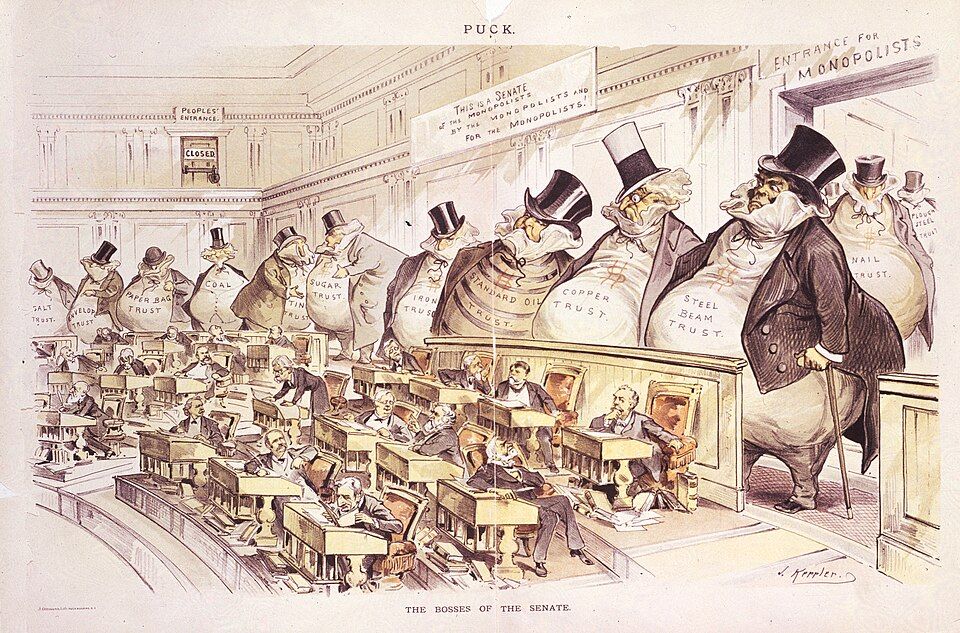
Under the spoils system, winning politicians handed out government jobs to loyal supporters. Factions fought over these jobs. The Republican “Stalwarts” defended patronage, while “Half-Breeds” and reform-minded “Mugwumps” opposed it.
In 1881, a disappointed office seeker assassinated President Garfield. The shock pushed Congress to pass the Pendleton Civil Service Act (1883), which required that some federal jobs be filled through competitive exams based on merit.
Tariffs
High protective tariffs shielded American industry from foreign competition but raised prices for consumers and farmers. Republicans pushed rates higher with the McKinley Tariff of 1890. Democrats, led by Grover Cleveland, argued for lower rates.
Money and Currency
| Position | Supporters | Reasoning |
|---|---|---|
| Gold standard (“sound money”) | Bankers, creditors, Eastern business | Stable currency protects the value of loans and investments |
| Free silver or greenbacks (“soft money”) | Farmers, debtors, silver miners | More money in circulation would raise crop prices and ease debts |
Early Federal Regulation
Despite the era’s laissez-faire reputation, Congress took first steps toward regulating big business. The Interstate Commerce Act (1887) created the first federal regulatory agency to oversee railroad rates. The Sherman Antitrust Act (1890) outlawed monopolies, though it was weakly enforced at first.
The Populist Challenge
Struggling farmers, organized through the Grange and the Farmers’ Alliances, formed the People’s (Populist) Party in 1892. Its Omaha Platform called for:
- Free and unlimited coinage of silver
- A graduated income tax
- Government ownership of railroads, telegraphs, and telephones
- Direct election of U.S. senators
- An eight-hour workday
Many of these ideas seemed radical in 1892, but several, including the income tax and direct election of senators, became law in the Progressive Era.
The Election of 1896
After the Panic of 1893, the Democrats nominated William Jennings Bryan, who electrified the convention with his “Cross of Gold” speech for free silver. The Populists endorsed Bryan too. Republican William McKinley, backed by business and a well-funded campaign run by Mark Hanna, won decisively.
The result was a turning point. It ended the era of close elections, began a long period of Republican dominance, kept the gold standard, and effectively ended the Populist Party as a national force.
Why does this matter? Gilded Age politics shows how a political system can lag behind economic change. On essays, you can use the Pendleton Act, the Interstate Commerce Act, and the Populist movement as evidence that Americans were beginning to demand a larger federal role, a trend that peaked in the Progressive Era and the New Deal.
Test-Taking Strategies
Mnemonic Devices and Memory Shortcuts
- “Garfield’s death, merit’s birth.” The assassination led to the Pendleton Act.
- “Farmers want more money.” Free silver meant inflation, which helped debtors.
- “1896 broke the tie.” McKinley’s win ended the era of close elections.
Cross-Topic Connections
- Topic 6.11: Farmers’ organizations laid the groundwork for Populism. See our review of the Grange.
- Topic 6.12: Debates over laissez-faire and Social Darwinism shaped federal inaction. See our review of debates over the role of government.
- Topic 6.7: Labor unrest raised pressure on politicians to act.
- Topic 7.4: Progressives adopted several Populist goals. See our review of the Progressive Era.
Common Question Formats
- Stimulus MCQ. An excerpt from the Omaha Platform or the “Cross of Gold” speech, and you identify the group it represents.
- Causation SAQ. You explain why farmers supported the Populist Party.
- Continuity and change SAQ. You explain how Populist ideas influenced later reform.
- LEQ. You evaluate the extent to which the federal government responded to industrialization between 1865 and 1898.
Frequent Student Mistakes
- Calling the federal government completely inactive. The ICC and Sherman Act were real, if limited, steps.
- Reversing the money debate. Farmers wanted silver because inflation eased debts.
- Thinking Bryan won in 1896. McKinley won, and the gold standard held.
- Treating Populists as a labor party. Its core was farmers, though it reached out to workers.
Test-Day Shortcuts
- Spot “cross of gold.” That phrase always points to Bryan and 1896.
- Match the platform. Income tax, direct election of senators, and free silver signal Populists.
- Use causation chains. Falling crop prices led to debt, which led to demands for silver.
Time Management Tips
- Multiple choice: Section IA has 55 questions in 55 minutes, about 1 minute each. Check the date on political sources carefully, since many issues spanned decades.
- Short answer: Section IB has 3 required questions in 40 minutes, roughly 13 minutes each. Pair each claim with a named law, person, or election.
- Essays: The DBQ gets 60 minutes, including a 15-minute reading period, and the single required LEQ gets 40 minutes. The 1896 election makes a strong turning point to anchor an argument.
Check for Understanding
Think you’ve got it? Complete the quiz below to make sure. Download your results at the end.