
Maximize your score with these resources:
- Albert.io AP® US History question banks
- Free AP® US History cheat sheets
- Free AP® US History score calculator
When war broke out in Europe in 1914, President Woodrow Wilson asked Americans to be “impartial in thought as well as in action.” Less than three years later, he asked Congress to declare war so the world could be “made safe for democracy.” American troops arrived late, but they helped tip the balance on the Western Front. Wilson then went to Paris hoping to remake the world order, and came home to defeat in the Senate. Topic 7.5 covers that arc, from neutrality to war to a failed peace.
This article covers Topic 7.5: World War I: Military and Diplomacy in Period 7, 1890 to 1945. The topic asks you to explain why the United States entered World War I, how American forces contributed to the Allied victory, and why the Senate rejected the Treaty of Versailles and the League of Nations.
By the end, you should be able to:
- Explain why the U.S. moved from neutrality to war.
- Describe the American military contribution.
- Summarize Wilson’s Fourteen Points.
- Explain why the Senate rejected the Treaty of Versailles.

What We Review
From Neutrality to War
At first, most Americans wanted to stay out of the war. But economic, cultural, and military pressures pulled the country toward the Allies.
| Factor | How It Pushed the U.S. Toward War |
|---|---|
| Economic ties | U.S. trade and loans to Britain and France grew enormously. By 1917, American banks had lent the Allies more than $2 billion. |
| Cultural and propaganda ties | Shared language and British propaganda shaped American opinion against Germany. |
| Submarine warfare | German U-boats sank the Lusitania in 1915, killing 128 Americans. Germany later pledged to stop attacking passenger ships in the Sussex Pledge (1916). |
| Unrestricted submarine warfare | In January 1917, Germany resumed attacks on all ships, including American ones. |
| The Zimmermann Telegram | Britain intercepted a German proposal for Mexico to attack the U.S. in exchange for regaining Texas, New Mexico, and Arizona. |
| The Russian Revolution | The fall of the tsar in March 1917 meant the U.S. could join a war framed as democracies against autocracies. |
Congress declared war on Germany in April 1917.
The American Military Role
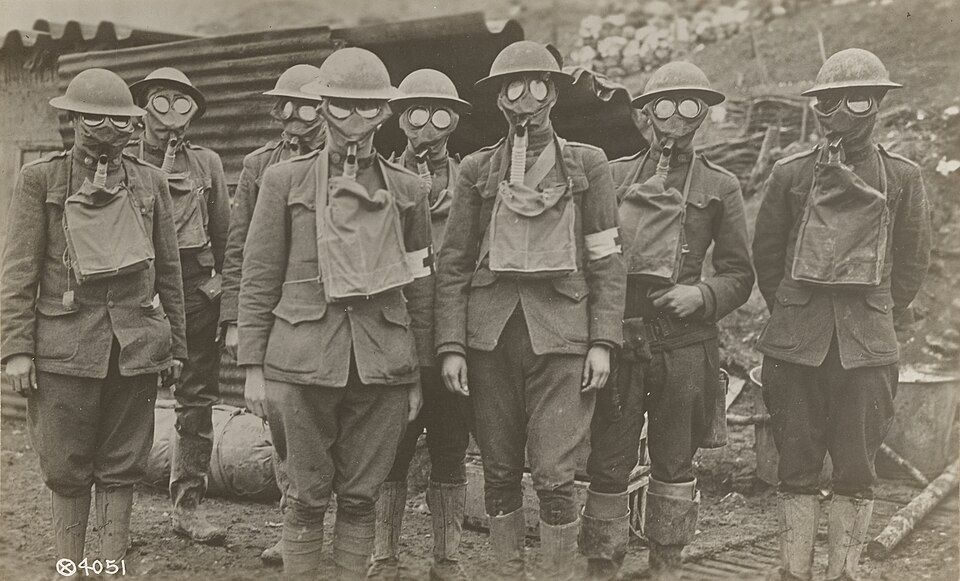
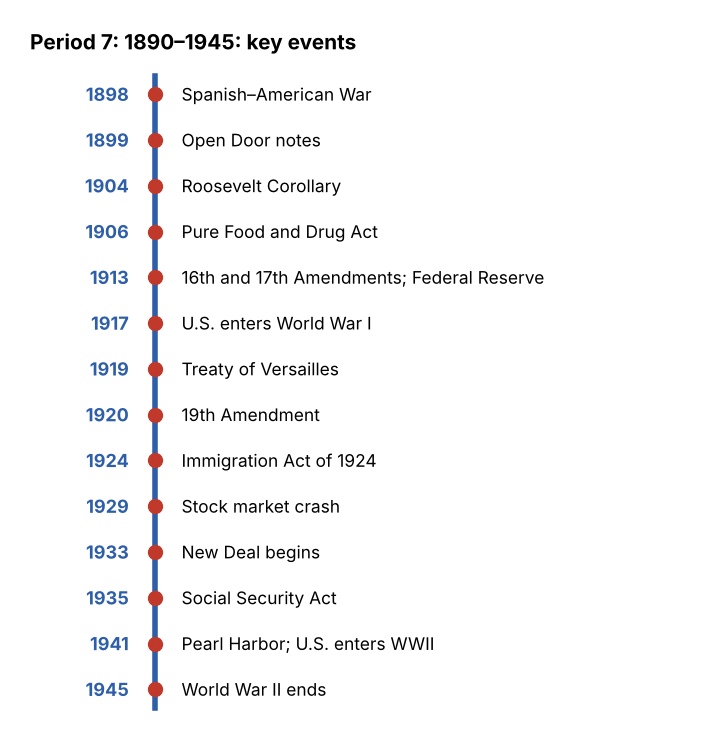
- Building an army: The Selective Service Act (1917) drafted about 2.8 million men. In total, roughly 4 million Americans served, and about 2 million went to France.
- The American Expeditionary Force (AEF): General John J. Pershing insisted that American troops fight as an independent army rather than being scattered among Allied units.
- Key battles: Americans helped stop Germany’s 1918 spring offensive at Château-Thierry and Belleau Wood, then fought in the Meuse-Argonne offensive, the largest American battle of the war.
- Segregated service: About 380,000 African Americans served, mostly in segregated support units. The 369th Infantry, the “Harlem Hellfighters,” fought under French command and earned the Croix de Guerre.
- Cost: About 116,000 Americans died, roughly half from disease, especially the 1918 influenza pandemic.
The armistice took effect on November 11, 1918. The U.S. role was short, but fresh American troops and supplies helped break the stalemate.
Wilson’s Fourteen Points
In January 1918, Wilson laid out a plan for a lasting peace. Its main ideas:
- Open diplomacy, with no secret treaties
- Freedom of the seas
- Free trade and lower tariffs
- Arms reductions
- National self-determination, letting peoples choose their own governments
- A League of Nations to resolve disputes and guarantee collective security
The Treaty of Versailles and Its Rejection
At the Paris Peace Conference in 1919, Britain and France wanted to punish Germany. The final treaty forced Germany to accept blame for the war, pay huge reparations, and give up territory. Wilson compromised on many points but won the creation of the League of Nations.
At home, the Senate had to ratify the treaty with a two-thirds vote.
| Group | Position |
|---|---|
| Wilson and Democratic supporters | Ratify the treaty with no changes |
| “Reservationists,” led by Henry Cabot Lodge | Ratify only with reservations, especially about Article X, which might commit the U.S. to war without congressional approval |
| “Irreconcilables” | Reject the League completely as a threat to American independence |
Wilson refused to compromise and toured the country to rally support, but he suffered a severe stroke. The Senate rejected the treaty, and the U.S. never joined the League of Nations.
Why does this matter? World War I shows the tension between American idealism and isolationism that runs through 20th-century foreign policy. On essays, you can compare Wilson’s internationalism with the isolationism of the 1920s and 1930s, or with the U.S. leadership in creating the United Nations after World War II.
Test-Taking Strategies
Mnemonic Devices and Memory Shortcuts
- “Lusitania, Sussex, Zimmermann.” The three submarine and diplomatic crises in order: 1915, 1916, 1917.
- “Lodge blocked the League.” Senate opposition, not public vote, killed U.S. membership.
- “Self-determination for Europe.” Wilson’s principle was applied mainly to European nations, not to colonies.
Cross-Topic Connections
- Topic 7.6: The home front saw mobilization, propaganda, and limits on civil liberties.
- Topic 7.2: Earlier debates over imperialism shaped arguments about foreign entanglements. See our review of Big Stick diplomacy.
- Topic 7.11: Disillusionment after the war fed interwar isolationism.
- Topic 7.14: After World War II, the U.S. helped create the United Nations, reversing its rejection of the League.
Common Question Formats
- Stimulus MCQ. An excerpt from Wilson’s war message or the Fourteen Points, and you identify its goals.
- Causation SAQ. You explain one reason the U.S. entered the war in 1917.
- Comparison SAQ. You compare Wilson’s views with those of his Senate opponents.
- LEQ. You evaluate the extent to which U.S. foreign policy changed between 1898 and 1920.
Frequent Student Mistakes
- Saying the Lusitania caused U.S. entry. It came two years before the declaration of war.
- Thinking the U.S. joined the League. The Senate rejected the treaty.
- Overstating the U.S. military role. American troops mattered, but European armies did most of the fighting over four years.
- Confusing the Fourteen Points with the treaty. The treaty ignored many of Wilson’s points.
Test-Day Shortcuts
- Watch for “safe for democracy.” That phrase signals Wilson’s April 1917 war message.
- Link Article X to sovereignty. It’s the specific reason many senators opposed the League.
- Use the Harlem Hellfighters. They connect the war to African American history and the Great Migration.
Time Management Tips
- Multiple choice: Section IA has 55 questions in 55 minutes, about 1 minute each. Date clues in the source line often eliminate half the choices.
- Short answer: Section IB has 3 required questions in 40 minutes, roughly 13 minutes each. Tie each reason for entry to a specific event.
- Essays: The DBQ gets 60 minutes, including a 15-minute reading period, and the single required LEQ gets 40 minutes. Wilson’s internationalism is a strong anchor for change-over-time arguments.
Check for Understanding
Think you’ve got it? Complete the quiz below to make sure. Download your results at the end.