
Maximize your score with these resources:
- Albert.io AP® US History question banks
- Free AP® US History cheat sheets
- Free AP® US History score calculator
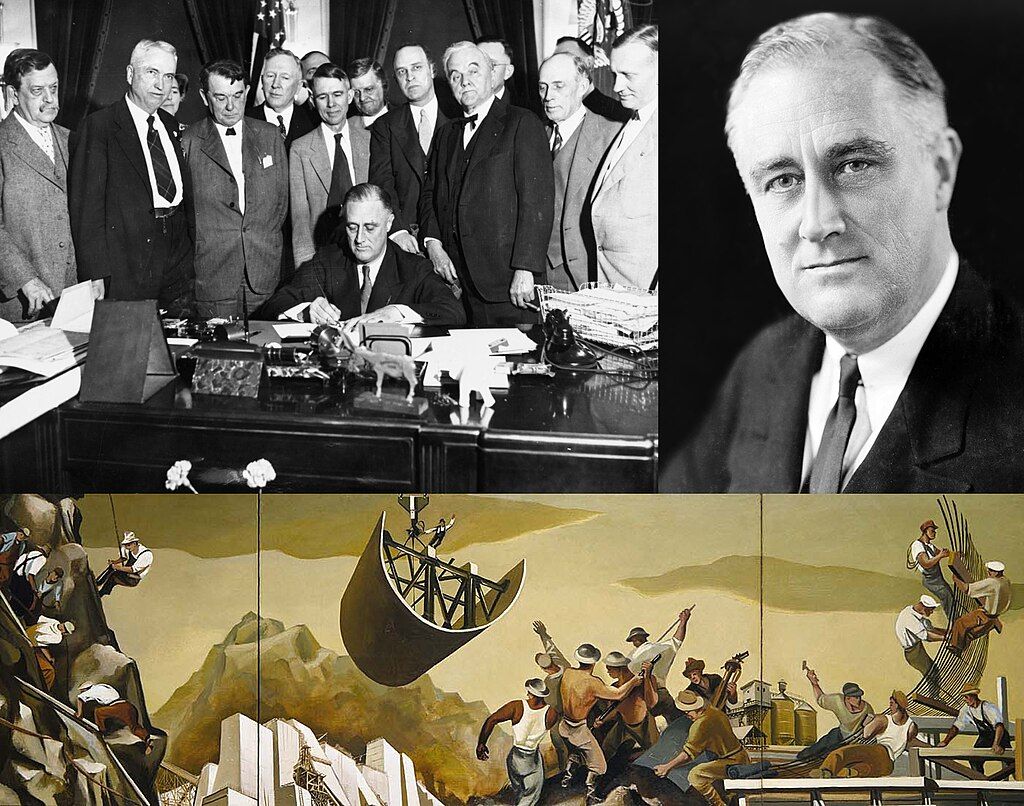
When Franklin Roosevelt took office in March 1933, banks in most states were closed, and the national economy was close to collapse. In his first 100 days, Congress passed 15 major laws. Over the next six years, the New Deal built dams, insured bank deposits, created Social Security, and gave unions legal protection. It didn’t end the Depression on its own, but it permanently changed what Americans expected from their government. Topic 7.10 covers how.
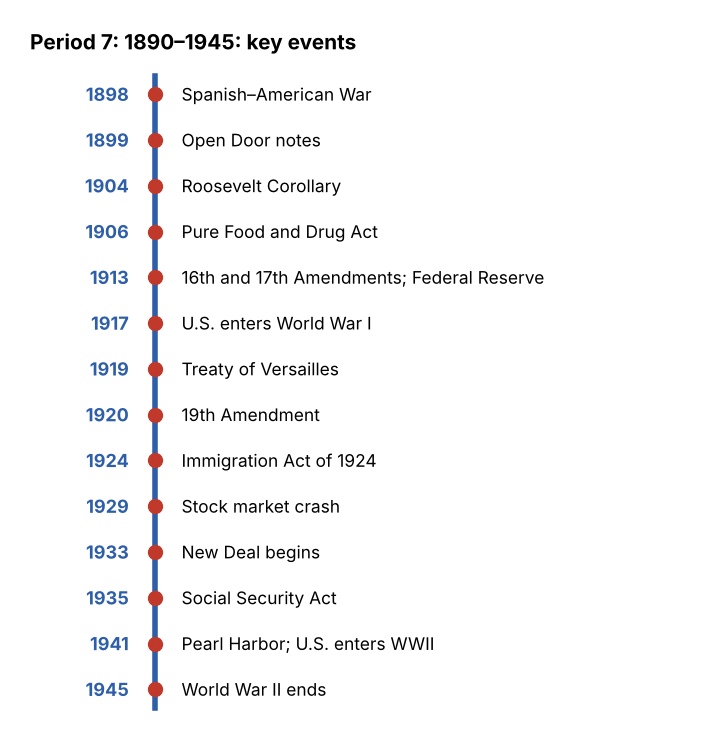
This article covers Topic 7.10: The New Deal in Period 7, 1890 to 1945. The topic asks you to explain how the New Deal attempted to end the Depression through relief, recovery, and reform, how it expanded the federal government’s role, and how Americans on the left and right criticized it.
By the end, you should be able to:
- Sort major New Deal programs into relief, recovery, and reform.
- Compare the First and Second New Deals.
- Explain the criticisms of the New Deal from both the left and the right.
- Evaluate the New Deal’s long-term effects.

What We Review
The Three R’s
| Goal | Meaning | Example Programs |
|---|---|---|
| Relief | Immediate help for the unemployed and poor | Civilian Conservation Corps (CCC), Federal Emergency Relief Administration (FERA), Works Progress Administration (WPA) |
| Recovery | Restarting economic growth | National Recovery Administration (NRA), Agricultural Adjustment Act (AAA), Public Works Administration (PWA) |
| Reform | Preventing another depression | Federal Deposit Insurance Corporation (FDIC), Securities and Exchange Commission (SEC), Social Security |
The First New Deal (1933 to 1934)
- Emergency Banking Act: Closed banks for a “bank holiday,” then reopened sound ones under federal inspection. Roosevelt explained it in the first of his radio “fireside chats.”
- Glass-Steagall Act: Created the FDIC to insure bank deposits and separated commercial from investment banking.
- Civilian Conservation Corps: Employed about 3 million young men planting trees, fighting erosion, and building parks.
- Tennessee Valley Authority (TVA): Built dams to control floods and bring electricity to one of the poorest regions of the country.
- Agricultural Adjustment Act: Paid farmers to grow less to raise crop prices. Payments often went to landowners, and many tenant farmers and sharecroppers, especially Black farmers, were pushed off the land.
- National Industrial Recovery Act: Created the NRA, which let industries write codes setting prices, wages, and hours.
The Second New Deal (1935 to 1938)
Facing criticism and Supreme Court setbacks, Roosevelt shifted toward programs aimed at long-term security and workers’ rights.
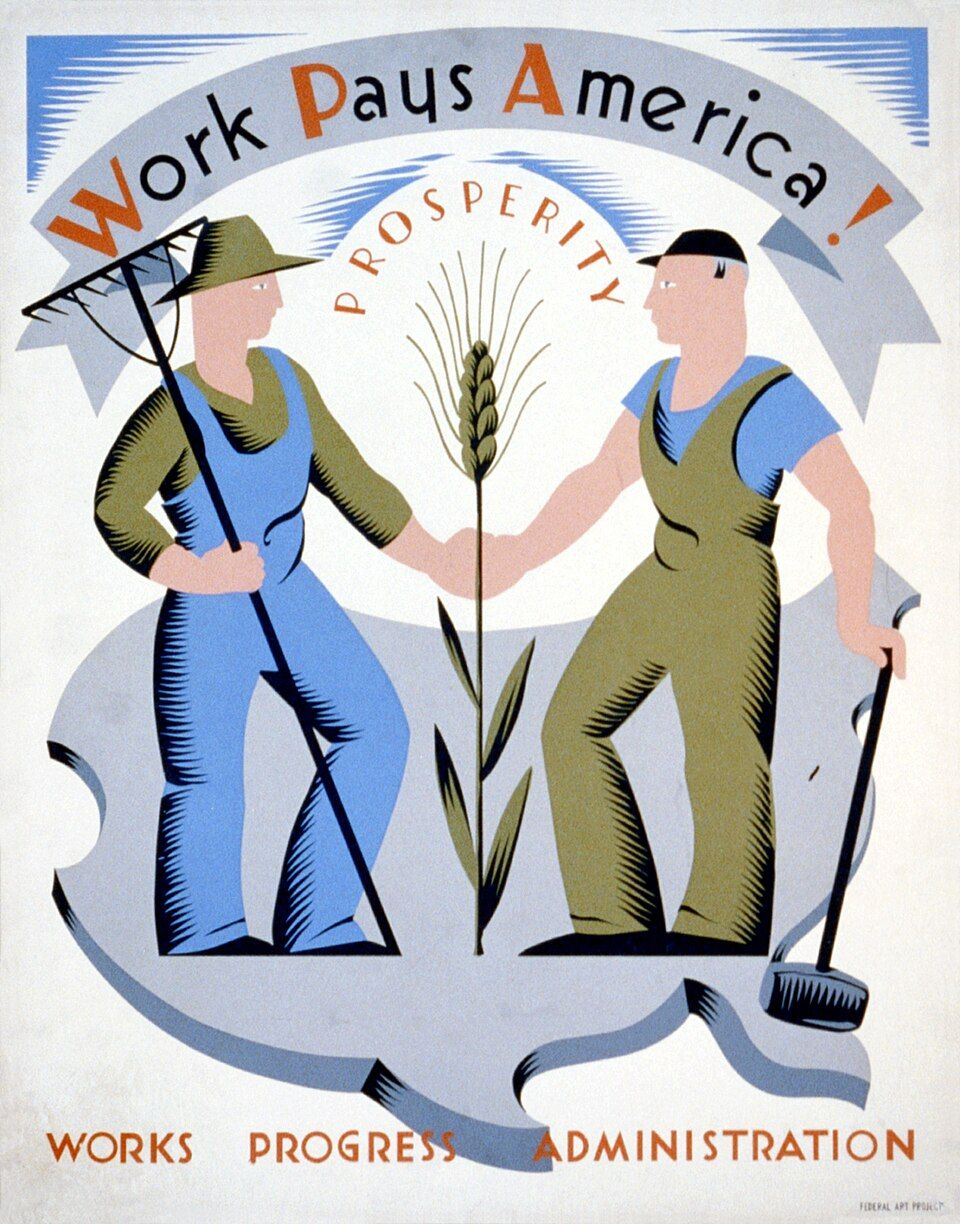
- Works Progress Administration: Employed about 8.5 million people over its life, building roads, schools, and airports, and funding artists and writers.
- Social Security Act (1935): Created old-age pensions, unemployment insurance, and aid to dependent children. At first it excluded farm and domestic workers, which left out many African Americans and women.
- Wagner Act (1935): Guaranteed workers the right to organize and bargain collectively, enforced by the National Labor Relations Board. Union membership rose sharply.
- Fair Labor Standards Act (1938): Set a federal minimum wage and a 40-hour workweek, and limited child labor.
Critics From Left and Right
| Critic | Position | Argument |
|---|---|---|
| American Liberty League | Right | The New Deal threatened free enterprise and property rights |
| Supreme Court | Legal challenge | Struck down the NRA in Schechter v. United States (1935) and the first AAA in 1936 |
| Huey Long | Left | “Share Our Wealth” plan to tax the rich and guarantee every family an income |
| Francis Townsend | Left | Monthly pensions of $200 for every American over 60 |
| Father Charles Coughlin | Left, later far right | Radio priest who attacked bankers and later spread antisemitic views |
The Court-Packing Plan
After winning a landslide in 1936, Roosevelt proposed adding up to six justices to the Supreme Court. Even many Democrats saw it as a threat to the separation of powers, and Congress rejected it. The Court did begin upholding New Deal laws in 1937, but the fight cost Roosevelt political support.
Legacy of the New Deal
- A larger federal role: Americans came to expect Washington to manage the economy and provide a safety net.
- The New Deal coalition: Labor unions, urban immigrants, African Americans, Southern whites, and farmers formed a Democratic majority that lasted decades.
- Limits: Unemployment was still about 17% in 1939. Full recovery came only with World War II spending. Many programs also accepted segregation and excluded workers of color.
Why does this matter? The New Deal is one of the most frequently tested topics on the exam. LEQs often ask you to evaluate its effectiveness or how it changed the federal government. A strong argument acknowledges both its lasting achievements and its real limits, especially for women and African Americans.
Test-Taking Strategies
Mnemonic Devices and Memory Shortcuts
- “Relief now, recovery soon, reform forever.” The three goals by time horizon.
- “First fixes, Second secures.” The First New Deal addressed emergencies. The Second built long-term protections.
- “Wagner for workers.” The Wagner Act protected unions.
Cross-Topic Connections
- Topic 7.9: Hoover’s limited response set up the New Deal’s bold experiments.
- Topic 7.4: Progressive ideas about regulation influenced New Deal reform. See our review of the Progressive Era.
- Topic 7.12: World War II spending finally ended the Depression.
- Topic 8.9: The Great Society expanded the New Deal’s welfare state in the 1960s.
Common Question Formats
- Stimulus MCQ. A cartoon about court-packing or a WPA poster, and you identify its context.
- Comparison SAQ. You compare New Deal critics from the left and right.
- Continuity and change SAQ. You explain how the New Deal changed the role of the federal government.
- LEQ. You evaluate the extent to which the New Deal succeeded in addressing the Depression.
Frequent Student Mistakes
- Saying the New Deal ended the Depression. Unemployment stayed high until wartime production.
- Treating all critics as conservatives. Long, Townsend, and Coughlin wanted the government to do more.
- Forgetting exclusions. Early Social Security left out farm and domestic workers.
- Mixing up the PWA and WPA. The PWA funded large projects through contractors. The WPA hired workers directly.
Test-Day Shortcuts
- Classify fast. Ask whether a program helped people now, revived the economy, or prevented future crises.
- Use the coalition. Naming its groups is strong evidence for long-term political change.
- Cite Schechter. It’s the key case showing judicial limits on the New Deal.
Time Management Tips
- Multiple choice: Section IA has 55 questions in 55 minutes, about 1 minute each. New Deal sources often hinge on whether the speaker supports or opposes federal action.
- Short answer: Section IB has 3 required questions in 40 minutes, roughly 13 minutes each. Name a specific program in every part.
- Essays: The DBQ gets 60 minutes, including a 15-minute reading period, and the single required LEQ gets 40 minutes. Qualify your thesis by naming both achievements and limits.
Check for Understanding
Think you’ve got it? Complete the quiz below to make sure. Download your results at the end.