
Maximize your score with these resources:
- Albert.io AP® US History question banks
- Free AP® US History cheat sheets
- Free AP® US History score calculator
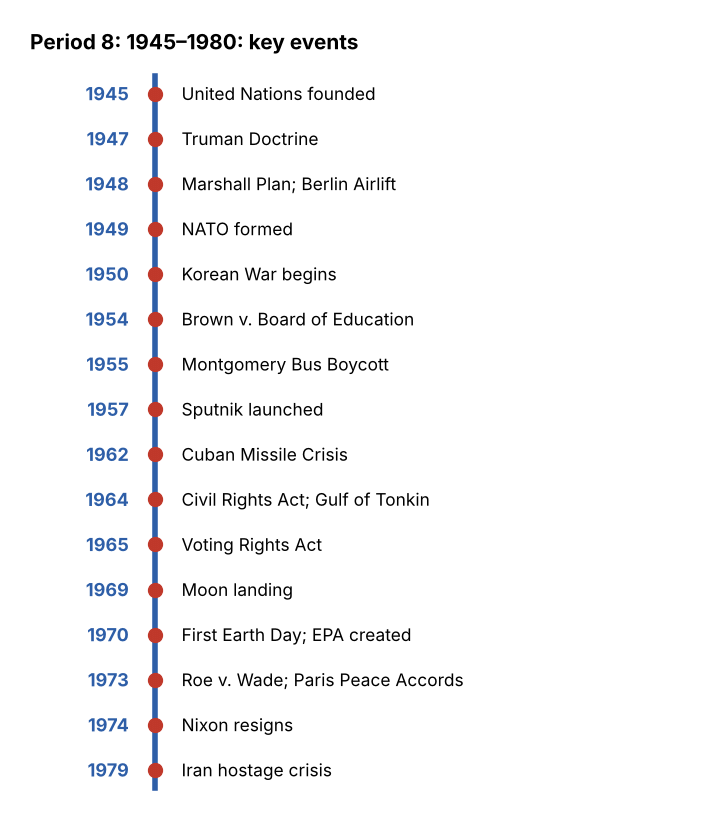
For thirteen days in October 1962, Americans wondered whether they would survive the week. Soviet nuclear missiles had been spotted in Cuba, 90 miles from Florida, and President John F. Kennedy ordered a naval blockade. The crisis ended with a deal, but it showed how far the U.S. had come since the 1930s. It now had military commitments on every continent, a nuclear arsenal, and an intelligence agency that overthrew governments. Topic 8.7 covers how the U.S. used that power around the world.
This article covers Topic 8.7: America as a World Power in Period 8, 1945 to 1980. The topic asks you to explain how the United States pursued containment around the world during the Cold War, including in Asia, Latin America, the Middle East, and Africa, and how these efforts produced both successes and controversies.
By the end, you should be able to:
- Explain how containment shaped U.S. policy in different regions.
- Describe the major Cold War crises of the 1950s and 1960s.
- Explain the use of covert action and alliances.
- Describe how Cold War policy shifted toward détente in the 1970s.

What We Review
Containment Goes Global
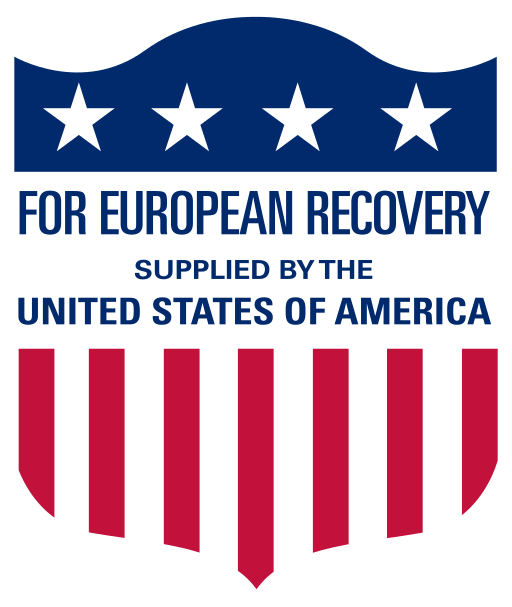
Containment, first outlined by diplomat George Kennan in 1946 and 1947, aimed to stop the spread of communism. Under Truman it focused on Europe. Under later presidents it spread worldwide.
| President | Approach | Key Features |
|---|---|---|
| Eisenhower (1953 to 1961) | “New Look” | Relied on nuclear weapons for “massive retaliation,” alliances like SEATO, and CIA covert operations. Warned of the “domino theory.” |
| Kennedy (1961 to 1963) | “Flexible response” | Expanded conventional forces and special forces. Created the Peace Corps and the Alliance for Progress for Latin America. |
| Johnson (1963 to 1969) | Escalation | Expanded the war in Vietnam and intervened in the Dominican Republic in 1965. |
| Nixon (1969 to 1974) | Détente | Opened relations with China and signed arms control agreements with the Soviet Union. |
Covert Action
The Central Intelligence Agency, created in 1947, carried out secret operations to topple governments seen as threats to U.S. interests.
- Iran (1953): The CIA helped overthrow Prime Minister Mohammad Mosaddegh, who had nationalized the country’s oil industry, and restored the Shah to power.
- Guatemala (1954): The CIA backed a coup against President Jacobo Árbenz after his land reforms threatened the United Fruit Company.
- Congo (1960 to 1961): The U.S. opposed independence leader Patrice Lumumba, who was overthrown and killed.
- Chile (1973): The U.S. supported opponents of socialist president Salvador Allende, who died in a military coup led by Augusto Pinochet.
These operations often brought short-term gains but left lasting resentment of the U.S. in Latin America and the Middle East.
Major Cold War Crises
| Crisis | Year | What Happened |
|---|---|---|
| Suez Crisis | 1956 | Eisenhower pressured Britain, France, and Israel to withdraw from Egypt |
| Sputnik | 1957 | The Soviet satellite launched the space race. The U.S. created NASA and passed the National Defense Education Act. |
| U-2 incident | 1960 | The Soviets shot down an American spy plane, wrecking a planned summit |
| Bay of Pigs | 1961 | A CIA-trained invasion of Cuba by exiles failed badly |
| Berlin Wall | 1961 | East Germany sealed off West Berlin |
| Cuban Missile Crisis | 1962 | The Soviets removed missiles from Cuba. The U.S. pledged not to invade Cuba and secretly agreed to remove missiles from Turkey. |
After the Cuban Missile Crisis, the superpowers installed a hotline and signed the Limited Test Ban Treaty (1963), which banned nuclear tests in the atmosphere.
The Nuclear Arms Race
- The U.S. tested the first hydrogen bomb in 1952, and the Soviets followed within a year.
- Both sides built intercontinental missiles and huge arsenals, leading to the doctrine of mutually assured destruction.
- Americans built fallout shelters, and schoolchildren practiced “duck and cover” drills.
- In his 1961 farewell address, Eisenhower warned against the growing influence of the “military-industrial complex.”
Détente in the 1970s
Under Nixon and his adviser Henry Kissinger, the U.S. eased tensions with communist powers.
- Opening to China (1972): Nixon visited Beijing, taking advantage of the split between China and the Soviet Union.
- SALT I (1972): The first treaty to limit nuclear weapons, along with the Anti-Ballistic Missile Treaty.
- Helsinki Accords (1975): Recognized postwar European borders and committed signers to human rights.
- Carter’s human rights policy: Jimmy Carter tied foreign aid to human rights and negotiated the Camp David Accords between Egypt and Israel in 1978. Détente collapsed after the Soviet invasion of Afghanistan in 1979.
Why does this matter? This topic shows how containment shaped U.S. policy far beyond Europe and Vietnam. On essays, covert actions in Iran and Guatemala are strong evidence that U.S. Cold War policy sometimes contradicted its democratic ideals. Détente also offers a clear example of change over time within the Cold War.
Test-Taking Strategies
Mnemonic Devices and Memory Shortcuts
- “Iran oil, Guatemala bananas.” The economic interests behind two CIA coups.
- “Massive, flexible, détente.” Eisenhower, Kennedy, then Nixon.
- “Thirteen days, one hotline.” The Cuban Missile Crisis led to direct communication.
Cross-Topic Connections
- Topic 8.2: Containment began with the Truman Doctrine and Marshall Plan. See our review of the Cold War.
- Topic 8.8: Vietnam was containment’s most costly application.
- Topic 7.2: Earlier interventions in Latin America offer a comparison. See our review of Big Stick diplomacy.
- Topic 9.3: Reagan abandoned détente before the Cold War ended.
Common Question Formats
- Stimulus MCQ. An excerpt from Eisenhower’s farewell address, and you identify his concern.
- Causation SAQ. You explain one cause and one effect of the Cuban Missile Crisis.
- Continuity and change SAQ. You explain how U.S. Cold War policy changed in the 1970s.
- LEQ. You evaluate the extent to which containment shaped U.S. foreign policy from 1945 to 1980.
Frequent Student Mistakes
- Treating containment as one fixed policy. Each president applied it differently.
- Forgetting covert action. CIA coups are key evidence of U.S. global power.
- Mixing up the Bay of Pigs and the Missile Crisis. The failed invasion came in 1961, the crisis in 1962.
- Calling détente the end of the Cold War. Tensions returned by 1979.
Test-Day Shortcuts
- Spot “military-industrial complex.” It signals Eisenhower’s 1961 farewell address.
- Use Sputnik for domestic effects. It links foreign policy to education and science funding.
- Connect Nixon to China. The 1972 visit is the clearest example of détente.
Time Management Tips
- Multiple choice: Section IA has 55 questions in 55 minutes, about 1 minute each. Cold War sources often hinge on the specific president, so check the date.
- Short answer: Section IB has 3 required questions in 40 minutes, roughly 13 minutes each. Use one named crisis or operation per part.
- Essays: The DBQ gets 60 minutes, including a 15-minute reading period, and the single required LEQ gets 40 minutes. Organize foreign policy essays by region or by president.
Check for Understanding
Think you’ve got it? Complete the quiz below to make sure. Download your results at the end.