
Maximize your score with these resources:
- Albert.io AP® US History question banks
- Free AP® US History cheat sheets
- Free AP® US History score calculator
In 1965, about 23,000 American military advisers were in South Vietnam. By 1968, more than 500,000 American troops were fighting there, and the nightly news brought the war into American living rooms. The Vietnam War became the longest war in U.S. history up to that time, divided the country more deeply than any conflict since the Civil War, and ended with a communist victory. Topic 8.8 covers how the U.S. got in, how the war divided Americans, and how it finally got out.
This article covers Topic 8.8: The Vietnam War in Period 8, 1945 to 1980. The topic asks you to explain the causes of U.S. involvement in Vietnam, the course of the war, the rise of the antiwar movement, and the war’s effects on American politics and foreign policy.
By the end, you should be able to:
- Explain why the U.S. became involved in Vietnam.
- Describe key escalations and turning points.
- Explain the causes and influence of the antiwar movement.
- Describe the war’s lasting effects.

What We Review
Roots of U.S. Involvement
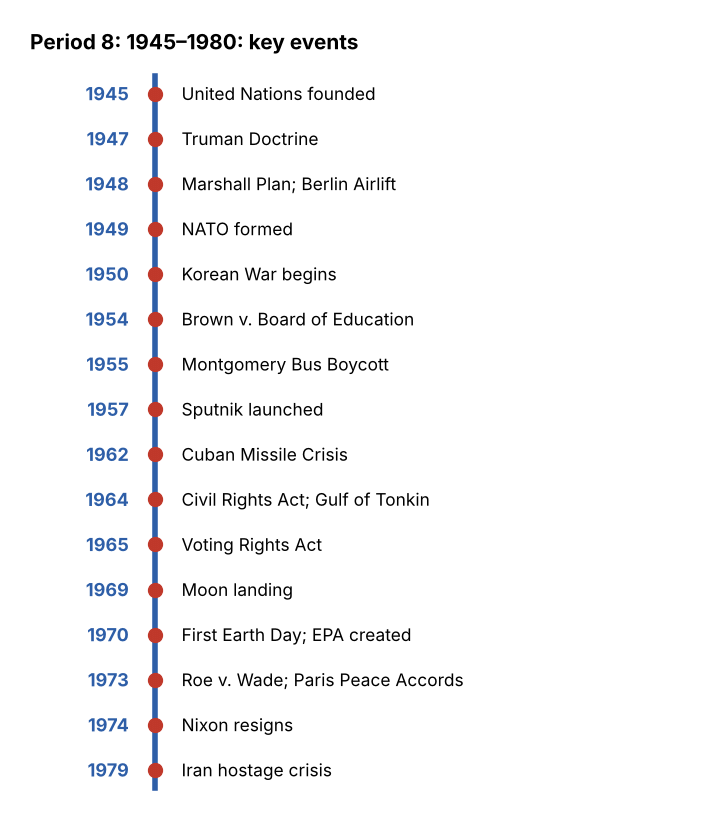
| Date | Event |
|---|---|
| 1945 to 1954 | Ho Chi Minh’s Viet Minh fought French colonial rule. The U.S. paid much of France’s war costs. |
| 1954 | The French lost at Dien Bien Phu. The Geneva Accords split Vietnam at the 17th parallel and called for elections in 1956. |
| 1955 to 1956 | The U.S. backed Ngo Dinh Diem in South Vietnam. Fearing a communist victory, Diem and the U.S. refused to hold the national elections. |
| 1961 to 1963 | Kennedy increased military advisers from about 900 to about 16,000. Diem was overthrown and killed in a 1963 coup. |
U.S. leaders believed in the domino theory: if South Vietnam fell to communism, neighboring nations would follow.
Escalation Under Johnson
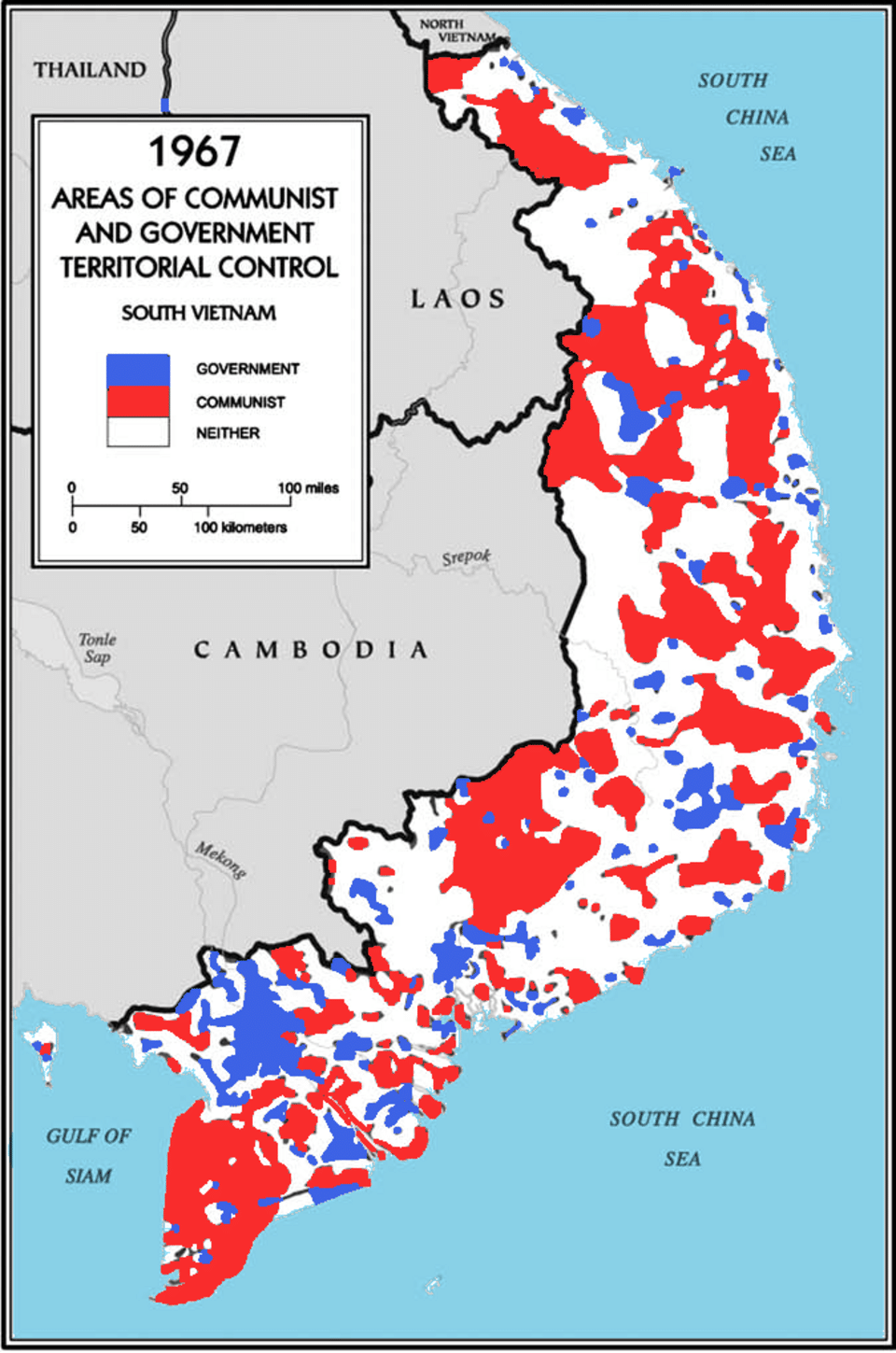
- Gulf of Tonkin Resolution (1964): After reported attacks on U.S. ships, Congress gave Johnson broad authority to use force, without a formal declaration of war. Evidence later showed the second attack likely never happened.
- Operation Rolling Thunder (1965): A sustained bombing campaign against North Vietnam.
- Ground troops: The first combat troops arrived in 1965. Troop levels peaked at about 543,000 in 1969.
- The draft: Draft deferments for college students meant poor and working-class men, including many African Americans and Latinos, served in disproportionate numbers early in the war.
The Tet Offensive (1968)
In January 1968, North Vietnamese and Viet Cong forces attacked cities across South Vietnam. Militarily, they were pushed back with heavy losses. Politically, Tet was a turning point. It contradicted official claims that victory was near, and the gap between government statements and reality became known as the credibility gap. CBS anchor Walter Cronkite told viewers the war was a stalemate. In March, Johnson announced he would not run for reelection.
The Antiwar Movement
- Campus protests: Students for a Democratic Society (SDS) organized teach-ins and marches beginning in 1965.
- Draft resistance: Some men burned draft cards or fled to Canada.
- Civil rights links: Martin Luther King Jr. spoke against the war in 1967, connecting it to poverty at home.
- 1968 Democratic National Convention: Police clashed with protesters in Chicago on live television.
- Kent State (1970): National Guard troops killed four students protesting the invasion of Cambodia. Two students were killed at Jackson State days later.
Not all Americans opposed the war. Nixon appealed to the “silent majority” who supported the government, and many working-class Americans resented protesters.
Nixon and the End of the War
| Policy or Event | Description |
|---|---|
| Vietnamization | Gradually withdrew U.S. troops while training South Vietnamese forces to take over |
| Expansion into Cambodia and Laos | Bombing and a 1970 invasion targeted supply routes, sparking new protests |
| Pentagon Papers (1971) | Leaked documents showed that several administrations had misled the public about the war |
| Paris Peace Accords (1973) | U.S. troops withdrew, and American prisoners of war came home |
| Fall of Saigon (1975) | North Vietnam conquered the South, reunifying the country under communist rule |
Effects of the War
- Human cost: About 58,000 Americans died, along with an estimated 2 million or more Vietnamese.
- War Powers Act (1973): Required presidents to notify Congress within 48 hours of sending troops and limited deployments without approval to 60 days, plus 30 days to withdraw.
- The 26th Amendment (1971): Lowered the voting age to 18, partly because 18-year-olds could be drafted.
- End of the draft (1973): The U.S. moved to an all-volunteer military.
- Distrust of government: Combined with Watergate, the war deepened public skepticism of official claims.
- The “Vietnam syndrome”: Leaders became wary of long military commitments abroad.
Why does this matter? Vietnam connects foreign policy, domestic politics, and social movements more tightly than almost any other topic. On essays, it lets you show how a Cold War policy produced protest at home and limits on presidential power, which is exactly the kind of cross-theme connection that earns complexity credit.
Test-Taking Strategies
Mnemonic Devices and Memory Shortcuts
- “Tonkin opened, Tet turned, Paris closed.” The war’s beginning, turning point, and end for the U.S.
- “Old enough to fight, old enough to vote.” The reasoning behind the 26th Amendment.
- “Vietnamize and withdraw.” Nixon’s exit strategy.
Cross-Topic Connections
- Topic 8.7: The domino theory came from global containment.
- Topic 8.12: The antiwar movement shaped 1960s youth culture.
- Topic 8.9: War spending drained resources from the Great Society.
- Topic 7.3: The Philippine–American War offers a comparison with an earlier war against Asian nationalists.
Common Question Formats
- Stimulus MCQ. An excerpt from the Gulf of Tonkin Resolution or a protest photo, and you identify its context.
- Causation SAQ. You explain one reason the U.S. escalated the war.
- Interpretation SAQ. Two historians disagree about why the U.S. lost, and you explain each view.
- LEQ. You evaluate how the Vietnam War affected American politics and society.
Frequent Student Mistakes
- Saying Congress declared war. It passed the Gulf of Tonkin Resolution instead.
- Calling Tet a military defeat for the U.S. It was a military setback for the attackers but a political blow to the U.S.
- Thinking all Americans opposed the war. Many supported it, especially early on.
- Ending the war in 1973. U.S. troops left in 1973, but fighting continued until 1975.
Test-Day Shortcuts
- Spot “credibility gap.” It points to the period after Tet.
- Link the war to Congress. The War Powers Act is the clearest institutional effect.
- Use Kent State. It shows how the Cambodia invasion reignited protest.
Time Management Tips
- Multiple choice: Section IA has 55 questions in 55 minutes, about 1 minute each. Check whether a source predates or follows Tet, since opinions shifted sharply.
- Short answer: Section IB has 3 required questions in 40 minutes, roughly 13 minutes each. Tie each effect to a named law or event.
- Essays: The DBQ gets 60 minutes, including a 15-minute reading period, and the single required LEQ gets 40 minutes. Vietnam essays work well organized by escalation, protest, and withdrawal.
Check for Understanding
Think you’ve got it? Complete the quiz below to make sure. Download your results at the end.