

Maximize your score with these resources:
- Albert.io AP® US History question banks
- Free AP® US History cheat sheets
- Free AP® US History score calculator
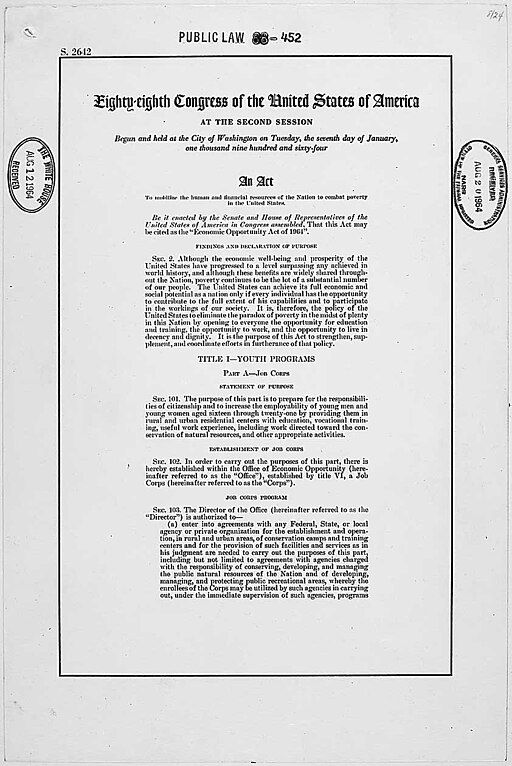
In 1964, President Lyndon Johnson told a crowd at the University of Michigan that America could build a “Great Society,” one that ended poverty and racial injustice. Over the next two years, Congress passed one of the largest bursts of social legislation in American history, including Medicare, Medicaid, federal aid to schools, and the landmark civil rights laws. The poverty rate fell sharply. But the Vietnam War, urban riots, and a conservative backlash soon limited what the Great Society could achieve. Topic 8.9 covers its goals, programs, and legacy.
This article covers Topic 8.9: The Great Society in Period 8, 1945 to 1980. The topic asks you to explain how liberalism reached its peak in the 1960s, how the Great Society and the Warren Court expanded federal power and individual rights, and why liberalism faced growing opposition.
By the end, you should be able to:
- Describe the major programs of the Great Society.
- Explain the War on Poverty and its results.
- Describe key Warren Court decisions.
- Explain the reasons for the backlash against liberalism.

What We Review
From the New Frontier to the Great Society
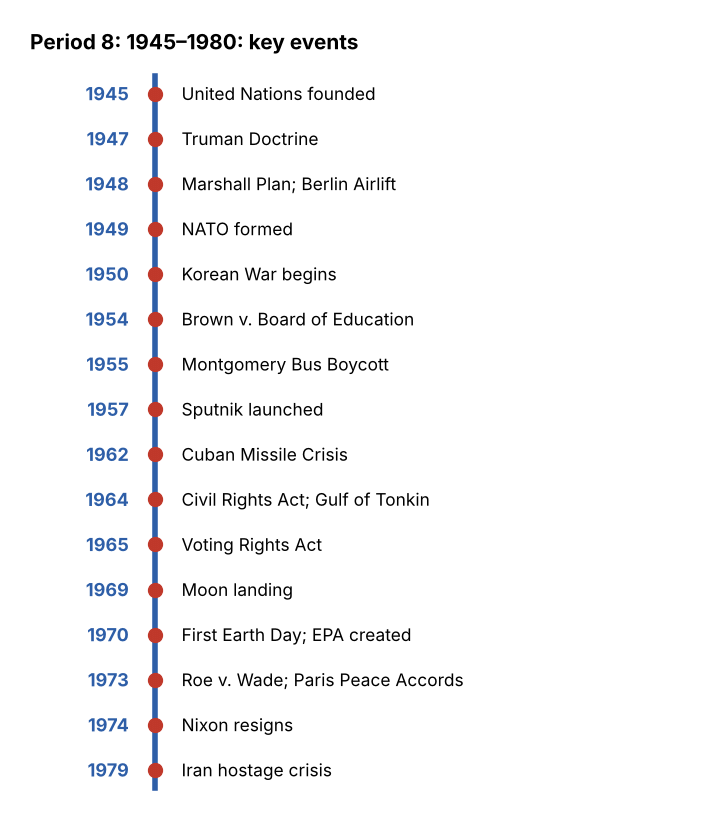
John F. Kennedy’s “New Frontier” proposed federal aid for education, health care for the elderly, and civil rights, but most of it stalled in Congress. After Kennedy’s assassination in November 1963, Johnson used his legislative skill, public sympathy, and a landslide victory in 1964 to pass much of Kennedy’s agenda and more.
Major Great Society Programs
| Area | Law or Program | What It Did |
|---|---|---|
| Civil rights | Civil Rights Act (1964) | Banned discrimination in public places and employment |
| Voting | Voting Rights Act (1965) | Banned literacy tests and sent federal examiners to register voters in the South |
| Health care | Medicare and Medicaid (1965) | Health insurance for Americans over 65 and for low-income families |
| Education | Elementary and Secondary Education Act (1965) | Federal funds for schools serving poor students |
| Poverty | Economic Opportunity Act (1964) | Created Job Corps, VISTA, and Community Action Programs. Head Start followed in 1965. |
| Immigration | Immigration and Nationality Act (1965) | Ended national-origin quotas from the 1920s and opened immigration from Asia and Latin America |
| Housing and cities | Department of Housing and Urban Development (1965) | Funded housing and urban renewal |
| Environment and consumers | Clean air, water, and auto safety laws | Expanded federal regulation for public health |
The War on Poverty
Johnson declared an “unconditional war on poverty” in 1964, inspired partly by Michael Harrington’s The Other America. The results were real but mixed.
- The official poverty rate fell from about 19% in 1964 to about 11% in 1973.
- Poverty among the elderly dropped sharply, thanks largely to Medicare and expanded Social Security.
- Community Action Programs required “maximum feasible participation” of the poor, which sometimes put them in conflict with local politicians.
- Rising costs of the Vietnam War drained funding. Critics on the left said the programs were too small, while critics on the right said they created dependency.
The Warren Court
Under Chief Justice Earl Warren (1953 to 1969), the Supreme Court expanded civil rights and civil liberties.
| Case | Year | Ruling |
|---|---|---|
| Brown v. Board of Education | 1954 | Segregated public schools are unconstitutional |
| Mapp v. Ohio | 1961 | Illegally obtained evidence can’t be used in state courts |
| Engel v. Vitale | 1962 | Banned official prayer in public schools |
| Gideon v. Wainwright | 1963 | States must provide lawyers to defendants who can’t afford one |
| Griswold v. Connecticut | 1965 | Recognized a constitutional right to privacy |
| Miranda v. Arizona | 1966 | Police must inform suspects of their rights |
Supporters saw these rulings as protecting individual rights. Critics accused the Court of “judicial activism” and of being soft on crime.
The Backlash
- Vietnam: The war consumed money and political attention.
- Urban unrest: Riots in Watts (1965), Newark, and Detroit (1967) frightened many white voters.
- The Southern shift: Johnson predicted that signing the Civil Rights Act would cost Democrats the South. Conservative Barry Goldwater won five Deep South states in 1964.
- Taxes and government size: Many middle-class Americans resented spending on programs they saw as benefiting others.
- Election of 1968: Richard Nixon appealed to “law and order,” and George Wallace ran a segregationist third-party campaign.
Why does this matter? The Great Society marked the high point of 20th-century liberalism and the start of the conservative reaction that would shape Period 9. On essays, compare it with the New Deal to show how federal power grew, or use the backlash to explain the rise of Ronald Reagan.
Test-Taking Strategies
Mnemonic Devices and Memory Shortcuts
- “1965: health, schools, votes, immigrants.” Medicare and Medicaid, ESEA, the Voting Rights Act, and the Immigration Act all passed that year.
- “Warren widened rights.” The Court expanded civil rights and the rights of the accused.
- “Guns or butter.” Vietnam spending competed with domestic programs.
Cross-Topic Connections
- Topic 7.10: The New Deal created the foundation the Great Society built on.
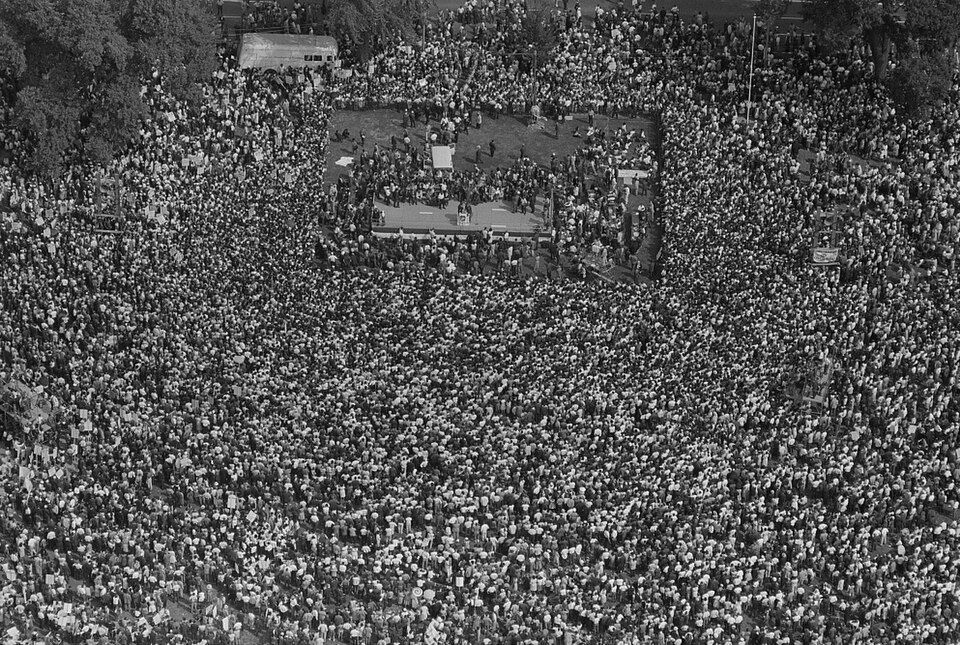
- Topic 8.10: Civil rights activism pushed the 1964 and 1965 laws through. See our review of the civil rights movement.
- Topic 8.8: The Vietnam War limited the Great Society’s funding.
- Topic 9.2: Reagan’s conservatism was a reaction against Great Society liberalism.
Common Question Formats
- Stimulus MCQ. An excerpt from Johnson’s Great Society speech, and you identify its goals or context.
- Comparison SAQ. You compare the Great Society with the New Deal.
- Causation SAQ. You explain one reason for the backlash against liberalism.
- LEQ. You evaluate the extent to which the federal government’s role expanded in the 1960s.
Frequent Student Mistakes
- Crediting Kennedy with the Great Society. Johnson passed it after Kennedy’s death.
- Saying the War on Poverty failed completely. Poverty fell sharply, especially among the elderly.
- Forgetting the 1965 Immigration Act. It transformed later immigration patterns.
- Mixing up Warren Court cases. Gideon is about lawyers. Miranda is about police warnings.
Test-Day Shortcuts
- Spot “war on poverty.” It points to Johnson and 1964.
- Use the poverty rate. 19% to 11% is strong, specific evidence.
- Link the Southern shift to Period 9. It sets up the realignment that helped elect Reagan.
Time Management Tips
- Multiple choice: Section IA has 55 questions in 55 minutes, about 1 minute each. Watch for whether a source supports or criticizes federal action.
- Short answer: Section IB has 3 required questions in 40 minutes, roughly 13 minutes each. Name a specific program or case in each part.
- Essays: The DBQ gets 60 minutes, including a 15-minute reading period, and the single required LEQ gets 40 minutes. A New Deal comparison makes a strong complexity move.
Check for Understanding
Think you’ve got it? Complete the quiz below to make sure. Download your results at the end.