
Maximize your score with these resources:
- Albert.io AP® US History question banks
- Free AP® US History cheat sheets
- Free AP® US History score calculator
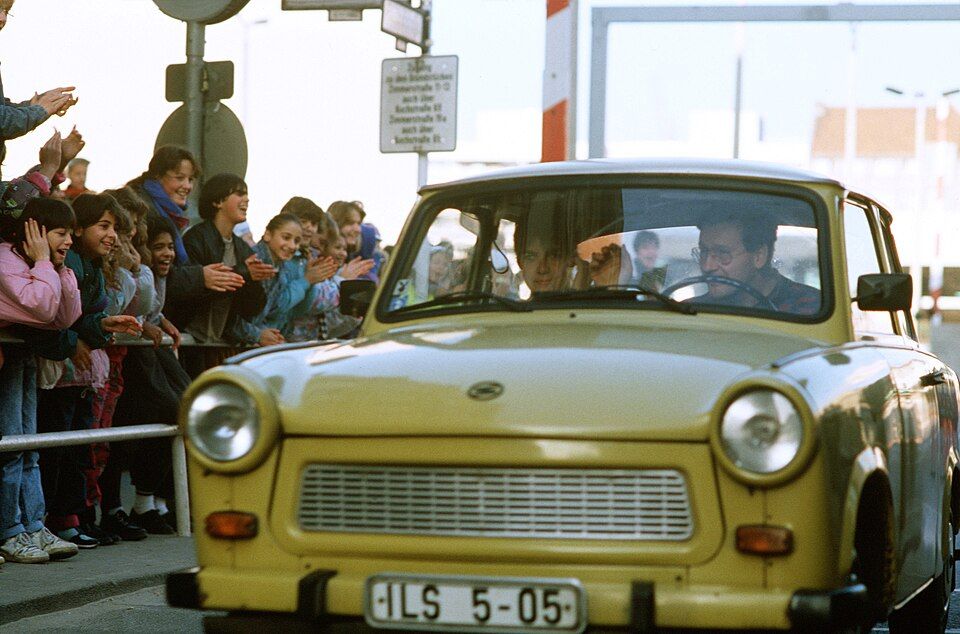
On the night of November 9, 1989, East German border guards opened the gates of the Berlin Wall, and crowds began tearing it apart with hammers. Two years later, the Soviet Union itself dissolved into fifteen independent countries. The Cold War, which had shaped American foreign policy, politics, and culture for more than four decades, ended without a war between the superpowers. Topic 9.3 covers how it ended and what role the United States played.
This article covers Topic 9.3: The End of the Cold War in Period 9, 1980 to the present. The topic asks you to explain how Reagan’s policies, Soviet reforms, and internal weaknesses in the Soviet system contributed to the end of the Cold War, and how the U.S. role in the world changed afterward.
By the end, you should be able to:
- Describe Reagan’s early Cold War policies.
- Explain Gorbachev’s reforms and their effects.
- Describe the arms agreements that eased tensions.
- Evaluate competing explanations for why the Cold War ended.
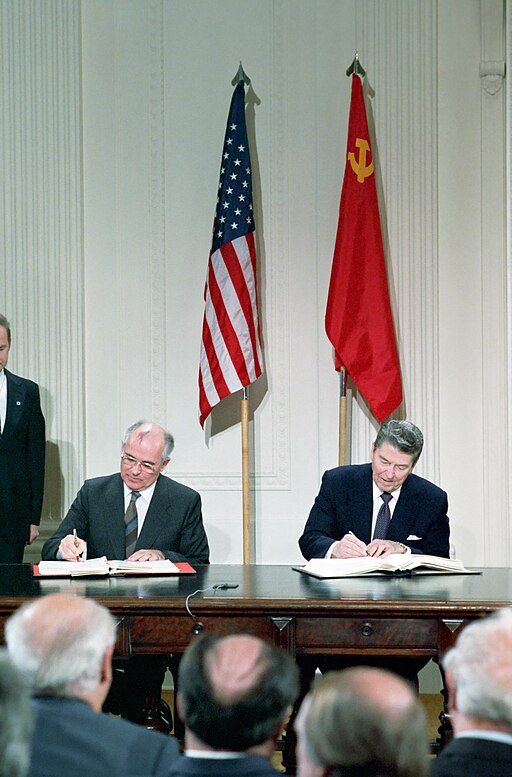
Series: Reagan White House Photographs, 1/20/1981 – 1/20/1989 Collection: White House Photographic Collection, 1/20/1981 – 1/20/1989, Public domain, via Wikimedia Commons

What We Review
Reagan’s Early Hard Line
Reagan rejected détente. He called the Soviet Union an “evil empire” in 1983 and pursued what his supporters called “peace through strength.”
- Military buildup: Defense spending nearly doubled between 1980 and 1985, approaching $300 billion a year by the late 1980s.
- Strategic Defense Initiative (SDI): A proposed space-based missile defense system, nicknamed “Star Wars” by critics.
- The Reagan Doctrine: U.S. support for anti-communist forces around the world, including the mujahideen fighting Soviet troops in Afghanistan and the Contras in Nicaragua.
- Grenada (1983): U.S. forces invaded the small Caribbean island and removed its Marxist government.
Tensions rose sharply. A 1983 NATO military exercise alarmed Soviet leaders, and a nuclear freeze movement drew hundreds of thousands of protesters in the U.S. and Europe.
Gorbachev’s Reforms
Mikhail Gorbachev became the Soviet leader in 1985. He inherited a stagnant economy, a costly war in Afghanistan, and falling oil revenues.
| Policy | Meaning | Effect |
|---|---|---|
| Glasnost | “Openness”: more freedom of speech and the press | Citizens openly criticized the government and the Communist Party |
| Perestroika | “Restructuring”: limited market reforms | Disrupted the planned economy without fixing it |
| New foreign policy | Withdrawal from Afghanistan and rejection of intervention in Eastern Europe | Eastern European nations were free to reject communism |
From Rivalry to Agreement
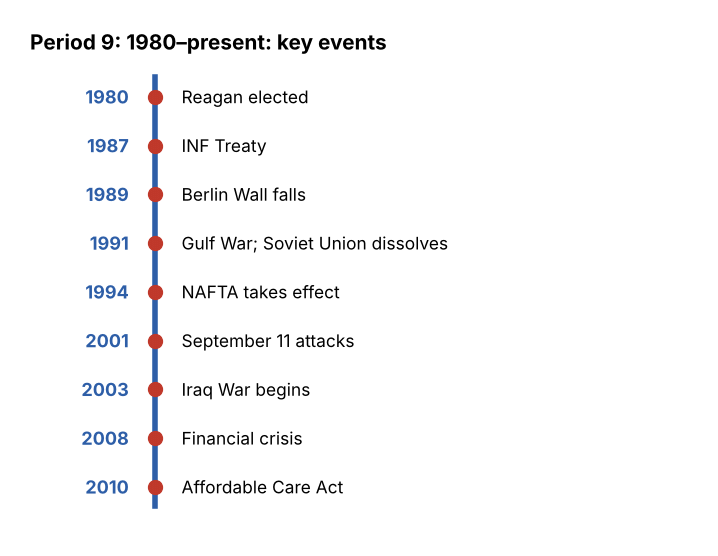
| Event | Year | Significance |
|---|---|---|
| Reykjavik Summit | 1986 | Reagan and Gorbachev nearly agreed to eliminate nuclear weapons but split over SDI |
| “Tear down this wall” speech | 1987 | Reagan challenged Gorbachev at the Berlin Wall |
| INF Treaty | 1987 | Eliminated an entire class of intermediate-range nuclear missiles for the first time |
| Revolutions of 1989 | 1989 | Communist governments fell in Poland, Hungary, Czechoslovakia, East Germany, and elsewhere |
| Fall of the Berlin Wall | 1989 | Germany reunified the following year |
| START I | 1991 | The first treaty to cut long-range nuclear arsenals |
| Dissolution of the Soviet Union | December 1991 | The USSR broke into 15 independent states |
Why Did the Cold War End?
Historians debate how much credit the U.S. deserves.
| Interpretation | Argument |
|---|---|
| Reagan’s pressure | The military buildup and SDI forced the Soviets into an arms race they couldn’t afford |
| Internal Soviet weakness | A failing economy, the Afghan war, and nationalist movements doomed the system regardless of U.S. policy |
| Gorbachev’s choices | His decision not to use force in Eastern Europe made peaceful change possible |
| Diplomacy | Reagan’s willingness to negotiate after 1985 built the trust needed for agreements |
Most historians combine several of these factors. Being able to explain more than one is how you show complexity on an essay.
After the Cold War
- Persian Gulf War (1991): George H.W. Bush led a UN-backed coalition that drove Iraq out of Kuwait. Bush spoke of a “new world order.”
- A single superpower: The U.S. faced no rival of equal strength.
- New conflicts: The U.S. intervened in Somalia, Haiti, and the Balkans in the 1990s, with mixed results.
- NATO expansion: Former Soviet allies in Eastern Europe began joining NATO in 1999.
- “Peace dividend”: Defense spending fell in the 1990s.
Why does this matter? The end of the Cold War closes the story that began in Topic 8.2. It’s ideal evidence for LEQs on U.S. foreign policy from 1945 onward, and the debate over its causes makes a natural place to show historical interpretation.
Test-Taking Strategies
Mnemonic Devices and Memory Shortcuts
- “Glasnost opens, perestroika rebuilds.” Gorbachev’s two reforms.
- “INF 87, Wall 89, USSR 91.” The three key dates.
- “Evil empire to partner.” Reagan’s shift from 1983 to 1987.
Cross-Topic Connections
- Topic 8.2: The Cold War’s beginnings. See our review of the Cold War.
- Topic 8.7: Détente was the policy Reagan rejected.
- Topic 9.2: Defense spending contributed to the deficits of the Reagan years.
- Topic 9.6: U.S. global power after 1991 shaped its responses to terrorism.
Common Question Formats
- Stimulus MCQ. An excerpt from the “evil empire” or “tear down this wall” speech, and you identify its context.
- Interpretation SAQ. Two historians disagree about why the Cold War ended, and you explain each view.
- Causation SAQ. You explain one reason the Soviet Union collapsed.
- LEQ. You evaluate how U.S. foreign policy changed from 1945 to 1991.
Frequent Student Mistakes
- Giving Reagan all the credit. Soviet weaknesses and Gorbachev’s choices mattered too.
- Dating the Soviet collapse to 1989. The Wall fell in 1989, but the USSR dissolved in 1991.
- Calling SDI a working system. It was never deployed.
- Forgetting the Gulf War. It shows the new post-Cold War U.S. role.
Test-Day Shortcuts
- Spot “glasnost.” It points to Gorbachev’s reforms after 1985.
- Use the INF Treaty. It’s the first agreement to eliminate a class of nuclear weapons.
- Present multiple causes. It’s the simplest route to complexity.
Time Management Tips
- Multiple choice: Section IA has 55 questions in 55 minutes, about 1 minute each. Check whether a source predates or follows 1985, since policy shifted under Gorbachev.
- Short answer: Section IB has 3 required questions in 40 minutes, roughly 13 minutes each. For interpretation questions, paraphrase each historian before comparing.
- Essays: The DBQ gets 60 minutes, including a 15-minute reading period, and the single required LEQ gets 40 minutes. The end of the Cold War makes a strong final paragraph for long-span foreign policy essays.
Check for Understanding
Think you’ve got it? Complete the quiz below to make sure. Download your results at the end.