

Maximize your score with these resources:
- Albert.io AP® Microeconomics question banks
- Free AP® Microeconomics cheat sheets
- Free AP® Microeconomics score calculator
Cost-benefit analysis is one of the most fundamental tools in microeconomics, and it appears on nearly every AP Exam in multiple formats. Topic 1.5 tests your understanding of how individuals and firms make rational decisions by comparing the costs and benefits of their choices. You’ll encounter it as standalone MCQs, as part of multi-step FRQs about production decisions, and embedded within questions about consumer behavior and firm strategy.
This article covers Topic 1.5: Cost-Benefit Analysis (Unit 1 — Basic Economic Concepts, exam weight 12-15%) and the learning objectives CBA-1.A (Explain the role of marginal analysis in decision-making) and CBA-1.B (Define types of costs). You’ll also need this foundation for nearly every topic that follows — production decisions, firm behavior, and consumer optimization all depend on understanding how to weigh costs against benefits.
Here’s what we’ll cover: the concept of cost-benefit analysis itself, the types of costs you need to distinguish, how marginal analysis drives rational decision-making, opportunity cost in context, and finally the test-taking strategies that will help you spot these questions quickly and answer them correctly.
The Foundation: What Is Cost-Benefit Analysis?
At its core, cost-benefit analysis is a method for making decisions by comparing the total benefits of an action against its total costs. The decision rule is simple: if total benefits exceed total costs, the action is economically rational. If total costs exceed total benefits, it’s not.
But here’s where most students stumble: the AP exam isn’t asking you to plug numbers into a formula. It’s asking you to think like an economist about what counts as a cost and what counts as a benefit. The exam will test whether you can identify hidden costs, distinguish between different types of costs, and apply the marginal analysis framework to real decisions.
Consider a simple example: Should you work an extra hour at your part-time job? The benefit is the hourly wage. But the costs aren’t just the money you spend on transportation. They include opportunity cost — what you give up by not doing something else, like studying for the AP Exam or attending a friend’s birthday party. If the wage is $20 per hour, but you could have earned $15 tutoring a younger student, your true economic cost includes that foregone opportunity. A complete cost-benefit analysis accounts for all of these.
Why does this matter for the exam? Because AP® Microeconomics tests your ability to think beyond simple, explicit dollar amounts. You need to recognize all relevant costs and benefits, including those that don’t show up in a cash register. That’s the skill that separates students who score 4 or 5 from those who don’t.
Types of Costs: Explicit, Implicit, and Sunk
Cost-benefit analysis is only as good as your ability to identify and categorize costs. The AP exam tests three types of costs explicitly, and your understanding of the difference between them is critical.
| Cost Type | Definition | Example | Why It Matters for Decisions |
|---|---|---|---|
| Explicit costs | Direct, out-of-pocket cash payments for goods or services. These are recorded in financial statements and appear on receipts and invoices. | A farmer pays $500 for seeds, $300 for fertilizer, and $200 for equipment rental. These are explicit costs. | Explicit costs are real money that leaves your account. They must be included in any rational decision-making process. However, they’re not the only costs that matter. |
| Implicit costs | The value of resources owned by the firm or individual that are used in production, but for which no explicit payment is made. These represent the opportunity cost of using a resource in a particular way. | A farmer owns land worth $50,000. If she uses it to grow wheat, the implicit cost is the rental income she could earn by leasing it to someone else. If the market rent is $2,000 per year, that’s an implicit cost of her wheat production. | Implicit costs are often overlooked, but they’re real economic costs. Ignoring them leads to overestimating the true profitability of a business and making poor decisions. The AP exam frequently tests whether you remember to include them. |
| Sunk costs | Costs that have already been paid and cannot be recovered, regardless of what decision you make going forward. Past expenditures that are irrelevant to future choices. | You paid $1,000 to enter a sports tournament. The tournament is starting tomorrow, and you just realized you’re injured. The $1,000 is sunk — you won’t get it back whether you compete or withdraw. | Sunk costs should be ignored in any forward-looking decision. Including them is a systematic error called the sunk cost fallacy. The exam tests whether you can recognize sunk costs and exclude them from your analysis. |
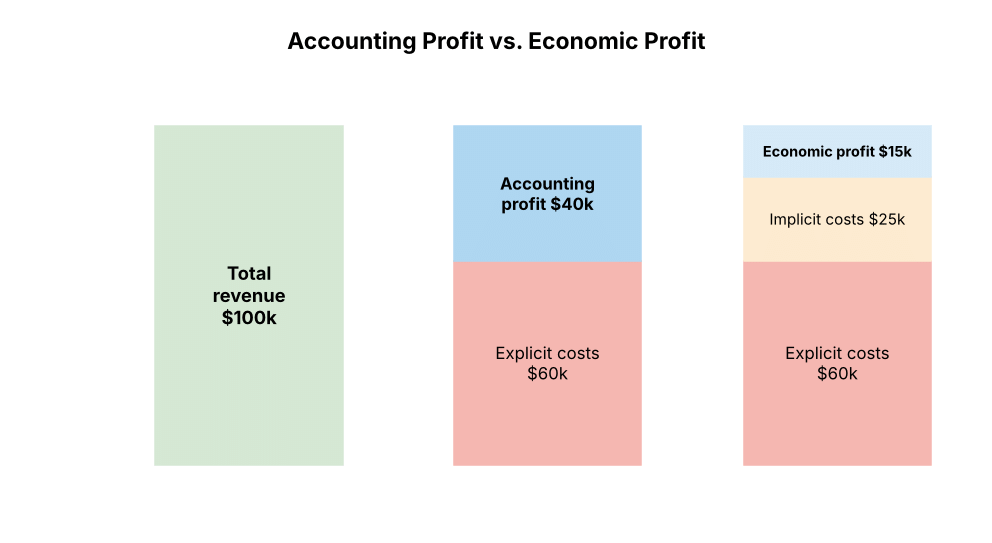
Here’s the crucial insight: economic profit accounts for both explicit and implicit costs. If a firm earns $100,000 in revenue and pays $60,000 in explicit costs, the accounting profit is $40,000. But if implicit costs (opportunity costs of the owner’s time, capital, or land) total $50,000, the economic profit is actually a loss of $10,000. The firm would be better off using those resources in a different way.
The AP exam loves testing this distinction. You might see a question where a small business owner is proud of her $50,000 annual profit, but the learning objective is for you to recognize that she could be earning $70,000 working as a salaried employee elsewhere. Her economic profit is negative, even though her accounting profit is positive. This is the kind of deeper thinking that gets you the right answer.
Sunk costs deserve special attention because they trip up so many students. Imagine you’ve spent $500 studying for the AP Exam and you’re now deciding whether to take it or skip it. That $500 is gone. It should not influence your decision. Your decision should depend on whether taking the exam now (given your current knowledge) has benefits that exceed the remaining costs (test fee, anxiety, time). The amount you’ve already spent is irrelevant. Yet many students reason, “I’ve already spent $500, so I might as well take the test.” That’s the sunk cost fallacy, and the exam will test whether you can identify and reject it.
Opportunity Cost: The Invisible Hand in Decision-Making
Opportunity cost is the value of the next best alternative foregone when making a choice. It’s perhaps the single most important concept in all of economics, and it appears in nearly every topic on the AP Exam.
Every choice has an opportunity cost because resources are scarce. When you decide to attend a 2-hour study session, the opportunity cost is the income you could have earned working, the leisure time you could have enjoyed, or the Netflix show you could have watched. Not all opportunity costs involve money. The most valuable things you give up often aren’t priced at all.
For the AP exam, opportunity cost shows up in several contexts:
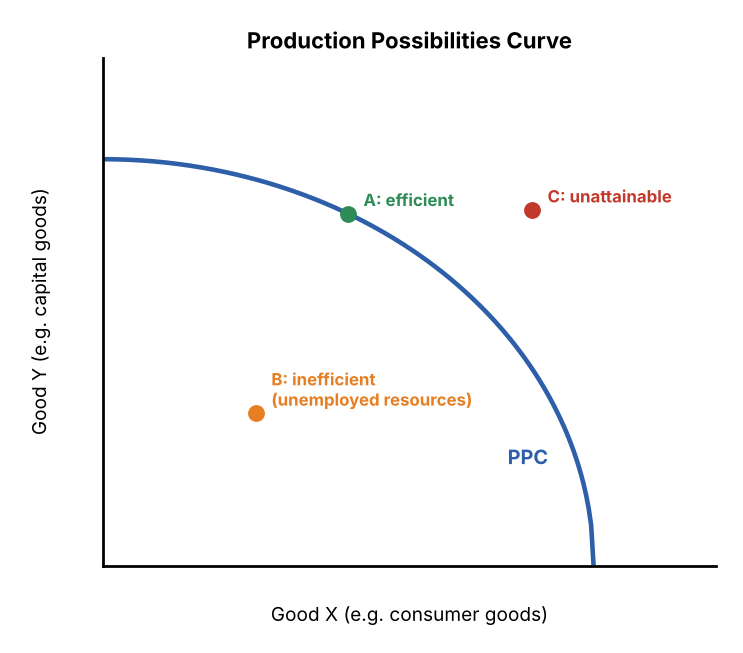
- Production decisions: A firm deciding how many units to produce must consider the opportunity cost of using its labor and capital on one product rather than another. This connects directly to the Production Possibilities Curve (Topic 1.3), where every point represents a different set of opportunity costs.
- Resource allocation: A student choosing between studying for the AP Exam versus the SAT must weigh the benefit of improving one score against the opportunity cost of not improving the other.
- Consumption decisions: Every dollar you spend on one good is a dollar you can’t spend on something else. The opportunity cost of buying a $50 textbook is whatever else you could have bought with that money.
A key insight: opportunity cost is subjective and depends on individual circumstances. For a brain surgeon earning $500 per hour, the opportunity cost of an hour of volunteer work is $500. For a student earning $15 per hour, it’s $15. The same activity has radically different opportunity costs depending on who’s doing it and what their alternatives are. The AP exam tests whether you can adjust your analysis to different contexts.
Marginal Analysis: How Rational Decision-Makers Really Decide
Here’s where cost-benefit analysis becomes a powerful decision-making tool: most real-world decisions aren’t about choosing between “do it” or “don’t do it.” They’re about choosing how much to do — one more, or one less.
Marginal analysis is the examination of the change in costs and benefits that results from a one-unit change in a decision variable. Instead of asking, “Should I go to college?” you ask, “Should I attend one more year of college?” Instead of “Should I produce widgets?” you ask, “Should I produce one more widget?”
The decision rule for rational decision-making is elegant and appears repeatedly on the AP Exam:
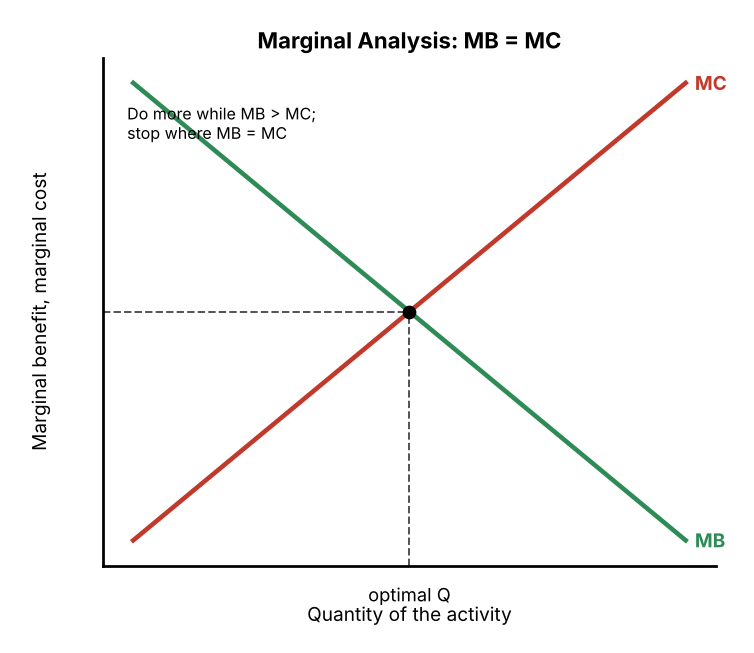
- Increase the activity as long as marginal benefit (MB) exceeds marginal cost (MC).
- Stop increasing the activity when MB = MC.
- Never increase the activity when MB < MC.
This rule applies to production decisions, consumption decisions, hiring decisions, and nearly every optimization problem in microeconomics. When you see the phrase “maximize profit” on the AP exam, it means set quantity where MC = MB. When you see “allocate resources efficiently,” the same rule applies.
Consider a concrete example: You’re working part-time and considering whether to pick up extra shifts. Should you?
- Marginal benefit: The wage you earn per extra shift (say, $120).
- Marginal cost: The time you give up studying, plus the cost of transportation, plus the fatigue. Suppose you value these at $80 total.
- Decision: Because MB ($120) > MC ($80), you should pick up the extra shift. Your net benefit increases by $40.
- What if another shift is offered? MB is still $120, but MC might now be $150 (you’re more fatigued, you’re falling behind in studying). Because MB < MC, you should decline. The harm to your other goals outweighs the benefit.
This is how actual decision-makers think — not whether to do something in absolute terms, but whether to do a bit more or a bit less. The AP exam tests this relentlessly because it’s the foundation of firm behavior, consumer choice, and resource allocation.
A critical point for learning objective CBA-1.A: marginal analysis explains why decisions change at the margin, even when total costs or benefits remain large. A firm might be highly profitable overall, but if producing one more unit has MC > MB, it should stop. This is counterintuitive to students who think “profitability” means “keep going.” But economists know better. The firm maximizes profit (not total revenue or total production) by setting MC = MB.
Rational Decision-Making: Putting It All Together
Now let’s integrate these pieces into a coherent framework for rational economic decision-making, which is the heart of learning objectives CBA-1.A and CBA-1.B.
A rational decision-maker:
- Identifies all relevant costs — both explicit (cash payments) and implicit (opportunity costs of using owned resources). Ignores sunk costs.
- Identifies all relevant benefits — both monetary (revenue, wages) and non-monetary (leisure, satisfaction, risk reduction).
- Compares marginal benefits to marginal costs for the decision at hand, rather than comparing total benefits to total costs.
- Makes the decision that maximizes net benefit — continues an activity as long as MB exceeds MC, and stops when they’re equal.
Let’s apply this framework to a typical AP Exam scenario: A small business owner is deciding whether to expand her operation. Here’s how you’d analyze it:
- Explicit costs of expansion: $50,000 per year to lease new equipment, $30,000 per year in wages for additional staff.
- Implicit costs: The owner would need to spend her own time running the expanded operation, reducing her ability to consult on outside projects. Her outside consulting income is $20,000 per year. That’s an implicit cost.
- Benefits: Additional revenue of $110,000 per year from expanded sales.
- Sunk costs to ignore: The amount she spent building her current business five years ago. That’s water under the bridge.
- Marginal decision: Is the marginal benefit of expansion ($110,000 additional revenue) worth the marginal cost ($50,000 equipment lease + $30,000 wages + $20,000 opportunity cost = $100,000 per year)? Yes, the net benefit is $10,000. She should expand.
This is the kind of layered reasoning the AP exam expects. It’s not just plugging numbers into a formula. It’s demonstrating that you understand what costs matter, why, and how decision-makers actually think.
Test-Taking Strategies
Mnemonic Devices and Memory Shortcuts
The “ESS” framework for costs: Explicit (cash out), Sunk (forget it), Stay relevant (implicit costs matter). This helps you quickly categorize costs when a question presents multiple types.
“MB = MC” is the magic equation. Whenever you see “maximize,” “optimize,” or “best decision,” think MB = MC. This rule applies across production, consumption, hiring, and pollution abatement.
Cross-Topic Connections
Cost-benefit analysis and marginal analysis form the backbone of everything that follows:
- Topic 1.3 (Production Possibilities Curve): Every point on the PPC represents a different opportunity cost. Moving from one point to another shows what you give up to get something else. This is opportunity cost in visual form.
- Topic 2.2 (Supply): Firms decide how much to produce by setting MC = MB (where MB equals the market price). Cost-benefit analysis is the decision rule for supply.
- Topic 1.6 (Marginal Analysis and Consumer Choice): Consumers choose how much to buy by comparing marginal benefit (utility) to marginal cost (price). Same MB = MC rule.
- Topic 6.2 (Externalities): Society maximizes welfare when marginal social benefit equals marginal social cost — expanding the cost-benefit framework to include external effects.
Common Question Formats
You’ll encounter cost-benefit analysis in these formats:
- “Which of the following should be included in a cost-benefit analysis?” Watch for sunk costs (wrong), implicit costs (right), and opportunity costs (right). Common trap: questions that list sunk costs alongside real costs and ask you to identify what matters.
- “A firm should increase production as long as…” Answer: marginal revenue exceeds marginal cost (or price exceeds marginal cost in perfect competition).
- Scenario-based FRQs: You’re given a business situation and asked whether the owner should take an action. You must identify all costs (explicit and implicit), all benefits, and apply MB = MC to justify your answer.
- Comparison questions: “Which option maximizes profit?” You calculate the net benefit (total benefit minus total cost, including opportunity costs) for each option and choose the highest.
Frequent Student Mistakes
Mistake 1: Including sunk costs in forward-looking decisions. Students often think, “We’ve already spent $50,000, so we might as well continue with the project.” Sunk costs are irrelevant. The decision should depend only on whether future benefits exceed future costs.
Mistake 2: Forgetting implicit costs. Students calculate profit as revenue minus explicit costs and declare the business successful. But if the owner could earn more as a salaried employee elsewhere, the economic profit is negative. The AP exam tests this constantly because it requires deeper thinking.
Mistake 3: Using total analysis when marginal analysis is needed. A question asks whether to “increase” production. Students compare total revenue to total cost. Wrong. You should compare marginal revenue to marginal cost. The business might be highly profitable overall, but still shouldn’t expand if the next unit adds more cost than revenue.
Mistake 4: Confusing opportunity cost with sunk cost. These are opposites. Opportunity cost is the value of a foregone alternative (relevant to future decisions). Sunk cost is a past payment (irrelevant to future decisions).
Test-Day Shortcuts
When you see “maximize,” immediately write “MB = MC.” This is the decision rule across economics. If it’s a firm, this is the profit-maximizing output. If it’s a consumer, this is utility maximization. Don’t overthink it.
For sunk cost traps, ask: “Is this a payment already made that can’t be recovered?” If yes, cross it out. If no, it belongs in your analysis.
For implicit costs, ask: “What else could these resources be used for?” If the answer is valuable (like working a paying job, or renting out owned land), that’s an implicit cost.
For opportunity cost questions, identify the “next best alternative.” The opportunity cost isn’t everything you could do instead; it’s the single highest-value alternative you’re giving up.
Time Management Tips
Multiple-choice questions on cost-benefit analysis are usually quick. They test a single concept: Can you identify a sunk cost? Can you spot an implicit cost? Does MB exceed MC? These are often decided in 30-45 seconds once you know what to look for.
Free-response questions are where you earn the points. These require you to show your work: list the explicit costs, identify the implicit costs (and justify why they’re opportunity costs of resources the firm owns), calculate the net benefit, and explain your conclusion. Budget 8-10 minutes per FRQ that touches cost-benefit analysis. Write out your reasoning. Graders reward clear, structured thinking.
If you’re unsure whether a cost is relevant, ask yourself: “Does this cost change if I make the decision in question?” If yes, it’s relevant. If no (like a sunk cost), ignore it. This simple filter catches most of the traps.
Check for Understanding
Think you’ve got it? Complete the quiz below to make sure. Download your results at the end.