
Maximize your score with these resources:
- Albert.io AP® US Government question banks
- Free AP® US Government cheat sheets
- Free AP® US Government score calculator
Selective incorporation is one of the most consequential constitutional doctrines in American history—and one of the most tested on the AP Government and Politics exam. Before 1925, state governments could censor newspapers, establish official churches, and deny citizens basic legal protections. Selective incorporation, built on the 14th Amendment’s Due Process Clause, systematically stripped states of those powers. Understanding this doctrine will help you ace FRQs on federalism, the Bill of Rights, and the evolution of civil liberties (CON-3.A).
The Original Bill of Rights: Only Applied to the Federal Government
When the Bill of Rights was ratified in 1791, it applied only to the federal government. This was not an oversight—the Framers viewed state governments as separate sovereigns, answerable to their own constitutions and citizens.
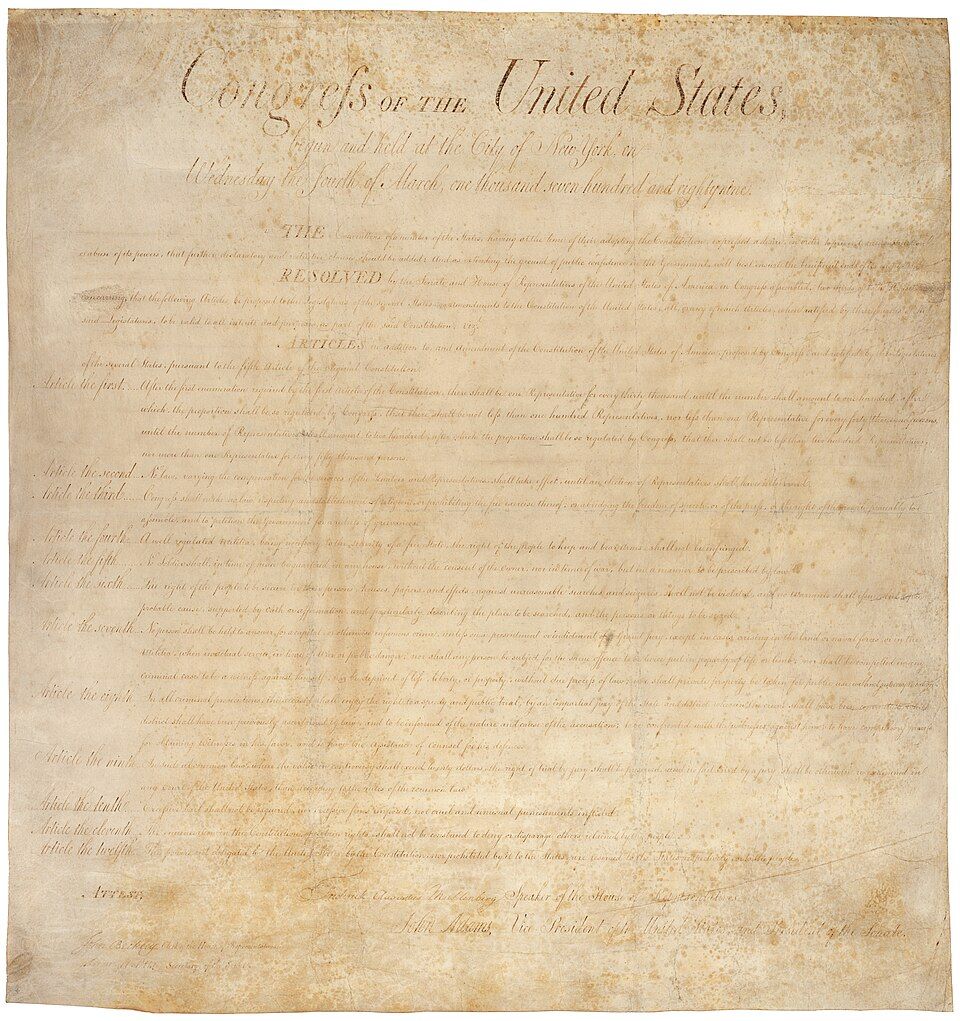
The Supreme Court confirmed this narrow reading in Barron v. Baltimore (1833). John Barron sued Baltimore after the city diverted water during construction projects, ruining his dock. He claimed the Fifth Amendment’s takings clause protected him from uncompensated property loss. Chief Justice John Marshall ruled that the Bill of Rights protected citizens only against federal action, not state action. States were free to act as they pleased regarding property rights, speech, religion, or any other matter covered by the Bill of Rights.
The result: for more than a century after the founding, states could restrict speech, censor press, quarter soldiers in homes, and conduct unreasonable searches without violating the Constitution. If you lived in a state, the Bill of Rights offered you zero protection against your own state government.
The 14th Amendment (1868): The Vehicle for Change
The Civil War and Reconstruction changed everything. The 14th Amendment, ratified in 1868, contained the critical language needed to overturn Barron and extend Bill of Rights protections to states.
Section 1 of the 14th Amendment states: “No State shall make or enforce any law which shall abridge the privileges or immunities of citizens of the United States; nor shall any State deprive any person of life, liberty, or property, without due process of law.”
The Due Process Clause became the critical tool. It prohibited states from depriving any person of “liberty” without due process. The question the Supreme Court had to answer: what does “liberty” include? Could it encompass rights protected by the Bill of Rights? For decades, the Court said no. In 1925, that changed.
Selective Incorporation Begins: Gitlow v. New York (1925)
Benjamin Gitlow, a socialist, distributed pamphlets advocating violent overthrow of the government. New York prosecuted him under a state law criminalizing such advocacy. Gitlow argued the First Amendment protected him even from state prosecution.
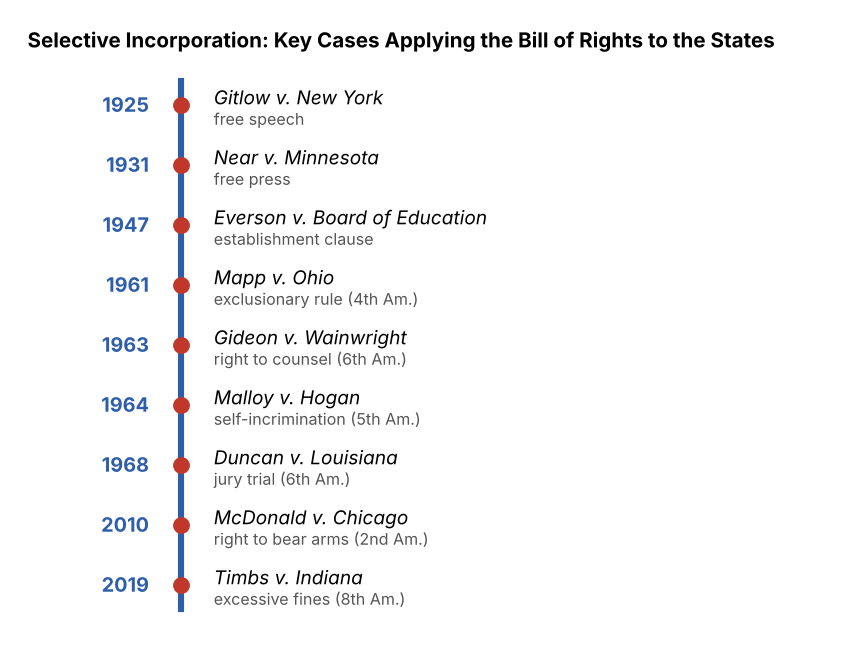
In Gitlow v. New York (1925), the Supreme Court ruled that freedom of speech is so fundamental to ordered liberty that it must be protected against state governments through the 14th Amendment’s Due Process Clause. This was the first selective incorporation decision. The Court incorporated the First Amendment’s free speech protection against state governments—though it still upheld Gitlow’s conviction on other grounds.
Why “selective”? The Court didn’t incorporate all of the Bill of Rights at once. Instead, it examined each right individually and asked: is this right fundamental to our concept of ordered liberty? If yes, it gets incorporated against the states. If no, states remain free to restrict it as they see fit.
The Selective Incorporation Test: “Fundamental to Ordered Liberty”
The Supreme Court formalized its framework in Palko v. Connecticut (1937). The case involved a Connecticut law permitting prosecutors to appeal acquittals. Justice Benjamin Cardozo wrote that a right qualifies for incorporation if it is “of the very essence of a scheme of ordered liberty” or “implicit in the concept of ordered liberty.” Rights that are merely helpful but not fundamental stay with the states.
This test explains why some Bill of Rights protections have been incorporated while others have not. Incorporated rights include:
- First Amendment: freedom of speech, religion, assembly, petition, and press
- Second Amendment: right to bear arms (McDonald v. Chicago, 2010)
- Fourth Amendment: protection against unreasonable search and seizure
- Fifth Amendment: protection against self-incrimination, double jeopardy, and uncompensated takings
- Sixth Amendment: right to counsel, confrontation of witnesses, speedy trial, jury trial
- Eighth Amendment: protection against cruel and unusual punishment
Notable non-incorporated rights include the Third Amendment (quartering of soldiers), the Fifth Amendment’s grand jury requirement, and the Seventh Amendment’s civil jury trial right. States can regulate these areas differently from the federal government.
Landmark Incorporation Cases You Must Know
The Court incorporated Bill of Rights protections case-by-case throughout the 20th century. These are the decisions that appear most frequently on the AP exam:
| Case | Year | Right Incorporated | Amendment | Key Principle |
|---|---|---|---|---|
| Gitlow v. New York | 1925 | Freedom of speech | 1st | First selective incorporation case; launched the entire process |
| Mapp v. Ohio | 1961 | Search and seizure protections | 4th | Exclusionary rule applies to states; illegally obtained evidence excluded |
| Gideon v. Wainwright | 1963 | Right to counsel | 6th | States must provide attorneys to defendants who cannot afford them |
| Robinson v. California | 1962 | Cruel and unusual punishment | 8th | States cannot criminalize addiction as a status or condition |
| Duncan v. Louisiana | 1968 | Jury trial in criminal cases | 6th | States must provide jury trials in serious criminal prosecutions |
| McDonald v. Chicago | 2010 | Right to bear arms | 2nd | Major modern incorporation (later: Timbs v. Indiana 2019, Ramos v. Louisiana 2020); 14th Amendment protects gun rights against state bans |
Notice the timeline: incorporation picked up pace dramatically during the Warren Court era of the 1960s. Each case reflects the same logic—the Court identified a right it deemed fundamental to ordered liberty, then used the 14th Amendment’s Due Process Clause to extend it to state governments.
Total vs. Selective Incorporation: Why the Court Chose Selective
Justice Hugo Black argued throughout his career that the entire Bill of Rights should be incorporated against the states at once—called total incorporation. He believed the 14th Amendment’s framers intended exactly that.
The Supreme Court rejected Black’s view. Instead it adopted selective incorporation for three reasons:
- Flexibility: Not every Bill of Rights protection was intended to be universal. Some reflect specific historical concerns. Selective incorporation let the Court apply only those rights truly essential to liberty.
- A workable test: The “fundamental to ordered liberty” standard gave courts a consistent framework for future decisions—grounded in history, tradition, and the nation’s commitment to liberty.
- Preserved federalism: States retain some ability to govern themselves differently. They just cannot infringe on rights the Constitution explicitly protects. This balance preserved room for state variation on non-fundamental matters.
The Federalism Tension: Power Shifting to the Federal Government
Selective incorporation had a massive impact on American federalism. Before the 14th Amendment, states held nearly all power to regulate citizen behavior. After selective incorporation, the federal government—through the Supreme Court—set a constitutional floor below which no state could fall.
This shift happened quietly, through case law. The Court didn’t declare sweeping national mandates. Case by case, it told states: “This right is so fundamental that your state must protect it, just as the federal government must.” Over a century of incremental decisions, selective incorporation transformed the federal system. States today operate under virtually all Bill of Rights protections. Powers that were once theirs—to censor newspapers, restrict speech, deny counsel to the poor, conduct unreasonable searches—were taken away one case at a time.
This federalism shift remains contested. Critics argue the Court overreached and that the 14th Amendment doesn’t clearly mandate incorporation. Defenders argue that fundamental rights cannot depend on geography and that states cannot be allowed to oppress minorities even with majority support.
The Practical Impact: What Selective Incorporation Means Today
Selective incorporation changed your daily life. Because of this doctrine:
- Police cannot search your home without probable cause and a warrant (or your car without probable cause), even in states that once allowed such searches
- You have the right to an attorney if accused of a serious crime, regardless of whether you can afford one
- You cannot be tried twice for the same offense in state court, even in states that once permitted it
- You can speak freely on political matters without fear of state prosecution
- You can practice any religion (or none) without state interference
- States cannot impose torture or execution methods deemed cruel and unusual
Without selective incorporation, your constitutional rights would depend entirely on which state you happened to live in. The doctrine created a baseline all states must meet.
Test-Taking Strategies
Mnemonic Devices and Memory Shortcuts
Remember the landmark cases with G-M-G-R-D-M (“Gig-Rum-Drum”):
- Gitlow (1925) — Free speech (1st)
- Mapp (1961) — Search and seizure (4th)
- Gideon (1963) — Right to counsel (6th)
- Robinson (1962) — Cruel and unusual punishment (8th)
- Duncan (1968) — Jury trial (6th)
- McDonald (2010) — Right to bear arms (2nd)
For the 14th Amendment’s role, remember: “14 = Due Process = Incorporation.” The Due Process Clause of the 14th Amendment is the vehicle for every selective incorporation decision. If you forget everything else on exam day, remember that connection.
For non-incorporated rights: 3-5-7 = Third Amendment (quartering), Fifth Amendment grand jury, Seventh Amendment civil jury. These three stay with the states.
Cross-Topic Connections
- Federalism: Incorporation is one of the most dramatic power shifts from states to the federal judiciary in American history. Use this concept to answer any question about the balance of power between federal and state governments. The AP exam frequently pairs selective incorporation with federalism questions.
- Bill of Rights: Incorporation explains why Bill of Rights protections apply nationwide. When you see a question about limits on police conduct, free speech restrictions, or gun ownership bans, selective incorporation is the underlying constitutional principle.
- Supreme Court power: Selective incorporation is a prime example of judicial review reshaping federalism without a constitutional amendment. The Court essentially rewrote the federal-state balance using the 14th Amendment as its tool. This connects to questions about the Court’s role in shaping policy.
Common Question Formats
- “Which scenario demonstrates selective incorporation?” Look for a case where the Court extends a Bill of Rights protection to a state. “A state is prohibited from conducting an unreasonable search” shows the 4th Amendment incorporated against the state via selective incorporation.
- “Why did the Court adopt selective rather than total incorporation?” Answer: flexibility to determine which rights are truly fundamental, using the “ordered liberty” test to evaluate each right individually.
- “What is the 14th Amendment’s role in selective incorporation?” Answer: The Due Process Clause prohibits states from depriving persons of liberty; courts interpreted “liberty” to include fundamental Bill of Rights protections.
- Free response on a specific incorporated right and federalism: Explain how the Court used selective incorporation to apply that right to states, then discuss the federalism implications (power shift, protection of individuals, state sovereignty concerns).
Frequent Student Mistakes
- Mistake: “The Bill of Rights always applied to states.” Correction: Barron v. Baltimore (1833) ruled the Bill of Rights applied only to the federal government. States were free to restrict rights for nearly 100 years. Selective incorporation changed this starting in 1925.
- Mistake: “All of the Bill of Rights has been incorporated.” Correction: Selective incorporation means only rights deemed “fundamental to ordered liberty” are incorporated. The Third Amendment, the Fifth Amendment grand jury requirement, and the Seventh Amendment civil jury trial remain non-incorporated.
- Mistake: “Incorporation is mainly about the Second Amendment.” Correction: Selective incorporation spans the entire Bill of Rights—First (speech, religion), Fourth (search and seizure), Fifth (self-incrimination, double jeopardy), Sixth (counsel, speedy trial), and Eighth (cruel and unusual punishment). McDonald v. Chicago (2010) incorporated the Second Amendment, but the process started with the First Amendment in 1925.
Test-Day Shortcuts
- 14th Amendment Due Process Clause = the vehicle. Any question about Bill of Rights protections applied to states traces back here.
- “Fundamental to ordered liberty” = the test. When asked why a specific right was incorporated, center your answer on this standard.
- Barron v. Baltimore = the starting point. Many questions set up a state action that seems to violate a Bill of Rights protection. Before selective incorporation, states had that power. After incorporation of that specific right, they don’t.
- Know the direction of power. Selective incorporation gave the Supreme Court authority to impose constitutional requirements on state governments—a major federalism shift toward national standards.
Time Management Tips
For multiple-choice questions on selective incorporation, the answer usually hinges on identifying the 14th Amendment’s role or naming the correct landmark case. Spend no more than 60 seconds. For free-response questions, use this five-part structure: (1) define selective incorporation, (2) explain the 14th Amendment’s Due Process Clause role, (3) describe the “fundamental to ordered liberty” test, (4) provide a specific example case, (5) discuss the federalism implications. With that outline in mind, you can write a strong FRQ response in 8–10 minutes.
Check for Understanding
Think you’ve got it? Complete the quiz below to make sure. Download your results at the end.