

Maximize your score with these resources:
- Albert.io AP® US Government question banks
- Free AP® US Government cheat sheets
- Free AP® US Government score calculator
Topic 3.6: Amendments: Balancing Individual Freedom with Public Order and Safety is a crucial part of Unit 3 (Civil Liberties and Civil Rights), which comprises 13-18% of the AP® US Government and Politics exam. This topic explores one of the most fundamental tensions in the American constitutional system: how far the government can limit individual rights in pursuit of public safety, and what legal tests courts use to decide.
You’ll encounter this concept on the exam primarily through Supreme Court cases and hypotheticals asking you to apply constitutional standards. Questions typically ask you to identify which legal test applies, predict how a court would rule, or explain why a particular government restriction is (or isn’t) constitutional. Understanding the tests — and the cases that created them — is essential to earning high marks on MCQs and FRQs alike.
This article covers the Supreme Court’s approach to balancing competing interests: the individual’s fundamental rights and the government’s responsibility to protect public order and safety. Learning Objective LOR-2.G.
The Fundamental Tension: Rights vs. Order
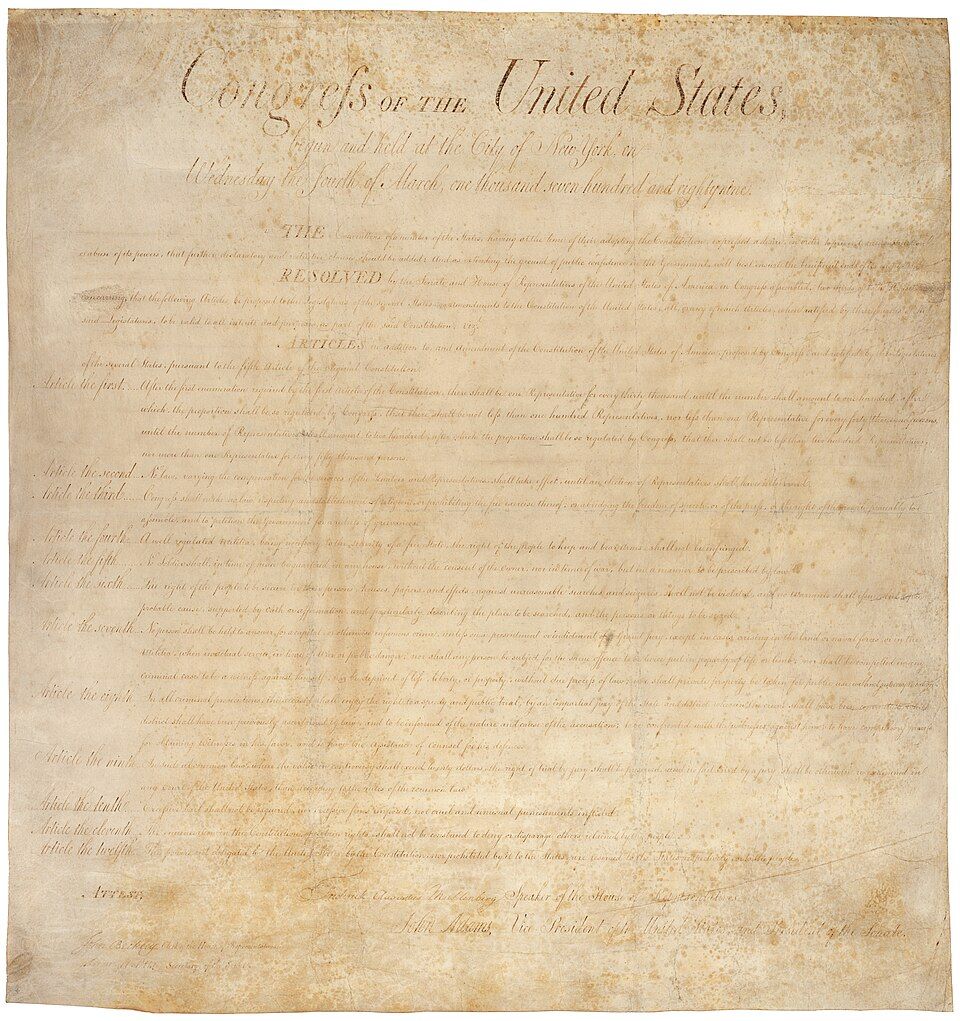
The Bill of Rights grants individuals sweeping freedoms: speech, religion, assembly, petition, and more. Yet no right is truly absolute. Your right to free speech doesn’t extend to shouting “fire” in a crowded theater. Your right to religious practice may yield if it endangers others. The question the Supreme Court has wrestled with for over a century is: When exactly does government authority override individual liberty?
The Court could answer this in two extreme ways. It could say that any government restriction on a fundamental right is unconstitutional (absolute protection). Or it could defer entirely to legislative and executive judgment about what threats justify limiting rights (minimal protection). Instead, the Court created a middle path: tests that require the government to justify restrictions with varying levels of scrutiny.
The choice of test shapes the outcome. A strict test makes it hard for government to win. A lenient test makes it easy. The Court’s job is to choose the right test for each type of right and government action.
The Three-Tiered Scrutiny System
When the government restricts a fundamental right or targets a suspect class (like race), courts don’t just accept the government’s reasoning. They apply one of three levels of scrutiny, ranging from very demanding to very lenient:
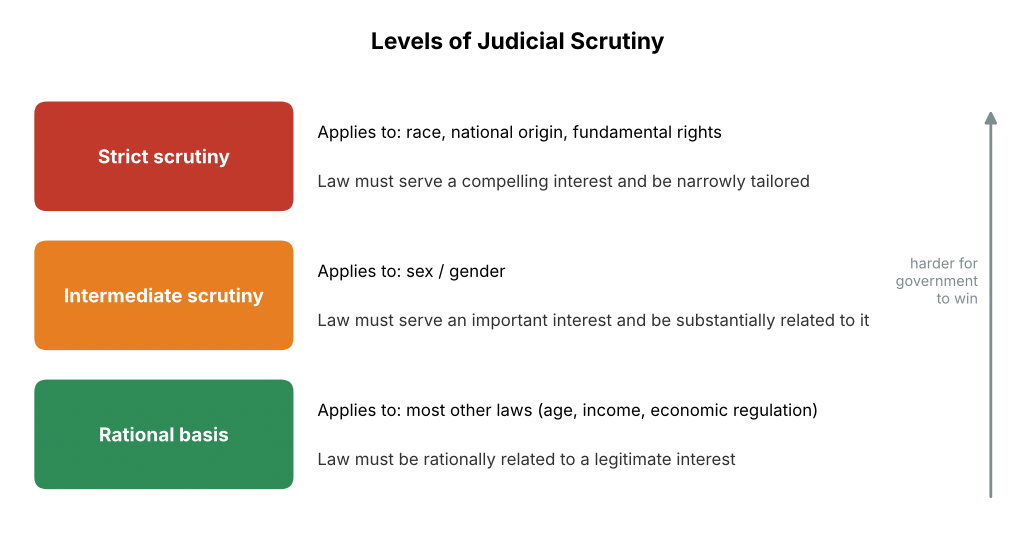
| Scrutiny Level | Standard | Burden of Proof | Outcome | When Used |
|---|---|---|---|---|
| Strict Scrutiny | Government must show the law is necessary to achieve a compelling state interest and is the least restrictive means available. | Very high. Government almost always loses. | Law is struck down unless government can meet an extremely demanding standard. | Restrictions on fundamental rights (speech, religion, voting) or laws targeting suspect classes (race, national origin). |
| Intermediate Scrutiny | Government must show the law substantially advances an important governmental interest and is narrowly tailored to that interest. | Moderate. Outcome depends on specific facts. | Law survives or is struck down depending on whether the fit between means and ends is close enough. | Restrictions on semi-fundamental rights (some expressive conduct) or laws targeting semi-suspect classes (gender). |
| Rational Basis | Government must show the law has some rational relationship to a legitimate governmental interest. | Very low. Government almost always wins. | Law survives unless it’s arbitrary or irrational. | Economic and social legislation. Most laws are reviewed under rational basis. |
Why does this matter? Because the test you choose determines whether a law passes constitutional muster. A speech restriction that fails strict scrutiny might survive rational basis review. The Court’s selection of which test to apply is therefore one of its most consequential decisions in a case.
Key Cases: How Courts Apply the Tests
Schenck v. United States (1919) established the first major test for limiting speech. During World War I, Schenck distributed pamphlets urging men to resist the draft. The Supreme Court upheld his conviction, but in doing so, it created the clear and present danger test: speech can be restricted if it poses a clear and present danger of bringing about lawless action that the government has a right to prevent.
Under this test, the government doesn’t have to wait for harm to occur. The danger must be imminent and obvious, but if those conditions are met, speech loses protection. This test remained the standard for decades, though it evolved. Later, the Court adopted the Brandenburg test (from Brandenburg v. Ohio, 1969), which is stricter: speech can be restricted only if it is directed to inciting imminent lawless action and is likely to incite such action. “Likely to” replaced “clear and present danger,” making it harder to restrict speech.
Tinker v. Des Moines (1969) addressed student speech. High school students wore black armbands to protest the Vietnam War. School administrators removed them, claiming they’d cause disruption. The Supreme Court ruled for the students, holding that schools can restrict student expression only if it causes substantial disruption or interferes with school operations. This standard is more protective of speech than Schenck’s but still allows government to limit expression when concrete harms are likely. Tinker remains the controlling standard for student speech on school grounds.
Why these cases matter on the exam: Tinker appears frequently in questions about student rights. Know the “substantial disruption” test, and recognize that a school cannot simply ban speech because it dislikes the message. Schenck and Brandenburg appear in questions about political speech and protest; you need to distinguish between the two tests and understand that Brandenburg is the modern standard.
Wisconsin v. Yoder (1972) tackled religious freedom vs. compulsory education. The Amish sought exemption from mandatory school attendance beyond the eighth grade (Wisconsin required attendance until age 16), citing religious conviction. The Court sided with the Amish, holding that a compelling state interest in education did not outweigh the religious freedom interest when the Amish provided alternative education and posed no threat to educational goals or public safety.
Yoder is crucial for understanding how courts balance religious liberty with public safety. The Court applied strict scrutiny to the compulsory education law and found that the state’s interest in one or two more years of formal schooling did not outweigh the burden on the Amish’s free exercise of religion. Yoder shows that even fundamental government goals (universal education) can yield to religious freedom if the burden on the state is minimal.
Categories of Rights and Their Protection Levels
Not all rights receive the same protection. The Court has created a hierarchy:
- Fundamental rights (strict scrutiny) — First Amendment rights (speech, religion, assembly, petition), voting rights, rights related to family and reproduction. These are protected unless the government has a compelling reason to restrict them and uses the least restrictive means.
- Important but not fundamental rights (intermediate scrutiny) — Some forms of expressive conduct (wearing an armband), gender-based classifications. These receive meaningful protection but can be restricted if the law serves an important goal and is closely tailored to that goal.
- Economic and social rights (rational basis) — Most property rights, commercial regulations, social welfare laws. These face minimal judicial scrutiny; the law survives unless it’s arbitrary or completely irrational.
For the AP exam, the critical skill is identifying which category a right falls into. When you see a question about speech or religion, default to strict scrutiny. When you see gender, think intermediate scrutiny. When you see economic regulation, rational basis will likely apply.
When Government Wins: Legitimate Reasons to Restrict Rights
Courts recognize several legitimate reasons for government to limit rights, even fundamental ones:
- Public safety and order — The government can restrict speech that incites violence, guns near schools, or assembly that blocks traffic. The restriction must be tailored to the actual threat, not to the speaker’s unpopular message.
- National security — During wartime or imminent security threats, courts give government significant leeway. This is where strict scrutiny becomes somewhat more forgiving. However, courts have recently rejected blanket restrictions and have required government to show specific, concrete threats.
- Compelling educational or other institutional interests — Tinker allows schools to restrict student speech when disruption is substantial. Yoder still exempted the Amish from compulsory attendance beyond eighth grade because the state’s interest in one or two more years of schooling did not outweigh the burden on their religious practice. The lesson: even compelling interests don’t automatically win.
- Protecting others’ rights — Speech that threatens others (true threats, incitement to imminent violence) can be restricted. The government is protecting the safety and rights of potential victims.
Why this matters: Students often assume any government restriction fails. But the Court recognizes that rights aren’t infinite. Your right to free speech doesn’t include the right to incite a riot. Your right to religious practice doesn’t include the right to harm others in the name of faith. On the exam, don’t default to “all rights are absolute.” Instead, ask: Is the government’s interest compelling? Is the restriction necessary and narrowly tailored? If yes to both, the restriction likely survives.
How Courts Actually Decide: The Analytical Framework
When you encounter a hypothetical on the AP exam, apply this framework:
- Identify the right at issue. Is it a fundamental right (speech, religion, voting)? Is it an important right (some expressive conduct)? Or is it an economic/social right? This determines the scrutiny level.
- Identify the government action restricting the right. What law or policy is the government enforcing? Who is it affecting and how?
- Choose the appropriate test. Fundamental rights and suspect classifications get strict scrutiny. Semi-fundamental rights and semi-suspect classes get intermediate scrutiny. Everything else gets rational basis.
- Apply the test rigorously. For strict scrutiny, ask: Does the government have a compelling interest? Is the law narrowly tailored? If either answer is no, the law fails. For intermediate scrutiny, ask whether the law substantially advances an important interest and is narrowly tailored. For rational basis, ask if the law has any rational relationship to a legitimate interest (very low bar).
- Reach a conclusion. Based on the test, would the law survive? Cite specific cases if you can.
This framework mirrors how appellate courts actually reason through these cases. Mastering it will help you answer any question about rights and restrictions, even if you haven’t seen that specific case before.
Test-Taking Strategies
Mnemonic devices and memory shortcuts
- Remember the scrutiny tiers with “SIR”: Strict, Intermediate, Rational basis. Strict is hardest for government. Rational basis is easiest. When you see speech or religion, go straight to Strict.
- For the main cases, use “STB”: Schenck (clear and present danger), Tinker (substantial disruption), Brandenburg (imminent lawless action). Brandenburg is the most modern and strictest test.
- “LYNR” for Yoder‘s holding: Laws may yield if they burden a religious minority, the state has no narrowly tailored alternative, and public safety isn’t threatened.
Cross-topic connections
- Topic 3.1 (The Bill of Rights) — This topic applies the general principles of constitutional protection introduced there. Every specific right relies on the scrutiny framework.
- Topics 3.2-3.3 (The First Amendment) — Speech and religion questions almost always invoke the cases and tests from this topic. If you see a speech hypothetical, map it to Brandenburg or Tinker.
- Topic 3.10 (Social Movements and Equal Protection) — The scrutiny tiers (strict, intermediate, rational basis) apply to both rights and classifications. Gender discrimination uses intermediate scrutiny; race uses strict scrutiny. Same framework, different context.
Common question formats
- Case matching: “Which of the following cases established the standard that speech can be restricted if it poses a clear and present danger?” (Answer: Schenck). These are straightforward if you know the cases.
- Hypothetical application: “A school bans students from wearing anti-war armbands. Which test would the Supreme Court apply, and would the ban survive?” (Tinker / substantial disruption standard / the ban fails). These require you to identify the right, choose the test, and apply it.
- Distinguish cases: “How does Brandenburg differ from Schenck?” (Brandenburg requires imminent lawless action and likelihood of incitement; Schenck required only clear and present danger.) These test depth of understanding.
- FRQ prompt: Often presents a hypothetical law restricting speech, religion, or assembly and asks you to analyze whether it survives constitutional scrutiny. You must identify the right, state the applicable test, and apply it with evidence from cases.
Frequent student mistakes
- Confusing the scrutiny tests. Students often say “strict scrutiny means the law must be strict” rather than “the court’s review is strict.” Remember: strict scrutiny is hard for government to satisfy. Rational basis is easy. This reversal trips up many students.
- Assuming all restrictions fail. Some students think any limit on speech or religion is automatically unconstitutional. Wrong. If the government has a compelling interest and uses a narrowly tailored means, the restriction can survive strict scrutiny. Understand that rights are not absolute.
- Missing the “narrowly tailored” requirement. A law might serve a compelling interest but still fail if it’s broader than necessary. Always check both the interest and the fit.
- Forgetting Brandenburg. Many students cite Schenck as the current test for speech. Brandenburg (1969) is the modern standard. Schenck is historically important but outdated. Know which test applies today.
- Conflating Yoder with absolute religious exemption. Yoder doesn’t mean religious groups can ignore all laws. It means courts will strictly scrutinize laws that burden religious practice. The Amish still had to provide education; they just got an exemption from the compulsory attendance rule specifically.
Test-day shortcuts
- On MCQs, if the question mentions speech or religion, flag it as “strict scrutiny likely.” This narrows your options immediately.
- If a hypothetical describes a law targeting a specific group (speakers, religious practitioners), think about whether that targeting makes it more vulnerable. Laws that restrict speech based on content or viewpoint face strict scrutiny; content-neutral restrictions face intermediate scrutiny. Content matters.
- Recognize the phrase “substantially disrupts” or “likely to incite.” These trigger Tinker or Brandenburg respectively. Matching the language to the test is fast and reliable.
- On FRQs, always explicitly name the scrutiny level and the test. “I would apply strict scrutiny because this law restricts a fundamental right. Under strict scrutiny, the government must show a compelling interest and use the least restrictive means. Here…” This structure earns points even if graders disagree with your conclusion.
Time management tips
- MCQs on this topic are usually straightforward if you know the cases and tests. Don’t overthink. If you’re confident in the scrutiny level, select your answer and move on.
- Hypothetical FRQs may require 5-8 minutes. Spend 1-2 minutes identifying the right and test, then 3-4 minutes applying with evidence. Don’t write lengthy legal briefs; focus on analysis.
- If a question asks you to compare two cases, jot down the key difference before writing your answer. “Schenck: clear and present danger. Brandenburg: imminent lawless action + likelihood.” This prevents mixing them up under time pressure.
Check for Understanding
Think you’ve got it? Complete the quiz below to make sure. Download your results at the end.