
Maximize your score with these resources:
- Albert.io AP® US Government question banks
- Free AP® US Government cheat sheets
- Free AP® US Government score calculator
The Second Amendment stands as one of the most debated provisions in the U.S. Constitution, and it’s a recurring topic on the AP® U.S. Government and Politics exam. This article covers Topic 3.5: Second Amendment — Right to Bear Arms (Learning Objective LOR-2.F) as part of Unit 3: Civil Liberties and Civil Rights. Understanding the Second Amendment requires mastering both the constitutional text and how the Supreme Court has interpreted it over time — particularly the landmark cases District of Columbia v. Heller (2008) and McDonald v. City of Chicago (2010), which consistently appear on the exam.
You’ll encounter Second Amendment questions on the AP exam as multiple-choice items asking about the holdings in Heller and McDonald, their limits, and how they relate to state and federal regulation. You may also see free-response questions asking you to explain the debate over individual versus collective rights, or to analyze how selective incorporation applies to the Second Amendment. By the end of this article, you’ll understand the constitutional text, the historical debate, the two landmark Supreme Court cases, and what regulations remain permissible under current law.
The Text and Two Competing Interpretations
The Second Amendment reads: “A well regulated Militia, being necessary to the security of a free State, the right of the people to keep and bear Arms, shall not be infringed.” This 27-word sentence has sparked centuries of legal and constitutional debate, largely because its structure contains two distinct clauses, each of which supports a different interpretation.
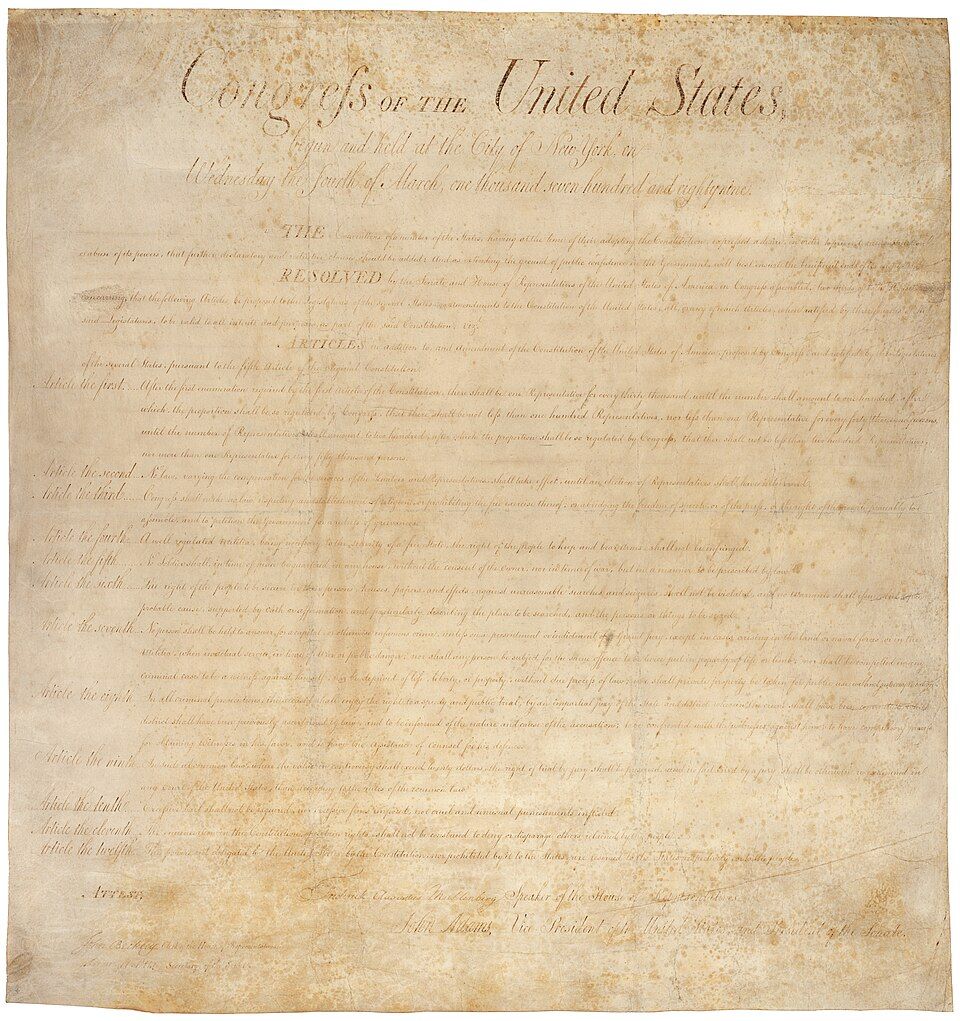
For more than 200 years, scholars and judges disagreed about what the Second Amendment actually protects. These disputes centered on how to read the relationship between the “well regulated Militia” clause and the “keep and bear Arms” clause. The debate shaped what the amendment meant in practice, and it remained unresolved until the Supreme Court clarified the issue in the 21st century.
| Interpretation | Focus | Argument | Implication |
|---|---|---|---|
| Collective Right | The prefatory “well regulated Militia” clause | The amendment protects only the militia’s (state’s) right to maintain armed forces. Individual gun ownership is not constitutionally protected; only states can regulate militia. The militia clause limits the scope of “keep and bear Arms” to militia service. | Governments have broad power to regulate civilian gun ownership without violating the Constitution. |
| Individual Right | The operative “keep and bear Arms” clause | The amendment protects an individual’s right to possess and carry firearms for traditionally lawful purposes, particularly self-defense. The militia clause provides context for why this right was important, but does not restrict the right to militia members only. The right exists independent of militia service. | Governments cannot ban categories of firearms or deprive individuals of the ability to defend themselves without violating the Second Amendment. |
For most of American history, the collective-right interpretation dominated. Courts upheld gun regulations as constitutional because they didn’t threaten the states’ militia capacity. This assumption — that the Second Amendment was fundamentally about militias, not individuals — went largely unchallenged in the courts for decades. But that consensus cracked in 2008.
District of Columbia v. Heller (2008): The Turning Point
D.C. had one of the nation’s strictest gun laws: a near-total handgun ban, a requirement that all firearms be kept unloaded and either disassembled or locked, and a requirement that trigger locks be used. Dick Heller, a D.C. resident and armed security guard, wanted to keep a loaded handgun in his home for self-defense but was prohibited by the law. He sued, arguing that the D.C. restrictions violated his Second Amendment rights.
The case reached the Supreme Court in 2008, and the Court ruled 5-4 in Heller’s favor. This was a watershed moment: the Court definitively rejected the collective-right interpretation and held that the Second Amendment protects an individual’s right to possess firearms for traditionally lawful purposes, especially self-defense in the home.
Here’s what the Heller holding actually says (crucial for the AP exam):
- Core holding: The Second Amendment protects an individual right to possess a firearm for lawful purposes, particularly self-defense in the home. This right exists independent of militia service.
- Scope of the right: The right applies to firearms in common use for lawful purposes — at the time, handguns were the most common firearm for self-defense.
- What Heller struck down: The decision invalidated D.C.’s near-total handgun ban because it prevented individuals from exercising their core Second Amendment right.
- What Heller explicitly left open: The Court stated that its holding “is not a right to keep and carry any weapon whatsoever in any manner whatsoever and for whatever purpose.” The opinion explicitly noted that longstanding prohibitions (such as bans on possession by felons and the mentally ill), sensitive-place laws, conditions on commercial sales, and restrictions on dangerous and unusual weapons might still be permissible. The Court also noted that its decision did not address whether the Second Amendment applied to the states.
This distinction is essential for AP exam questions: Heller held that an individual right exists, but it left many regulatory questions unanswered. The Court invited future litigation over where the line between protected rights and permissible regulations should be drawn.
McDonald v. City of Chicago (2010): Incorporation and State Power
Heller applied only to the federal government and D.C., which is a federal enclave. But what about state and local gun laws? Could states impose restrictions that went beyond what Heller allowed? The answer came two years later in McDonald v. City of Chicago.
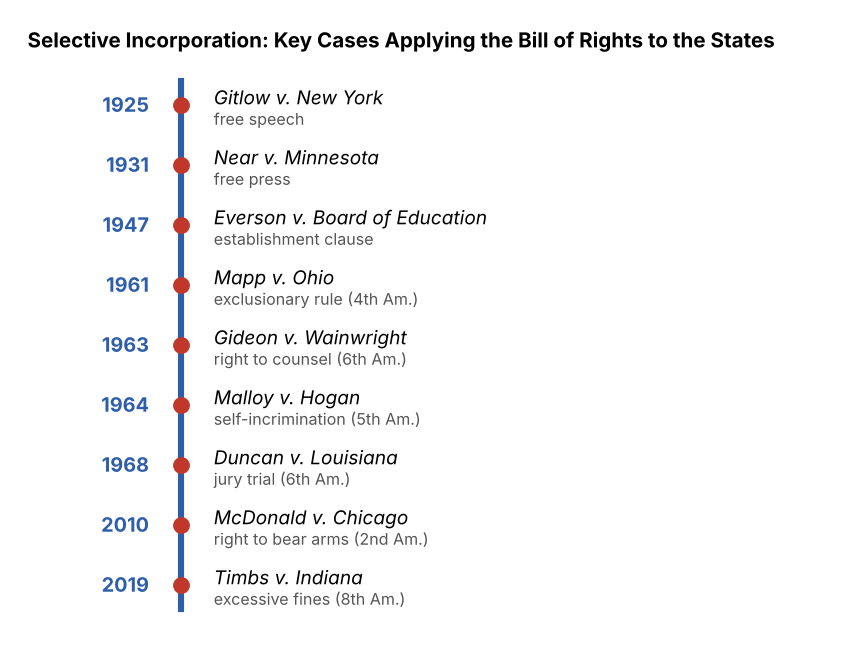
Chicago and some suburbs had handgun bans similar to D.C.’s. Otis McDonald and other residents sued, arguing that the Second Amendment, like other fundamental rights, should apply to the states through the Fourteenth Amendment. This is where selective incorporation becomes crucial. Selective incorporation is the doctrine that certain fundamental rights in the Bill of Rights are incorporated against the states through the Due Process Clause of the Fourteenth Amendment, meaning they bind state and local governments, not just the federal government.
The Supreme Court ruled 5-4 that the Second Amendment is incorporated and applies to the states. Here’s what McDonald established:
- The Second Amendment applies to states and municipalities through the Due Process Clause of the Fourteenth Amendment. This means states cannot ban handguns or deprive citizens of the core right identified in Heller.
- The same individual-right interpretation applies nationwide. State and local governments must respect the Second Amendment as understood in Heller, though they can still regulate firearms subject to constitutional limits.
- State and local handgun bans are unconstitutional under the new framework, just as D.C.’s ban was.
McDonald is the incorporation case students often confuse with other selective incorporation examples. The key distinction: Heller (2008) identified the right; McDonald (2010) made that right applicable to every state and city in America. Together, these two cases fundamentally transformed Second Amendment law.
What Regulations Remain Permissible?
Here’s where many students and the general public get confused: Heller and McDonald protect an individual right to possess firearms, but they do not strike down all gun regulations. The Supreme Court explicitly stated that its holdings were consistent with “longstanding prohibitions” and “regulations on the commercial sale of arms.”
The Court identified several categories of regulation that remain permissible:
- Longstanding prohibitions on possession by certain groups: Felons and the mentally ill may be barred from possessing firearms without violating the Second Amendment. Heller described these restrictions as “longstanding.”
- Licensing and registration: Heller did not list these among its presumptively lawful regulations and expressly declined to address D.C.’s licensing requirement, leaving the question to later cases.
- Restrictions on place and manner: The right to bear arms does not mean the right to carry firearms anywhere for any purpose. Restrictions on carrying in sensitive places (courthouses, federal buildings, schools) are likely permissible.
- Regulations on certain categories of weapons: The Court noted that “dangerous and unusual” weapons not in common use might be regulated or even banned. This language has become central to post-Heller litigation over assault weapons and high-capacity magazines.
- Commercial regulation: Heller called “laws imposing conditions and qualifications on the commercial sale of arms” presumptively lawful, though it did not specifically mention background checks.
This is the crucial point for AP exams: the Second Amendment protects an individual right, but it does not prevent all regulation. The ongoing constitutional debate is about where the line should be drawn. Questions about assault weapon bans, magazine capacity limits, universal background checks, and “red flag” laws remain contested because Heller and McDonald established the right but left the boundaries of permissible regulation unclear.
The Ongoing Constitutional Debate
Since Heller and McDonald, courts have struggled with how much regulation the Second Amendment permits. In New York State Rifle & Pistol Association v. Bruen (2022), the Supreme Court issued its first major Second Amendment decision since McDonald, recognizing a right to carry a handgun in public for self-defense and establishing a “text and historical tradition” test for evaluating gun laws (later applied in United States v. Rahimi (2024)).
Areas of continued dispute include:
- Assault weapons and magazine capacity: Can states ban semiautomatic rifles or large-capacity magazines? Lower courts have upheld such bans, but the reasoning varies. Some courts use a “historical tradition” test inspired by recent Supreme Court precedent; others use different methods.
- Background checks: Universal background checks are widely supported by the public, though Heller did not specifically address them. However, some Second Amendment advocates argue that private sales should remain unregulated.
- Red flag laws (extreme risk protection orders): These statutes allow courts to temporarily remove firearms from individuals deemed an immediate danger to themselves or others. Courts have begun evaluating whether such laws comply with the Second Amendment and due process.
- Carrying outside the home: Heller emphasized “the home” as the site of the core right, but do individuals have a Second Amendment right to carry firearms in public? The Court resolved this in NYSRPA v. Bruen (2022), holding that the Second Amendment protects an individual’s right to carry a handgun in public for self-defense.
For the AP exam, you don’t need to know the details of post-Heller litigation. However, you should understand that Heller and McDonald established that the Second Amendment protects an individual right, and that they left open questions about which regulations are constitutional. These ongoing disputes are part of normal constitutional law: establishing a right and determining its scope are separate tasks, and courts continue to work out the boundaries.
Test-Taking Strategies
Mnemonic Devices and Memory Shortcuts
Remember “HM” for Heller (Individual right) and McDonald (incorporation). Heller says individuals have the right; McDonald says that right applies to the states. A quick way to distinguish them: Heller is about what the right is, McDonald is about where it applies.
Cross-Topic Connections
The Second Amendment appears in the context of several other topics on the AP exam:
- Topic 3.1 (The Bill of Rights): The Second Amendment is the second of ten amendments in the Bill of Rights. Know that it addresses individual rights against federal power originally, but selective incorporation changed that.
- Topic 3.7 (Selective Incorporation): McDonald is a selective incorporation case. It applies a fundamental right (Second Amendment) to the states through the Fourteenth Amendment. You may see a question asking which rights are incorporated and citing McDonald as an example.
- Topic 3.3 (First Amendment: Freedom of Speech): Both the First and Second Amendments protect individual rights and both face the question of how much government can regulate them. Expect comparative questions.
Common Question Formats
Second Amendment questions typically appear in one of these ways on the AP exam:
- Multiple-choice questions asking about Heller’s holding (e.g., “In Heller, the Supreme Court held that the Second Amendment protects what?”) or about McDonald’s incorporation holding (e.g., “In McDonald v. Chicago, the Supreme Court applied the Second Amendment to state and local governments through which amendment?”).
- Questions about what regulations remain permissible after Heller (e.g., “Which of the following regulations is most consistent with the holdings in Heller and McDonald?” followed by options about background checks, licensing, bans on certain groups, etc.).
- Free-response questions asking you to explain the difference between the collective-right and individual-right interpretations and to discuss how Heller resolved that debate.
- Questions connecting the Second Amendment to other civil rights topics, such as how selective incorporation affects Second Amendment rights.
Frequent Student Mistakes
- Mistake 1: Assuming Heller eliminated all gun regulations. Students often think that because Heller protects an individual right, all gun laws are unconstitutional. The reality is the opposite. The Court explicitly said that many regulations — restrictions on felons and the mentally ill, sensitive-place laws, conditions on commercial sales, restrictions on dangerous and unusual weapons — remain permissible. On exam questions, if an answer choice says “the Second Amendment prohibits all gun regulations,” that’s wrong. The correct answer will distinguish between regulations that violate the Second Amendment (like blanket handgun bans) and those that don’t (like background checks).
- Mistake 2: Confusing Heller and McDonald. Students sometimes mix up which case did what. Heller said individuals have a right to possess firearms. McDonald said that right applies to states. If a question asks “In which case did the Supreme Court apply the Second Amendment to state and local governments?” the answer is McDonald, not Heller.
- Mistake 3: Thinking the Second Amendment right is absolute. The Court said the right is “not a right to keep and carry any weapon whatsoever in any manner whatsoever.” This phrase appears in Heller and signals that limits are permissible. If a question presents a regulation and asks whether it’s constitutional, look for whether it’s a “dangerous and unusual” weapon or falls into a historically recognized category of restriction.
Test-Day Shortcuts
- When you see “Heller”: Think “individual right in the home.” If the question is about whether the federal government or D.C. can regulate guns, Heller is your case. If it’s about the scope of the right, Heller applies.
- When you see “McDonald”: Think “incorporation” and “states.” If the question is about whether a state or city can regulate guns, McDonald is likely relevant. McDonald adds that what Heller said about the federal government now applies to every state and municipality.
- For permissible regulation questions: Use Heller’s own language: the Court listed felon and mental-illness bans, sensitive-place laws, conditions on commercial sales, and “dangerous and unusual” weapon restrictions as permissible. If the regulation fits one of these categories, it’s likely constitutional.
Time Management Tips
- If you encounter a multiple-choice question about Heller or McDonald, you can answer it quickly if you’ve memorized the core holdings: Heller = individual right; McDonald = applies to states. Don’t get bogged down in details about the specific D.C. or Chicago handgun bans unless the question specifically asks about them.
- On free-response questions, structure your answer around the two cases and the dispute they resolved (collective vs. individual right). Allocate your time by giving most of it to explaining the cases and their holdings, and less time to the ongoing regulatory debates (which are interesting but not as heavily tested).
- If a question asks you to analyze a hypothetical gun regulation, apply the Heller test: Does it ban a category of firearms commonly used for lawful self-defense (likely unconstitutional), or does it regulate possession, licensing, or restrict certain groups (likely constitutional)? This framework will help you answer most questions quickly.
Check for Understanding
Think you’ve got it? Complete the quiz below to make sure. Download your results at the end.