

Maximize your score with these resources:
- Albert.io AP® Human Geography question banks
- Free AP® Human Geography cheat sheets
- Free AP® Human Geography score calculator
Agriculture has shaped human societies for over 10,000 years. It transformed how we live, where we settle, and how we organize our societies. For AP® Human Geography, understanding agriculture means understanding one of geography’s most fundamental human activities. Topic 5.1 focuses on the basics: what agriculture is, how it started, and what types exist today. Master this foundation, and the rest of Unit 5 becomes much easier.
What Is Agriculture? Subsistence vs. Commercial
Agriculture is the deliberate cultivation of plants and animals for food, fiber, and other products. The first major distinction you need to understand is between subsistence and commercial agriculture.
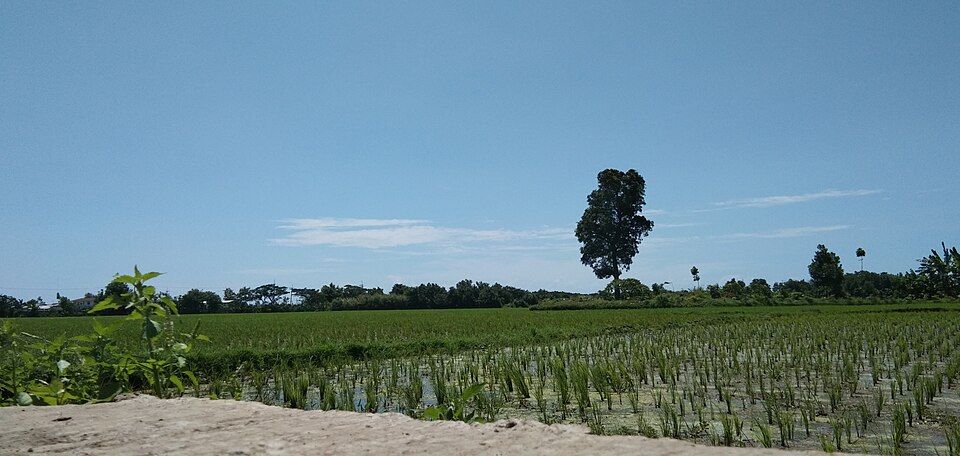
Subsistence agriculture is farming for survival. Farmers grow crops and raise animals primarily to feed themselves and their families. Any surplus is sold locally or traded. The goal is self-sufficiency, not profit. Most subsistence farmers work small plots of land using family labor. They focus on producing diverse crops suited to their local environment. These farms are common in low-income countries, particularly in Africa, South Asia, and parts of Latin America.
Commercial agriculture is farming for profit. Farmers produce crops and livestock intended primarily for sale in regional, national, or global markets. Commercial farms tend to be larger, more specialized, and more mechanized. They rely on purchased inputs like fertilizers, pesticides, and fuel. Commercial agriculture dominates in high-income countries like the United States, Canada, and Western Europe, though it’s growing rapidly in middle-income countries too.
| Feature | Subsistence Agriculture | Commercial Agriculture |
|---|---|---|
| Primary goal | Feed family; self-sufficiency | Generate profit; sell to markets |
| Typical scale | Small plots | Large farms |
| Labor source | Family labor | Hired labor or mechanization |
| Crop diversity | Diverse, locally adapted | Specialized monocultures |
| Technology level | Low-tech, traditional tools | High-tech, modern machinery |
| Where dominant | Low-income countries (Africa, South/SE Asia) | High-income countries; growing globally |
| Examples | Shifting cultivation, pastoral nomadism, intensive rice farming | Grain farming, plantation agriculture, dairy |
This distinction matters because the type of agriculture a region practices shapes land-use patterns, population density, labor systems, and economic structures.
The First Agricultural Revolution: Origins and Spread
Agriculture didn’t always exist. For most of human history, people hunted, fished, and gathered wild plants for food. The shift to farming marks one of humanity’s most significant changes. This transition is called the First Agricultural Revolution or the Neolithic Revolution, which occurred roughly between 10,000 and 5,000 BCE.
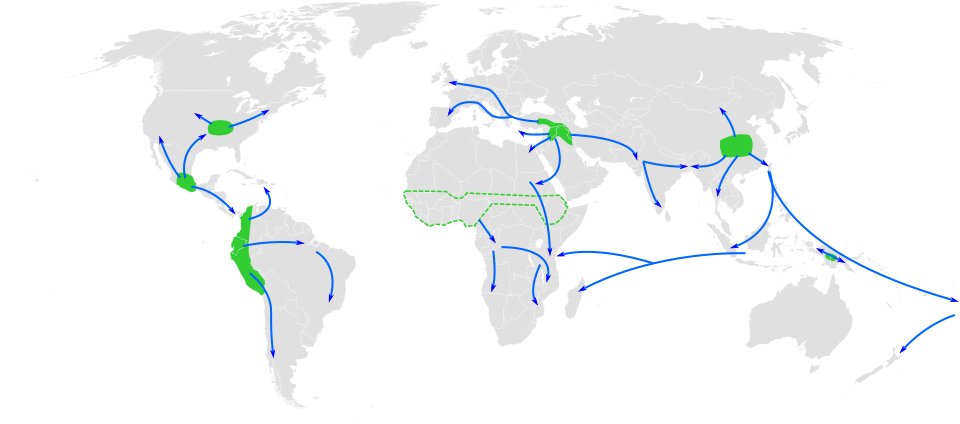
This revolution happened independently in several locations around the world:
- Fertile Crescent (modern-day Iraq, Syria, Lebanon, Israel/Palestine): Wheat and barley were domesticated around 10,000 BCE.
- China: Millet in the north and rice in the south around 9,000 BCE.
- Mesoamerica: Maize, beans, and squash around 8,000 BCE.
- Sub-Saharan Africa: Sorghum and yams around 5,000 BCE.
- Andean South America: Potatoes and llamas around 8,000 BCE.
The causes of agriculture’s origin remain debated, but scholars generally point to climate change after the last ice age, population pressure, and the availability of plants and animals suitable for domestication. Once established, agriculture spread through cultural diffusion, trade, and migration.
Why does this matter for AP® Human Geography? Because the regions where agriculture originated became centers of civilization, cultural innovation, and eventually global power. The crops domesticated in each region shaped what people could produce for millennia. These patterns still influence global agriculture today.
Types of Subsistence Agriculture
Shifting Cultivation (Slash and Burn)
In shifting cultivation, farmers clear a plot of land by cutting down vegetation and burning it. The ash adds nutrients to the soil. They farm the plot for a few years, then move to a new plot and let the original one recover (fallow). This system is sustainable if population density remains low and there’s enough land to allow recovery periods of 10-20 years. Shifting cultivation is common in tropical rainforests, particularly in sub-Saharan Africa, the Amazon, and Southeast Asia.
Pastoral Nomadism
Pastoral nomads raise livestock (cattle, sheep, goats, camels) and move seasonally to find water and pasture. This system works in arid and semi-arid regions where rainfall is too low or unpredictable for reliable crop farming. Pastoral nomadism is found in the Sahara, the Middle East, Central Asia, and the Mongolian Steppe. Modern nation-states often pressure pastoral nomads to settle, which disrupts traditional migration patterns and can harm ecosystems.
Intensive Subsistence Agriculture
Intensive subsistence agriculture relies on maximizing output from small plots of land through heavy labor investment, multiple cropping seasons, and high-yielding crops. It’s common in densely populated regions of Asia, particularly East and South Asia. Double cropping (growing two crops per year on the same land) is standard. Farmers use irrigation, terracing, and careful soil management to maintain productivity. Rice is the dominant crop in East and Southeast Asia, while South Asia grows both rice and wheat.
Types of Commercial Agriculture
Mixed Crop and Livestock Farming
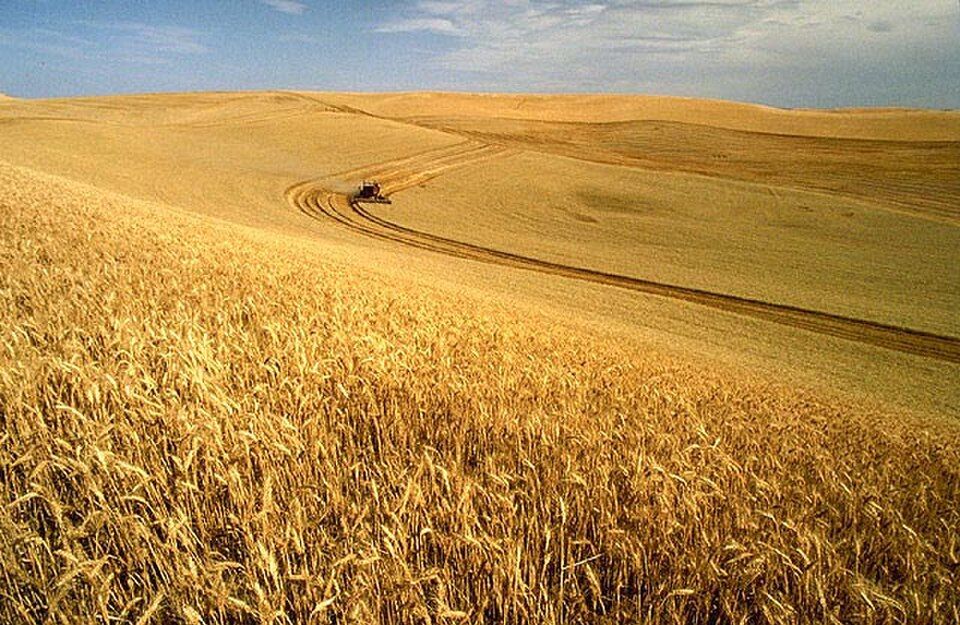
This system combines the production of crops and livestock on the same farm. Crop residues feed animals, and animal manure fertilizes crops. This integration reduces input costs and spreads risk. Mixed farming is common in North America, Europe, and parts of Australia.
Commercial Grain Farming
Large-scale cultivation of crops like wheat, corn, and soybeans, primarily for sale. Commercial grain farming dominates the Great Plains of North America, the Argentine Pampas, the Russian steppes, and the wheat belts of southeastern and southwestern Australia. Monoculture (growing a single crop across large areas) is the norm, which simplifies harvest logistics but increases pest vulnerability and requires heavy pesticide use.
Plantation Agriculture
Large farms specializing in a single cash crop like coffee, cocoa, bananas, sugar, or rubber. Plantations emerged during colonialism and remain important in tropical regions, particularly in Central America, South America, West Africa, and Southeast Asia. They generate export revenue but often concentrate wealth and depend on global commodity prices.
Mediterranean Agriculture
In regions with hot, dry summers and mild, wet winters, farmers grow specialty crops: olives, grapes, citrus fruits, and nuts. This system is found in Mediterranean Europe, parts of California, and parts of Australia. These crops are typically high-value and often sold as processed goods (wine, olive oil).
Key Agricultural Vocabulary
- Agribusiness: Large-scale, industrialized agricultural operations that integrate farming, processing, distribution, and marketing.
- Aquaculture: The cultivation of fish and other aquatic organisms. The fastest-growing source of protein globally, common in China, India, and Vietnam.
- Double cropping: Growing two crops on the same land in a single year. Common in intensive subsistence agriculture in Asia.
- Monoculture: Growing a single crop across large areas. Increases efficiency but reduces biodiversity and pest resistance.
- Polyculture: Growing multiple crops together on the same land. More labor-intensive but more resilient. Common in subsistence farming.
Environmental Factors and Agricultural Location
Where agriculture happens depends on three overlapping sets of factors: climate, soil, and topography.
Climate determines what crops can grow and how much water is available. Tropical regions support year-round growing but require careful management of pests. Temperate regions have distinct growing seasons. Arid regions cannot support crop farming without irrigation, so pastoral nomadism dominates.
Soil quality determines productivity. Volcanic soils are naturally fertile. River floodplains deposit nutrient-rich silt annually. Tropical rainforest soils are often poor in nutrients despite lush vegetation.
Topography affects mechanization, irrigation, and erosion risk. Flat terrain is ideal for large-scale commercial farming with machinery. Steep slopes require terracing or are left to pastoralism.
These factors combined explain why rice dominates in monsoon Asia (abundant water, suitable climate, dense populations on floodplains), wheat dominates in temperate mid-latitudes with moderate rainfall, and pastoral nomadism dominates in arid regions.
Global Distribution of Agricultural Types by Region
- East and Southeast Asia: Intensive subsistence agriculture (rice paddies) in lowlands; rapid shift to commercial agriculture and aquaculture.
- South Asia: Mixed intensive subsistence (wheat in the north, rice in the south) with commercial grain farming expanding in northwestern areas.
- Sub-Saharan Africa: Predominantly subsistence farming with growing commercial plantation agriculture (cocoa, coffee, cotton, sugar).
- Latin America: Diverse range from subsistence farming in Andean highlands to large-scale plantation agriculture and commercial grain farming in Argentina and Brazil.
- North America: Dominated by commercial grain farming in the Great Plains and Midwest, Mediterranean agriculture in California, dairy and specialty crops in the Northeast.
- Europe: Mixed crop and livestock farming in Western Europe, Mediterranean agriculture in the south, commercial grain farming in Eastern Europe and Russia.
Test-Taking Strategies
Mnemonic: SCPM Remember the major agricultural types: Subsistence (Shifting, Pastoral), Commercial (Plantation, grain, Mixed). This helps you quickly categorize any agricultural practice you encounter.
Cross-Topic Connections: Topic 5.1 connects directly to agricultural origins and diffusions (Topic 5.3), which explains why crops are grown where they are today. The Von Thunen Model (Topic 5.8) explains land-use patterns around cities based on transport costs – a concept built on understanding basic agricultural types. Maps and spatial data (Unit 1) are crucial for understanding global agricultural distribution patterns shown on exam questions.
Common Question Formats: Expect three main types of questions: identifying and defining agricultural types (“Which of the following best describes shifting cultivation?”), matching regions to agricultural types (“Which agricultural system is most common in Southeast Asia?”), and analyzing causes of agricultural location (“Which environmental factor most directly explains why rice farming dominates in monsoon Asia?”).
Frequent Student Mistakes: First, confusing intensity with type. Intensive subsistence farming is still subsistence (for local consumption). Commercial farms can be extensive (large-scale grain monocultures). Don’t mix up scale dimension (intensive vs. extensive) with purpose dimension (subsistence vs. commercial). Second, labeling any large monoculture farm a plantation – commercial-scale monoculture farming exists in wealthy countries too (California wine, Iowa corn), but those farms are not plantations. Third, treating pastoralism as primitive or outdated. It’s a rational adaptation to arid environments where crop farming isn’t feasible.
Test-Day Shortcuts: When you see a map or photo showing agricultural patterns, ask yourself: “Is this subsistence or commercial?” This single question often narrows answer choices. Then ask: “What environmental conditions support this?” This two-step mental check works for about 70% of Topic 5.1 questions.
Time Management Tips: Topic 5.1 questions are usually straightforward if you’ve memorized the basic definitions and regional patterns. Create flashcards for each agricultural type with a definition, example crops/animals, typical regions, and one key characteristic. Most 5.1 questions can be answered in 60-90 seconds, leaving time for trickier topics later in Unit 5.
Check for Understanding
Think you’ve got it? Complete the quiz below to make sure. Download your results at the end.