
Maximize your score with these resources:
- Albert.io AP® Microeconomics question banks
- Free AP® Microeconomics cheat sheets
- Free AP® Microeconomics score calculator
Introduction
Profit is not a single concept. Accountants, economists, and business managers define it differently, and AP® Microeconomics tests all three definitions. The distinction between accounting profit and economic profit determines whether a business is truly worth running. Opportunity cost is the key: it separates profitable-looking businesses from actually viable ones.
Accounting Profit Versus Economic Profit
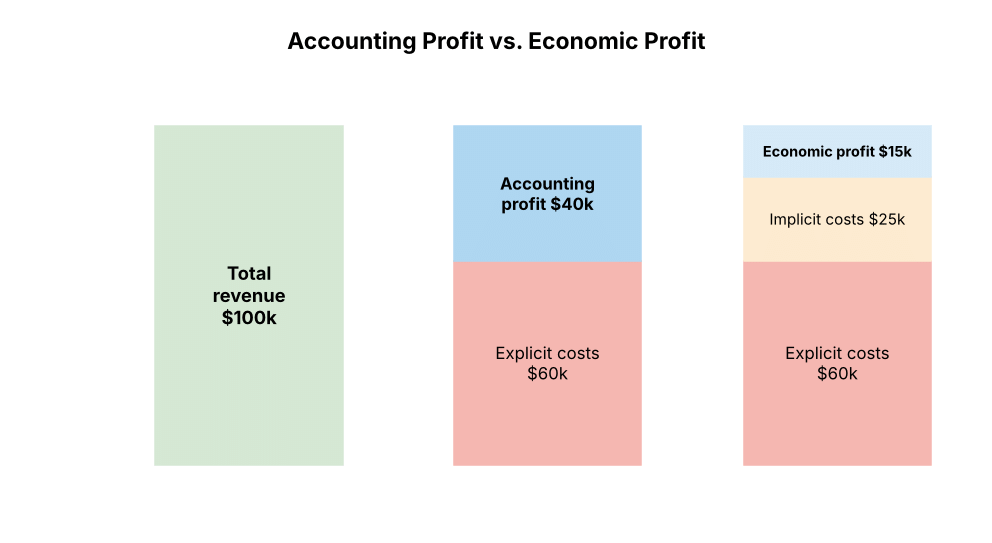
Accounting profit = Total Revenue minus Explicit Costs
Explicit costs are out-of-pocket cash payments: employee wages, rent, materials, utilities, equipment purchases. Accountants tally these directly observable expenses and subtract from revenue.
Economic profit = Total Revenue minus Explicit Costs minus Implicit Costs
Implicit costs are opportunity costs: the value of the next-best alternative use of your time and resources. This is where the two concepts diverge radically.
Example: Sarah’s bakery generated $200,000 in revenue. Explicit costs (payroll, ingredients, rent, utilities) were $165,000. Accounting profit: $35,000.
But Sarah could have earned $60,000/year as a corporate chef. She could have invested her $100,000 life savings in bonds at 5% annually ($5,000/year). Implicit costs: $65,000. Economic profit: $200,000 − $165,000 − $65,000 = −$30,000. Sarah is actually losing money in economic terms. She should take the chef job and invest her savings.
This is the core insight: Firms earning positive accounting profit may incur losses in economic terms if they overlook opportunity costs. AP exams test this constantly.
Explicit Costs and Implicit Costs
Explicit costs appear on invoices and bank statements. They are straightforward to identify and measure.
Implicit costs require economic thinking. Ask: “What am I giving up by choosing this action?”
- Work in your own business instead of taking a $50,000 job? The $50,000 salary is an implicit cost.
- Use your own land instead of renting it out? The foregone rental income is an implicit cost.
- Use capital for this business instead of investing it elsewhere? The foregone investment return is an implicit cost.
Implicit costs are real economic sacrifices. Money does not change hands, so they do not appear in financial statements, but they are just as real as explicit costs. Business owners who ignore them systematically overestimate their profitability.
Normal Profit (Zero Economic Profit)
Normal profit occurs when economic profit = zero. Total revenue exactly equals explicit costs plus implicit costs.
Normal profit is the break-even point in economic terms. The firm earns just enough to cover all opportunity costs. The business is worth running (you are not better off doing something else), but it generates no surplus above that.
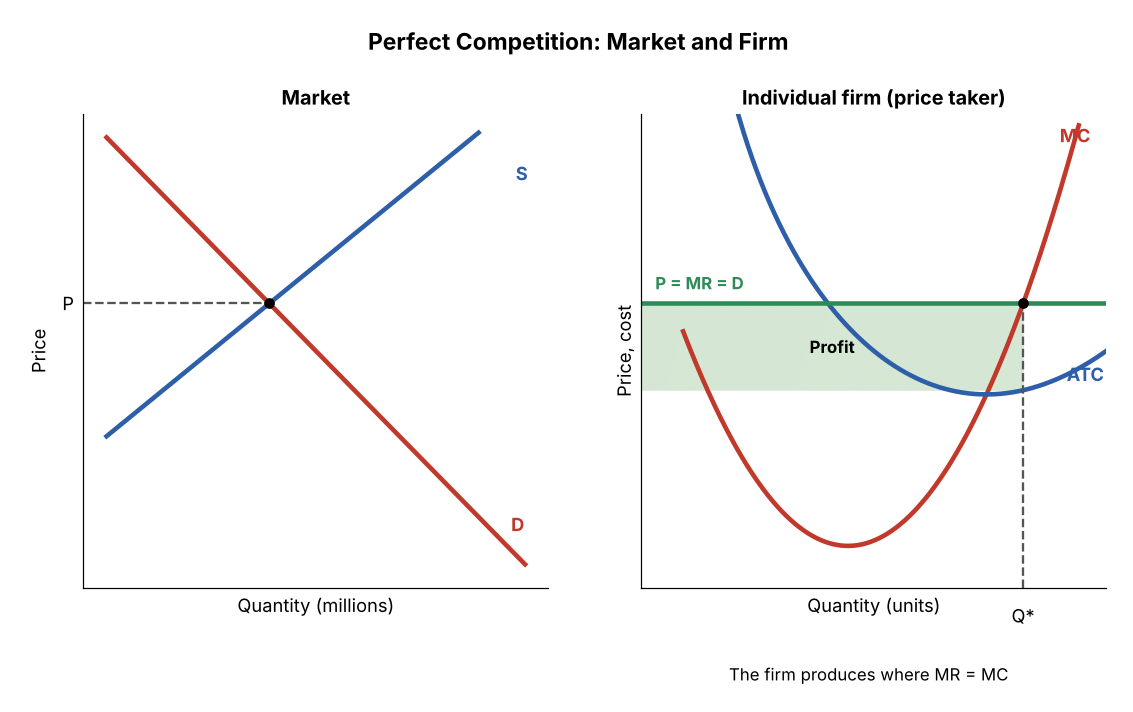
Why it matters: In long-run competitive equilibrium, firms earn normal profit. If a firm earns positive economic profit, competitors enter, increasing supply and driving prices down until profit falls to zero. If a firm incurs losses, it exits, supply contracts, and prices rise until remaining firms break even. Competition erodes all above-normal returns.
Example: A barber shop generates $60,000 revenue. Explicit costs: $30,000. Best alternative job: $25,000/year. Economic profit = $60,000 − $30,000 − $25,000 = $5,000 (positive, worth staying). If a competitor opens next door and reduces the barber’s revenue to $55,000, economic profit becomes $55,000 − $30,000 − $25,000 = $0 (normal profit, equilibrium reached).
Entry and Exit Signals: The Role of Economic Profit
Long-Run Decisions: Firms use economic profit to decide whether to enter or exit an industry.
- Positive economic profit → Enter. The industry offers better returns than alternative uses of capital and entrepreneurship.
- Negative economic profit → Exit. Resources are better deployed elsewhere.
- Zero economic profit → Stay (or remain indifferent). Long-run equilibrium reached.
In long-run competitive equilibrium, all firms earn zero economic profit (normal profit). This is not failure; it is the natural outcome of competition. Successful industries attract entry until competitive pressure eliminates above-normal returns.
Short-Run Shutdown Decision (The P > AVC Test): In the short run, some costs are fixed (e.g., rent on a lease you cannot break). The firm must decide: operate or shut down temporarily?
The rule: If price exceeds average variable cost (P > AVC), operate. Revenue covers variable costs and contributes to fixed costs, minimizing losses. If price falls below average variable cost (P < AVC), shut down. Continuing to operate only increases losses by incurring avoidable variable costs.
Example: A ski resort has fixed costs (lodge, equipment). In winter (high season), revenue easily covers variable costs (staff, utilities). P > AVC; operate. In summer (low season), few visitors; revenue does not cover variable costs. P < AVC; shut down operations. The lodge still has fixed costs (building stands idle) but avoids variable costs of operation.
Long-Run Exit Decision (The P > ATC Test): In the long run, all costs are avoidable. The firm must cover explicit and implicit costs entirely. If P < ATC (economic losses), exit the industry permanently. If P ≥ ATC, stay.
Producer Surplus Versus Economic Profit
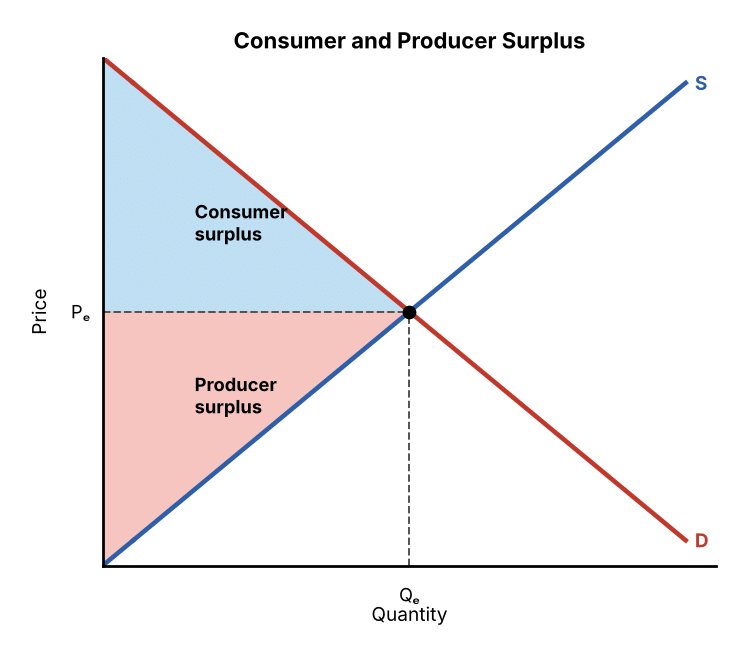
These are related but distinct. Producer surplus = Market price minus the minimum price at which the firm is willing to supply. On a graph, it is the area above the supply curve and below the price line.
Profit = Total revenue minus all costs (explicit + implicit). It captures the overall financial return.
For a firm, producer surplus equals total revenue minus total variable cost, which is economic profit plus fixed cost, so the two are equal only when fixed cost is zero (as in the long run, when all costs are variable). A firm with high fixed costs can earn large producer surplus but little or negative economic profit, and a competitive firm earning zero economic profit in the short run still has positive producer surplus equal to its fixed cost.
Key distinction: Producer surplus tells you about the benefit of selling at this price. Profit tells you about overall business viability. For entry/exit decisions, economic profit matters more.
Relationship Between Market Structure and Profit
Perfect Competition (Long Run): Zero economic profit. Easy entry erodes above-normal returns.
Monopolistic Competition (Long Run): Zero economic profit. Many firms and easy entry erase any short-run advantage.
Oligopoly and Monopoly (Long Run): Positive economic profit is possible. Barriers to entry prevent erosion of returns, so firms can sustain above-normal profit in the long run, though it is not guaranteed (it depends on demand and costs).
This connection between market structure and long-run profit is a major exam theme. Barriers to entry determine everything: they allow monopolies and oligopolies to maintain positive profit while competitive firms cannot.
Test-Taking Strategies
Mnemonic: “Accounts Equal Economic + Effort”: Remember that Economic profit accounts for effort (implicit costs) that Accounting profit misses. This reinforces the difference.
Cross-Topic Connections (Exam Favorites): (1) Market structure determines long-run profit: perfect competition and monopolistic competition → zero economic profit; monopoly and oligopoly → positive economic profit. (2) Entry/exit behavior depends on the sign of economic profit: positive drives entry, negative drives exit, zero = equilibrium. (3) Shutdown decisions use P vs. AVC (short run) and P vs. ATC (long run). These are tested constantly together.
Common Question Formats: “Calculate economic profit from a revenue and cost scenario.” “If firms in an industry earn positive economic profit, what happens in the long run?” (Answer: Entry. New firms compete, prices fall, profit erodes to zero.) “Should this firm shut down in the short run?” (Check P vs. AVC.) “What will happen to the industry in the long run?” (Check initial profit, infer entry/exit, conclude zero profit for all at equilibrium.)
Setup Template for Calculation Questions:
- Total Revenue = Price × Quantity
- Explicit Costs = Sum of all out-of-pocket payments (usually given)
- Implicit Costs = Opportunity costs (salary given up, interest not earned, etc.)
- Economic Profit = Total Revenue − Explicit Costs − Implicit Costs
Always show this formula and fill in each component. Partial credit rewards clear setup even if you make an arithmetic error.
Frequent Student Mistakes and How to Avoid Them: (1) Forgetting implicit costs entirely: If a scenario mentions foregone salary or alternative investment returns, include them. Reread problems for hidden opportunity costs. (2) Confusing normal profit with failure or zero value: Normal profit (zero economic profit) is healthy equilibrium. It means the firm is covering all costs and earning its opportunity cost. The business is worth running. (3) Mixing up shutdown triggers: P < AVC → shut down in short run (minimize losses by avoiding variable costs). P < ATC → exit in long run (cannot cover all costs). AVC is for short-run decisions; ATC is for long-run decisions. (4) Forgetting that entry erodes profit: When a question says “firms are earning positive economic profit,” immediately ask: “In the long run, what happens?” Answer: Entry. Profit falls toward zero. This is the automatic response.
Test-Day Process of Elimination: When a question asks about long-run equilibrium in competitive markets, the answer involves zero economic profit. When it asks if a firm should shut down, check the price-to-cost relationship. When it asks what happens next, check the current profit level. Positive profit → entry next. Negative profit → exit next.
Time Management Tip: Profit calculation problems are high-yield and appear on nearly every practice exam and released test. Master the formula template in 5 minutes now, then practice it on 3-4 problems. Once you internalize the structure (Revenue, Explicit, Implicit, Calculate), you can solve these under 90 seconds and get full credit. This skill unlocks 10-15% of the AP exam points.
Check for Understanding
Think you’ve got it? Complete the quiz below to make sure. Download your results at the end.