

Maximize your score with these resources:
- Albert.io AP® US Government question banks
- Free AP® US Government cheat sheets
- Free AP® US Government score calculator
Introduction
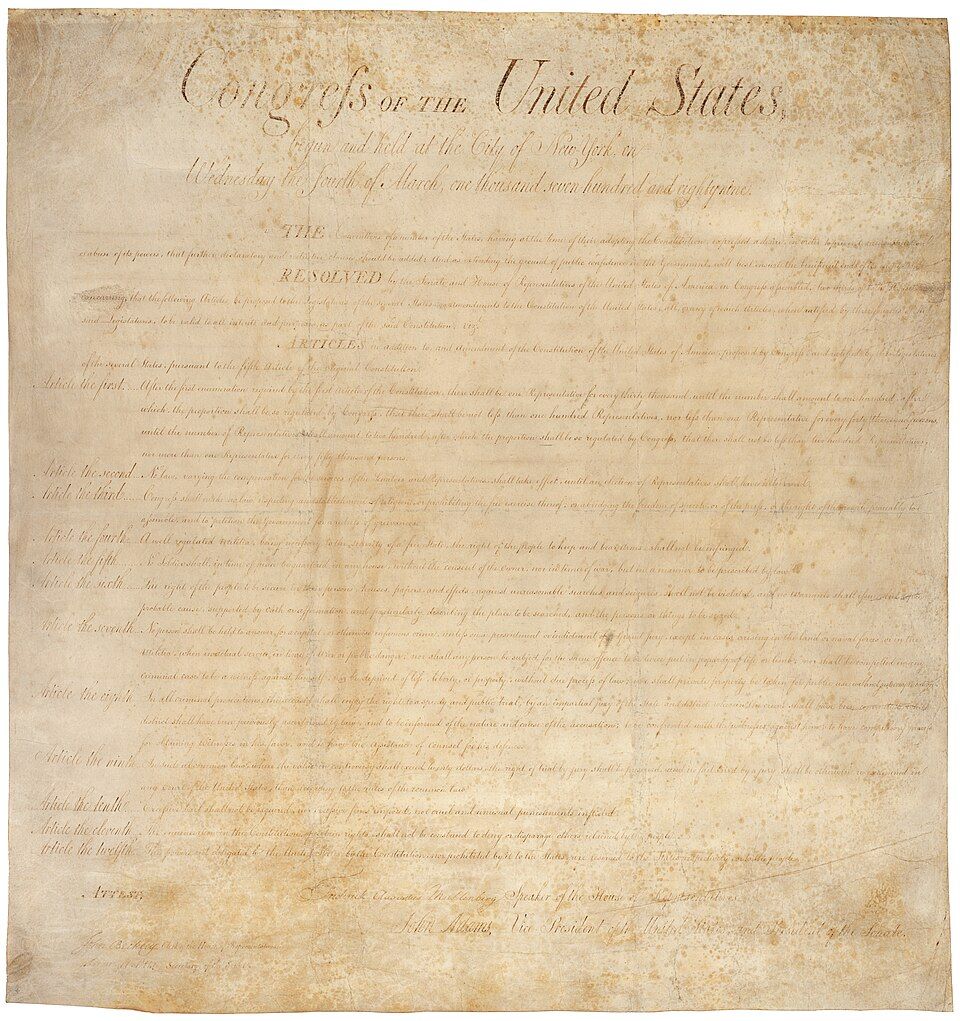
Four amendments protect people accused of crimes: the Fourth (unreasonable search), Fifth (self-incrimination), Sixth (right to counsel), and Eighth (cruel punishment). The 14th Amendment’s Due Process Clause extends these to the states through incorporation. You need to know the major Supreme Court cases that interpret these rights, understand how courts balance public safety against liberty, and recognize that these protections apply everywhere in America.
Fourth Amendment: Protection Against Unreasonable Search and Seizure
The Fourth Amendment protects you from unreasonable searches and seizures. Police generally need a warrant based on probable cause to search your person or home; a vehicle can usually be searched with probable cause alone. The exclusionary rule enforces this by preventing illegally obtained evidence from being used in court.
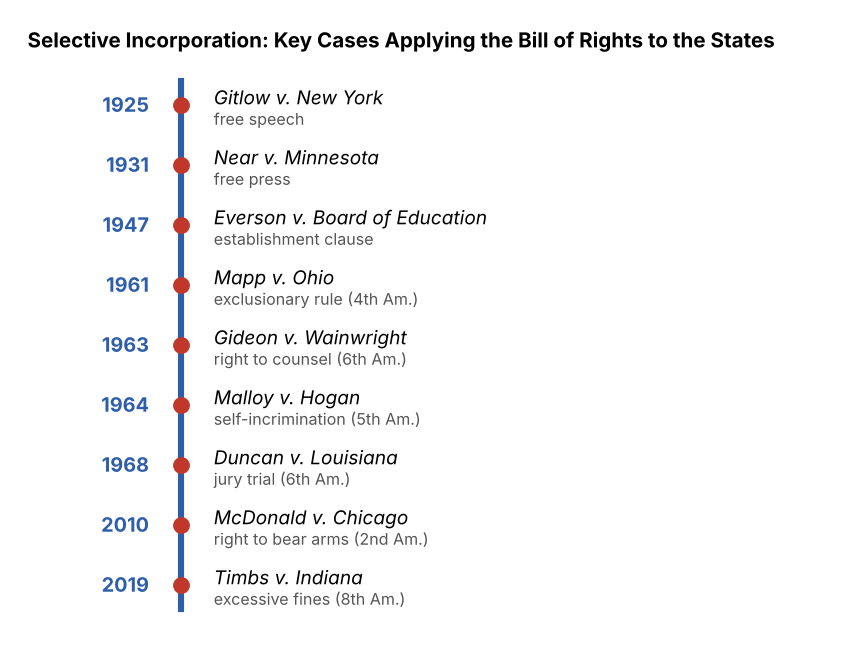
Mapp v. Ohio (1961) incorporated the exclusionary rule to the states. Police searched Mapp’s home without a warrant. She challenged the search, and the Supreme Court held that the 14th Amendment requires every state to exclude illegally obtained evidence. Guilty defendants sometimes go free because of the exclusionary rule, but the Court reasoned that without it, police would have no incentive to respect the Fourth Amendment.
Warrantless searches are presumed unreasonable unless they fit an exception:
- Searches incident to a lawful arrest (limited scope)
- Consent (must be voluntary)
- Plain view (obvious contraband in plain sight)
- Automobile searches (cars get less protection than homes)
- Exigent circumstances (emergency where waiting for a warrant risks harm)
Modern courts require a warrant to search phones or computers incident to arrest, recognizing that digital devices contain vastly more personal information than traditional searches reveal.
Fifth Amendment: Self-Incrimination, Double Jeopardy, and Due Process
The Fifth Amendment protects you in three ways: you cannot be forced to testify against yourself, you cannot be tried twice for the same crime, and the government cannot take your life, liberty, or property without due process.
Miranda v. Arizona (1966) is the most famous case. Police arrested Miranda, interrogated him without warning him of his rights, and extracted a confession. The Supreme Court held that the Fifth Amendment requires police to inform suspects of their rights before custodial interrogation:
- You have the right to remain silent
- Anything you say can and will be used against you in a court of law
- You have the right to an attorney
- If you cannot afford an attorney, one will be provided for you
If police fail to give Miranda warnings, the confession is inadmissible, even if it’s true. A later confession given after proper warnings is generally admissible (Oregon v. Elstad, 1985), unless police deliberately used a “question first, warn later” tactic (Missouri v. Seibert, 2004).
Double jeopardy protects the finality of acquittals. If a jury acquits you, the government cannot appeal and retry you. This prevents the government from using unlimited resources to harass defendants until it wins.
The Takings Clause in the Fifth Amendment requires the government to pay you fair market value if it takes your private property for public use (a highway, park, or airport).
Sixth Amendment: Right to Counsel, Speedy Trial, Jury Trial, and Confrontation
The Sixth Amendment guarantees you the right to a lawyer, a speedy trial, a jury trial, and the right to confront witnesses against you.
Gideon v. Wainwright (1963) held that if you cannot afford a lawyer, the state must provide one. Gideon was accused of burglary, could not afford counsel, and asked for one. The court refused. Gideon defended himself, was convicted, and appealed. The Supreme Court held that due process requires effective assistance of counsel. Today, a defendant who cannot afford a lawyer has the right to a state-provided one in felony cases and in any case that results in jail time.
A speedy trial protects you from spending years in jail waiting for trial. Courts must move cases forward within reasonable time, though what counts as speedy depends on the facts.
A jury trial provides a check on government power. The jury represents the community’s conscience and can refuse to convict even if guilt is proven beyond doubt.
The right to confront witnesses means the government cannot convict you based on evidence you cannot test. Witnesses must testify in person, and your lawyer can cross-examine them. This is fundamental to a fair trial.
Eighth Amendment: Protection Against Cruel and Unusual Punishment
The Eighth Amendment forbids cruel and unusual punishment. Torture is prohibited. Punishments must be proportional to the crime.
Furman v. Georgia (1972) held that capital punishment as then administered was cruel and unusual. States gave juries unlimited discretion in deciding whether to impose death, which led to arbitrary and discriminatory application. Race and geography affected who received death sentences. Furman effectively abolished the death penalty for a few years.
States responded with new statutes providing clearer standards. Gregg v. Georgia (1976) held that capital punishment was constitutional if states provided meaningful standards and appellate review. Today, 27 states allow capital punishment; many have abolished it.
Due Process: Procedural vs. Substantive
Due process has two components. Procedural due process requires fair procedures when the government takes life, liberty, or property: you get notice, a hearing, and a chance to appeal. Substantive due process asks whether the government has a legitimate reason to restrict liberty at all. A law can follow fair procedures but violate substantive due process if it serves no legitimate purpose or the means are not reasonably related to the goal. Both must be satisfied for government action to be constitutional.
The incorporation doctrine, based on the 14th Amendment, applies most of the Bill of Rights to the states. These Fourth, Fifth, Sixth, and Eighth Amendment protections all apply to every state, meaning every state must respect criminal suspects’ rights.
Key Supreme Court Cases at a Glance
| Case | Year | Amendment | Holding |
|---|---|---|---|
| Mapp v. Ohio | 1961 | Fourth | Exclusionary rule applies to states; illegally obtained evidence inadmissible |
| Miranda v. Arizona | 1966 | Fifth | Police must warn suspects of rights before custodial interrogation |
| Gideon v. Wainwright | 1963 | Sixth | Right to state-appointed counsel for those who cannot afford a lawyer |
| Furman v. Georgia | 1972 | Eighth | Death penalty as administered was cruel and unusual; requires standards |
| Gregg v. Georgia | 1976 | Eighth | Death penalty permissible with meaningful standards and appellate review |
Test-Taking Strategies
Mnemonic: “45678” — remember Fourth, Fifth, Sixth, and Eighth Amendments, in order, each protecting criminal suspects. Or “FSMG” — Fourth (searches), Fifth (silence), Sixth (lawyers), Eighth (punishment).
Cross-Topic Connections: Criminal procedure questions connect to federalism (does this protection apply to states?), separation of powers (role of courts in reviewing government action), and individual rights. When you see a question about state criminal law, always ask: “Is this right incorporated to the states?” If yes, every state must respect it. Questions balancing public safety with individual rights require applying these amendments.
Common Question Formats: Police conduct a search, interrogate a suspect, or arrest someone. You apply the relevant amendment to determine if rights were violated. You identify whether a right is incorporated to the states. You match cases to their holdings. You explain why the exclusionary rule or Miranda rule exists. You compare catching criminals with protecting rights.
Frequent Student Mistakes:
- Forgetting that the 14th Amendment incorporates most Bill of Rights protections to the states. Many students think these protections only apply to federal action.
- Confusing Miranda rights with the Fifth Amendment right against self-incrimination. The right against self-incrimination is fundamental; Miranda is the rule police must follow to enforce that right.
- Thinking the exclusionary rule applies everywhere. It does not apply in grand jury proceedings, some civil contexts, or immigration proceedings. Know the general rule and the major exceptions.
- Overstating what Gideon requires. Gideon guarantees counsel, not perfect counsel. Defendants have a right to effective assistance, a lower standard.
Test-Day Shortcut: Criminal procedure questions hinge on which amendment applies and what that amendment requires. After you identify the amendment, ask: Has the government followed the rule? Miranda warnings given? Search with a warrant or exception? Lawyer provided? If government followed the rule, rights are protected. If government violated the rule, evidence is excluded or conviction is overturned. This systematic approach works for almost all criminal procedure questions.
Time Management Tip: Criminal procedure questions are fast points once you memorize the major cases and their holdings. Memorize which amendments apply to states. Know Miranda rights by heart. If you do this, you can answer quickly and move to harder questions.
Check for Understanding
Think you’ve got it? Complete the quiz below to make sure. Download your results at the end.