

Maximize your score with these resources:
- Albert.io AP® US Government question banks
- Free AP® US Government cheat sheets
- Free AP® US Government score calculator
This article covers Topic 2.3: Congressional Behavior (Learning Objective CON-3.C) from Unit 2: Interactions Among Branches of Government. You’ll learn the three models of representation, the competing pressures that shape voting decisions, and the structural incentives behind incumbent advantage, gerrymandering, logrolling, pork barrel spending, and partisan polarization.
The Three Models of Congressional Representation
Members of Congress face a fundamental tension: they represent their constituents, but they also hold personal values, owe loyalty to their political party, and respond to interest groups that fund their campaigns. How they balance these competing pressures defines their representation style. The AP exam tests three models of representation, and you need to recognize each one and predict how it shapes voting behavior.
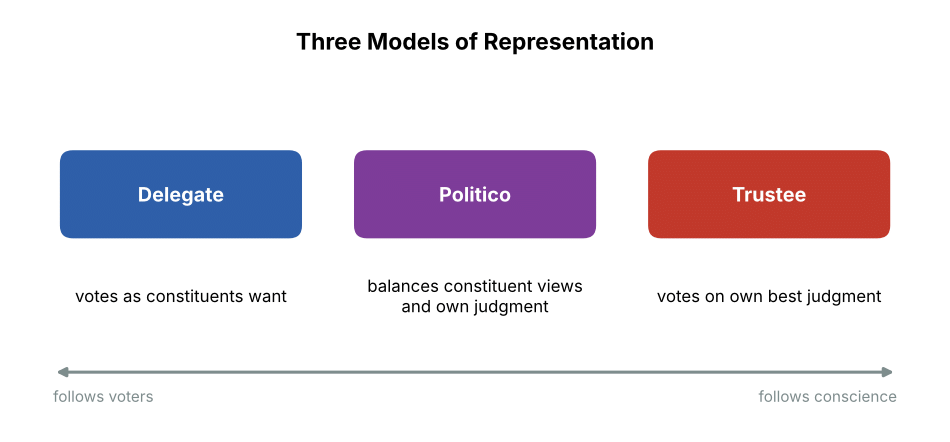
| Model | How It Works | Voting Behavior | When It Appears on the Exam |
|---|---|---|---|
| Trustee Model | The representative uses personal judgment and expertise to vote in the best interest of the nation or district, even if constituents disagree. The rep votes their conscience, not a poll. | Votes based on own political ideology, expert advice, and moral conviction. May defy constituent opinion on controversial issues. | Questions about how reps balance personal values against constituent demands. Example: a senator voting for an unpopular military intervention because they believe it’s necessary. |
| Delegate Model | The representative acts as a direct agent of constituent wishes, voting the way their district or state wants them to vote. The rep functions as a conduit, not a decision-maker. | Votes based on polling, constituent surveys, town halls, and direct feedback. Closely tracks district opinion on major votes. | Questions about representatives responding to constituent pressure or district demographics. Example: a rep voting for a popular local infrastructure bill because their district strongly supports it. |
| Politico Model | The representative switches between trustee and delegate modes depending on the issue. On high-salience, constituency-focused issues (local jobs, education), they act as delegates. On obscure, technical, or national issues, they act as trustees. | Votes vary by issue. Follows the delegate model on issues where constituents have strong opinions; follows the trustee model on issues where constituents are disengaged or lack consensus. | The most realistic and most frequently tested model. Questions ask you to predict behavior across different types of issues or explain why a rep voted one way on one issue but differently on another. |
The politico model is the one you’ll see most often on the AP exam because it reflects reality. Members of Congress can’t ignore their constituents entirely (they need votes to be reelected), but they also can’t poll their district on every single procedural vote. Smart representatives use the politico model: they act as delegates on issues that dominate local news and town hall meetings, but as trustees on technical votes where most constituents aren’t paying attention.
Factors That Influence Congressional Voting Decisions
Beyond the representation model, individual legislators face multiple competing pressures that shape their votes. Understanding these factors lets you predict congressional behavior and recognize why gridlock happens.
- Party pressure. Members of Congress care deeply about their party’s success. Party leaders use committee assignments, campaign funding, and public endorsements to reward loyalty and punish defection. The cost of voting against your party is high: you lose committee influence, your party might fund a primary challenger, and you face public embarrassment. This is why roll call votes in Congress increasingly fall along strict party lines.
- Constituency preferences. Representatives must balance party loyalty with district opinion. If their district is heavily Democratic but the member is Republican (or vice versa), they face constant pressure to moderate. Safe seats (gerrymandered districts that strongly favor one party) actually increase polarization because members can afford to vote their true ideology without electoral fear.
- Interest groups and campaign donors. Members of Congress need campaign money to win reelection. Donors expect votes in return. Agricultural representatives vote for farm subsidies. Tech representatives oppose regulation. Banking committee members receive millions from financial institutions. This isn’t always corruption — it’s a rational response to the incentive structure. Interest groups don’t necessarily “own” members, but they have access and influence that ordinary constituents lack.
- Personal ideology and values. Some members vote their conscience on issues they care deeply about, even at electoral cost. Civil rights, national defense, and abortion often trigger trustee-model voting. But pure ideology without electoral or party calculation is rare.
- Presidential pressure. When a president from your party asks for your vote on a major legislative priority, saying no is costly. You lose presidential support for district projects, campaign appearances in your district, and future influence. This is especially true for party leaders and members from marginal districts. Conversely, members can gain political capital by voting with the opposition on lower-stakes issues.
The interplay of these factors explains a lot of confusing congressional behavior. A member might vote for a bill they personally oppose because their district wants it, or against a bill their party supports because their district is swing territory. Knowing which factor dominates in a given scenario is key to predicting voting behavior.
Incumbent Advantage and Reelection Incentives
Members of Congress vote with reelection constantly in mind, and this shapes behavior in ways that puzzle casual observers. The structural advantages of incumbency are enormous, and they warp legislative incentives.
Incumbent advantages include:
- Name recognition and visibility. Incumbents have been in the news for years. They’re household names. Challengers have to spend millions just to become known.
- Franking privilege. Members of Congress can mail newsletters and other official (non-campaign) mail to constituents for free using their official letterhead. This is a massive free advertising advantage. Imagine your opponent being able to mail full-color newsletters to half a million homes for zero cost.
- Casework and constituent services. Members employ staff specifically to help constituents navigate the federal bureaucracy. A constituent’s Social Security check gets stuck? The congressional office fixes it. In return, they earn goodwill and repeat voters. Casework creates a personal relationship between the member and the constituent that transcends ideology.
- Gerrymandering. In many states, the party in power redraws district lines to pack opposition voters into a few districts and spread their own voters across many safe seats. This means most representatives face no real general election threat. In the 2012 House election, Democratic candidates won the national popular vote, yet Republicans kept the House majority because of districting and geographic advantage. Safe seats create a different incentive: members fear primary challenges from ideological purity, not general election losses. This increases partisan polarization.
Why does this matter? Because reelection incentives push members toward short-term thinking. A representative who supports a popular but fiscally unsustainable farm subsidy is making a rational reelection calculation: the subsidy is visible and benefits a clear constituency, while the fiscal cost is diffuse and delayed. Members vote for pork barrel spending that benefits their district even when the overall spending package is wasteful. They vote against taxes even when the nation needs revenue. They cast symbolic votes on divisive issues that generate headlines and energize base voters, but don’t advance legislation.
Partisan Polarization and Legislative Gridlock
Congressional behavior has become increasingly partisan over the past two decades, and this polarization creates gridlock. Understanding the causes and effects is crucial for the AP exam.
Causes of partisan polarization:
- Geographic sorting. Americans increasingly live in politically homogeneous areas. Liberals cluster in cities; conservatives in rural regions. This makes most districts safely Republican or Democratic, which increases primary pressure for ideological purity over general election moderation.
- Media fragmentation. Cable news and social media create partisan echo chambers. Members and voters consume only news that confirms their existing worldview. Compromise looks like betrayal when your information diet tells you the other side is ideologically dangerous.
- Campaign finance and donor bases. Conservative donors demand votes against social programs; liberal donors demand votes against business-friendly legislation. Members feel pressure to vote their donor base, not the median constituent.
- Party leadership and messaging discipline. Modern party leaders use whip systems and public messaging campaigns to enforce party loyalty. Voting with the opposition is now publicly shamed in ways it wasn’t decades ago.
Effects of polarization on congressional behavior:
- Gridlock and legislative failure. Polarization makes compromise harder. Bills that would pass with 60% support face 100% opposition because they come from the other party. Even uncontroversial bills get tied up in partisan disputes. The result is less legislation passed, more reliance on executive action and court decisions, and frustration with Congress.
- Voting strictly along party lines. Roll call votes in Congress increasingly split cleanly along party lines, with nearly every member of each party voting together, rather than drawing support from both parties. Members have less freedom to vote their district or their conscience.
- Increased use of procedural obstruction. The Senate filibuster allows a minority of senators to block bills through delay. Members use these tactics constantly, turning legislative chambers into battlegrounds rather than negotiating bodies.
Logrolling, Pork Barrel Spending, and Earmarks
Some of the most transactional voting in Congress happens through logrolling and pork barrel spending. These behaviors look wasteful from a national perspective, but they’re rational from individual members’ perspectives.
Logrolling (also called vote trading) is when members vote for each other’s bills even when they wouldn’t independently support them. “I’ll vote for your farm subsidy if you vote for my highway project.” Each member gets something their district wants; the overall bill is bloated with special favors. Logrolling enables both members to claim credit for securing federal funding, which helps with reelection. The cost — inefficiency and waste — is diffuse and invisible to most voters.
Pork barrel spending refers to federal spending directed toward specific districts, often with limited national benefit. A dam nobody needs, a military base in a safe district, a research grant to a university in a swing state. Members vote for these projects because they bring jobs and visible economic activity to their district. The national debate becomes not “should we build a dam?” but “who gets the dam?” Pork becomes currency for legislative deals.
Earmarks are specific provisions in larger bills that direct spending to a particular project or organization. For decades, members used earmarks freely. A defense bill would have 50 earmarks directing contracts to companies in members’ districts. In 2011, Republicans and Democrats agreed to a voluntary ban on congressional earmarks, largely due to Tea Party pressure and public anger at “wasteful spending.” The ban lasted until 2021, when it was lifted. Why the reversal? Because logrolling is easier with earmarks. Without the ability to direct specific dollars to district projects, members have less incentive to compromise and cooperate.
From the AP exam perspective, you need to understand that pork barrel spending and logrolling aren’t aberrations — they’re features of the reelection incentive system. Members vote for them because it’s rational.
Congressional Oversight as a Behavioral Pattern
Oversight — the power of Congress to investigate and challenge executive branch actions — is a key congressional behavior pattern that varies dramatically depending on partisan alignment.
When the president is from the opposing party, Congress conducts vigorous oversight. Committees hold hearings, issue subpoenas, investigate alleged misconduct. When the president is from the same party, oversight is lighter. This isn’t necessarily corruption; it reflects partisan incentives. Members know their party’s base will punish them for undermining their party’s president, but reward them for attacking the opposition president. Major oversight investigations (Iran-Contra, Watergate, Benghazi hearings) happen when one party controls Congress and opposes the White House.
The AP exam tests your ability to recognize how oversight behavior changes with partisan composition and to explain it using congressional incentive structures.
Test-Taking Strategies
Mnemonic Devices and Memory Shortcuts
“TDP” for the three representation models: Trustee, Delegate, Politico. Remember: Politico is the realistic one because it’s context-dependent — members switch based on issue salience.
“PPIDD” for factors influencing voting: Party, President, Interest groups, District (constituency), Donors (campaign finance). Each factor pulls in a different direction, and the member’s vote depends on which pressure dominates.
“FCGN” for incumbent advantages: Franking privilege, Casework, Gerrymandering, Name recognition. These four explain why incumbents rarely lose.
Cross-Topic Connections
Congressional behavior connects directly to three other areas of the course:
- Unit 5: Elections and representation — Electoral systems shape representation models. Proportional representation encourages consensus-building; winner-take-all elections encourage polarization.
- Unit 2: The Executive — Presidential popularity and leadership shape how much presidents can pressure Congress. Weak presidents get ignored; popular presidents get cooperation. Understanding congressional voting requires understanding executive power.
- Unit 2: The Judiciary — Court decisions about gerrymandering and campaign finance directly affect congressional incentives. Shelby County v. Holder (2013) weakened voting rights enforcement and affected representation. Citizens United (2010) increased campaign finance, affecting donor influence on voting.
Common Question Formats
Scenario-based MCQs: “A representative from a safe Republican district votes against a popular local infrastructure bill that would benefit their constituents. Which of the following best explains this behavior?” The answer depends on whether party loyalty outweighs district pressure — test your understanding by identifying which factor dominates the scenario.
Data interpretation: You might see roll call voting data showing party-line votes, or maps showing gerrymandered districts. You need to interpret these as evidence of polarization or incumbent advantage.
Case study analysis: Questions may reference a specific congressional vote or scandal (logrolling, pork barrel spending, oversight investigation) and ask you to explain it using representation models or incentive structures.
Frequent Student Mistakes
Mistake 1: Assuming representatives always follow their constituents. The delegate model seems intuitive, but most members use the politico model. They only follow constituent opinion on salient issues. On technical votes with low visibility, they vote their party or their conscience. Don’t assume delegate behavior; ask what the issue is and whether constituents are paying attention.
Mistake 2: Calling pork barrel spending “corruption” instead of recognizing it as rational behavior. Pork isn’t aberrant — it’s a feature of the reelection incentive system. Members vote for it because it brings visible benefits to their district. This is legal, rational, and predictable. The exam tests whether you understand the incentive logic, not whether you think it’s wasteful.
Mistake 3: Missing the connection between gerrymandering and polarization. Students often learn these as separate topics. But gerrymandering creates safe seats, which increase primary pressure for ideological purity, which increases polarization. Safe seats make members less moderate, not more.
Test-Day Shortcuts
When a question asks “Why would a member vote this way?” ask first: “Is this a high-salience or low-salience issue?” If high-salience (local jobs, popular local projects, major national debates), assume delegate or politico behavior. If low-salience, assume trustee (party/ideology/donor) behavior.
When analyzing voting data, look for party-line votes as evidence of polarization. The more votes split cleanly on party lines, the more polarized Congress is, and the more party pressure dominates individual incentives.
When a question involves oversight, check partisan alignment. Same party? Oversight is light. Opposing party? Oversight is vigorous. This is the quickest predictor of oversight intensity.
Time Management Tips
Scenario MCQs about congressional behavior: These questions require you to identify which incentive dominates. Spend 30 seconds identifying the key players (representative, their party, their district), then 30 seconds identifying which pressure (party, district, interest groups) the question emphasizes. The answer usually follows directly from the incentive structure.
FRQs on congressional voting behavior: Structure your response around one or two key incentives. Instead of listing all five factors, pick the two or three that matter most to the scenario, explain them in depth with specific examples, and link them to the representation model the question asks about. Depth beats breadth.
Check for Understanding
Think you’ve got it? Complete the quiz below to make sure. Download your results at the end.