

Maximize your score with these resources:
- Albert.io AP® US Government question banks
- Free AP® US Government cheat sheets
- Free AP® US Government score calculator
The presidency has grown far beyond what the Framers imagined. What started as an office with explicitly enumerated powers has expanded into a role that shapes American governance in ways the Constitution never explicitly authorized. This expansion appears in nearly every AP® U.S. Government exam, in both multiple-choice questions and free-response prompts about federalism, separation of powers, and congressional oversight.
This article covers Topic 2.6: Expansion of Presidential Power (Learning Objective CON-4.C) from the AP® U.S. Government and Politics CED. Understanding how and why presidential power has grown, and the constitutional limits that constrain it, is essential for exam success and understanding modern American politics.
Constitutional Powers vs. Expansion: The Foundation
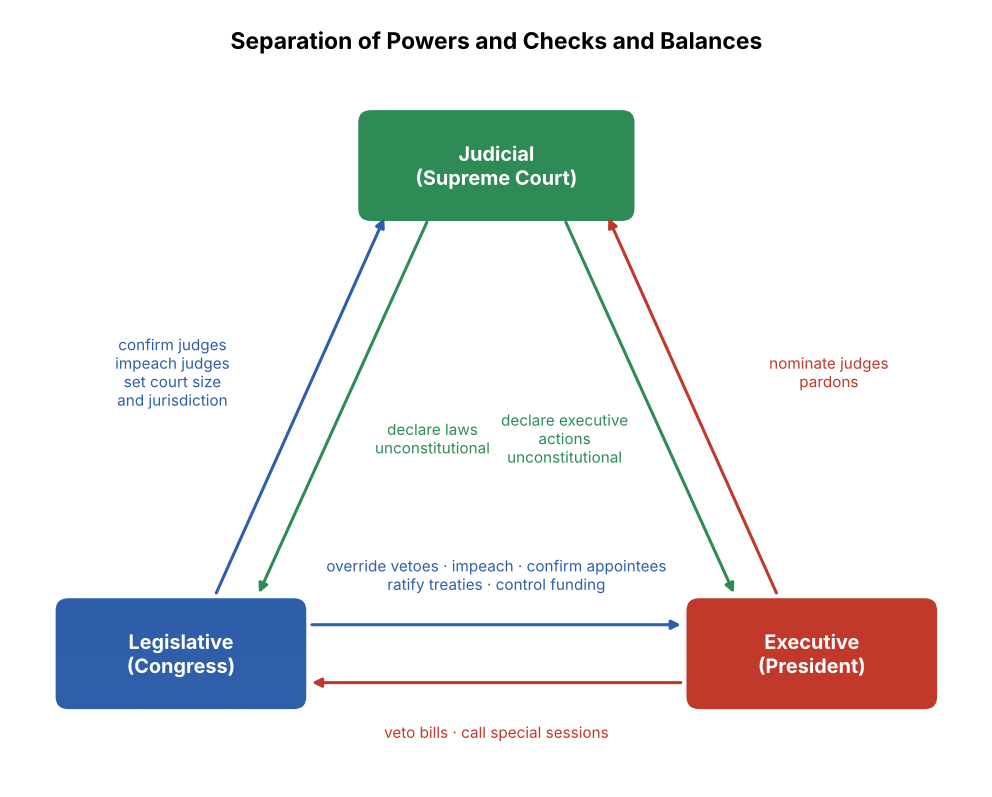
The Constitution grants the president specific, enumerated powers. As commander-in-chief, the president directs military operations. As chief executive, the president enforces the law. As chief diplomat, the president negotiates treaties and recognizes nations. The Constitution also permits the president to veto legislation and issue pardons. These are the official powers.
But the gap between the Constitution and modern presidential authority is enormous. Presidents now direct military operations without congressional declarations of war, reshape legislation through signing statements, and regulate entire industries through executive orders. None of this appears explicitly in Article II. How did this happen?
The answer lies in constitutional vagueness. The Framers left the door open for expansion. Article II’s requirement that the president “take care that the laws be faithfully executed” is elastic enough to stretch into nearly anything a president claims is necessary. This ambiguity has created a century of expansion that courts, Congress, and the public have been unable—or unwilling—to fully contain.
Theories of Presidential Power: The Intellectual Framework
Legal scholars and presidents have developed competing frameworks for justifying executive action. These theories matter because they define the arguments presidents use to defend decisions in court and public opinion.
- Constitutional theory (William Howard Taft): The president possesses only powers explicitly granted in the Constitution or necessarily implied by those explicit grants. This is the narrowest view. Under this theory, if the Constitution doesn’t authorize an action, the president can’t take it. Taft argued that expansive executive power threatens the separation of powers.
- Stewardship theory (Theodore Roosevelt): The president acts as the steward of the nation, responsible for the American people’s welfare and the nation’s strength. Under this theory, the president can take any action not explicitly forbidden by the Constitution. Roosevelt famously stated, “I did not usurp power, but I did greatly broaden the use of executive power.” He used executive orders and proclamations to set aside federal land as national forests and monuments, and he directed the Justice Department to prosecute trusts. Roosevelt believed the presidency was as powerful as the public trusted it to be.
- Unitary executive theory (modern conservative jurisprudence): The president is the unitary head of the executive branch and possesses broad inherent powers to direct federal agencies and personnel without congressional interference. This theory became especially influential during the George W. Bush administration’s response to 9/11.
Why these theories matter for the exam: The AP exam tests whether you understand how presidents justify their authority. A multiple-choice question might show a president taking an action and ask which theory best explains the rationale. Free-response questions often ask you to defend or critique a particular expansion of power using constitutional and textual evidence.
Executive Orders: The President’s Unilateral Tool
An executive order is a directive issued by the president that has the force of law without requiring congressional approval. Presidents use executive orders to establish policy, direct federal agencies, clarify existing law, and sometimes reshape legislation. The number and scope of executive orders has grown dramatically over time.
| President | Number of Executive Orders | Notable Uses | Why It Matters for Exam |
|---|---|---|---|
| Franklin D. Roosevelt | 3,721 (1933-1945) | New Deal programs; military reorganization; Japanese American internment (Executive Order 9066) | FDR used executive orders to bypass Congress and implement the New Deal. This set a precedent for using executive orders during crises. However, the Supreme Court later ruled some programs unconstitutional, and internment is now condemned as a civil rights violation. |
| Harry Truman | 907 | Military desegregation (Executive Order 9981); steel mill seizure during Korean War | Truman desegregated the military unilaterally. He tested executive power limits by seizing steel mills—the Supreme Court ruled against him in Youngstown Sheet & Tube Co. v. Sawyer (1952), establishing a framework for evaluating presidential power. |
| Barack Obama | 276 | Deferred Action for Childhood Arrivals (DACA); environmental regulations; Guantanamo Bay closure | Obama used executive orders when Congress blocked his agenda, particularly on immigration and environmental policy. Courts blocked DACA, then it survived litigation. DACA demonstrates courts now scrutinize executive orders more closely. |
| Donald Trump | 220 (in one term) | Travel ban on Muslim-majority nations; Paris Climate Agreement withdrawal; border wall funding | Trump issued executive orders rapidly and attempted to use them for purposes requiring legislation. Courts blocked several on statutory and constitutional grounds, showing modern limits on executive power. |
Executive orders are powerful because they implement policy without congressional debate or approval. Congress can override an executive order through legislation, but that requires the president’s signature or a two-thirds override. Presidents can repeal predecessor executive orders unilaterally—resulting in instability in federal policy.
Constitutional limit: Executive orders must rest on constitutional or statutory authority. A president cannot issue an order that directly contradicts a statute. The Supreme Court’s framework from Youngstown Sheet & Tube Co. v. Sawyer (1952) establishes that presidential power is strongest when Congress has authorized the action, in a “zone of twilight” when Congress is silent, and weakest when Congress has forbidden the action. Courts strike down executive orders falling into the third category.
War Powers and Undeclared Wars: Constitutional Crisis
The Constitution grants Congress the power to declare war and control military spending. The president is commander-in-chief. This seems clear: Congress declares, the president commands. But modern practice inverts this arrangement. Presidents now direct military operations globally without congressional declarations of war—and Congress has largely acquiesced.
Presidents have committed troops to combat in Korea, Vietnam, Kuwait, Afghanistan, Iraq, Syria, and dozens of other locations, often without explicit congressional authorization or with vague authorizations that presidents interpret broadly. The pattern:
- President claims an imminent threat to national security or American interests.
- President directs military action without waiting for congressional approval.
- Congress either approves after the fact, authorizes broadly, or remains silent.
- Courts rarely intervene, citing the political question doctrine.
The War Powers Resolution (1973): Congress attempted to constrain presidential war-making by requiring presidents to notify Congress within 48 hours of committing armed forces and to withdraw forces within 60 days unless Congress authorizes continued action (with a 30-day extension). The resolution has failed in practice. Presidents routinely ignore it, calling operations “military exercises” rather than “wars.” Congress rarely enforces the 60-day requirement. The resolution has not prevented a single conflict.
Why has this constraint failed? Presidential arguments about speed and secrecy in the age of terrorism have become persuasive. Congress has also been reluctant to force confrontation with a president over military policy. Vague congressional authorizations give presidents room to maneuver.
Other Tools of Presidential Expansion: Signing Statements, Executive Agreements, and Impoundment
Beyond executive orders and war powers, presidents have wielded several other mechanisms to expand their authority.
- Signing statements: When the president signs a bill, the president may issue a statement interpreting what the bill means or how the administration will implement it. In theory, this clarifies the executive branch’s understanding. In practice, signing statements have become a tool for presidents to undermine congressional intent. A president might sign a bill constraining executive authority but then issue a statement declaring that the constraint is unconstitutional and that the administration will not follow it. George W. Bush issued hundreds of signing statements challenging congressional restrictions, often on national security matters. This practice violates the spirit of bicameralism—Congress passes laws, but the president rewrites them unilaterally.
- Executive agreements: The president can negotiate agreements with foreign nations without Senate ratification. A treaty requires a two-thirds Senate vote; an executive agreement does not. Presidents have increasingly used executive agreements for what are effectively treaties. The Iran nuclear agreement and numerous trade agreements began as executive agreements. Congress has limited power to block them. This practice transfers treaty-making power from Congress to the president.
- Impoundment: Presidents have withheld appropriated funds, refusing to spend money Congress allocated. This allows presidents to reject congressional spending priorities. President Richard Nixon attempted widespread impoundment to frustrate Congress’s budget decisions. Congress responded with the Budget and Impoundment Control Act of 1974, which requires presidents to either spend appropriated funds or request congressional approval for rescissions. Impoundment is less common now, but presidents still occasionally attempt it.
Expansion Through Crisis: FDR, 9/11, and Economic Emergency
Presidential power grows in times of crisis. The two most dramatic examples are the Great Depression and the response to 9/11.
Franklin D. Roosevelt and the Great Depression: When FDR took office in 1933, the economy was in collapse. Unemployment exceeded 25 percent. Congress was paralyzed. FDR believed the crisis required swift executive action. In his first hundred days, he issued executive orders establishing a bank holiday, stabilizing the financial system, and launching New Deal agencies. Congress passed legislation quickly to ratify his actions, and the public supported bold executive action. FDR’s expansion of executive power during the Depression became the template for future presidents facing crises.
9/11 and the War on Terror: After September 11, 2001, President George W. Bush claimed broad executive powers to conduct surveillance, detain combatants, and prosecute the “war on terror.” The administration authorized warrantless wiretapping of Americans, created secret detention facilities, and sanctioned enhanced interrogation. Congress passed the Authorization for Use of Military Force, which gave the president broad language to use “all necessary and appropriate force” against al-Qaeda and the Taliban—language the administration stretched to justify military operations in dozens of countries. Some of these practices have been constrained by subsequent legislation and court rulings, but the AUMF remains in effect today.
Economic crisis: During the 2008 financial crisis and the COVID-19 pandemic, presidents used executive authority to direct emergency spending and restructure agencies. Trump and Biden both used emergency declarations to fund priorities Congress opposed. These exercises of emergency power raise questions about whether the executive branch is becoming a check on Congress rather than Congress a check on the executive.
Constraints on Presidential Power: Congress, Courts, and Public Opinion
Presidential expansion does not occur unchecked. Three forces constrain presidential power: Congress, the courts, and public opinion.
Congressional constraints: Congress controls the purse. Congress can pass legislation overriding executive orders, defund executive initiatives, or remove presidential appointees through impeachment. The Senate also confirms Supreme Court justices, and Congress creates or eliminates federal agencies. However, Congress has often been complicit in or indifferent to presidential expansion. Divided government, polarization, and the difficulty of passing legislation with a supermajority have weakened Congress’s ability to check the president. Most constraints (like the War Powers Resolution) have been weakened through presidential non-compliance and congressional passivity.
Judicial constraints: Courts can strike down executive orders that exceed statutory or constitutional authority. Youngstown Sheet & Tube Co. v. Sawyer (1952) remains the leading framework: presidential power varies with congressional authorization. Courts have blocked executive orders on immigration, environmental regulation, and other areas. However, courts are often reluctant to intervene in foreign policy and national security matters, citing the political question doctrine. They also move slowly, and by the time a court strikes down an executive order, the president may have already achieved the policy goal.
Public opinion and elections: Presidents who push executive power too far may face public backlash and electoral consequences. Nixon’s abuses of power during Watergate led to his resignation and subsequent constraints on executive authority. However, polarization means that supporters of a president are likely to tolerate expansions of executive power while opponents criticize them. Public opinion is not a consistent constraint.
Federalist No. 70 and Hamilton’s Defense of Executive Energy
Federalist No. 70 is the primary document the AP exam uses to discuss presidential power. In this essay, Alexander Hamilton argued for a strong, unified executive. He believed that executive power should be concentrated in a single president (not a council or committee) so that the executive could act with “energy”—speed, decisiveness, and accountability. Hamilton argued that a vigorous executive was essential for national defense, the execution of laws, and the protection of liberty.
However, Hamilton also insisted that the president should be accountable. He wrote that the president’s responsibility for actions meant that abuse of power would damage the president’s reputation and lead to impeachment or electoral defeat. Hamilton believed the Constitution’s separation of powers, elections, and impeachment power would constrain the president from abusing the office.
The AP exam tests whether you understand Hamilton’s argument and can apply it to modern situations. A free-response prompt might ask: “Does modern presidential power align with Hamilton’s vision in Federalist No. 70? Why or why not?” You would argue that while Hamilton wanted energy and decisiveness, he also expected meaningful accountability—which has eroded as Congress has ceded power.
Test-Taking Strategies
Mnemonics and Memory Shortcuts
The three theories of presidential power: Taft’s Constitutional theory (narrow), Roosevelt’s Stewardship (broad), and Unitary executive (presidential control of bureaucracy). For executive tools, use SEPIA: Signing statements, Executive orders, Power in foreign policy (executive agreements), Impoundment, and Actions in war (war powers).
Cross-Topic Connections on the AP Exam
Presidential power connects to Topic 2.4 (Roles and Powers of the President), Topic 2.2 (Structures, Powers, and Functions of Congress), Topic 2.12 (The Bureaucracy), and Topic 1.6 (Principles of American Government, including separation of powers). Know which powers are uniquely presidential, which are shared, and which Congress jealously guards (the power of the purse and treaty ratification).
Common Question Formats You’ll See
Scenario-based MCQs: “A president issues an executive order contradicting a statute. Which constitutional problem results?”
Document-based MCQs: Show a signing statement, executive order, or presidential quote and ask which theory explains the action.
Free-response questions: “Explain how presidential expansion demonstrates strengths and weaknesses of the Constitution’s separation of powers” or “To what extent has Congress constrained presidential war-making?”
Frequent Student Mistakes to Avoid
Mistake 1: Confusing executive orders with laws. Executive orders are powerful but can be overridden by Congress or struck down by courts. They’re not equivalent to legislation.
Mistake 2: Thinking the War Powers Resolution successfully limits presidential war-making. It does not. Presidents ignore it regularly, and Congress rarely enforces it. Many students think it works as intended.
Mistake 3: Forgetting that the Constitution doesn’t mention executive orders, signing statements, or most tools presidents use to expand power. The expansion is extra-constitutional, not unconstitutional. There’s a difference.
Mistake 4: Not distinguishing between the three theories of presidential power. Taft and Roosevelt represent opposite ends of a spectrum. Know the differences so you can apply them to fact patterns.
Mistake 5: Overestimating judicial constraints on presidential power. Courts move slowly and are deferential on national security. By the time a court blocks an executive order, the policy goal may be achieved.
Test-Day Shortcuts That Work
Shortcut 1: The Youngstown framework. On scenario questions: Where does the Constitution authorize this? If nowhere, is Congress silent (zone of twilight) or forbidden it (weakest power)? This three-tier framework answers most questions.
Shortcut 2: Use specific examples. Rather than generalizing about presidential power, reference FDR and the New Deal, Bush and 9/11, or Trump and executive orders. Specific examples demonstrate understanding and earn higher scores.
Shortcut 3: Remember the constraints come in three forms: congressional (purse), judicial (striking down orders), and electoral (public opinion). A strong answer addresses all three, explaining which is most effective and why.
Shortcut 4: Cite Federalist No. 70 when asked about presidential authority. Hamilton’s argument for “energy” with accountability is the intellectual foundation for understanding modern presidential power debates.
Time Management for the AP Exam
MCQs: Presidential power questions feel complex because they involve history, constitutional theory, and modern politics. Focus on which constitutional power is at issue rather than getting lost in historical details. Budget 30-45 seconds per question.
Free-response: Before writing, outline: (1) What expanded? (2) How did it expand? (3) What was the justification? (4) What checked it? Spend 1-2 minutes on the outline and 8-9 minutes writing. This structure ensures your answer directly addresses the prompt.
Longer essays: If asked about the Constitution’s success in constraining presidential power, structure your answer around the three theories. Does modern presidential power align with Taft, Roosevelt, or unitary executive theory? This analytical framework prevents rambling and stays focused on the key issues.
Check for Understanding
Think you’ve got it? Complete the quiz below to make sure. Download your results at the end.