
Maximize your score with these resources:
Luis de Góngora’s Soneto CLXVI (“Mientras por competir con tu cabello”) is the AP® Spanish Literature curriculum’s most celebrated example of Baroque culteranismo — a densely ornamented style built on hyperbaton (inverted word order), elaborate metaphor, and classical allusion. For the AP exam, this sonnet teaches you how form and content work together: the difficulty of reading Góngora’s syntax is itself part of the poem’s argument about the struggle to hold beauty against the encroachment of time.
The Life and Literary Context of Luis de Góngora
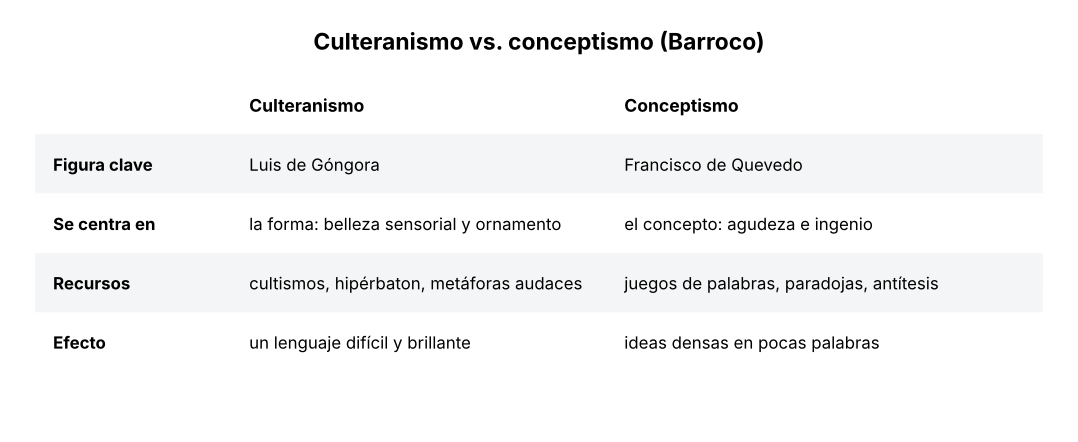
Luis de Góngora y Argote (1561–1627) was a Catholic clergyman and the defining figure of culteranismo in Spanish Baroque poetry. His radical approach to language made him simultaneously celebrated and attacked by contemporaries — his rival Francisco de Quevedo wrote scathing critiques of Góngora’s style, while later generations celebrated him as a master of formal innovation.
| Movement | Key Poet | Defining Style |
|---|---|---|
| Culteranismo | Góngora | Elaborate imagery, hyperbaton, classical allusion, formal difficulty |
| Conceptismo | Quevedo | Wit, wordplay, intellectual surprise, more direct syntax |
Both movements explored decay and mortality but through radically different techniques. The AP exam frequently asks you to distinguish between them.
Poem Summary and Translation
The sonnet opens with sustained hyperbolic praise of the beloved: her hair outcompetes burnished gold in the wind, her eyes’ light disdains all other brilliance, her forehead rivals white ivory, her crimson lips ignite ice and fire at once. Each “mientras” (while) clause adds one more feature to the catalog of her beauty. Then time irrupts: the tercet introduces time as an eternal, relentless force that conquers all — without home or rest, it waits, observes, and destroys everything it withers.
Note: The sonnet is structurally incomplete — it lacks the traditional closing couplet. This incompleteness is itself thematically significant (see the themes section below).
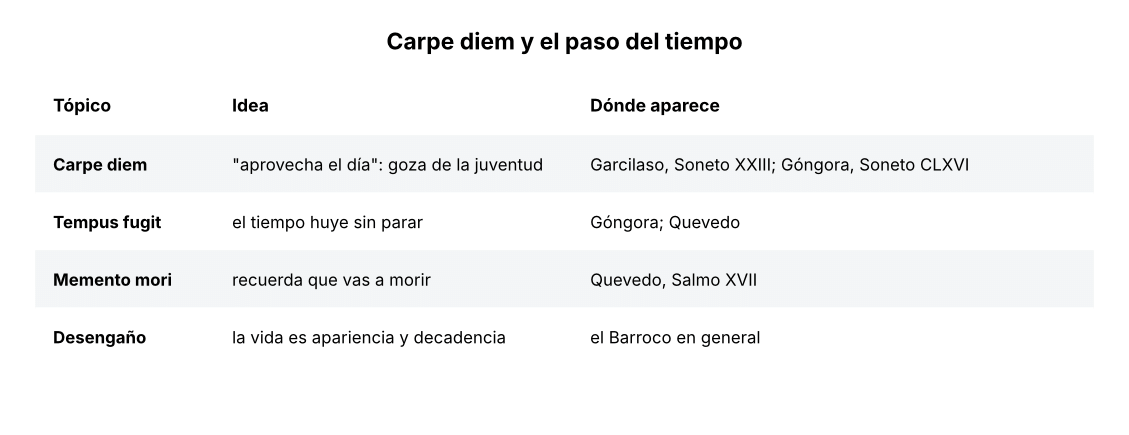
Carpe Diem and the Threat of Time
The classical carpe diem theme is transformed by Góngora into something distinctly Baroque. Whereas Garcilaso’s Soneto XXIII explicitly commands the beloved to enjoy her beauty now, Góngora never states the imperative directly. He suspends the reader in a moment of hyperbolic praise, then shatters it with time’s intrusion. The carpe diem message is implied, discovered by the reader — not delivered as advice. This psychological sophistication is Góngora’s key innovation over Renaissance predecessors.
Literary Devices and Culteranismo Style
| Device | Definition and Example | Why It Matters |
|---|---|---|
| Hyperbaton | “Mientras por competir con tu cabello, / oro bruñido al sol relumbra en vano” — subject and verb are suspended across lines | Mimics the reader’s experience of desire and suspense — you don’t get the full image until the verb arrives, mirroring the poem’s concern with delay and loss |
| Metaphor and the Blazon | Hair = burnished gold (oro bruñido), forehead = lily (lilio bello), lips = crimson (carmesí) | The blazon dehumanizes the beloved into precious objects — more striking and more fragile. Artificiality amplifies the anxiety: even precious things are destroyed by time |
| Oxymoron | “Enciende alumbre y yelo desatado” (“ignites ice and frozen fire”) | Hallmark of Baroque style; expresses beauty as existing beyond nature; signals the paradox that will consume the poem: impossible beauty is not immune to inevitable destruction |
| Anaphora | “Mientras” opens the key lines — a rhythmic incantation building from one praised feature to the next | Creates hypnotic effect; each “while” marks another moment passing — the anaphora ticks like a clock toward time’s arrival |
| Antithesis | Time “conquers all” while it also “withers and destroys” — opposing actions both pointing toward destruction | Sharpens the poem’s central paradox: time is simultaneously active (conquering) and destructive (withering), making the threat feel unavoidable from multiple angles |
Comparison with Garcilaso’s Soneto XXIII
| Element | Garcilaso’s Soneto XXIII | Góngora’s Soneto CLXVI |
|---|---|---|
| Directness | Explicit carpe diem: “Coged de vuestra alegre primavera / el dulce fruto” — direct command | Never commands action; message is implicit, discovered by the reader |
| Syntax | More linear; argument is followable without struggle | Heavily inverted with hyperbaton; reader must hold multiple clauses in suspense |
| Time | Time as external threat (tiempo airado — angry time); rational warning to act | Time as omnipresent, mystical stalking force; existential, not practical |
| Tone | Respectful, persuasive, courtly | Obsessive, hallucinatory, almost frenzied |
Major Themes
| Theme | How It Appears | AP Significance |
|---|---|---|
| Vanitas | Beloved’s features described as precious materials — gold, ivory, crimson — suggesting beauty is artificial and fragile | Dominant moral theme of Spanish Baroque literature; when asked about the poem’s philosophical position, vanitas is the organizing concept |
| Carpe diem transformed | The message (enjoy beauty before time destroys it) is never stated — Góngora suspends the reader in praise, then shatters it | AP® Comparative questions test whether you can explain how Góngora transforms the theme, not just identify it |
| Time as active destroyer | Time personified: it waits, observes, conquers — with intention and relentlessness | Time is not passive — it has will. This distinguishes Góngora’s treatment from simply noting that beauty fades |
| Structural incompleteness | The sonnet lacks its traditional closing couplet, trailing off as if cut short | Form enacts content: the poem is incomplete because beauty is incomplete; time interrupts both. AP questions on form and meaning often focus on this feature |
Test-Taking Strategies
Use the mnemonic “WHILE-TIME”: W = While (repeated mientras clauses praising beauty); H = Hyperbole (exaggerated descriptions); I = Imagery (precious materials: oro, marfil, carmesí); L = Lament (the turn when time enters); E = Eternity (time’s relentless nature); T = Vanitas theology; I = Inversion (hyperbaton as the dominant device); M = Meaning (implied carpe diem); E = Ending (incomplete tercet as thematic statement).
Cross-topic connections:
- Compare Góngora (culteranismo) with Quevedo (conceptismo) — both treat vanitas through radically different techniques. Góngora’s culteranismo buries meaning in beautiful ornament; Quevedo’s conceptismo makes it visible through wit.
- Compare Góngora’s implicit carpe diem with Garcilaso’s explicit one. Góngora intensifies the Petrarchan tradition by refusing to state the moral directly — the reader must draw the conclusion, making it more psychologically powerful.
- Connect culteranismo’s difficulty to the Baroque principle that form and content are inseparable. The syntax is the argument.
Common question formats:
- Stylistic analysis: “The primary function of the word order in lines 1–4 is to…” — Answer: create suspense, delay meaning, mirror the reader’s desire to hold onto the beloved’s beauty.
- Thematic: “The poem’s final tercet serves to…” — Answer: undermine the preceding praise by introducing time as an active destroyer.
- Literary movement: “Soneto CLXVI exemplifies culteranismo primarily through its use of…” — Answer: hyperbaton, elaborate imagery, difficult syntax, classical allusions.
- Comparative: “Unlike Garcilaso’s carpe diem, Góngora’s approach…” — Answer: implies rather than states the message, deepens psychological complexity, introduces existential dread alongside beauty.
Frequent student mistakes:
- Reading carpe diem as a direct command: Góngora never tells the beloved to act. The message is implied, not stated.
- Treating hyperbaton as a flaw: Culteranismo’s difficult syntax is intentional — explain what the difficulty accomplishes when asked about stylistic choices.
- Missing the volta: The shift happens within the final tercet, almost violently, when time enters as a stalking, conquering force.
Test-day shortcuts:
- Scan for the shift from “mientras” to time actively destroying — that’s your volta. Mark “praise” and “threat” in the margins before reading questions.
- For the incomplete ending: form enacts content — the poem cannot complete itself because time does not permit completion.
- MCQ shortcut: hyperbaton = culteranismo, instantly. Any answer option that doesn’t reference culteranismo or Baroque style for questions about the poem’s movement is wrong.
- FRQ: lead with the incomplete tercet. “Góngora’s structural incompleteness enacts the poem’s central argument: time does not permit completion.” Pair it with one concrete example of hyperbaton and you have a thesis and evidence in under two sentences.
Check for Understanding
Think you’ve got it? Complete the quiz below to make sure. Download your results at the end.