

Maximize your score with these resources:
El burlador de Sevilla y convidado de piedra (1630), attributed to Tirso de Molina, is the founding text of the Don Juan tradition in Western literature. Don Juan Tenorio seduces women across multiple social classes through false marriage promises, kills the father of one victim, then mocks the dead man’s stone statue — which accepts his dinner invitation and drags him to Hell. For the AP® Spanish Literature exam, this play is essential for understanding Golden Age honor codes (códigos de honor del Siglo de Oro), divine justice (justicia divina), and how Tirso uses the supernatural to enforce moral consequences that human law cannot deliver.
This play connects directly to the AP theme La construcción del género: Don Juan’s seductions reveal how gender roles in 17th-century Spain operated as a system of honor, reputation, and vulnerability. His female victims — Isabela, Tisbea, Doña Ana — each suffer because their value in Spanish society depends on chastity and the credibility of men’s promises. The play also connects to El yo y la comunidad: Don Juan refuses communal accountability until supernatural force imposes it.
Plot Summary and the Don Juan Archetype
El burlador de Sevilla traces Don Juan Tenorio through a chain of escalating seductions, each raising the dramatic stakes and narrowing his escape routes.
- First seduction: Isabela — In Naples, Don Juan tricks the Duchess Isabela by impersonating her betrothed, Duke Octavio. When exposed, Isabela’s honor is destroyed. This establishes the pattern: Don Juan exploits the gap between appearance and reality, between a man’s word and his actions.
- Second seduction: Tisbea — A working-class fisherwoman seduced on the beach through false marriage promises. Don Juan now transgresses class boundaries as well as social ones.
- Third seduction: Doña Ana and the murder of the Comendador — Don Juan impersonates the Marqués de la Mota to seduce Doña Ana, but she discovers the deception and cries out. Her father, the Comendador Gonzalo, confronts him. Don Juan kills him. This transforms the play from a comedy of seduction into a tragedy of divine judgment.
- The statue’s invitation — The Comendador’s tomb bears the inscription: “Aquí aguarda del Señor, el más leal caballero, la venganza de un traidor” (Here the most loyal knight awaits the Lord’s vengeance on a traitor). When Don Juan mockingly invites the statue to dinner, the statue accepts.
- Damnation — The statue appears at Don Juan’s final feast, grasps his hand in an iron grip, and drags him to Hell. Don Juan asks for a confessor to absolve him, but the statue tells him it is too late.
Golden Age Theater, Honor, and Divine Justice
Honor (honra) in Golden Age Spain was not merely personal reputation but a social contract. A nobleman’s honor derived from blood purity, sexual propriety of female relatives, and observance of codes of conduct. A woman’s seduction destroyed her family’s honor and made her unmarriageable. When Don Juan deceives Isabela, Tisbea, and Doña Ana, he doesn’t just satisfy lust — he destabilizes the entire social order. The play shows honor as fragile and performance-based: Don Juan succeeds by exploiting darkness, impersonation, and the gap between a man’s word and his actions.
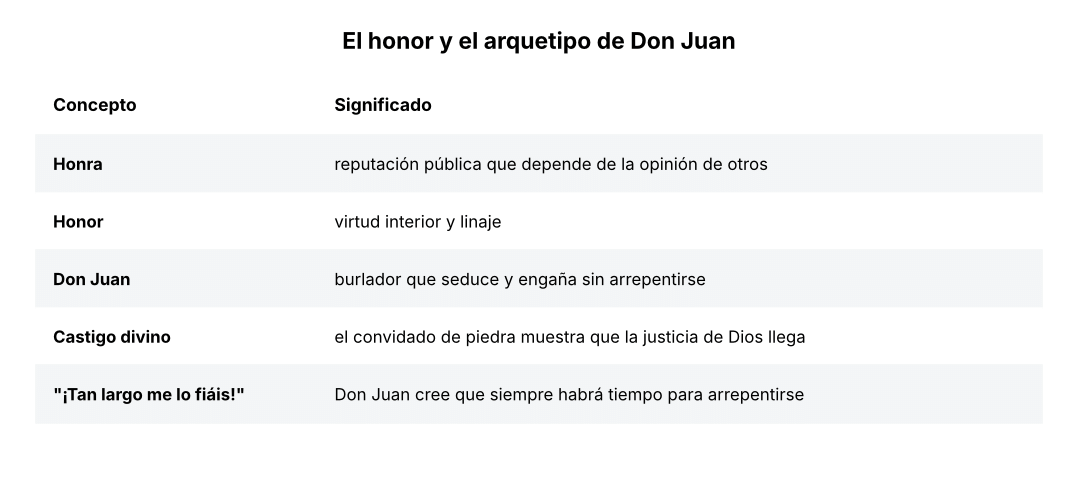
Why divine intervention (intervención divina) is necessary: Human law cannot contain Don Juan. He is a nobleman — above many forms of ordinary accountability. The king and courts are powerless to stop his accumulation of crimes before they escalate to murder. Only the supernatural can enforce judgment. The stone guest is not a ghost seeking revenge; it is a divine instrument. This distinction matters for the exam.
Major Themes
| Theme | How It Appears in the Play | Significance for AP |
|---|---|---|
| Seduction as strategic deception (seducción como engaño estratégico) | Don Juan’s seductions are calculated performances: false identities, darkness, false marriage promises tailored to each victim’s desires. “¡Qué largo me lo fiáis!” mocks the very concept of accountability. | AP asks how Don Juan’s tactics work and why. Key: he exploits the gap between appearance and reality — the same gap that sustains honor culture. |
| Time, mortality, and deferred judgment (juicio diferido) | Don Juan constantly defers accountability: “I’ll repent later.” The statue’s invitation, made as a jest, becomes the moment of reckoning. God’s patience is not infinite. | The play’s central theological argument: deferring repentance is itself the mortal sin. When Don Juan finally asks for a confessor as the statue drags him to Hell, he is told it is too late. |
| Social class and honor’s fragility | Don Juan’s victims span classes: duchess, fisherwoman, noblewoman. All are equally destroyed by seduction, though lower-class Tisbea has fewer resources to recover. | Honor knows no class boundary. The social system is exposed as fragile and dependent on trust that Don Juan weaponizes. |
| Divine justice versus human law (justicia divina vs. ley humana) | Human law (courts, kings) fails to stop Don Juan throughout the play. Only the supernatural statue can enforce judgment. | The insufficiency of human law to contain transgression is the play’s political and theological argument — key for FRQ essays. |
Literary Devices and Verse Structure
| Device | Example from the Play | Effect |
|---|---|---|
| Dramatic irony (ironía dramática) | The audience knows Don Juan has no intention of marrying any victim; each woman believes his promise. He mocks the statue not knowing it will literally accept his invitation. | Creates tension and moral clarity; the audience’s superior knowledge makes Don Juan’s confidence increasingly chilling rather than charming |
| Foreshadowing (presagio) | The Comendador’s tomb inscription; servants warning Don Juan repeatedly; repeated opportunities for repentance that he refuses | Structures the play as an inevitable march toward judgment; every warning Don Juan ignores tightens the dramatic noose |
| The stone guest as symbol (el convidado de piedra como símbolo) | The Comendador’s statue arrives at dinner, grasps Don Juan’s hand in an iron grip, and drags him to Hell | Stone = immutable law that cannot be reasoned with; the statue materializes divine justice, making the abstract consequence physical and undeniable |
| Verbal irony (ironía verbal) | “¡Qué largo me lo fiáis!” — Don Juan mocks the idea he will ever be held accountable, unaware accountability is already approaching | His boasts become indictments; every claim of immunity is undercut by what the audience knows about the statue’s impending arrival |
Verse forms and dramatic function in Golden Age theater — Tirso employs multiple verse forms, each serving a specific dramatic purpose:
| Verse Form | Function in the Play | Example Moment |
|---|---|---|
| Décimas (10-line stanzas) | Elevated, formal moments; emotional intensity; reflective monologues | Characters lamenting seduction or expressing honor’s destruction |
| Romance (octosyllabic lines with assonant rhyme on the even lines) | Narrative momentum; dialogue; plot advancement; conversational tone | Don Juan’s rapid seductions, servant banter, exposition |
| Redondillas (four-line stanzas) | Comedy, lightness, domestic scenes; witty exchange | Comic servant scenes, lighter moments between seductions |
| Tercetos (three-line stanzas) | Solemnity, gravity, final judgments | The damnation scene; characters reflecting on divine justice |
The shift from lighter verse forms to heavier ones as Don Juan’s crimes accumulate mirrors the darkening moral tone. When the statue appears, verse becomes grave and formal — Tirso uses form itself as a signal that we have moved from human comedy into divine tragedy.
Test-Taking Strategies
Use the mnemonic “Three Women, One Statue, One Damnation” to anchor the structure. As Don Juan accumulates victims (Isabela → Tisbea → Doña Ana), divine judgment accumulates against him, culminating in the statue. The three seductions are not equivalent — each escalates (deception → class transgression → murder of the father). The statue is not a plot twist; it is the logical conclusion of the accumulation.
AP Theme connections:
- La construcción del género: Each female victim’s destruction reveals that women’s value in 17th-century Spain was entirely contingent on male promises and protection. Isabela trusted her betrothed’s honor; Tisbea trusted Don Juan’s false promise; Doña Ana was betrayed by impersonation. Their fates expose the fragility of gender-based honor.
- Compare with Lope de Vega’s Fuenteovejuna: Both examine honor and collective justice, but Lope emphasizes community resistance while Tirso emphasizes supernatural divine judgment as the only sufficient corrective.
- Compare with Calderón’s La vida es sueño: Both explore fate, free will, and moral redemption — but Segismundo repents and learns while Don Juan refuses repentance unto death.
Common question formats:
- “What does Don Juan’s false marriage promise reveal about his character?” — He weaponizes the most sacred social institution; the promise is a performance, not a commitment.
- “How does the statue function as a turning point?” — It transforms seduction comedy into divine tragedy; the supernatural intrusion signals that human law has failed and only God can enforce justice.
- “Why is Don Juan damned even though he asks for a confessor at the end?” — His pride made him defer repentance until it was too late; this is the play’s theological argument: sin leads to damnation because the sinner’s defiance blocks God’s mercy.
Frequent student mistakes:
- Treating Don Juan as a romantic hero: The play condemns him. Every seduced woman suffers lasting harm. His charm is a weapon. The punishment is not a plot twist; it is the moral framework of the entire work.
- Treating all seductions as equivalent: Each seduction escalates — the AP exam rewards students who trace this escalation: Isabela (deception) → Tisbea (class transgression) → Doña Ana + murder of the father.
- Misreading the statue as a ghost seeking revenge: The statue is a supernatural instrument of divine justice (instrumento de justicia divina), not the Comendador’s spirit seeking personal retribution.
Test-day shortcuts: When you encounter a passage, ask immediately: “Does this passage show Don Juan as a deceiver, the consequences of his actions, or the supernatural judgment?” This three-category framework orients you to the correct thematic answer quickly. For verse-form questions: lighter forms (redondillas, romance) signal comedy and plot momentum; heavier forms (décimas, tercetos) signal gravity and moral consequence.
Time management tips:
- Know your seduction order before the exam: Isabela (Naples, impersonation) → Tisbea (beach, class transgression) → Doña Ana + Comendador’s murder. Three seductions = three ready-made essay examples in 10 seconds.
- Verse-form shortcut: Glance at the verse form before reading the passage. Romance = narrative movement; décimas = emotional intensity; tercetos = divine judgment. The form alone narrows answer choices before you finish reading.
- “¡Qué largo me lo fiáis!” as your anchor quote: Don Juan’s recurring boast that he has plenty of time to repent is the theological heart of the play. Any FRQ about time, deferral, repentance, or divine justice can launch from this quote in under 30 seconds.
- FRQ structure: Lead with the escalation framework (three seductions, each worse), then show how the supernatural fills the gap left by human law’s failure, then close with Don Juan’s unrepentant death as the theological endpoint.
Check for Understanding
Think you’ve got it? Complete the quiz below to make sure. Download your results at the end.