

Maximize your score with these resources:
- Albert.io AP® Calculus question banks
- Free AP® Calculus cheat sheets
- Free AP® Calculus score calculator
Series are infinite sums of terms that help reveal patterns, behaviors, and solutions in advanced mathematics. In particular, determining whether a series converges or diverges is a key step in understanding its overall behavior. An alternating series is a series that switches between positive and negative terms, which adds an interesting twist to the question of convergence. The alternating series test is often introduced in AP® Calculus BC courses because it provides a straightforward way to determine if certain types of alternating series converge.
This post explains the basics of an alternating series, why convergence is important, and how to apply the alternating series test to solve problems. It includes worked examples and strategies designed for high school students preparing for AP® Calculus AB-BC exams.
What We Review
Understanding Alternating Series
What Makes a Series “Alternating”?
An alternating series is a series where consecutive terms alternate in sign. One term is positive, the next is negative, and then it repeats. You can express this pattern as: \(\sum_{n=1}^\infty (-1)^n a_n\) or \(\sum_{n=1}^\infty (-1)^{n+1} a_n\) depending on whether the first term is positive or negative.
Think of a line of people facing opposite directions: the first person faces right (positive), the next faces left (negative), then right again, then left, and so on. This back-and-forth pattern captures the essence of an alternating series.
Importance of Convergence in Alternating Series
A series converges when its partial sums approach a finite number. For alternating series, convergence usually depends on two main conditions. First, each new term must have a smaller magnitude than the previous term. Second, each term must get closer and closer to zero as \(n\) increases. Without these conditions, the sum may not settle on a definite value. That’s why a specialized test is needed to capture these behaviors—and why the alternating series test is so important in AP® Calculus BC.

The Alternating Series Test for Convergence
Statement of the Test
The Alternating Series Test (AST) states that if a series has the form \(\sum_{n=1}^\infty (-1)^{n} b_n\) (or a similar pattern of alternating signs), it will converge if both of the following conditions are satisfied:
- Decreasing condition: The absolute values of the terms \(b_n\) get smaller as \(n\) increases. In other words, \(b_{n+1} \leq b_n\) for all \(n\) (it is enough for the sequence \(\{b_n\}\) to be eventually decreasing, that is, for this to hold for all \(n\) past some point).
- Limit condition: The limit of \(b_n\) is zero. That is, \(\lim_{n \to \infty} b_n = 0\).
Both conditions must hold. If either fails, the series does not converge by the alternating series test.
Step-by-Step Application
- Confirm the series has alternating signs via \((-1)^n\) or \((-1)^{n+1}\).
- Verify that \(b_{n+1} \leq b_n\)—check that the absolute value of each term shrinks.
- Calculate \(\lim_{n \to \infty} b_n\). If it equals zero, this condition is satisfied.
- If both conditions hold, conclude the series converges (though not necessarily absolutely).
Example 1: Applying the Alternating Series Test
Consider the series: \(\sum_{n=1}^\infty \frac{(-1)^n}{n}\).
Solution:
- The factor \((-1)^n\) makes the terms alternate in sign—this is an alternating series.
- The absolute value of the \(n\)th term is \(b_n = \frac{1}{n}\). As \(n\) increases, \(\frac{1}{n}\) gets smaller. Therefore, \(b_{n+1} \leq b_n\) is satisfied.
- Check the limit: \(\lim_{n \to \infty} \frac{1}{n} = 0\). ✓
- Both conditions are met, so the alternating series test confirms convergence. (This is the alternating harmonic series—it converges conditionally.)
Why the Alternating Series Test Works
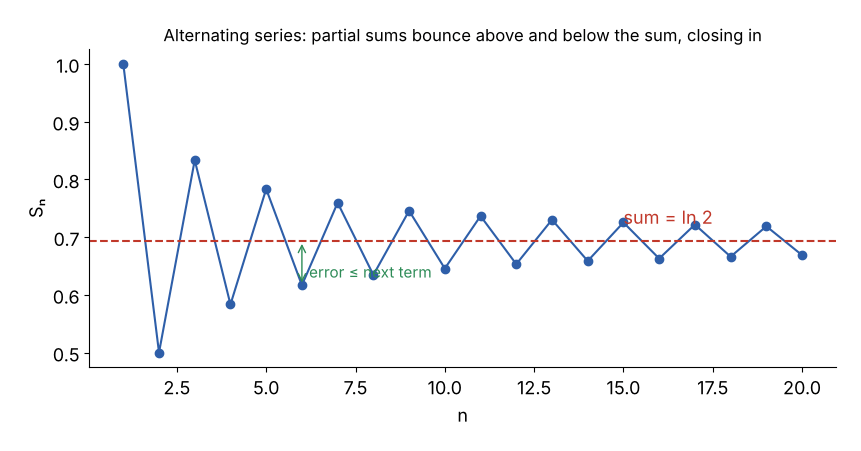
The alternating series test works because each positive term is counterbalanced by a negative term of nearly equal size, while the magnitude of these terms steadily decreases. Imagine the partial sums as a ball bouncing back and forth on a tightening path: after a positive term pushes the sum right, the next negative term pushes it left—but not as far because the terms shrink. If the terms approach zero, the ball eventually settles into a fixed point. This “zigzag convergence” guarantees that the series converges to a definite value.
Additional Example: Variety in Application
Example 2: A Different Alternating Series
Consider the series: \(\sum_{n=1}^\infty (-1)^{n+1} \frac{1}{n^2}\).
Solution:
- The factor \((-1)^{n+1}\) makes the first term positive, then alternates—this is an alternating series.
- Let \(b_n = \frac{1}{n^2}\). Since \(\frac{1}{n^2}\) decreases as \(n\) increases, we have \(b_{n+1} \leq b_n\). ✓
- Check the limit: \(\lim_{n \to \infty} \frac{1}{n^2} = 0\). ✓
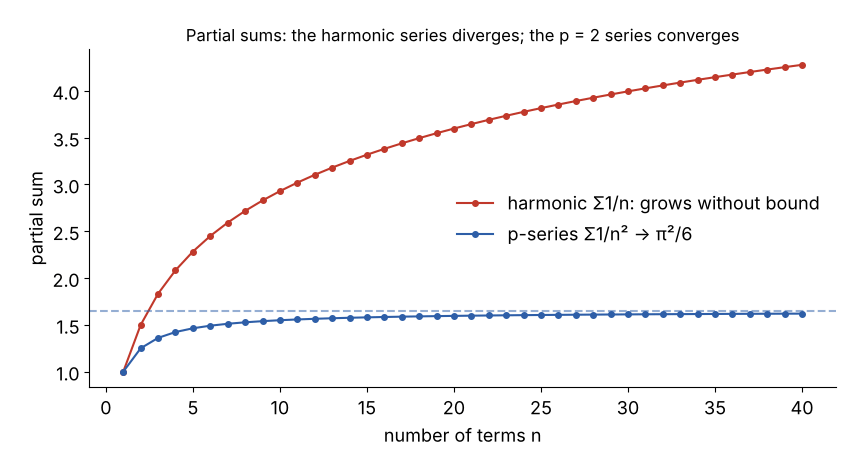
- Both conditions are satisfied. The series converges by the alternating series test. (Bonus: this series also converges absolutely because \(\sum_{n=1}^\infty \frac{1}{n^2}\) converges.)
Common Mistakes
- Forgetting the decreasing condition: Just because a series alternates doesn’t mean it converges. Terms must actually shrink in magnitude. For example, \(\sum_{n=1}^\infty (-1)^n n\) diverges even though signs alternate, because its terms grow in size and never approach 0, so it fails the divergence test.
- Skipping the limit check: Both conditions are non-negotiable. If \(\lim_{n \to \infty} b_n \neq 0\), the series fails the divergence test and cannot converge by AST.
- Confusing conditional vs. absolute convergence: The alternating series test tells you if a series converges, but not whether it converges absolutely. Always check separately if \(\sum |a_n|\) converges to determine absolute convergence.
Comparison with Other Convergence Tests
Several convergence tests exist, and choosing the right one saves time on exams. The Alternating Series Test is ideal when you have an alternating series and want a quick verdict. The Ratio Test takes the ratio of successive terms and works well for series with factorials or exponentials. The Integral Test converts a series into an integral, useful for comparison with known integrals. The p-Series Test applies directly to series of the form \(\sum \frac{1}{n^p}\).
On the AP® exam, if you recognize alternating signs immediately, the AST is often the fastest path. Save other tests for non-alternating series or when you need to determine absolute convergence.
Quick Reference Chart
| Concept | Definition/Key Point |
| Alternating Series | A series with alternating signs: \(\sum_{n=1}^\infty (-1)^n a_n\) or \(\sum_{n=1}^\infty (-1)^{n+1} a_n\) |
| AST Condition 1 | Terms decrease in absolute value: \(b_{n+1} \leq b_n\) |
| AST Condition 2 | Limit goes to zero: \(\lim_{n \to \infty} b_n = 0\) |
| Convergence | Series converges if both AST conditions hold (may be conditional, not absolute) |
| Error Bound | If AST applies, error when truncating at \(n\) terms is at most \(b_{n+1}\) |
| Absolute vs. Conditional | Alternating series may converge conditionally (converges but absolute value series diverges). Check \(\sum |a_n|\) separately. |
Test-Taking Strategies
Mastering the alternating series test on the AP® exam requires more than just knowing the conditions. Here are practical strategies to maximize your score:
Mnemonic: “D-L” (Decreasing and Limit)
Remember the two conditions as D-L: Decreasing terms (in absolute value) and Limit equals zero. Write “D-L” in your test margin as a quick checklist. If either fails, the series does not converge by AST.
Cross-Topic Connections
- Error Bounds: If a series converges by AST, you can estimate the error when truncating at \(n\) terms. The error is at most \(b_{n+1}\), the absolute value of the first omitted term. Use this to answer “approximate to within \(0.01\)” type questions.
- Conditional vs. Absolute Convergence: The AST tells you a series converges, but not how. Always ask: “Does \(\sum |a_n|\) converge?” If yes, it’s absolute convergence. If no (but the original converges), it’s conditional convergence. Conditional convergence frequently appears on free-response questions.
- Divergence Test First: Before using AST, check if \(\lim_{n \to \infty} a_n \neq 0\). If the limit is non-zero (or doesn’t exist), the series diverges immediately—no further testing needed.
Common Question Formats on AP® Exams
- “Does the series converge or diverge?” Apply AST directly. State both conditions clearly and conclude convergence or divergence.
- “Is the convergence absolute or conditional?” After using AST, test \(\sum |a_n|\) with another test (ratio, comparison, integral). If it converges, answer “absolute.” If \(\sum |a_n|\) diverges but the original converges, answer “conditional.”
- “Approximate the sum to within \(\epsilon\).” Use the error bound: find the smallest \(n\) such that \(b_{n+1} < \epsilon\). Sum the first \(n\) terms to get your approximation.
- “Which test would you use and why?” If you see alternating signs, lead with AST. Explain that it applies directly and is more efficient than ratio test or root test.
Frequent Student Mistakes to Avoid
- Checking only the limit: Many students verify \(\lim b_n = 0\) and stop, forgetting to confirm the terms decrease. Both conditions are mandatory.
- Assuming alternation guarantees convergence: Series like \(\sum (-1)^n n\) alternate but diverge. Always verify the decreasing condition explicitly.
- Skipping the absolute value: The decreasing condition applies to \(|b_n|\), not \(b_n\). Write it clearly: \(|b_{n+1}| \leq |b_n|\).
- Confusing conditional convergence with divergence: A conditionally convergent series still converges—it just doesn’t converge absolutely. Don’t say “it converges conditionally, so it diverges.”
Test-Day Shortcuts
- Spot the pattern instantly: \(\sum \frac{(-1)^n}{n}\), \(\sum \frac{(-1)^n}{n^2}\), \(\sum (-1)^n \frac{1}{\sqrt{n}}\)—these are all famous alternating p-series. If you recognize them, AST applies immediately.
- Use calculus to verify “decreasing”: If \(b_n = f(n)\) for some continuous function \(f\), show \(f'(x) < 0\) for large \(x\). This proves the sequence is eventually decreasing without checking every term.
- Write the verdict early: Once you confirm both AST conditions, write “By the Alternating Series Test, [series name] converges” in your answer. This shows the grader your logic clearly and prevents lost points for reasoning even if a small error follows.
Time Management
- AST is one of the fastest convergence tests. If you spot alternation, use it instead of slower tests like the integral test or comparison test.
- On a typical free-response problem worth 9 points, budgeting 2–3 minutes for AST is reasonable. Spend 1 minute identifying conditions, 1 minute checking each, and 30 seconds writing your conclusion.
- If you’re on a multiple-choice section and unsure about absolute vs. conditional convergence, mark the answer and move on. Return if time permits.
By internalizing these strategies, you’ll handle alternating series questions with confidence and precision on test day.
Check for Understanding
Think you’ve got it? Complete the quiz below to make sure. Download your results at the end.