
Maximize your score with these resources:
- Albert.io AP® Calculus question banks
- Free AP® Calculus cheat sheets
- Free AP® Calculus score calculator
The Ratio Test is one of the most versatile convergence tests in your AP® Calculus BC toolkit. It works by examining the limit of the ratio of consecutive terms — if that ratio shrinks below 1, the series converges; if it exceeds 1, the series diverges. The test is especially powerful for series involving factorials, exponentials, and powers of n, where other tests often stall. If you see \(n!\) or \(r^n\) in a series, the Ratio Test should be your first instinct.
What We Review
Recap: Convergence Tests and Where the Ratio Test Fits
Common Tests for Convergence
You have a full toolkit of convergence tests, each suited to different series structures:
- nth Term Test — quick divergence check (if \(\lim_{n \to \infty} a_n \neq 0\), the series diverges)
- p-series Test — for series of the form \(\sum \frac{1}{n^p}\)
- Comparison and Limit Comparison Tests — compare against a known series
- Integral Test — connect a series to an improper integral
- Alternating Series Test — for series with alternating signs
- Ratio Test — compare consecutive terms via their ratio
- Root Test — use the nth root of \(|a_n|\)
Why Use the Ratio Test?
The Ratio Test shines when the general term involves factorials or exponential expressions. Here’s why: forming the ratio \(\frac{a_{n+1}}{a_n}\) causes factorials to cancel telescopically (since \((n+1)! = (n+1) \cdot n!\)) and exponentials to simplify into a constant base ratio. This makes the limit dramatically easier to compute than with other tests.
Rule of thumb: if you see \(n!\), \(r^n\), or products of both in the general term, reach for the Ratio Test first.
How the Ratio Test Works
Ratio Test Rules
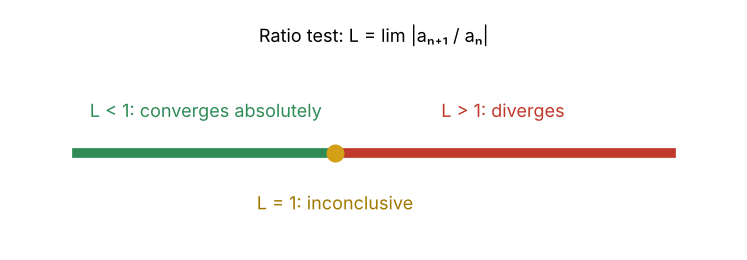
Given a series \(\sum_{n=1}^{\infty} a_n\), compute:
\(L = \lim_{n \to \infty} \left| \frac{a_{n+1}}{a_n} \right|\)Then apply these rules:
- If \(L < 1\), the series converges absolutely
- If \(L > 1\) (or \(L = \infty\)), the series diverges
- If \(L = 1\), the test is inconclusive — you need a different test
Notice that the Ratio Test tells you about absolute convergence, not just convergence. If \(L < 1\), the series converges absolutely.
Step-by-Step Method
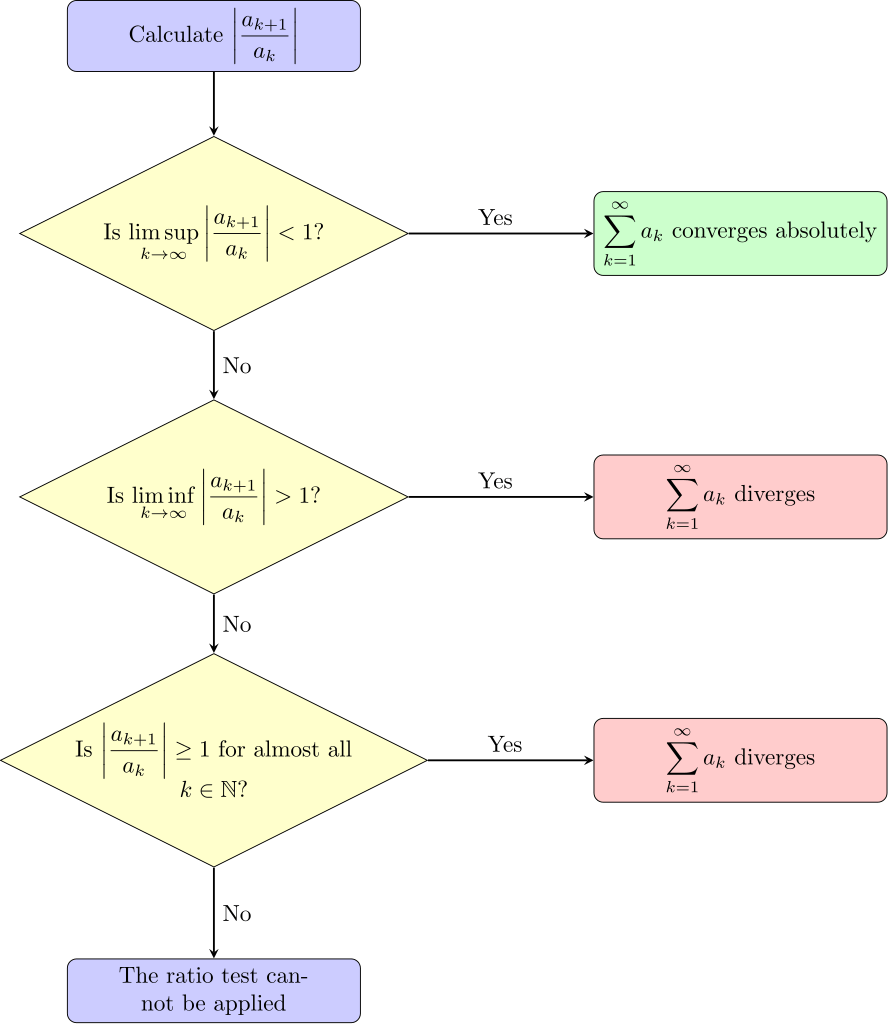
- Identify \(a_n\) — write out the general term of the series
- Form the ratio — compute \(\left| \frac{a_{n+1}}{a_n} \right|\) by substituting \(n+1\) into the general term and dividing by \(a_n\)
- Simplify — cancel common factors (this is where factorials and exponentials collapse)
- Take the limit — evaluate \(\lim_{n \to \infty}\) of the simplified ratio
- Apply the rules — compare \(L\) to 1 and state your conclusion

Check for Understanding
Think you’ve got it? Complete the quiz below to make sure.
Ratio Test Examples: Step-by-Step Solutions
Example 1: Series Involving Factorials
Determine whether \(\sum_{n=1}^{\infty} \frac{n!}{3^n}\) converges or diverges.
Step 1: Identify the general term: \(a_n = \frac{n!}{3^n}\)
Step 2: Form the ratio:
\(\left| \frac{a_{n+1}}{a_n} \right| = \frac{\frac{(n+1)!}{3^{n+1}}}{\frac{n!}{3^n}} = \frac{(n+1)! \cdot 3^n}{n! \cdot 3^{n+1}}\)Step 3: Simplify. Since \((n+1)! = (n+1) \cdot n!\), the \(n!\) terms cancel:
\(= \frac{(n+1) \cdot n! \cdot 3^n}{n! \cdot 3^n \cdot 3} = \frac{n+1}{3}\)Step 4: Take the limit:
\(L = \lim_{n \to \infty} \frac{n+1}{3} = \infty\)Step 5: Since \(L = \infty > 1\), the series diverges by the Ratio Test. The factorial in the numerator grows far faster than the exponential in the denominator.
Example 2: Exponential Functions
Determine whether \(\sum_{n=1}^{\infty} \frac{3^n}{4^n}\) converges or diverges.
Step 1: Rewrite: \(a_n = \left( \frac{3}{4} \right)^n\)
Step 2: Form the ratio:
\(\left| \frac{a_{n+1}}{a_n} \right| = \frac{\left( \frac{3}{4} \right)^{n+1}}{\left( \frac{3}{4} \right)^n} = \frac{3}{4}\)Step 3: The ratio is constant — no limit needed:
\(L = \frac{3}{4} < 1\)Step 4: Since \(L < 1\), the series converges by the Ratio Test. (You could also recognize this as a geometric series with \(r = \frac{3}{4}\), which confirms the result.)
Connect to the Root Test for Convergence
When to Consider the Root Test Instead
The Root Test evaluates \(\lim_{n \to \infty} \sqrt[n]{|a_n|}\) and uses the same threshold rules as the Ratio Test (\(L < 1\) converges, \(L > 1\) diverges, \(L = 1\) inconclusive). It’s often more efficient when the general term is raised entirely to the \(n\)th power, such as \(a_n = \left( \frac{n}{n+1} \right)^{n^2}\), because the nth root peels off the exponent cleanly.
Similarities and Differences
| Feature | Ratio Test | Root Test |
| What it computes | \(\lim \left| \frac{a_{n+1}}{a_n} \right|\) | \(\lim \sqrt[n]{|a_n|}\) |
| Best for | Factorials, products, exponentials | Terms raised to the nth power |
| Threshold | \(L < 1\) converges, \(L > 1\) diverges | Same thresholds |
| Inconclusive when | \(L = 1\) | \(L = 1\) |
When both tests apply, they always give the same result. Choose whichever simplifies the algebra more.
Common Pitfalls and Tips
Watch for Complex Expressions
When the general term involves products of factorials, polynomials, and exponentials (like \(\frac{n^3 \cdot 2^n}{n!}\)), write out \(a_{n+1}\) fully before forming the ratio. The most common algebra mistakes happen when students try to simplify too quickly without expanding \((n+1)^3\) or \((n+1)!\) first.
Inconclusive Case
If \(L = 1\), the Ratio Test tells you nothing — the series could converge or diverge. Classic examples where this happens:
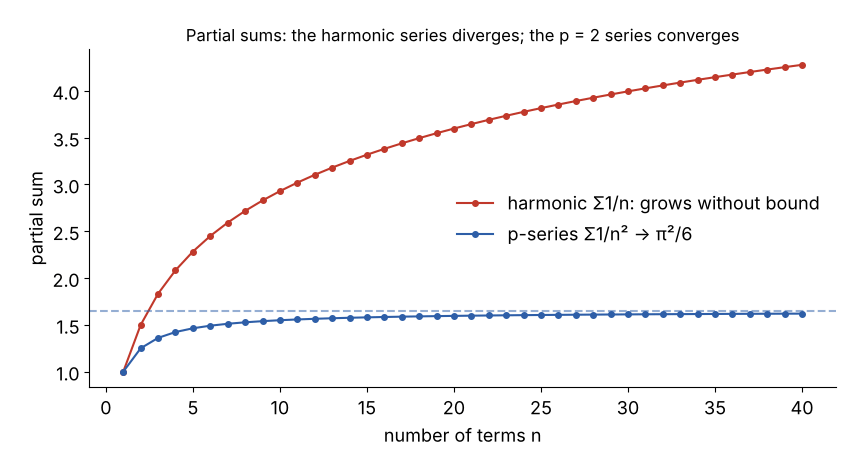
- p-series \(\sum \frac{1}{n^p}\) — the Ratio Test always gives \(L = 1\) regardless of \(p\), so you need the p-series test instead
- Harmonic-like series — any series where consecutive terms have the same asymptotic growth rate
When this happens, try the Comparison Test, Limit Comparison Test, or Integral Test.
VII. Quick Reference Chart
| Term | Definition |
| Convergence of a Series | The partial sums \(S_N = \sum_{n=1}^{N} a_n\) approach a finite limit as \(N \to \infty\). |
| Ratio Test | Compute \(L = \lim_{n \to \infty} \left| \frac{a_{n+1}}{a_n} \right|\). If \(L < 1\), series converges absolutely. If \(L > 1\), series diverges. |
| Inconclusive (\(L = 1\)) | The Ratio Test provides no information. Use a different convergence test. |
| Root Test | Compute \(L = \lim_{n \to \infty} \sqrt[n]{|a_n|}\). Same convergence thresholds as the Ratio Test. |
| Factorial Growth | \(n!\) grows faster than any exponential \(r^n\), which is why \(\sum \frac{n!}{r^n}\) always diverges. |
Test-Taking Strategies
Here’s how to use the Ratio Test efficiently on exam day.
The “FEP” trigger mnemonic — reach for the Ratio Test when you see Factorials, Exponentials, or Products of both in the general term. FEP = “Ratio Test First.” If none of these appear, another test is probably faster.
Cross-topic connections:
- Radius of convergence for power series — the Ratio Test is the standard method for finding the radius of convergence. You apply it to \(\sum c_n (x – a)^n\), and the resulting \(L\) (as a function of \(x\)) determines the interval where \(L < 1\). This is one of the most frequently tested applications.
- Taylor/Maclaurin series — when determining where a Taylor series converges, you almost always use the Ratio Test to find \(R\), then check endpoints separately.
- Absolute vs. conditional convergence — because the Ratio Test determines absolute convergence, a result of \(L < 1\) immediately tells you the series converges absolutely — no further testing needed.
Common question formats:
- “Determine whether the series converges or diverges” with a factorial/exponential general term — straightforward Ratio Test application
- “Find the radius of convergence” — apply the Ratio Test to the power series, solve \(L < 1\) for \(|x – a|\)
- “For what values of \(x\) does the series converge?” — Ratio Test for the interval, then test endpoints separately
Frequent student mistakes:
- Forgetting absolute values. The Ratio Test uses \(\left| \frac{a_{n+1}}{a_n} \right|\), not just \(\frac{a_{n+1}}{a_n}\). Without absolute values, alternating series give negative ratios that produce wrong conclusions.
- Claiming convergence when \(L = 1\). This is inconclusive, not convergent. The Ratio Test cannot distinguish \(\sum \frac{1}{n}\) (diverges) from \(\sum \frac{1}{n^2}\) (converges) — both give \(L = 1\).
- Algebra errors with factorials. Remember: \((n+1)! = (n+1) \cdot n!\), not \((n+1) \cdot n\). The entire \(n!\) must cancel, leaving just the \((n+1)\) factor.
- Using the Ratio Test on p-series. It always gives \(L = 1\) for \(\sum \frac{1}{n^p}\), wasting time. Recognize this pattern and skip to the p-series test.
Test-day shortcuts:
- For \(\sum \frac{n!}{r^n}\): always diverges (factorial beats exponential). You can state this immediately without computing the full limit.
- For \(\sum \frac{r^n}{n!}\): always converges (exponential loses to factorial). This is the Taylor series pattern for \(e^r\).
- For geometric-like series \(\sum r^n\): the Ratio Test gives \(L = |r|\) instantly. Converges when \(|r| < 1\).
Time management: The Ratio Test involves forming a ratio, simplifying, and taking a limit — budget about 2 minutes for a standard MCQ application. If the algebra isn’t simplifying after 90 seconds, check whether the Root Test would be cleaner. On FRQ problems, show each step (form ratio → simplify → limit → conclusion) for full credit.