
Maximize your score with these resources:
- Albert.io AP® Chemistry question banks
- Free AP® Chemistry study guides
- Free AP® Chemistry score calculator
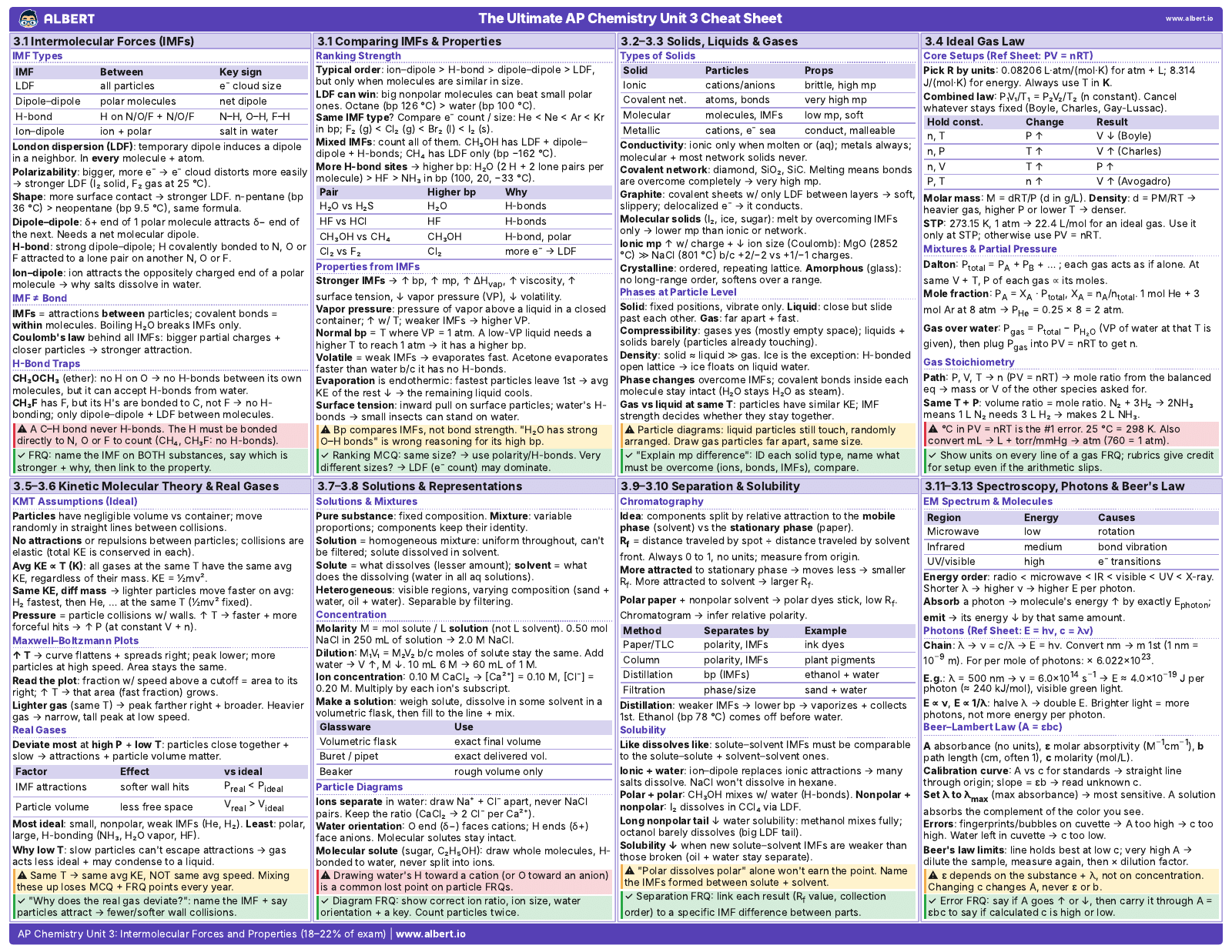
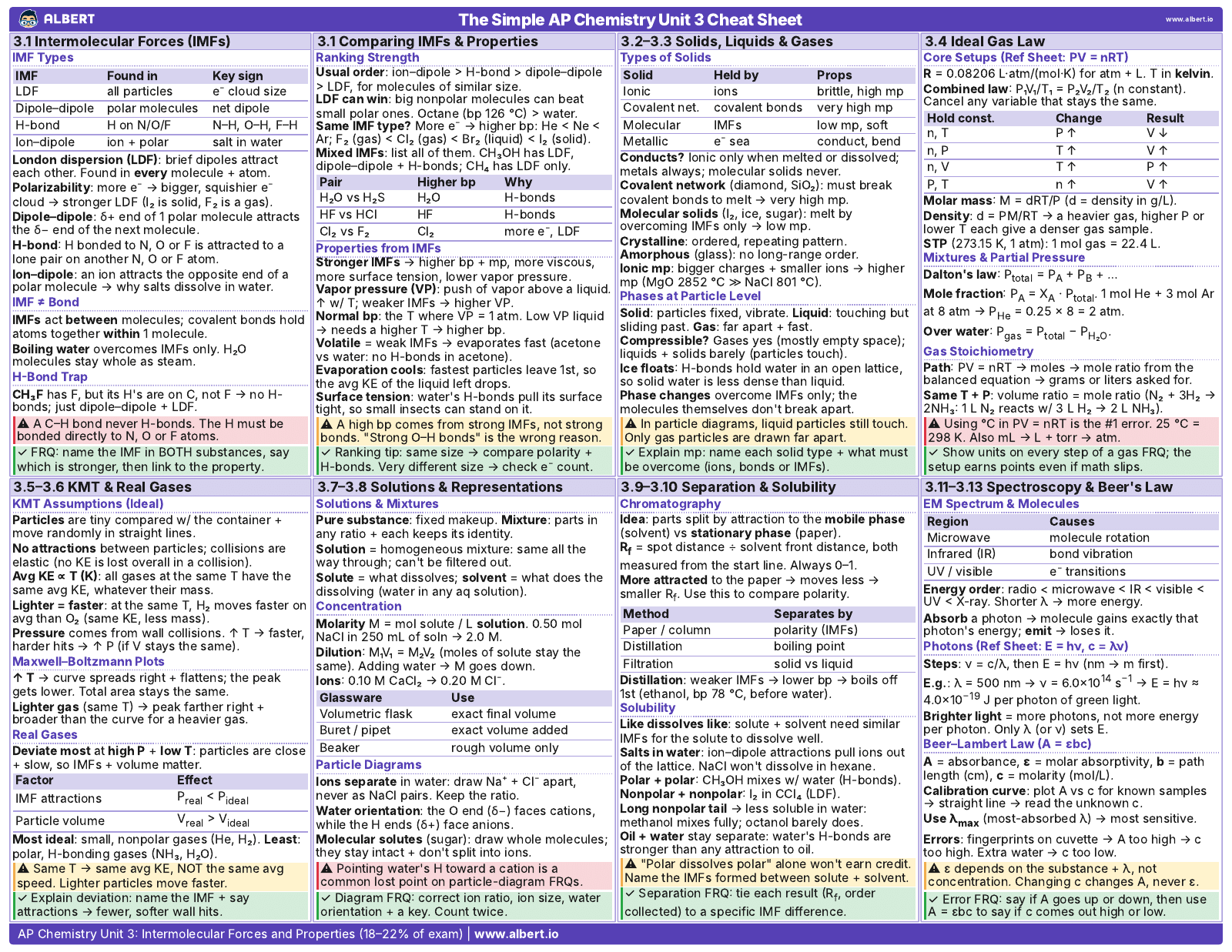
This AP Chem Unit 3 cheat sheet covers intermolecular forces and the properties they control: solids and liquids, gases, solutions, separation and spectroscopy. Unit 3 makes up 18–22% of the AP® Chemistry exam, the biggest share of any unit. Use the Simple version to learn the core ideas, then switch to the Ultimate version for dense, exam-week review.
Practice AP® Chemistry Unit 3 questions on Albert
What’s on the AP Chem Unit 3 Cheat Sheet?
Both versions of the AP Chem Unit 3 cheat sheet follow the College Board’s topics 3.1 through 3.13 across eight cards: types of IMFs, comparing IMFs and properties, solids and phases, the ideal gas law, kinetic molecular theory and real gases, solutions and particle diagrams, separation and solubility, and spectroscopy with Beer’s law.
The Simple version keeps each card to the main rule, one worked number and the trap that costs the most points. It is the right starting place if you are still sorting out which IMFs a molecule has.
The Ultimate version adds boiling point data you can use as evidence, more comparison tables, Maxwell–Boltzmann plot reading, gas-over-water and mole fraction setups, chromatography details and lab error analysis for spectrophotometry. Use it once the Simple sheet feels routine.
The AP® Chemistry exam gives you a periodic table and an equations sheet, so neither cheat sheet repeats them. Instead, the cards show you when to use PV = nRT, E = hν and A = εbc, and how to explain your answer.
AP Chem Unit 3 at a Glance
Unit 3 is weighted at 18–22% of the exam. The College Board’s current course framework calls it “Properties of Substances and Mixtures”; you’ll also see the older title, “Intermolecular Forces and Properties.”
| Topic | Name | Focus |
|---|---|---|
| 3.1 | Intermolecular and Interparticle Forces | LDF, dipole–dipole, H-bonds, ion–dipole |
| 3.2 | Properties of Solids | Ionic, covalent network, molecular, metallic |
| 3.3 | Solids, Liquids, and Gases | Particle-level views of phases |
| 3.4 | Ideal Gas Law | PV = nRT, partial pressures |
| 3.5 | Kinetic Molecular Theory | Particle speed, KE and temperature |
| 3.6 | Deviation from Ideal Gas Law | When and why real gases differ |
| 3.7 | Solutions and Mixtures | Molarity and mixture types |
| 3.8 | Representations of Solutions | Particle diagrams of solutions |
| 3.9 | Separation of Solutions and Mixtures | Chromatography and distillation |
| 3.10 | Solubility | “Like dissolves like” through IMFs |
| 3.11 | Spectroscopy and the Electromagnetic Spectrum | What each region of light does to molecules |
| 3.12 | Properties of Photons | E = hν and c = λν |
| 3.13 | Beer-Lambert Law | A = εbc and calibration curves |
Key Concepts in Unit 3: Intermolecular Forces and Properties
Intermolecular Forces (3.1)
Intermolecular forces are attractions between particles, not the covalent bonds inside a molecule. Every molecule has London dispersion forces, which grow stronger as the electron cloud gets larger and easier to distort. Polar molecules add dipole–dipole attractions. A hydrogen bond forms only when H is bonded directly to N, O or F and is attracted to a lone pair on another N, O or F. Ion–dipole forces explain why salts dissolve in water.
Worked example: rank H₂O, H₂S and CH₄ by boiling point. CH₄ is nonpolar, so it has only LDF (bp −162 °C). H₂S is polar, so it adds dipole–dipole (bp −60 °C). H₂O has hydrogen bonds (bp 100 °C). The order is CH₄ < H₂S < H₂O.
Size can override polarity. Octane is nonpolar, but its large electron cloud gives it strong enough dispersion forces to boil at 126 °C, above water.
Exam tip: when you justify a ranking, name the IMFs in both substances and say which is stronger. “Water has hydrogen bonds” alone usually doesn’t earn the point.
Properties of Solids, Liquids and Gases (3.1–3.3)
Stronger IMFs mean a higher boiling point, higher viscosity, higher surface tension and lower vapor pressure. The normal boiling point is the temperature at which vapor pressure equals 1 atm, so a liquid with low vapor pressure must be heated more to boil.
Solids fall into four types. Ionic solids are brittle with high melting points and conduct only when melted or dissolved. Covalent network solids like diamond and SiO₂ have very high melting points because covalent bonds must be overcome. Molecular solids such as I₂ and ice melt easily because only IMFs are overcome. Metallic solids conduct and are malleable because of their sea of delocalized electrons.
Worked example: explain why MgO melts at 2852 °C and NaCl at 801 °C. Both are ionic, but Mg²⁺ and O²⁻ carry twice the charges of Na⁺ and Cl⁻ and are smaller, so the Coulombic attraction is much stronger.
Exam tip: in particle diagrams, liquid particles still touch each other. Only gas particles are drawn far apart.
Gases: Ideal Gas Law, KMT and Real Gases (3.4–3.6)
PV = nRT is on the equations sheet, but setup errors still cost points. Temperature must be in kelvin, and R = 0.08206 L·atm/(mol·K) only works with liters and atmospheres. For mixtures, Dalton’s law says the partial pressures add up to the total, and PA = XA·Ptotal.
Worked example: a container holds 1 mol He and 3 mol Ar at a total pressure of 8 atm. The mole fraction of He is 1/4, so PHe = 0.25 × 8 atm = 2 atm.
Kinetic molecular theory explains the law. Average kinetic energy depends only on temperature, so at the same temperature all gases have the same average KE, and lighter particles move faster. On a Maxwell–Boltzmann plot, a higher temperature or a lighter gas shifts the peak to the right and spreads the curve out.
Real gases differ from ideal behavior most at high pressure and low temperature. Attractions between particles lower the pressure below the ideal value, and the particles’ own volume makes the real volume larger than ideal.
Exam tip: “same temperature” means same average kinetic energy, not same speed. This mix-up appears on the exam often.
Solutions and Particle Diagrams (3.7–3.8)
A solution is a homogeneous mixture. Molarity is moles of solute per liter of solution, not per liter of solvent. When you dilute, the moles of solute stay the same, so M₁V₁ = M₂V₂.
Worked example: 0.10 M CaCl₂ contains 0.10 M Ca²⁺ and 0.20 M Cl⁻, because each formula unit releases two chloride ions.
Particle diagrams are graded closely. Ions separate in water, so draw them apart in the correct ratio. Water’s oxygen end (δ−) points toward cations, and its hydrogen ends (δ+) point toward anions. Molecular solutes like sugar stay as whole molecules.
Exam tip: count the particles in your diagram twice before moving on. A wrong ratio is an easy point to lose.
Separation and Solubility (3.9–3.10)
Chromatography separates a mixture by how strongly each part is attracted to the stationary phase compared with the mobile phase. The Rf value is the distance the spot travels divided by the distance the solvent front travels. On polar paper, a more polar component sticks to the paper, travels less and has a smaller Rf. Distillation separates by boiling point: the component with weaker IMFs boils off first.
Solubility follows “like dissolves like,” but the exam wants the reason. Methanol mixes with water because the two form hydrogen bonds with each other. Iodine dissolves in CCl₄ because both are nonpolar and attract through dispersion forces.
Exam tip: always name the IMF that forms between solute and solvent.
Spectroscopy, Photons and Beer’s Law (3.11–3.13)
Different regions of the electromagnetic spectrum affect molecules in different ways. Microwaves change rotation, infrared changes bond vibrations, and UV or visible light causes electronic transitions. Photon energy comes from E = hν, with c = λν linking frequency and wavelength.
Worked example: for 500 nm light, ν = (3.00 × 10⁸ m/s) ÷ (5.00 × 10⁻⁷ m) = 6.0 × 10¹⁴ s−1, and E = hν ≈ 4.0 × 10⁻¹⁹ J per photon.
The Beer–Lambert law, A = εbc, connects absorbance to concentration. A calibration curve of absorbance against concentration for known standards is a straight line, which lets you read off an unknown concentration. Measurements are taken at the wavelength of maximum absorbance for the best sensitivity.
Exam tip: for lab error questions, decide whether absorbance goes up or down, then follow it through A = εbc. Fingerprints on the cuvette raise A, so the calculated concentration comes out too high.
How Unit 3 Shows Up on the Exam
The AP® Chemistry exam has 60 multiple-choice questions in 90 minutes and 7 free-response questions (3 long, 4 short) in 105 minutes. Each section counts for 50% of the score.
In the multiple-choice section, Unit 3 appears as boiling point and vapor pressure rankings, particle diagrams to identify, gas law calculations, Maxwell–Boltzmann graphs and spectrophotometry data sets. On the free-response section, expect parts that ask you to explain a property using IMFs, draw a particle representation of a solution, calculate with PV = nRT, or analyze a Beer’s law experiment and its errors.
Scorers reward explanations that compare: name the forces on both sides, say which is stronger and why, and connect that to the property in the question. For calculations, show the setup with units; correct setups can earn credit even when an arithmetic slip follows.
Common Mistakes in Unit 3
- Mistake: blaming a high boiling point on strong covalent bonds. Fix: boiling overcomes IMFs; the molecules stay intact.
- Mistake: calling any H-containing molecule a hydrogen bonder. Fix: H must be bonded directly to N, O or F.
- Mistake: using °C in PV = nRT. Fix: convert to kelvin every time.
- Mistake: saying gases at the same temperature have the same speed. Fix: they share the same average KE; lighter particles move faster.
- Mistake: drawing ionic solutes as paired units in water. Fix: separate the ions and orient the water molecules correctly.
Frequently Asked Questions
Can I use this cheat sheet on the exam?
No. It is a study tool for review before the exam. On exam day you get only the official periodic table and equations sheet.
Should I start with the Simple or the Ultimate version?
Start with Simple if you are still learning to identify IMFs and set up gas problems. Move to Ultimate when you can explain the Simple examples on your own, or use it for the last week of your AP Chem Unit 3 review.
Why is Unit 3 weighted so heavily?
Intermolecular forces explain physical properties across the whole course, from boiling points to solubility. They return in later units, so the exam tests them often.
What’s the best way to practice Unit 3?
Work AP Chem Unit 3 practice questions that ask you to explain, not just choose. Write a one-sentence justification for each answer naming the IMFs involved, then check it against the cards on the AP Chem Unit 3 cheat sheet.