
Maximize your score with these resources:
- Albert.io AP® Chemistry question banks
- Free AP® Chemistry study guides
- Free AP® Chemistry score calculator
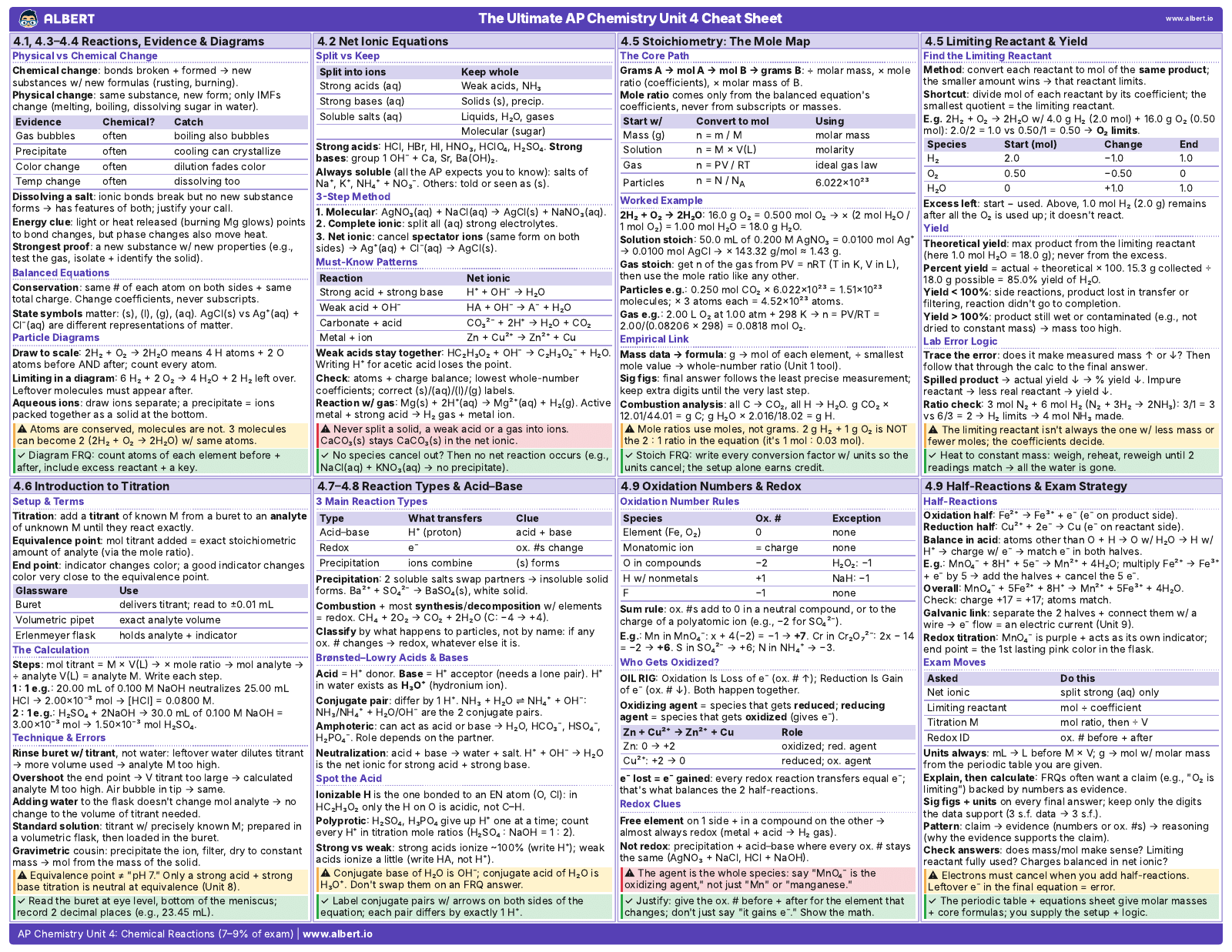
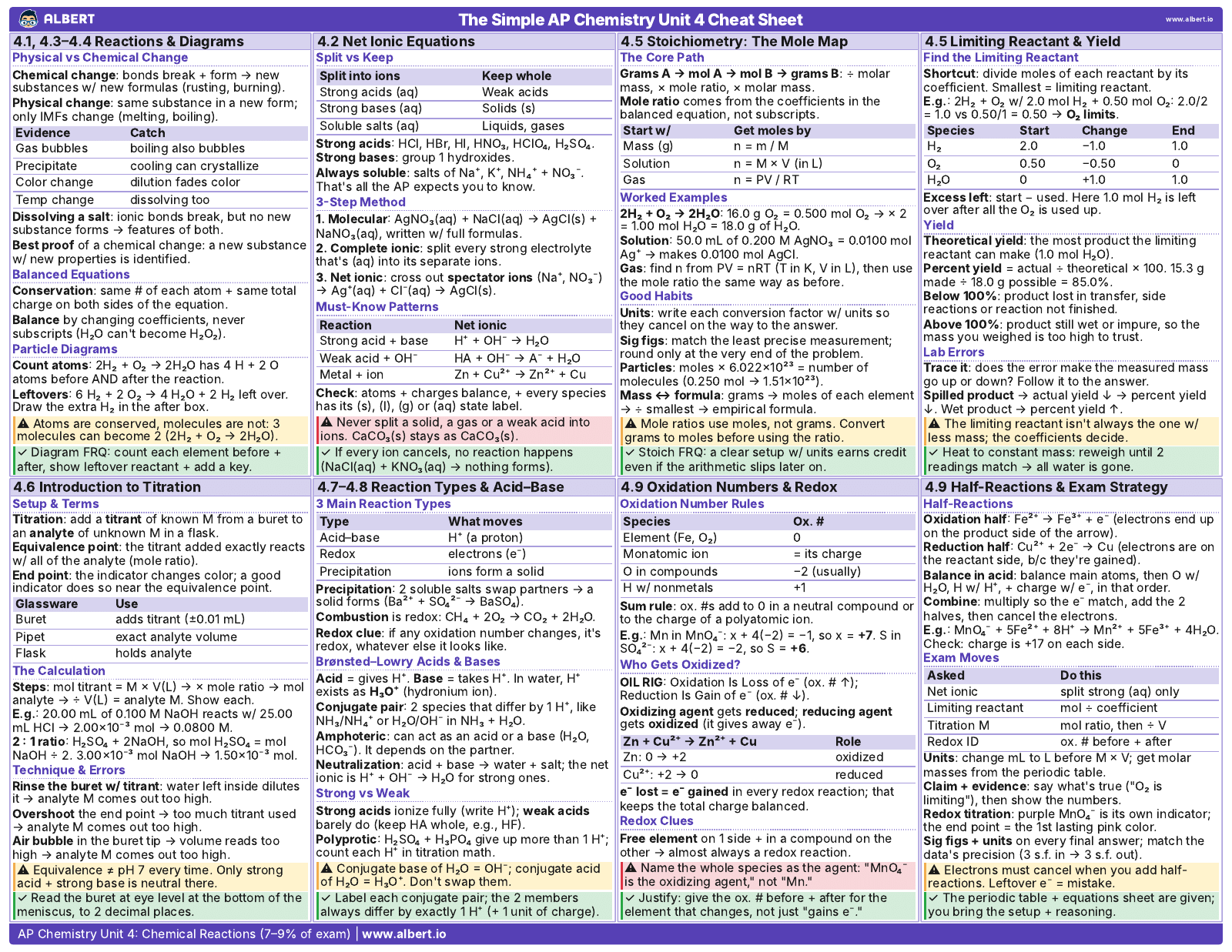
This AP Chem Unit 4 cheat sheet covers chemical reactions: net ionic equations, stoichiometry, limiting reactants, titration, acid–base reactions and redox. Unit 4 makes up 7–9% of the AP® Chemistry exam, but its skills show up in nearly every later unit. Start with the Simple version for the core methods, then use the Ultimate version for worked examples and lab error logic.
Practice AP® Chemistry Unit 4 questions on Albert
What’s on the AP Chem Unit 4 Cheat Sheet?
Both versions of the AP Chem Unit 4 cheat sheet follow the College Board’s topics 4.1 through 4.9 across eight cards: evidence of reactions and particle diagrams, net ionic equations, the mole map, limiting reactants and yield, titration, reaction types and Brønsted–Lowry acids and bases, oxidation numbers, and half-reactions with exam strategy.
The Simple version keeps each card to the main method, one worked number and the most common trap. Use it if stoichiometry or net ionic equations still feel slow.
The Ultimate version adds more worked examples (solution, gas and particle stoichiometry), a full limiting-reactant table, titration error analysis, oxidation number exceptions and a balanced redox equation built from half-reactions. Use it once the Simple methods feel automatic.
You get a periodic table and an equations sheet on the AP® Chemistry exam, so neither sheet repeats them. The cards focus on setting up problems and explaining your reasoning.
AP Chem Unit 4 at a Glance
Unit 4 is weighted at 7–9% of the exam. The skills it teaches, especially stoichiometry and net ionic equations, are reused in kinetics, equilibrium, acids and bases, and electrochemistry.
| Topic | Name | Focus |
|---|---|---|
| 4.1 | Introduction for Reactions | Evidence of chemical change |
| 4.2 | Net Ionic Equations | Which species to split and which to keep |
| 4.3 | Representations of Reactions | Balanced equations and particle diagrams |
| 4.4 | Physical and Chemical Changes | Telling the two apart |
| 4.5 | Stoichiometry | Mole ratios, limiting reactants, yield |
| 4.6 | Introduction to Titration | Equivalence point and concentration |
| 4.7 | Types of Chemical Reactions | Acid–base, redox, precipitation |
| 4.8 | Introduction to Acid-Base Reactions | Brønsted–Lowry acids, bases and conjugates |
| 4.9 | Oxidation-Reduction (Redox) Reactions | Oxidation numbers and half-reactions |
Key Concepts in Unit 4: Chemical Reactions
Evidence, Equations and Particle Diagrams (4.1, 4.3–4.4)
A chemical change breaks and forms bonds to make new substances. A physical change keeps the same substance and changes only its form. Gas bubbles, a precipitate, a color change or a temperature change can all point to a chemical change, but each has a catch: boiling also makes bubbles, and dissolving can change temperature. The strongest evidence is identifying a new substance.
Balanced equations conserve atoms and charge, and you balance them by changing coefficients, never subscripts. Particle diagrams test the same idea visually.
Worked example: a box holds 6 H₂ and 2 O₂ molecules. The reaction 2H₂ + O₂ → 2H₂O uses all 2 O₂ and 4 H₂, so the after box must show 4 H₂O molecules and 2 leftover H₂ molecules.
Dissolving a salt is the classic gray area. Ionic bonds break as the ions separate, but no new substance forms, so the process has features of both physical and chemical change. On an FRQ, either answer can work if you justify it with what happens to the particles.
Exam tip: atoms are conserved, but the number of molecules can change. Count atoms of each element, not molecules.
Net Ionic Equations (4.2)
Net ionic equations show only the particles that actually react. Split strong acids, strong bases and soluble salts that are aqueous into ions. Keep solids, liquids, gases, weak acids and molecular compounds whole. For solubility, the AP exam expects you to know only that salts of Na⁺, K⁺, NH₄⁺ and NO₃⁻ are always soluble.
Worked example: mixing AgNO₃(aq) and NaCl(aq) forms a white precipitate. Splitting the soluble salts gives Ag⁺, NO₃⁻, Na⁺ and Cl⁻. Na⁺ and NO₃⁻ appear unchanged on both sides, so they are spectator ions. The net ionic equation is Ag⁺(aq) + Cl⁻(aq) → AgCl(s).
Exam tip: weak acids stay together. For acetic acid and hydroxide, write HC₂H₃O₂ + OH⁻ → C₂H₃O₂⁻ + H₂O, not H⁺ + OH⁻ → H₂O.
Stoichiometry, Limiting Reactants and Yield (4.5)
Every stoichiometry problem follows the same path: get moles of what you know, use the mole ratio from the balanced equation, then convert to what you want. Moles can come from mass (n = m/M), solution volume (n = M × V) or gas data (n = PV/RT).
Worked example: 4.0 g H₂ (2.0 mol) reacts with 16.0 g O₂ (0.50 mol) by 2H₂ + O₂ → 2H₂O. Dividing moles by coefficients gives 1.0 for H₂ and 0.50 for O₂, so O₂ is the limiting reactant. The theoretical yield is 1.0 mol H₂O, or 18.0 g, and 1.0 mol H₂ is left over. If you collect 15.3 g of water, the percent yield is 15.3 ÷ 18.0 × 100 = 85.0%.
Solution and gas problems use the same path. For example, 50.0 mL of 0.200 M AgNO₃ contains 0.0100 mol Ag⁺, so it can form at most 0.0100 mol AgCl, about 1.43 g. For a gas, 2.00 L of O₂ at 1.00 atm and 298 K holds n = PV/RT = 0.0818 mol, and that number goes straight into the mole ratio. Keep extra digits until the final step, then round to the number of significant figures your least precise measurement supports.
Lab errors follow a simple rule: decide whether the error raises or lowers the measured mass, then follow that through the calculation. A wet product weighs too much, which pushes the percent yield too high.
Exam tip: the limiting reactant is not always the one with less mass. The coefficients decide.
Titration (4.6)
In a titration, a titrant of known concentration is added from a buret to an analyte until the equivalence point, where the titrant exactly reacts with the analyte. An indicator signals the end point, which should fall close to the equivalence point.
Worked example: 20.00 mL of 0.100 M NaOH neutralizes 25.00 mL of HCl. Moles of NaOH = 0.02000 L × 0.100 M = 2.00 × 10⁻³ mol. The ratio is 1 : 1, so the HCl concentration is 2.00 × 10⁻³ mol ÷ 0.02500 L = 0.0800 M. With H₂SO₄, two moles of NaOH react with each mole of acid, so divide the moles of NaOH by 2.
Exam tip: rinsing the buret with water instead of titrant dilutes the titrant. More volume is needed, so the calculated analyte concentration comes out too high.
Reaction Types and Acid–Base Reactions (4.7–4.8)
The three main reaction types are acid–base (a proton transfers), redox (electrons transfer) and precipitation (ions combine into a solid). Classify by what the particles do: if any oxidation number changes, the reaction is redox.
A Brønsted–Lowry acid donates H⁺, and a base accepts it. Conjugate acid–base pairs differ by one H⁺. In NH₃ + H₂O ⇌ NH₄⁺ + OH⁻, NH₃ and NH₄⁺ form one pair and H₂O and OH⁻ form the other. Water is amphoteric: it can act as an acid or a base depending on its partner.
Exam tip: the conjugate base of H₂O is OH⁻, and its conjugate acid is H₃O⁺. Swapping them is a common lost point.
Redox and Half-Reactions (4.9)
Assign oxidation numbers with a few rules: elements are 0, monatomic ions equal their charge, oxygen is usually −2 and hydrogen is usually +1, and the numbers add up to the overall charge. In MnO₄⁻, x + 4(−2) = −1, so manganese is +7.
Oxidation is loss of electrons, so the oxidation number rises; reduction is gain, so it falls. The oxidizing agent is the species that gets reduced. In Zn + Cu²⁺ → Zn²⁺ + Cu, zinc is oxidized and is the reducing agent, while Cu²⁺ is reduced and is the oxidizing agent.
Worked example: combine MnO₄⁻ + 8H⁺ + 5e⁻ → Mn²⁺ + 4H₂O with five copies of Fe²⁺ → Fe³⁺ + e⁻. The electrons cancel, giving MnO₄⁻ + 5Fe²⁺ + 8H⁺ → Mn²⁺ + 5Fe³⁺ + 4H₂O, with a charge of +17 on each side.
Exam tip: name the whole species as the agent. Write “MnO₄⁻ is the oxidizing agent,” not “Mn.”
How Unit 4 Shows Up on the Exam
The AP® Chemistry exam has 60 multiple-choice questions in 90 minutes and 7 free-response questions (3 long, 4 short) in 105 minutes. Each section counts for 50% of the score.
In multiple choice, expect net ionic equations to choose from, particle diagrams, limiting reactant and titration calculations, and questions asking which species is oxidized. On the free-response section, Unit 4 often appears inside larger lab-based questions: write a net ionic equation, calculate a concentration from titration data, find a percent yield, or explain how a lab error affects a result.
Scorers reward clear setups with units and claims backed by evidence. If you say a reactant is limiting, show the numbers that prove it.
Common Mistakes in Unit 4
- Mistake: splitting weak acids or solids into ions. Fix: only strong electrolytes in solution are written as ions.
- Mistake: using grams in a mole ratio. Fix: convert to moles first; coefficients relate moles.
- Mistake: choosing the limiting reactant by smallest mass. Fix: divide moles by coefficients and compare.
- Mistake: assuming every equivalence point is at pH 7. Fix: only strong acid with strong base is neutral there.
- Mistake: mixing up the oxidizing and reducing agent. Fix: the oxidizing agent gets reduced.
Frequently Asked Questions
Can I use this cheat sheet on the exam?
No. It is a study tool for review before the exam. On exam day you get only the official periodic table and equations sheet.
Should I start with the Simple or the Ultimate version?
Start with Simple if you are still learning the mole map and net ionic rules. Move to Ultimate when you can solve the Simple examples on your own, or use it for your final AP Chem Unit 4 review.
Why does Unit 4 matter if it’s only 7–9% of the exam?
Its skills are everywhere. Titration returns in acids and bases, redox returns in electrochemistry, and stoichiometry appears in almost every calculation on the exam.
What’s the best way to practice Unit 4?
Work AP Chem Unit 4 practice problems by writing every conversion factor with units. Then compare your setup to the steps on the AP Chem Unit 4 cheat sheet to see exactly where any mistakes happen.