
Maximize your score with these resources:
- Albert.io AP® English Language question banks
- Free AP® English Language study guides
- Free AP® English Language score calculator
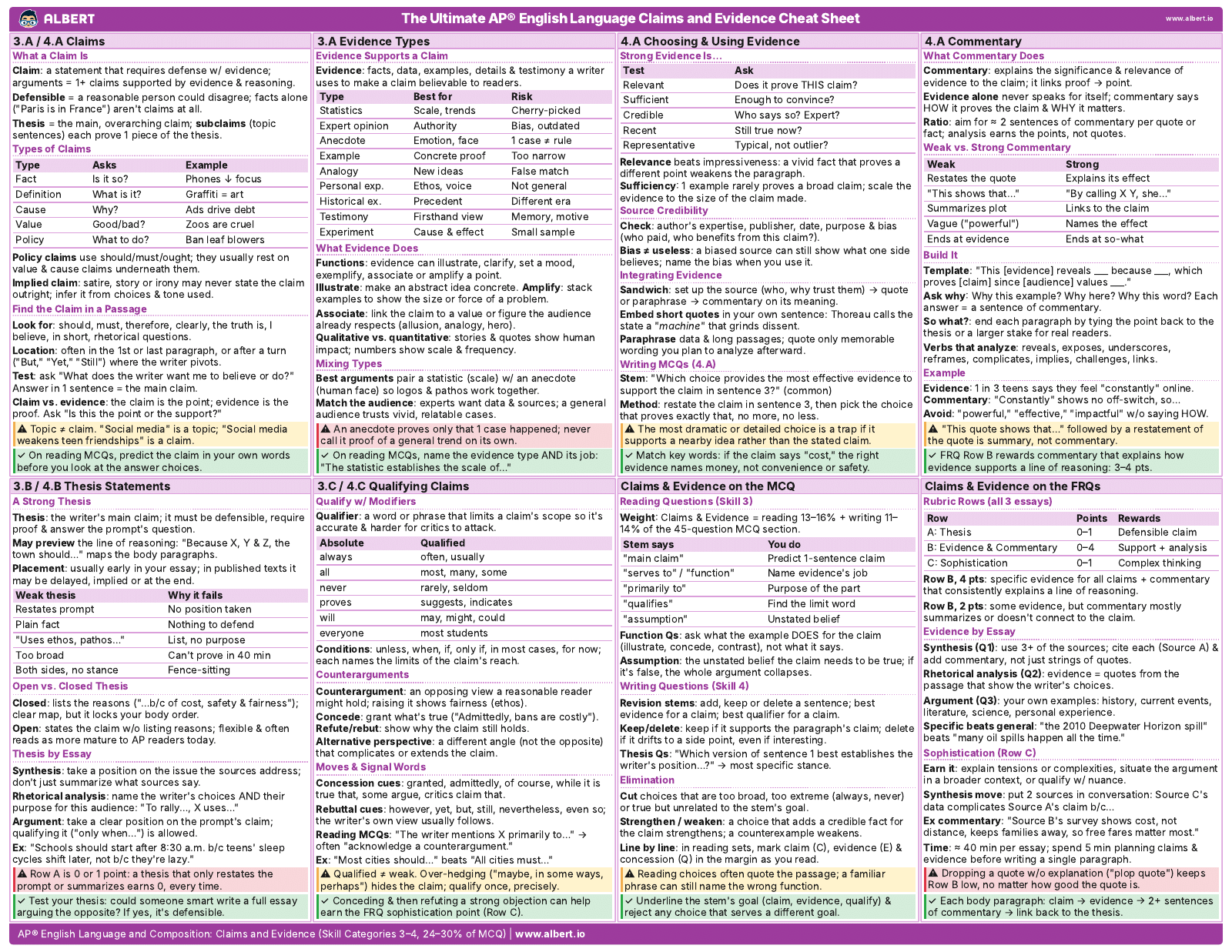
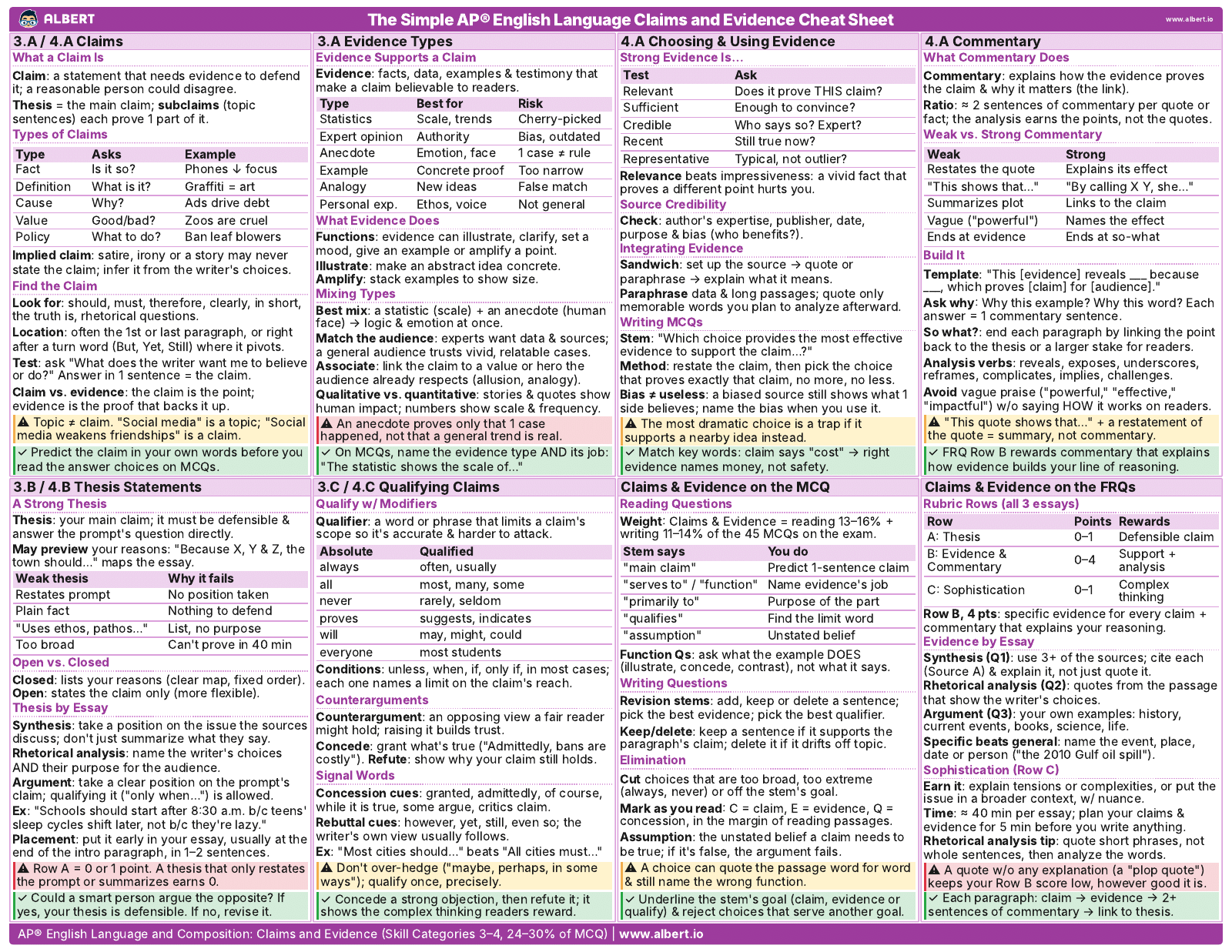
This AP Lang claims and evidence cheat sheet covers how arguments are built: what makes a claim defensible, which kinds of evidence persuade, how commentary connects proof to a point, and how writers qualify their positions. Claims and Evidence skills make up about 24% to 30% of the multiple-choice section and drive Row B on every essay. Choose the Simple version for the core moves or the Ultimate version for every trap and template.
Practice AP® English Language & Composite questions on Albert
What’s on the AP Lang Claims and Evidence Cheat Sheet?
Both versions follow the Claims and Evidence big idea in the College Board’s AP® English Language and Composition Course and Exam Description. The cards are labeled by the course skills they support: identifying claims and evidence (3.A) and building paragraphs with them (4.A), describing and writing a thesis (3.B and 4.B), and qualifying claims (3.C and 4.C). The last two cards show how these skills are tested on the multiple-choice section and the three essays.
The Simple version gives you the five types of claims, a table of evidence types with their strengths and risks, the five tests for strong evidence, a weak-versus-strong commentary table, thesis mistakes to avoid, and a list of qualifying words.
The Ultimate version adds implied claims, the functions evidence can serve, source credibility and bias, how to embed quotations, a commentary template with analysis verbs, open and closed thesis statements, concession and rebuttal signal words, assumption and strengthen-or-weaken questions, and rubric detail for Rows A, B, and C. Start with Simple, then move to Ultimate once you can explain the difference between evidence and commentary without looking.
AP Lang Claims and Evidence at a Glance
| Skill | What you do |
|---|---|
| 3.A | Identify and explain the claims and evidence within an argument |
| 3.B | Identify and describe the overarching thesis and any preview of the argument’s structure |
| 3.C | Explain how claims are qualified through modifiers, counterarguments, and alternative perspectives |
| 4.A | Develop a paragraph with a claim and evidence that supports it |
| 4.B | Write a thesis that requires proof or defense and may preview the argument’s structure |
| 4.C | Qualify a claim using modifiers, counterarguments, or alternative perspectives |
On the multiple-choice section, Claims and Evidence reading questions (Skill Category 3) count for 13% to 16% and writing questions (Skill Category 4) count for 11% to 14%, out of 45 questions in 60 minutes. On the free-response section, these skills decide Row A (thesis) and Row B (evidence and commentary) on the synthesis, rhetorical analysis, and argument essays.
Key Concepts in Claims and Evidence
1. Claims: Statements That Need Defense
A claim is a statement a reasonable person could disagree with, so it needs evidence and reasoning to hold up. “Paris is in France” is a fact, not a claim. “Paris should ban cars from its center” is a claim. An argument’s thesis is its main claim, and each body paragraph usually proves a smaller subclaim that supports it.
Claims come in types. Claims of fact ask whether something is true, claims of value ask whether it is good or bad, and claims of policy ask what should be done. Policy claims usually rest on value and cause claims underneath them, which is why strong arguments for a policy also explain why the problem matters and what causes it.
Worked example: In a passage arguing that cities should plant more trees, the writer might open with heat data, describe a neighborhood without shade, and end with “Every city budget should treat trees as infrastructure.” The last sentence is the claim. The data and the neighborhood are evidence.
Exam tip: On reading questions, put the writer’s claim into one sentence of your own before you look at the choices. Then pick the choice that matches your sentence, not the one that repeats the most words from the passage.
2. Evidence: Types, Functions, and Fit
Evidence is what makes a claim believable: statistics, expert opinion, anecdotes, examples, analogies, personal experience, historical examples, testimony, and experiments. Each type has a strength and a risk. Statistics show scale but can be cherry-picked. An anecdote puts a human face on a problem but proves only that one case happened.
The CED also describes what evidence does. It can illustrate an abstract idea, clarify a point, set a mood, provide an example, associate the claim with something the audience already respects, or amplify a point by stacking examples. Reading questions often ask about this function: “The anecdote in paragraph 2 primarily serves to…”
Strong evidence is relevant, sufficient, credible, recent, and representative. Relevance matters most. A vivid fact that proves a nearby idea weakens a paragraph, because the reader has to work out what it has to do with the claim.
Exam tip: On writing questions that ask for “the most effective evidence,” match the key words of the claim. If the claim is about cost, the right evidence is about money, not convenience.
3. Commentary: The Part That Earns Points
Commentary explains how evidence supports a claim and why it matters. Evidence never speaks for itself. A quotation followed by “This shows that…” and a restatement of the quotation is summary, and AP readers score it as weak commentary.
Good commentary answers “why.” Why this example? Why this word? Why would this audience be moved by it? A useful template: “This evidence reveals ___ because ___, which proves the claim since the audience values ___.” Aim for about two sentences of commentary for every quotation or fact, and end each paragraph by tying the point back to the thesis.
Worked example: Evidence: a survey finds one in three teens feels online “constantly.” Weak commentary: “This shows teens are online a lot.” Strong commentary: “The word ‘constantly’ suggests there is no off switch, so the problem is not screen time alone but the loss of any time away from the feed.”
Exam tip: Swap vague words like “powerful” and “effective” for verbs that name the effect: reveals, exposes, underscores, reframes, complicates.
4. Thesis Statements: Defensible and Specific
A thesis is the writer’s main claim. On the exam, it must take a position that requires defense and must respond to the prompt. It may also preview the line of reasoning (“Because of cost, safety, and fairness, the town should…”). A closed thesis lists its reasons; an open thesis states the claim without listing them, which gives you more freedom as you write.
Four kinds of thesis earn no point: one that restates the prompt, one that states a plain fact, one that lists devices without a purpose (“uses ethos, pathos, and logos”), and one that takes no side.
Worked example: Weak: “Schools have different start times.” Strong: “Schools should start after 8:30 a.m. because teenagers’ sleep cycles shift later, not because teens are lazy.”
Exam tip: Test your thesis by asking whether a smart person could write a full essay arguing the opposite. If they could, it is defensible.
5. Qualifying Claims: Precision, Not Weakness
A qualified claim limits its own scope so it is accurate and harder to attack. Writers qualify with modifiers (“often” instead of “always,” “most” instead of “all,” “suggests” instead of “proves”), with conditions (“unless,” “only if,” “in most cases”), with counterarguments, and with alternative perspectives.
A counterargument is an opposing view a reasonable reader might hold. Writers concede what is true about it, then refute or rebut it to show why their claim still holds. Watch for concession cues like “granted,” “admittedly,” and “some argue,” followed by rebuttal cues like “however” and “still.”
Worked example: “Admittedly, banning cars downtown will hurt some businesses at first. Still, more people on foot means more shoppers passing every storefront.” The first sentence concedes; the second rebuts.
Exam tip: When a reading question asks why a writer mentions an opposing view, “to acknowledge a counterargument before refuting it” is often the right function.
How Claims and Evidence Shows Up on the Exam
In the reading sets, expect questions that ask for the passage’s main claim, the function of a piece of evidence, the purpose of a paragraph, the role of a qualifying phrase, or the assumption a claim depends on. In the writing sets, you revise student drafts: choosing the best evidence for a claim, deciding whether to add, keep, or delete a sentence, and picking the version of a thesis that best states a position.
On the essays, Row A gives 0 or 1 point for a defensible thesis. Row B gives up to 4 points for specific evidence plus commentary that consistently explains a line of reasoning. Row C gives 1 point for sophistication, which you can earn by explaining tensions in the issue, placing the argument in a broader context, or qualifying your claim with real nuance. In the synthesis essay you must draw on at least three sources and cite each one.
Common Mistakes in Claims and Evidence
- Confusing a topic with a claim. “Social media” is a topic. Fix: state what the writer believes about the topic in a full sentence.
- Dropping quotes without commentary. A quotation alone keeps your Row B score low. Fix: follow every quotation with at least two sentences that explain how it proves your claim.
- Treating one anecdote as proof of a trend. Fix: pair a story with data, or limit your claim to what the story shows.
- Picking the most dramatic evidence on writing questions. Fix: choose the option that proves the exact claim in the stem.
- Over-hedging. “Maybe, in some ways, perhaps” hides your position. Fix: qualify once, in a precise place.
Frequently Asked Questions
Can I use this cheat sheet on the exam?
No. Notes aren’t allowed on the AP® English Language exam. Use the cheat sheet while you practice so you can find claims, judge evidence, and write commentary from memory on test day.
Should I start with the Simple or the Ultimate version?
Start with the Simple version of the AP Lang claims and evidence cheat sheet if you are still learning the difference between evidence and commentary. Move to Ultimate when you are practicing timed essays and want templates, signal words, and rubric detail.
How much commentary do I need in an AP Lang essay?
Aim for about two sentences of commentary for every quotation or example. Commentary, not the number of quotations, is what moves you from 2 to 4 points on Row B.
What counts as evidence in the argument essay?
Anything specific you can explain: history, current events, literature, science, or personal experience. A named event or person is stronger than a general statement such as “many people believe.”
Does qualifying my thesis make it weaker?
No. A precise qualification (“Schools should ban phones during class, though not at lunch”) shows careful thinking and can help you earn the sophistication point.