
Maximize your score with these resources:
- Albert.io AP® English Language question banks
- Free AP® English Language study guides
- Free AP® English Language score calculator
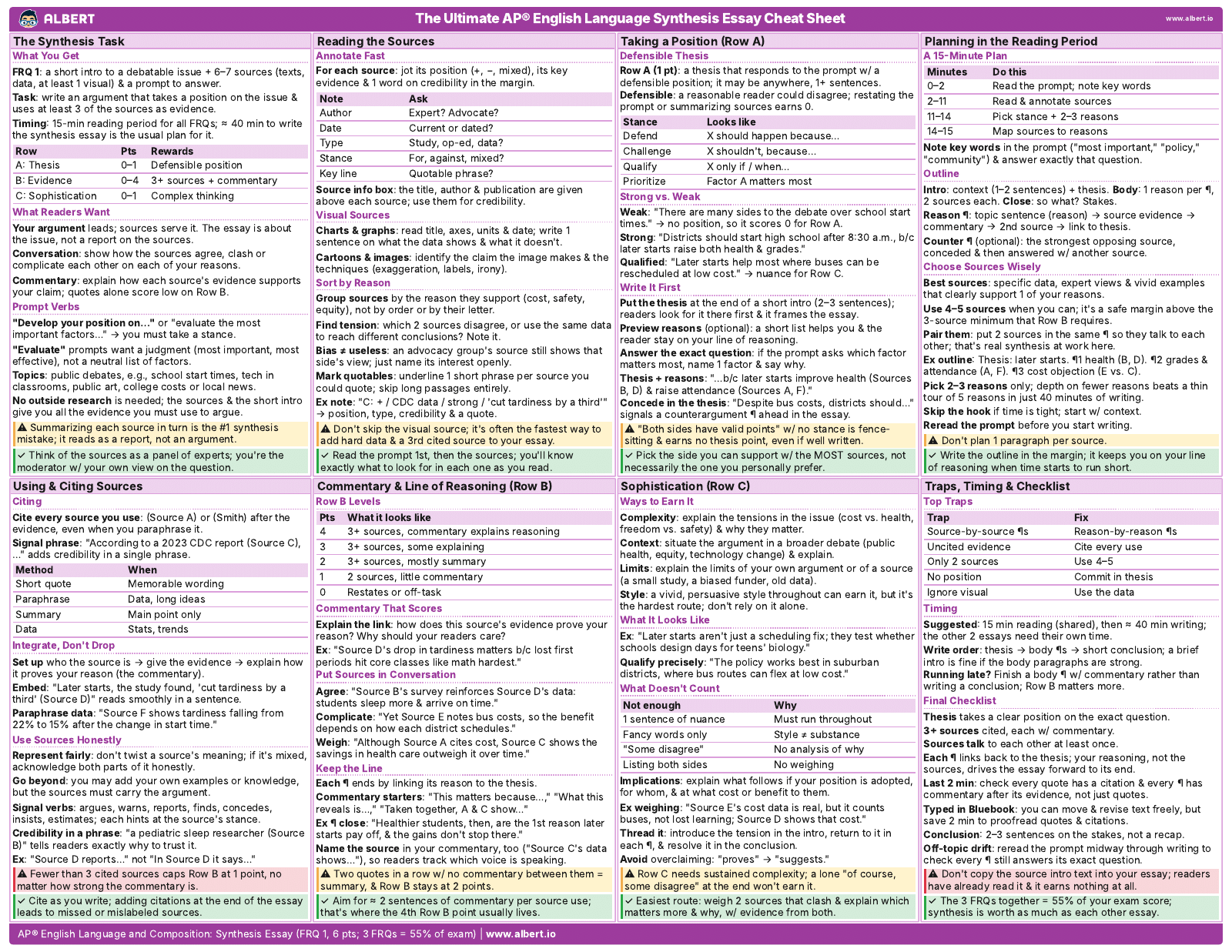
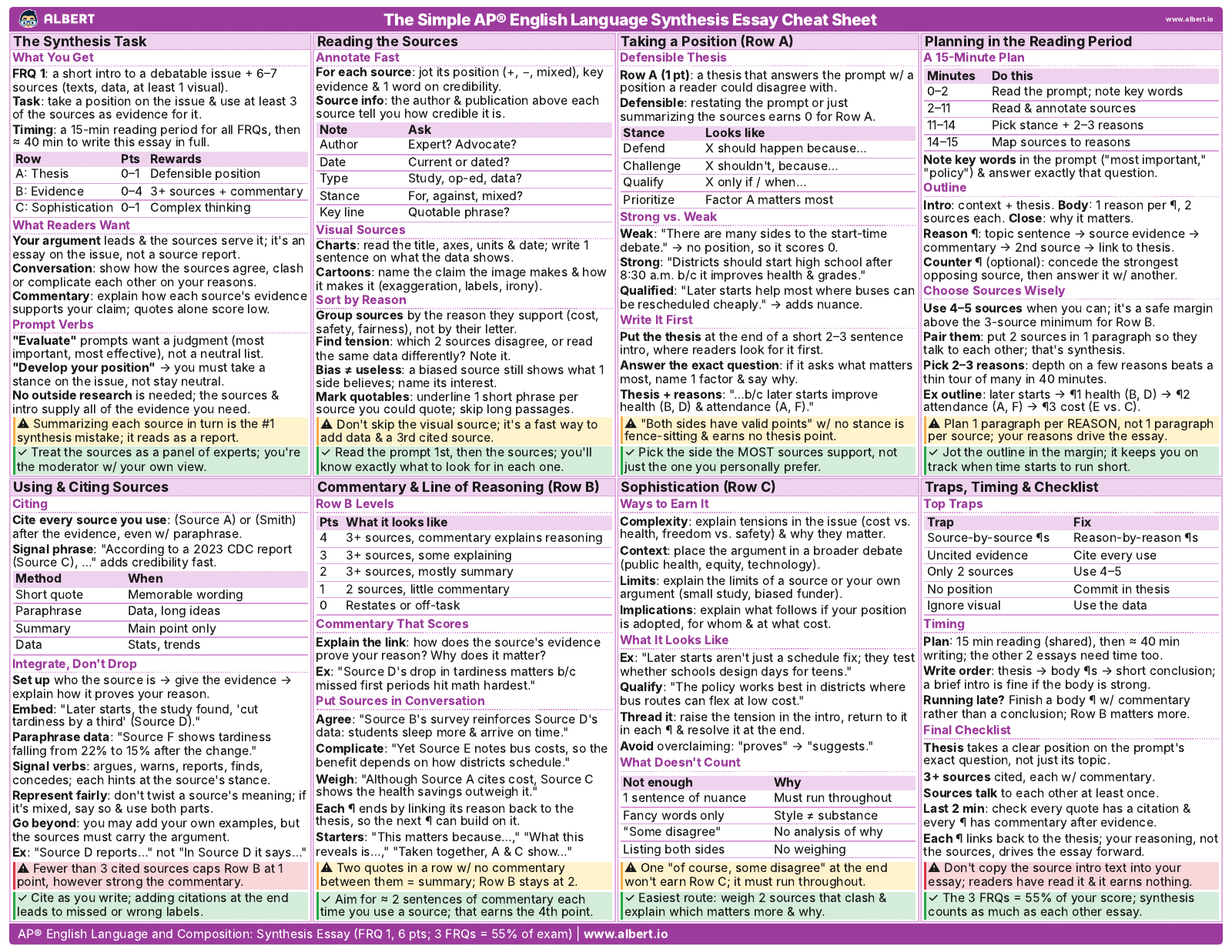
This AP Lang synthesis essay cheat sheet walks you through Free-Response Question 1 from the reading period to the final check: reading and sorting the sources, taking a defensible position, citing at least three sources, writing commentary that puts sources in conversation, and earning the sophistication point. The essay is scored out of 6 points. Choose the Simple version for the core plan or the Ultimate version for every template, example, and trap.
Practice AP® English Language & Composite questions on Albert
What’s on the AP Lang Synthesis Essay Cheat Sheet?
Both versions follow the synthesis question as the College Board describes it in the AP® English Language and Composition Course and Exam Description and the AP Lang exam page. Eight cards cover the task, reading the sources, writing the thesis (Row A), planning during the reading period, using and citing sources, commentary and line of reasoning (Row B), sophistication (Row C), and a final card of traps, timing, and a checklist.
The Simple version gives you the rubric rows, a source annotation table, four thesis stances, a 15-minute reading plan, citation methods, the Row B score levels, and a final checklist.
The Ultimate version adds prompt verbs, how to read charts and cartoons, sorting sources by reason, sample outlines, signal verbs and embedded quotations, sentence starters for commentary, worked examples of agreeing, complicating, and weighing sources, and the specific moves that earn sophistication. Start with Simple, then use Ultimate when you practice timed synthesis essays.
AP Lang Synthesis Essay at a Glance
| Feature | What to know |
|---|---|
| Position on the exam | Free-Response Question 1 of 3 |
| Sources | 6 to 7 sources on one issue, including at least one visual or quantitative source |
| Task | Develop a position on the issue using evidence from at least 3 sources |
| Timing | 15-minute reading period for all essays, then about 40 minutes of writing for this one |
| Scoring | 6 points: Thesis (0 to 1), Evidence and Commentary (0 to 4), Sophistication (0 to 1) |
| Weight | The three essays together are 55% of the exam score |
Key Concepts for the Synthesis Essay
1. Read the Sources With a Purpose
Read the prompt before the sources so you know what you are looking for. For each source, note its position (for, against, or mixed), its key evidence, and a word about its credibility. The information above each source gives the author, publication, and date, which tell you how much weight it deserves. Read visual sources carefully: the title, axes, units, and date of a chart, or the claim and technique of a cartoon.
Then sort the sources by the reasons they support, not by their letters. Note any two sources that disagree or that read the same data differently, because those tensions are where your best commentary will come from.
Exam tip: Don’t skip the visual source. It is often the fastest way to add hard data and a third cited source.
2. Take a Defensible Position
Row A gives 1 point for a thesis that responds to the prompt with a position a reasonable reader could disagree with. You can defend, challenge, or qualify a claim, or argue which factor matters most when the prompt asks you to evaluate. Restating the prompt, summarizing the sources, or saying “both sides have valid points” earns 0.
Worked example: Weak: “There are many sides to the debate over school start times.” Strong: “Districts should start high school after 8:30 a.m. because later starts improve both students’ health and their grades.” Qualified: “Later starts help most where districts can reschedule buses at low cost.”
Exam tip: Choose the side that the most sources support. You are being scored on your argument, not on your personal opinion.
3. Plan During the Reading Period
A simple plan for the 15-minute reading period: spend two minutes on the prompt, about nine minutes reading and annotating sources, three minutes choosing your stance and two or three reasons, and the last minute mapping sources to each reason. Plan one body paragraph per reason, not one per source, and try to use two sources in each paragraph so they speak to each other.
Worked example: Thesis: later start times. Paragraph 1: health (Sources B and D). Paragraph 2: attendance and grades (Sources A and F). Paragraph 3: the cost objection, conceded and answered (Source E against Source C).
4. Use and Cite at Least Three Sources
Cite every source you use, whether you quote, paraphrase, or summarize it, with a parenthetical such as (Source A) or the author’s name. Fewer than three cited sources limits Row B to 1 point. Set up each source with a signal phrase that shows why it is credible (“a pediatric sleep researcher (Source B) found…”), give the evidence, and then explain how it supports your reason.
Embed short quotations in your own sentences and paraphrase statistics: “Source F shows tardiness falling from 22% to 15% after the change.” Represent each source fairly. If a source is mixed, acknowledge both parts.
Exam tip: Cite as you write. Adding citations at the end leads to missing or mislabeled sources.
5. Write Commentary That Puts Sources in Conversation
Row B gives up to 4 points. To earn all four, use specific evidence from at least three sources and consistently explain how it supports your line of reasoning. Two quotations in a row with no explanation between them read as summary and keep the score at 2.
The strongest commentary shows sources interacting. Sources can agree (“Source B’s survey reinforces Source D’s data”), complicate each other (“Yet Source E notes bus costs, so the benefit depends on scheduling”), or be weighed (“Although Source A cites cost, Source C shows the health savings outweigh it”).
Exam tip: Aim for about two sentences of commentary every time you use a source, and end each paragraph by linking its reason back to your thesis.
6. Earn the Sophistication Point
Row C gives 1 point for sophisticated thinking or a vivid, persuasive style. The most reliable routes are explaining the tensions in the issue, placing the argument in a broader context, explaining the limits of a source or of your own claim, and discussing the implications of your position. The complexity has to run through the essay. A single sentence such as “of course, some disagree” at the end will not earn it.
Worked example: “Later start times are not just a scheduling fix; they test whether schools are willing to design the day around how teenagers actually sleep.”
How the Synthesis Essay Is Scored
Readers score the essay as a whole using the three rows. Row A checks for a defensible thesis anywhere in the essay. Row B checks the quality of evidence and commentary and requires at least three sources for scores above 1. Row C rewards sustained complexity or style. Because the three essays together make up 55% of the exam, the synthesis essay is worth as much as each of the other two essays, and planning carefully during the reading period pays off across all three.
Common Mistakes on the Synthesis Essay
- Writing a source-by-source report. Fix: organize by your reasons and use sources as evidence for them.
- Citing only two sources. Fix: plan to use four or five, which leaves a safe margin.
- Dropping quotations without commentary. Fix: follow every source with an explanation of how it proves your point.
- Taking no position. Fix: commit to a side or a clear qualified stance in your thesis.
- Copying the introduction to the sources. Fix: use that context in your own words, briefly.
Frequently Asked Questions
Can I use this cheat sheet on the exam?
No. Notes aren’t allowed on the AP® English Language exam. Use the cheat sheet while you practice so the plan and the rubric are second nature by test day.
Should I start with the Simple or the Ultimate version?
Start with the Simple version of the AP Lang synthesis essay cheat sheet if you are writing your first synthesis essays. Move to Ultimate once you are practicing under time and want templates and worked examples.
How many sources should I use in the synthesis essay?
At least three, and four or five is safer. What matters most is how well you explain each one, not the total count.
Can I add my own examples?
Yes, but the provided sources must carry your argument. Outside examples can support your reasoning without replacing the sources.
Do I have to use the visual source?
No rule requires it, but a chart or graph often gives you precise data quickly. Describe what the data shows in one sentence, cite it, and explain how it supports your reason, just as you would with a written source.
What if the sources mostly disagree with my position?
That usually means a different position would be easier to support. If you keep your stance, concede the strongest opposing source and answer it with evidence from another source, which can also strengthen your case for sophistication.
Do I need a conclusion?
A short conclusion helps, but if time runs out, finishing a body paragraph with strong commentary is worth more than writing a conclusion.