
Maximize your score with these resources:
- Albert.io AP® European History question banks
- Free AP® European History study guides
- Free AP® European History score calculator
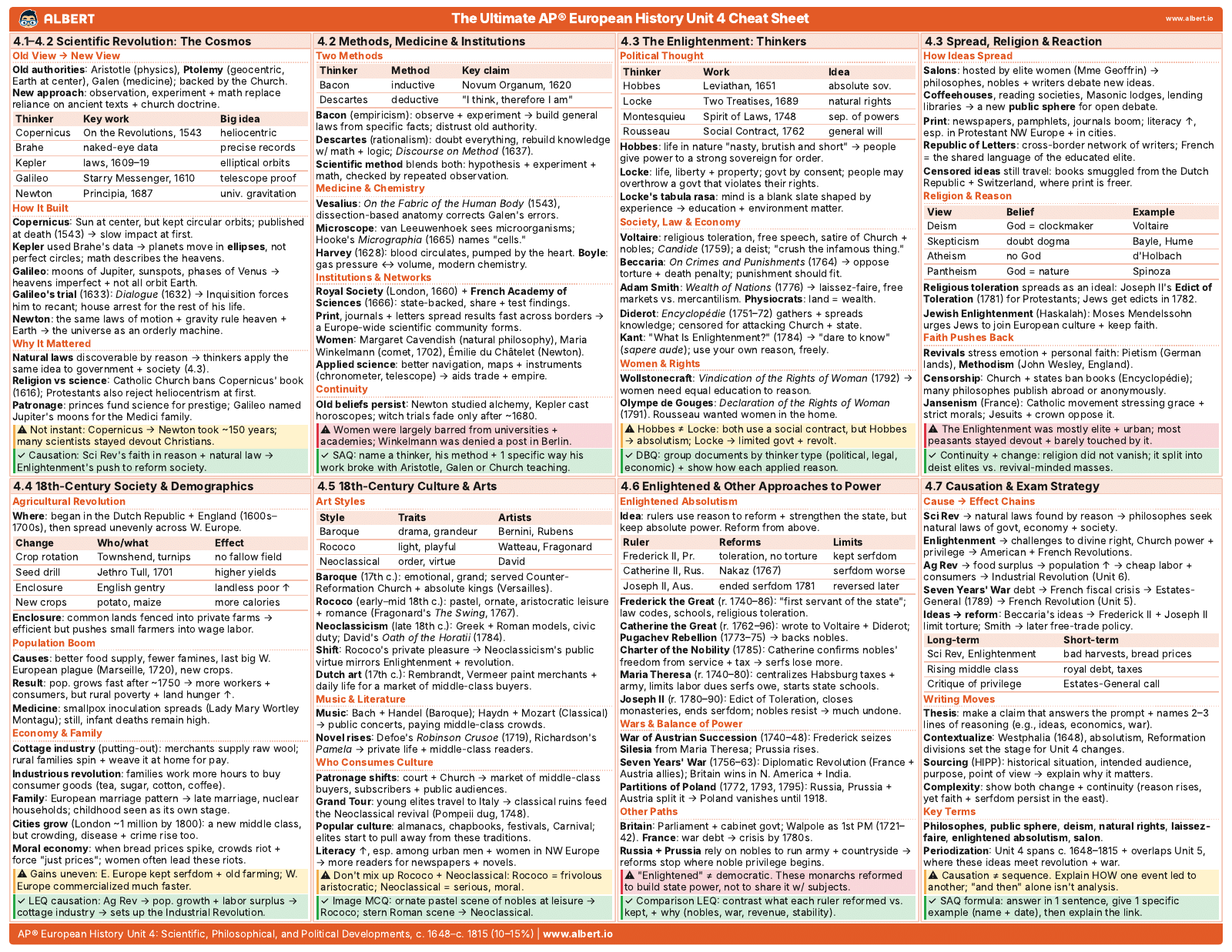
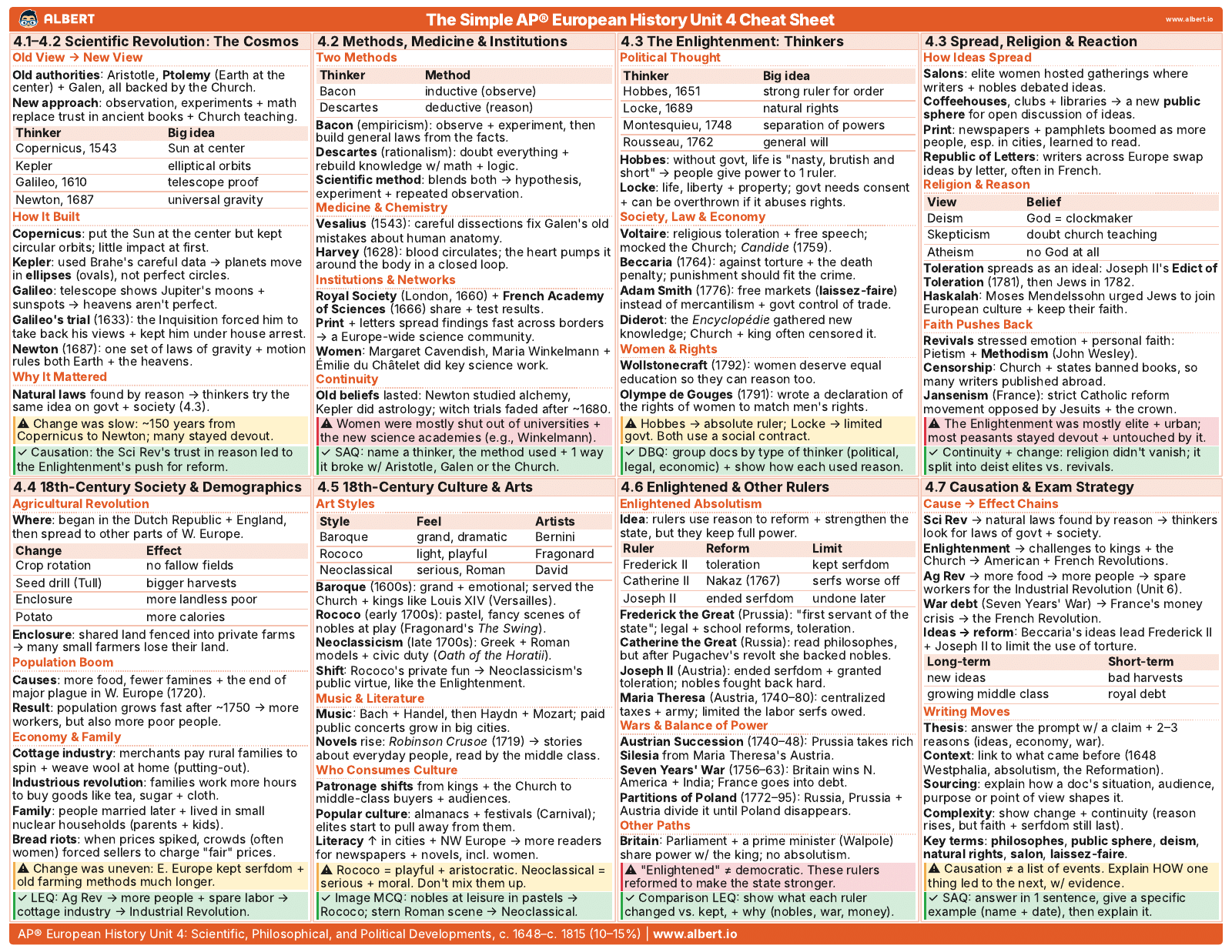
This AP Euro Unit 4 cheat sheet covers the Scientific Revolution, the Enlightenment and the way 18th-century rulers, families and artists responded to them, from about 1648 to 1815. Unit 4 makes up 10–15% of the AP® European History exam. Start with the Simple version to lock in the big ideas, then use the Ultimate version for dense review with names, dates and works.
Practice AP® European History Unit 4 questions on Albert
What’s on the AP Euro Unit 4 Cheat Sheet?
Both versions of the AP Euro Unit 4 cheat sheet follow the College Board’s topics 4.1 through 4.7 across eight cards: the new view of the cosmos, scientific methods and institutions, Enlightenment thinkers, how those ideas spread, 18th-century society, culture and the arts, enlightened absolutism, and a final card on causation and exam writing.
The Simple version keeps each card to the main thinkers and ideas, one or two dates and the trap students fall into most. It is a good first pass if names like Bacon, Descartes and Montesquieu still blur together.
The Ultimate version adds titles and dates of key works, more thinkers (Beccaria, Kant, Spinoza, Bayle), women in science and the Enlightenment, the Agricultural Revolution’s specific changes, art styles with named works, and the wars that shaped 18th-century politics. Use it when you need specific evidence for essays.
AP Euro Unit 4 at a Glance
Unit 4 spans roughly 1648 to 1815 and is weighted at 10–15% of the multiple-choice section. Its ideas also feed directly into Unit 5, where the Enlightenment meets the French Revolution.
| Topic | Name | Focus |
|---|---|---|
| 4.1 | Contextualizing the Scientific Revolution and the Enlightenment | Why new ways of thinking emerged |
| 4.2 | The Scientific Revolution | Copernicus to Newton; new methods |
| 4.3 | The Enlightenment | Reason applied to government, law, religion and the economy |
| 4.4 | 18th-Century Society and Demographics | Agricultural change, population growth, family life |
| 4.5 | 18th-Century Culture and Arts | Baroque, Rococo, Neoclassicism, the novel |
| 4.6 | Enlightened and Other Approaches to Power | Frederick II, Catherine II, Joseph II |
| 4.7 | Causation in the Age of the Scientific Revolution and the Enlightenment | Linking causes and effects across the unit |
Key Concepts in Unit 4: Scientific, Philosophical, and Political Developments
The Scientific Revolution (4.1–4.2)
Before the Scientific Revolution, Europeans relied on ancient authorities: Aristotle for physics, Ptolemy’s Earth-centered universe for astronomy and Galen for medicine, all supported by the Church. Over about 150 years, observation, experiment and mathematics replaced those texts as the test of truth.
The chain is worth memorizing. Copernicus proposed a Sun-centered universe in 1543. Kepler used Tycho Brahe’s precise observations to show that planets move in ellipses. Galileo’s telescope revealed Jupiter’s moons and sunspots, evidence against a perfect, Earth-centered heaven; the Inquisition forced him to recant in 1633. Newton’s Principia (1687) tied it together with universal gravitation: the same laws govern motion on Earth and in the heavens.
Method mattered as much as discovery. Francis Bacon championed induction, building general laws from observed facts. René Descartes championed deduction, starting from doubt and reasoning with mathematics. In medicine, Vesalius corrected Galen through dissection, and Harvey showed that blood circulates. New bodies like the Royal Society (1660) and the French Academy of Sciences (1666) shared and tested findings.
Exam tip: the Scientific Revolution did not end religion or older beliefs. Newton studied alchemy, and most scientists remained Christians. Mentioning that continuity is a simple way to show complexity.
The Enlightenment (4.3)
Enlightenment thinkers, the philosophes, applied the Scientific Revolution’s faith in natural law and reason to human society. Their political ideas come up again and again on the exam.
Hobbes’s Leviathan (1651) argued that people give up power to an absolute sovereign to escape a violent state of nature. Locke’s Two Treatises of Government (1689) also used a social contract but reached the opposite conclusion: government exists to protect life, liberty and property, rests on consent and may be overthrown if it violates those rights. Montesquieu’s The Spirit of the Laws (1748) called for separation of powers, and Rousseau’s The Social Contract (1762) argued for rule by the general will.
Other thinkers carried reason into other areas. Voltaire attacked religious intolerance and censorship. Beccaria’s On Crimes and Punishments (1764) opposed torture and the death penalty. Adam Smith’s Wealth of Nations (1776) argued for free markets over mercantilism. Mary Wollstonecraft’s A Vindication of the Rights of Woman (1792) demanded equal education for women.
Worked example: a document from Diderot’s Encyclopédie criticizes the Church. Sourcing it, you could note that its purpose was to spread knowledge widely and challenge traditional authority, which explains why French authorities repeatedly tried to suppress it.
Exam tip: don’t treat Hobbes and Locke as interchangeable. Both use a social contract, but one defends absolutism and the other limited government.
Spreading Ideas and Religious Change (4.3)
Ideas spread through salons hosted by elite women, coffeehouses, reading societies, Masonic lodges and a booming print market of newspapers and pamphlets. Historians call this new space for debate the public sphere.
Religion changed but did not disappear. Many philosophes were deists who saw God as a clockmaker who set the universe in motion. A few went further into skepticism or atheism. At the same time, revival movements such as Pietism and John Wesley’s Methodism emphasized emotion and personal faith, and Moses Mendelssohn led a Jewish Enlightenment. Toleration gained ground as an ideal; Joseph II’s Edict of Toleration (1781) extended rights to Protestants in the Habsburg lands, and further edicts in 1782 did the same for Jews.
Exam tip: the Enlightenment was largely an elite, urban movement. Most peasants were barely touched by it, a useful qualification for a complex argument.
18th-Century Society and Demographics (4.4)
An Agricultural Revolution began in the Dutch Republic and England. Crop rotation with turnips and clover ended the need for fallow fields, Jethro Tull’s seed drill raised yields, the potato added calories, and enclosure fenced common land into private farms. Food supplies grew, famines became less frequent, and the last major plague in western Europe struck Marseille in 1720.
The result was rapid population growth after about 1750. Many rural families earned extra income through cottage industry, spinning and weaving for merchants under the putting-out system. Families also worked longer hours to buy new consumer goods such as sugar, tea and coffee, a shift historians call the industrious revolution. Most western Europeans married relatively late and lived in nuclear households.
Exam tip: link this topic forward. More food → more people → surplus labor and cottage industry → the Industrial Revolution in Unit 6 is a strong causation argument.
18th-Century Culture and Arts (4.5)
Three art styles dominate exam images. Baroque art (1600s) is grand and dramatic, serving the Counter-Reformation Church and absolute monarchs. Rococo (early to mid-1700s) is light, pastel and ornate, showing aristocrats at leisure, as in Fragonard’s The Swing. Neoclassicism (late 1700s) borrows Greek and Roman models to celebrate civic virtue, as in David’s Oath of the Horatii (1784).
Culture also found new audiences. The novel rose with works like Defoe’s Robinson Crusoe (1719). Public concerts let middle-class listeners hear Haydn and Mozart, and patronage shifted from courts and the Church toward a market of paying buyers.
Exam tip: on image questions, playful aristocratic scenes point to Rococo, while stern, heroic Roman scenes point to Neoclassicism.
Enlightened and Other Approaches to Power (4.6)
Enlightened absolutists used reform to strengthen their states without giving up power. Frederick II of Prussia (r. 1740–86) called himself the “first servant of the state,” reformed laws and allowed religious toleration but kept serfdom. Catherine II of Russia (r. 1762–96) corresponded with Voltaire and Diderot, but after the Pugachev Rebellion (1773–75) she sided with the nobility, and the Charter of the Nobility (1785) left serfs worse off. Joseph II of Austria (r. 1780–90) abolished serfdom and issued his Edict of Toleration, but noble resistance undid much of his work.
Power politics continued. Frederick seized Silesia in the War of the Austrian Succession (1740–48). The Seven Years’ War (1756–63) gave Britain victory in North America and India and left France deeply in debt. Russia, Prussia and Austria partitioned Poland out of existence by 1795. Britain took a different path, with Parliament and a cabinet led by Robert Walpole sharing power with the king.
Exam tip: “enlightened” never means democratic. These rulers reformed to make their states more efficient and powerful.
How Unit 4 Shows Up on the Exam
The AP® European History exam has 55 multiple-choice questions in 55 minutes (40%), 3 required short-answer questions in 40 minutes (20%), a document-based question (25%) and a long essay question (15%). Multiple-choice questions come in sets built around a source, so expect Unit 4 excerpts from philosophes, paintings and population data.
Short-answer questions often ask you to identify and explain one cause or effect of the Scientific Revolution or the Enlightenment. DBQs and long essays from this period reward clear causation and comparison: how Enlightenment ideas challenged traditional authority, or how different rulers used those ideas. Scorers want a defensible thesis, specific evidence and analysis that explains why the evidence matters, not just a list of names.
Common Mistakes in Unit 4
- Mistake: saying the Scientific Revolution replaced religion. Fix: most scientists stayed devout; show change alongside continuity.
- Mistake: mixing up Hobbes and Locke. Fix: Hobbes → absolute sovereign; Locke → natural rights, consent and the right to revolt.
- Mistake: calling enlightened absolutists democratic. Fix: they reformed to strengthen the state and kept full power.
- Mistake: treating the Enlightenment as universal. Fix: it was mostly elite and urban; revivals and traditional faith remained strong.
- Mistake: listing events in order and calling it causation. Fix: explain how each development led to the next.
Frequently Asked Questions
Can I use this cheat sheet on the exam?
No. It is a study tool for review before the exam, not something you can bring into the test.
Should I start with the Simple or the Ultimate version?
Start with Simple if you are still learning who the major thinkers were and what they argued. Switch to Ultimate when you need dates, titles and extra examples to support essays, or for your final AP Euro Unit 4 review.
How much do I need to memorize for Unit 4?
Know the main thinkers, one work or idea for each and a few dates for context. The exam rewards explaining how ideas connect more than memorizing every name.
What’s the best way to practice Unit 4?
Work AP Euro Unit 4 practice questions built on primary sources. For each one, name the thinker or movement, then explain in a sentence how it challenged or supported traditional authority. Check your answers against the cards on the AP Euro Unit 4 cheat sheet.