
Maximize your score with these resources:
- Albert.io AP® US History question banks
- Free AP® US History study guides
- Free AP® US History score calculator
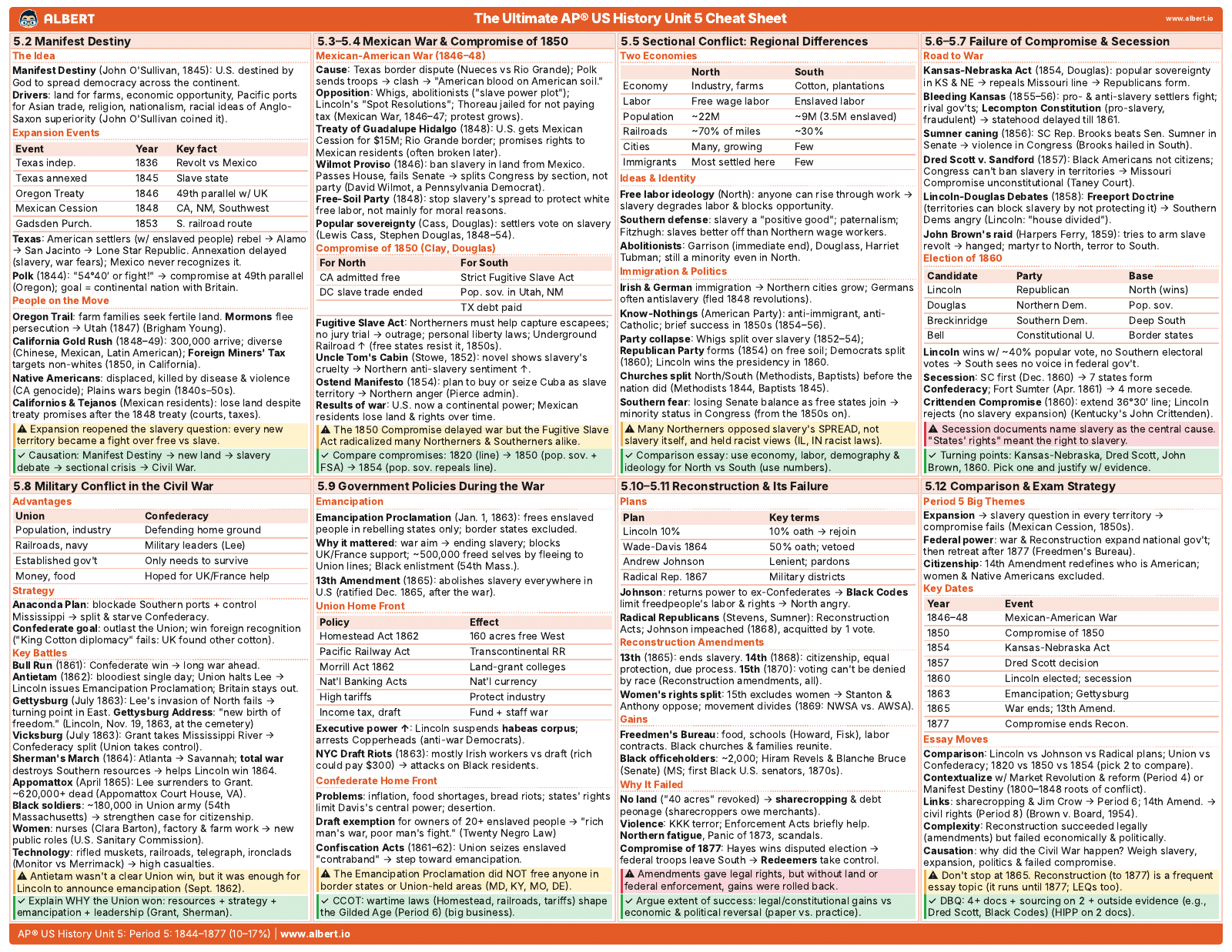
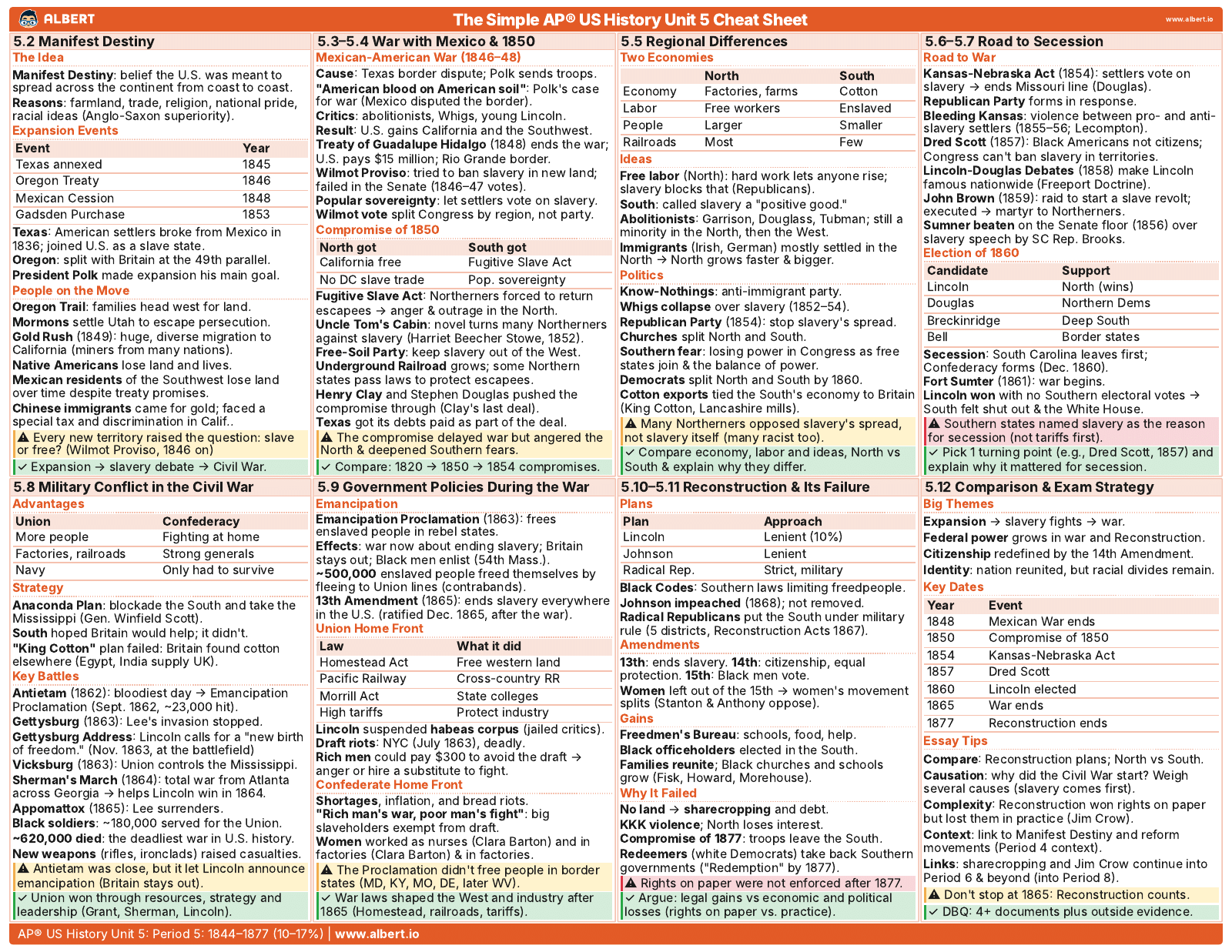
This APUSH Unit 5 cheat sheet covers Period 5, 1844 to 1877: Manifest Destiny, the Mexican-American War, the failed compromises over slavery, secession, the Civil War and Reconstruction. Period 5 makes up 10–17% of the AP® U.S. History exam. Download it below in Simple for a first pass or Ultimate for full detail.
Practice AP® US History Unit 5 questions on Albert
What’s on the APUSH Unit 5 Cheat Sheet?
Both versions use the same eight cards: Manifest Destiny, the Mexican-American War and the Compromise of 1850, regional differences, the failure of compromise and secession, the war’s military side, wartime government policies, Reconstruction and its failure, and comparison with essay strategy.
- Simple is for students learning the period or reviewing for a class test. It gives the main events in order with short notes on why each one pushed the nation closer to war or shaped what came after.
- Ultimate is for students aiming for a 4 or 5. It adds the terms of each compromise, a North vs South comparison table, the 1860 election breakdown, Union and Confederate advantages, wartime laws, Reconstruction plans side by side, and the court cases and events that ended Reconstruction.
Start with Simple until you can tell the story from Texas to 1877 without notes, then move to Ultimate for the evidence that earns essay points.
APUSH Unit 5 at a Glance
Period 5 follows the Market Revolution and reform era of Period 4 and sets up the Gilded Age of Period 6. The AP® U.S. History Course and Exam Description organizes it into these topics.
| Topics | Name | Focus |
|---|---|---|
| 5.1 | Contextualizing Period 5 | The big picture, 1844–1877 |
| 5.2 | Manifest Destiny | Westward expansion and its justifications |
| 5.3 | The Mexican-American War | Causes, opposition, new territory |
| 5.4 | The Compromise of 1850 | California, Fugitive Slave Act, popular sovereignty |
| 5.5 | Sectional Conflict: Regional Differences | Economies, ideologies, parties |
| 5.6–5.7 | Failure of Compromise; Election of 1860 and Secession | Kansas, Dred Scott, John Brown, Lincoln |
| 5.8–5.9 | Military Conflict; Government Policies During the Civil War | Battles, strategy, emancipation, home fronts |
| 5.10–5.11 | Reconstruction; Failure of Reconstruction | Plans, amendments, sharecropping, 1877 |
| 5.12 | Comparison in Period 5 | Connecting and comparing developments |
Key Concepts in Unit 5: Period 5, 1844–1877
Manifest Destiny and the Mexican-American War (5.2–5.3)
In the 1840s, many Americans believed the United States was destined to spread across the continent. Texas, which had broken away from Mexico in 1836, was annexed in 1845 as a slave state. The Oregon Treaty of 1846 split the Northwest with Britain. A border dispute in Texas led President Polk into war with Mexico, and the 1848 Treaty of Guadalupe Hidalgo gave the U.S. California and most of the Southwest. The Gold Rush drew a diverse population west, while Native Americans and Mexican residents lost land.
Reading a source: John O’Sullivan’s 1845 phrase “manifest destiny” appeared in a magazine arguing for Texas annexation. Its purpose was persuasion, and its audience was expansion-minded Americans. Use it to explain the ideology behind expansion, and note who it left out.
Exam tip: Expansion is the starting point of the sectional crisis, because every new territory raised the question of slavery.
The Compromise of 1850 and Regional Differences (5.4–5.5)
The Wilmot Proviso, which tried to ban slavery in land taken from Mexico, split Congress by region. The Compromise of 1850 admitted California as a free state and ended the slave trade in Washington, D.C., but it also passed a harsh Fugitive Slave Act and allowed popular sovereignty in Utah and New Mexico. The Fugitive Slave Act and Harriet Beecher Stowe’s Uncle Tom’s Cabin turned many Northerners against slavery. By the 1850s the North had more people, factories, railroads and immigrants, and its free labor ideology clashed with the South’s defense of slavery as a “positive good.” The Whig Party collapsed and the Republican Party formed to stop slavery’s spread.
Exam tip: Many Northerners opposed slavery’s expansion to protect opportunities for white farmers, not because they supported racial equality.
The Failure of Compromise and Secession (5.6–5.7)
The Kansas-Nebraska Act of 1854 let settlers vote on slavery, overturning the Missouri Compromise line and setting off violence in “Bleeding Kansas.” In 1857 the Dred Scott decision ruled that Black Americans were not citizens and that Congress could not ban slavery in the territories. John Brown’s 1859 raid on Harpers Ferry convinced many Southerners that the North meant to destroy slavery. When Lincoln won the 1860 election without a single Southern electoral vote, South Carolina seceded, followed by six more states. The attack on Fort Sumter in April 1861 began the war.
Reading a source: South Carolina’s 1860 declaration of secession repeatedly cites Northern hostility to slavery. Use it as direct evidence that slavery, not abstract states’ rights, drove secession.
Exam tip: For a turning point question, choose one event, explain what changed because of it, and compare it to what came before.
The Civil War (5.8–5.9)
The Union had more people, industry, railroads and a navy; the Confederacy had strong generals and only needed to survive. The Union’s Anaconda Plan aimed to blockade the South and control the Mississippi. Antietam in 1862 gave Lincoln the chance to issue the Emancipation Proclamation, which turned the war into a fight against slavery and kept Britain out. Gettysburg and Vicksburg in July 1863 were turning points, and Sherman’s March brought total war to the Deep South before Lee surrendered at Appomattox in 1865. At home, the Union passed the Homestead Act, the Pacific Railway Act and high tariffs, while Lincoln expanded executive power by suspending habeas corpus. The Confederacy struggled with shortages, inflation and conflict between its states.
Exam tip: The Emancipation Proclamation applied only to areas in rebellion. The 13th Amendment ended slavery everywhere.
Reconstruction and Its Failure (5.10–5.11)
Lincoln and Andrew Johnson wanted lenient terms for the South. When Southern states passed Black Codes to control freedpeople, Radical Republicans took over, placed the South under military districts and impeached Johnson. The 13th, 14th and 15th Amendments abolished slavery, defined citizenship and equal protection, and barred racial discrimination in voting. The Freedmen’s Bureau built schools, and about 2,000 Black men held public office. But without land, most freedpeople became sharecroppers trapped in debt. The Ku Klux Klan used terror, Northern interest faded after the Panic of 1873, and the Compromise of 1877 removed federal troops from the South.
Reading a source: Suppose a document is a sharecropping contract from the 1870s in which a family owes a share of its crop and pays high prices at the landowner’s store. Use it to show how economic dependence limited the freedom promised by the amendments.
Exam tip: Judge Reconstruction’s success by separating legal gains, which lasted on paper, from economic and political gains, which were mostly reversed.
How Unit 5 Shows Up on the Exam
Multiple-choice sets often use speeches, political cartoons, maps of free and slave states, or excerpts from court decisions. Short-answer questions ask for causes or effects of events like the Compromise of 1850 or Reconstruction.
Period 5 is a favorite for long essays and DBQs: the causes of the Civil War, the extent to which Reconstruction succeeded, or how the war changed federal power. See the AP® U.S. History exam page for the current format and rubrics.
A habit that helps on every Period 5 essay: build a short chain before you write. Expansion created new territory, new territory reopened the slavery question, each compromise failed a little faster than the last, and secession followed Lincoln’s election. Then decide where your prompt fits on that chain and which two or three pieces of evidence best support your claim.
Common Mistakes in Unit 5
- Mistake: Calling states’ rights the main cause of the war. Fix: Secession documents center on protecting slavery.
- Mistake: Saying the Emancipation Proclamation freed all enslaved people. Fix: It covered only rebelling states; the 13th Amendment finished the job.
- Mistake: Mixing up the compromises. Fix: 1820 drew a line; 1850 used popular sovereignty and the Fugitive Slave Act; 1854 erased the line.
- Mistake: Ending the story in 1865. Fix: Reconstruction to 1877 is part of this period and a common essay topic.
- Mistake: Treating all Northerners as abolitionists. Fix: Most opposed slavery’s spread, not slavery itself.
Frequently Asked Questions
Can I use this cheat sheet on the exam?
No. Notes aren’t allowed on the AP® U.S. History exam. The APUSH Unit 5 cheat sheet is a study tool for reviewing events, evidence and connections before exam day.
Should I start with the Simple or Ultimate version?
Start with Simple if Period 5 is new or you have a unit test. Move to Ultimate when you’re preparing essays and need specific evidence.
Which events are most often tested in Period 5?
The Compromise of 1850, the Kansas-Nebraska Act, Dred Scott, the election of 1860, the Emancipation Proclamation and the Reconstruction amendments appear again and again.
How should I explain why Reconstruction ended?
Combine several causes: Southern violence, Northern fatigue and economic depression, Supreme Court rulings that narrowed the 14th Amendment, and the political deal of 1877.
How does Period 5 connect to later periods?
Sharecropping and Jim Crow carry into Period 6, wartime laws helped build the industrial economy, and the 14th Amendment became the basis for the civil rights movement in Period 8.