
Maximize your score with these resources:
- Albert.io AP® US History question banks
- Free AP® US History study guides
- Free AP® US History score calculator
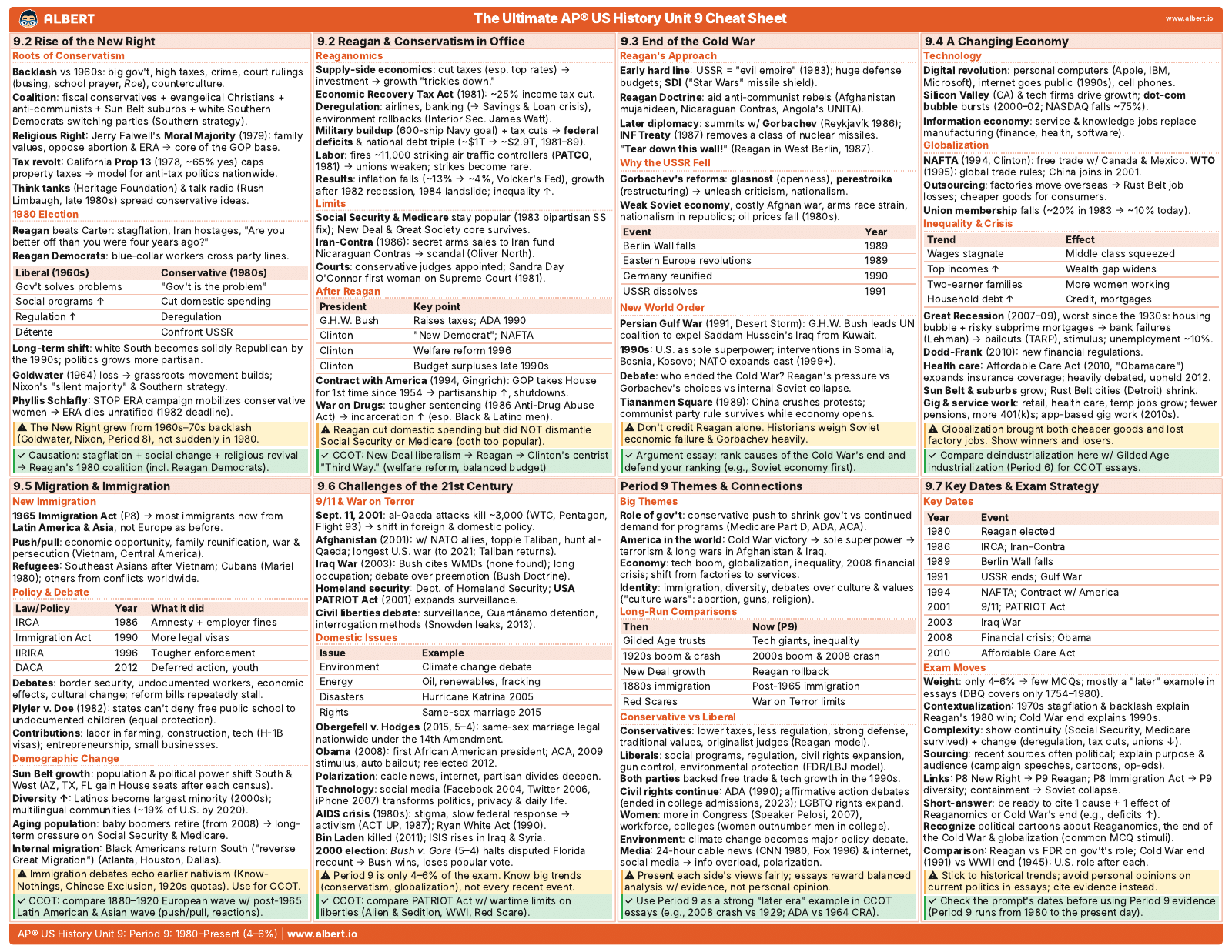
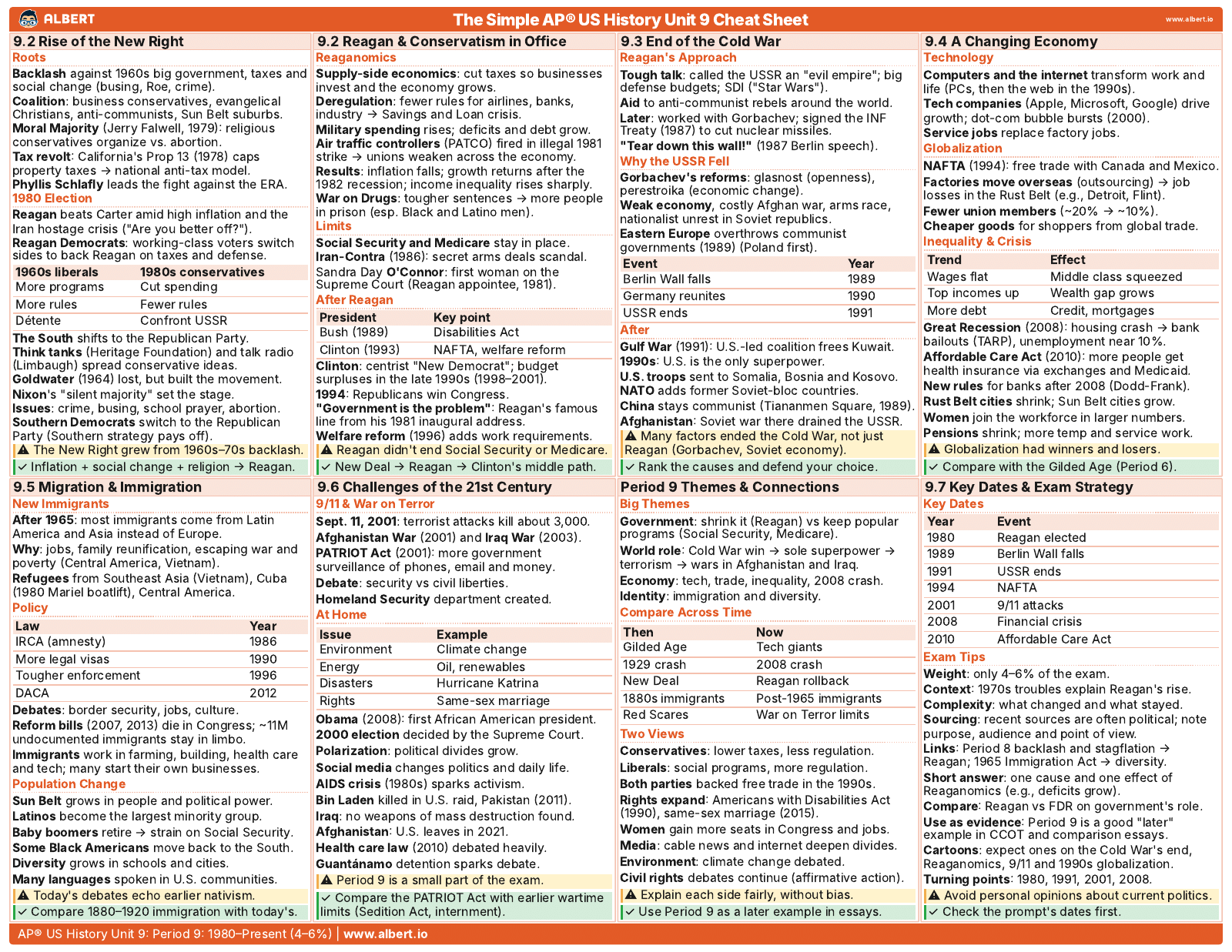
This APUSH Unit 9 cheat sheet covers Period 9, 1980 to the present: the rise of the New Right and Ronald Reagan, the end of the Cold War, a changing economy shaped by technology and globalization, new patterns of immigration, and the challenges of the 21st century. Period 9 makes up 4–6% of the AP® U.S. History exam. Download it below in Simple for a first pass or Ultimate for full detail.
Practice AP® US History Unit 9 questions on Albert
What’s on the APUSH Unit 9 Cheat Sheet?
Both versions share eight cards: the rise of the New Right, Reagan and conservatism in office, the end of the Cold War, the changing economy, migration and immigration, challenges of the 21st century, Period 9 themes and connections, and key dates with exam strategy.
- Simple is for students learning the period or reviewing quickly. It covers the main people, policies and turning points with short notes on why each one matters.
- Ultimate is for students aiming for a 4 or 5. It adds the coalition behind the New Right, Reaganomics and its results, presidents after Reagan, the causes of the Soviet collapse, globalization and inequality, immigration laws, the War on Terror and civil liberties, and a table of long-run comparisons with earlier periods.
Because Period 9 carries the smallest exam weight, most students get the most value from learning its big trends and using them as “later era” evidence in comparison and continuity essays.
APUSH Unit 9 at a Glance
Period 9 follows the turbulent 1960s and 1970s of Period 8. The AP® U.S. History Course and Exam Description organizes it into these topics.
| Topic | Name | Focus |
|---|---|---|
| 9.1 | Contextualizing Period 9 | The big picture, 1980 to the present |
| 9.2 | Reagan and Conservatism | The New Right, Reaganomics, limits of conservatism |
| 9.3 | The End of the Cold War | Reagan, Gorbachev, the Soviet collapse |
| 9.4 | A Changing Economy | Technology, globalization, inequality |
| 9.5 | Migration and Immigration in the 1990s and 2000s | New immigrants, policy debates, Sun Belt growth |
| 9.6 | Challenges of the 21st Century | 9/11, wars in Afghanistan and Iraq, domestic debates |
| 9.7 | Continuity and Change in Period 9 | Connecting the present to the past |
Key Concepts in Unit 9: Period 9, 1980 to the Present
The Rise of the New Right (9.2)
Conservatism grew out of backlash against 1960s liberalism: concerns about big government, high taxes, crime, court decisions and the counterculture. Business conservatives, evangelical Christians organized by groups like the Moral Majority, anti-communists and fast-growing Sun Belt suburbs formed a new coalition. Tax revolts like California’s Proposition 13 and Phyllis Schlafly’s campaign against the ERA showed its strength. In 1980, with inflation high and Americans held hostage in Iran, Ronald Reagan defeated Jimmy Carter, winning many working-class “Reagan Democrats.”
Exam tip: Contextualize Reagan’s election with the stagflation and political frustration of the 1970s.
Reagan and Conservatism in Office (9.2)
Reagan cut income taxes, especially at the top, arguing that supply-side economics would spur investment and growth. He loosened regulations, expanded military spending and broke the air traffic controllers’ strike. Inflation fell and the economy grew after a 1982 recession, but deficits rose sharply and income inequality widened. Popular programs like Social Security and Medicare remained, which shows the limits of the conservative rollback. After Reagan, George H.W. Bush signed the Americans with Disabilities Act, and Bill Clinton governed as a centrist “New Democrat,” signing NAFTA and welfare reform.
Reading a source: Reagan’s 1981 inaugural line that “government is not the solution to our problem; government is the problem” summarized his goals. Use it to contrast with Franklin Roosevelt’s New Deal view of government.
The End of the Cold War (9.3)
Reagan began with a hard line, calling the Soviet Union an “evil empire,” building up the military and backing anti-communist rebels. As Mikhail Gorbachev introduced reforms in the Soviet Union, the two leaders held summits and signed the INF Treaty in 1987. A struggling Soviet economy, the costly war in Afghanistan and nationalist movements weakened the USSR. The Berlin Wall fell in 1989 and the Soviet Union dissolved in 1991, leaving the U.S. as the only superpower. George H.W. Bush then led a coalition that pushed Iraq out of Kuwait in the 1991 Gulf War.
Exam tip: Historians debate who ended the Cold War. A strong answer weighs U.S. pressure, Gorbachev’s choices and the Soviet Union’s internal problems.
A Changing Economy (9.4)
Personal computers and the internet transformed work and daily life, and technology companies drove economic growth. Globalization, including NAFTA and the World Trade Organization, lowered prices for consumers but moved many manufacturing jobs overseas, hurting Rust Belt communities. Union membership declined, wages for many workers stagnated, and wealth concentrated at the top. The Great Recession of 2007–09, triggered by a housing bubble and risky mortgages, led to bank bailouts and new financial regulations.
Exam tip: For globalization, name who gained and who lost.
Migration and Immigration (9.5)
After the Immigration Act of 1965 ended national-origin quotas, most new immigrants came from Latin America and Asia rather than Europe. People came for jobs, to join family and to escape conflict. Congress tried to manage immigration through laws like the 1986 Immigration Reform and Control Act, but comprehensive reform repeatedly stalled. Meanwhile, population and political power shifted toward the Sun Belt, Latinos became the largest minority group, and aging baby boomers put pressure on Social Security and Medicare.
Exam tip: Compare this wave with the 1880–1920 wave from Southern and Eastern Europe, including the nativist reactions to each.
Challenges of the 21st Century (9.6)
The September 11, 2001, attacks killed nearly 3,000 people and led to wars in Afghanistan and Iraq, a new Department of Homeland Security and the USA PATRIOT Act, which expanded government surveillance. Americans debated how to balance security with civil liberties. At home, the country faced debates over climate change and energy, Hurricane Katrina, the 2008 financial crisis and health care. Barack Obama became the first African American president, and the Supreme Court legalized same-sex marriage nationwide in 2015. Political polarization increased as cable news and the internet reshaped how Americans got information.
Exam tip: Compare the PATRIOT Act with earlier wartime limits on civil liberties, such as the Alien and Sedition Acts or the Red Scares.
How Unit 9 Shows Up on the Exam
With only 4–6% of the exam, Period 9 appears in a few multiple-choice questions, often built around political cartoons about the end of the Cold War, speeches by Reagan or later presidents, or data on immigration and the economy.
Its biggest value is in essays. Period 9 examples work well in continuity and change or comparison essays that stretch across periods, such as the role of government from the New Deal to Reagan, or immigration from the 1880s to the 2000s. See the AP® U.S. History exam page for the current format and rubrics.
Starting with the May 2027 exam, all three short-answer questions are required. Each one comes with a source and focuses on a different period between 1491 and 2001, so a Period 9 source can appear there. The DBQ covers 1754 to 1980, so Period 9 won’t be its focus, but the single required long essay can reach into recent decades when the prompt allows.
When writing about recent history, describe each side’s views fairly. Scorers reward historical analysis, not personal opinion about current politics.
A quick way to organize Period 9 for essays is to sort it into four threads: the role of government (Reagan’s rollback and its limits), America’s place in the world (from Cold War victory to the War on Terror), the economy (technology, trade and inequality), and national identity (immigration and diversity). Each thread connects directly to an earlier period, which makes Period 9 evidence easy to fit into long-range comparisons.
Common Mistakes in Unit 9
- Mistake: Treating Reagan’s election as a sudden shift. Fix: Trace the New Right back to the 1960s and 1970s.
- Mistake: Saying Reagan ended major social programs. Fix: Social Security and Medicare remained.
- Mistake: Crediting one person with ending the Cold War. Fix: Weigh several causes.
- Mistake: Describing globalization as all good or all bad. Fix: Show winners and losers.
- Mistake: Using Period 9 evidence for a prompt that ends earlier. Fix: Check the prompt’s dates first.
Frequently Asked Questions
Can I use this cheat sheet on the exam?
No. Notes aren’t allowed on the AP® U.S. History exam. The APUSH Unit 9 cheat sheet is a study tool for reviewing before exam day.
Should I start with the Simple or Ultimate version?
Start with Simple if Period 9 is new or you’re short on time. Move to Ultimate when you want specific evidence for essays.
How much should I study Period 9?
Less than other periods, since it’s only 4–6% of the exam. Focus on Reagan and conservatism, the end of the Cold War, globalization, immigration and 9/11.
How can Period 9 help on essays about earlier periods?
Continuity and change essays often span long stretches of time. Period 9 gives you a modern endpoint, like comparing Reagan’s view of government with the New Deal, or recent immigration with the Gilded Age.
What events from Period 9 are most likely to be tested?
Reagan’s election and policies, the fall of the Berlin Wall and Soviet collapse, NAFTA and globalization, and the September 11 attacks and their aftermath.