

Maximize your score with these resources:
- Albert.io AP® Physics 1 question banks
- Free AP® Physics 1 cheat sheets
- Free AP® Physics 1 score calculator
On the AP® Physics 1 exam, energy questions almost always hinge on one distinction: does the force you’re dealing with conserve mechanical energy, or does it bleed some energy away as heat? Conservative forces let you use conservation of energy freely. Non-conservative forces require you to account for energy lost. Getting this right is the difference between a clean energy-bar chart and a frustrated student trying to figure out where the energy went.
What We Review
What is a Force?
A force is a push or pull acting on an object that causes it to accelerate, decelerate, or change direction. Forces transfer energy between objects and between energy forms. The type of force tells you immediately whether mechanical energy is conserved in that interaction.
Understanding Conservative Forces
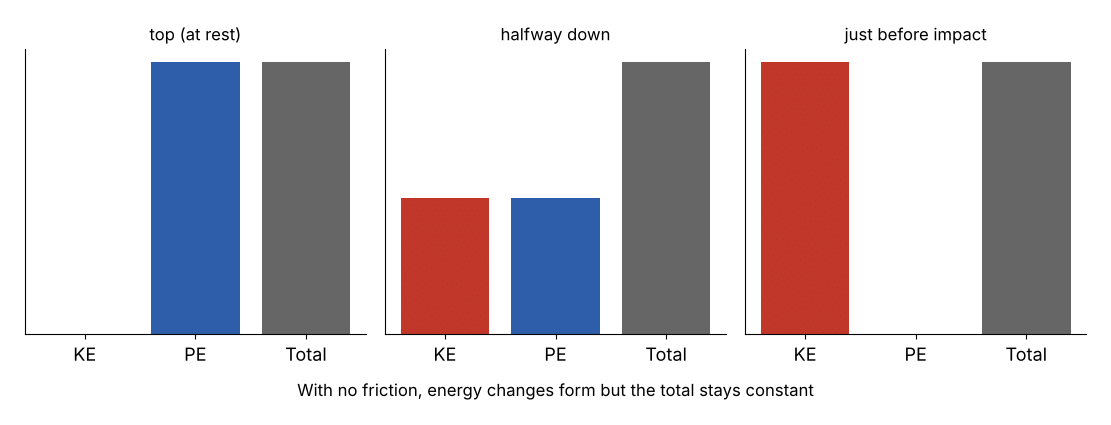
A conservative force does work that depends only on the starting and ending positions — not on the path taken. Because of this, total mechanical energy (kinetic + potential) is conserved when only conservative forces act. Energy is stored as potential energy and can be fully recovered.
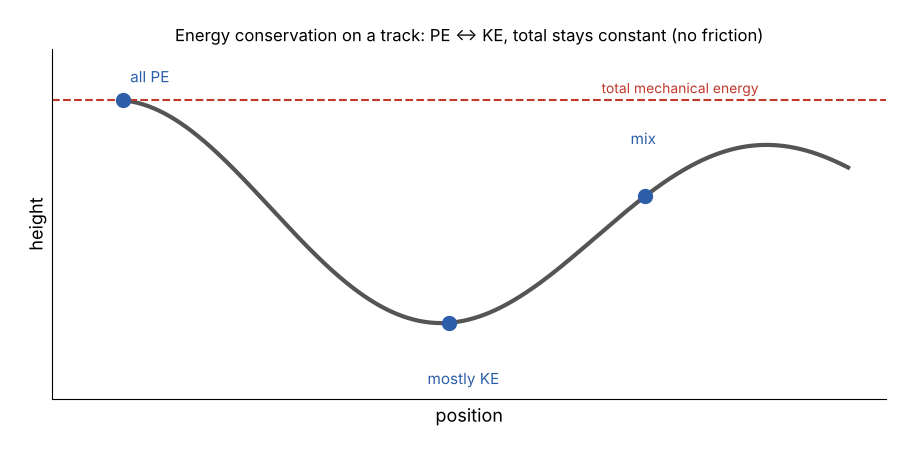
Key test: if an object travels along two different paths between the same two points and the work done is identical both ways, the force is conservative.


Examples of conservative forces:
- Gravitational Force: Stores energy as Ug = mgh. Drop a ball from any height and gravity does the same work whether it falls straight down or rolls down a ramp.
- Spring (Elastic) Force: Stores energy as Ue = ½kΔx². Compress a spring and release it — all stored energy becomes kinetic, nothing lost.
Example: Work done by gravity. A 5 kg object dropped 10 m: W = mgh = 5 × 9.8 × 10 = 490 J. That 490 J equals the decrease in gravitational PE — energy that converts entirely to kinetic energy. No energy is lost.
Understanding Non-Conservative Forces
A non-conservative force does work that depends on the path taken. It dissipates mechanical energy by converting it into thermal energy, sound, or other non-mechanical forms. Once lost, that energy cannot return as kinetic or potential energy.
When non-conservative forces act: ΔEmech = Wnc, where Wnc is the (negative) work done by friction or drag.
Examples of non-conservative forces:
- Kinetic Friction: Converts kinetic energy to thermal energy. The longer the path, the more energy dissipated — classic path-dependence.
- Air Resistance (drag): Dissipates energy as heat through the fluid. Also path-dependent.
- Applied forces: External pushes or pulls can add or remove energy from the system.
Example: Friction work. A 10 kg box slides 5 m across a floor with a friction force of 20 N: Wfriction = −20 × 5 = −100 J. Friction removed 100 J of mechanical energy, converting it to heat.
The Work-Energy Theorem
The Work-Energy Theorem bridges forces and energy changes. Net work equals change in kinetic energy:
Wnet = ΔK
When only conservative forces act, Wnet = −ΔU and total mechanical energy is constant. When non-conservative forces also act, the full energy equation becomes:
ΔK + ΔU = Wnc
where Wnc is negative for dissipative forces like friction.
Comparing Conservative and Non-Conservative Forces
| Property | Conservative Forces | Non-Conservative Forces |
| Path dependence | Path-independent | Path-dependent |
| Energy storage | Stores as potential energy | Dissipates as heat/sound |
| Mechanical energy | Conserved | Not conserved |
| Examples | Gravity, spring force | Friction, air resistance |
| Potential energy associated | Yes (Ug, Ue) | No |
| Reversible work? | Yes | No |
Quick Reference Chart: Conservative vs. Non-Conservative Forces
| Term | Definition |
| Conservative Force | Work is path-independent; stores as potential energy (gravity, spring) |
| Non-Conservative Force | Work is path-dependent; dissipates mechanical energy (friction, drag) |
| Work | Energy transferred by force over displacement; W = Fparallel × d |
| Potential Energy | Stored energy; associated only with conservative forces |
| Kinetic Energy | Energy of motion; K = ½mv² |
| Wnet = ΔK | Work-Energy Theorem: net work equals change in kinetic energy |
Test-Taking Strategies
Use the mnemonic CPND to quickly classify forces:
- Conservative forces = Can store energy (gravity, spring)
- Path doesn’t matter for conservative forces
- Non-conservative forces = Not reversible (friction, drag)
- Dissipation: non-conservative forces lose energy as heat
Cross-topic connections:
- Energy bar charts: if total bar height decreases, a non-conservative force acted. If height is conserved, only conservative forces are present.
- Conservation of energy: Ki + Ui = Kf + Uf only when no non-conservative forces act. Always check first.
- Work-energy theorem: ΔK + ΔU = Wnc is the general form when friction or drag is present.
Common question formats:
- Energy bar charts: identify which type of force caused energy loss. Decreasing total height = non-conservative force acted.
- Ramp problems: frictionless → Ki + Ui = Kf + Uf. With friction → subtract |Wfriction| from the right side.
- Round-trip check: object returns to start with same speed → only conservative forces acted. Returns slower → non-conservative forces did negative work.
Frequent student mistakes:
- Forgetting the negative sign on friction’s work. Wf = −fkd (friction always opposes displacement).
- Applying simple conservation of energy when friction is present. Always check if non-conservative forces act first.
- Labeling normal force as conservative or non-conservative. On horizontal surfaces, normal force is perpendicular to displacement — it does zero work and belongs to neither category in that context.
Test-day shortcut: When friction is the only non-conservative force, use ΔEmech = −fkd directly to find energy lost, without tracking every step of the motion.