
Maximize your score with these resources:
- Albert.io AP® Business with Personal Finance question banks
- Free AP® Business with Personal Finance score calculator
You spend weeks comparing reviews before buying a laptop, but you grab the same granola bar at the checkout every morning without a second thought. A “only 2 left!” banner makes a pair of sneakers suddenly feel urgent, and a free sample at the grocery store makes you oddly likely to buy the whole box. Buying is not purely logical. Topic 2.2 explains the personal, psychological, social, and situational forces behind consumer choices, and the persuasion principles marketers use to tap into them.
This article covers Topic 2.2: Consumer Behavior in Unit 2, Marketing. The topic asks you to explain why and how consumers make buying decisions, describe how legal and technological factors change purchasing patterns, and evaluate and develop sales tactics based on Cialdini’s principles of influence.
By the end, you should be able to:
- Compare rational and habitual buying decisions and their costs.
- Classify influences on buying as personal, psychological, social and cultural, or situational.
- Explain how laws and technology change purchasing patterns.
- Identify all seven of Cialdini’s principles in a marketing example and design a tactic of your own.
How Consumers Decide
Consumers buy goods and services to meet needs and wants. When rival products meet the same need, choices are swayed by price, differentiated features, availability, and advertising.
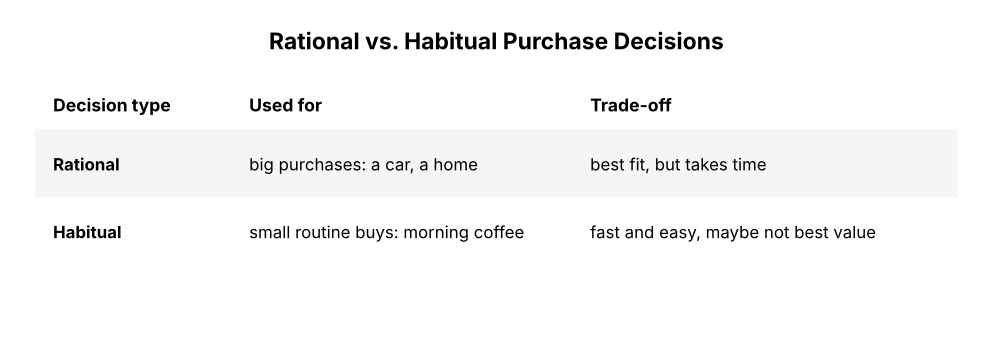
| Decision type | When it is used | Trade-off |
|---|---|---|
| Rational: systematically evaluating alternatives | Consequential purchases such as a home or car | Finds the best fit for needs and wants but costs time spent gathering information |
| Habitual or routine | Small, frequent purchases such as a morning coffee | Fast and easy but may not be the best value |
Four Groups of Influences
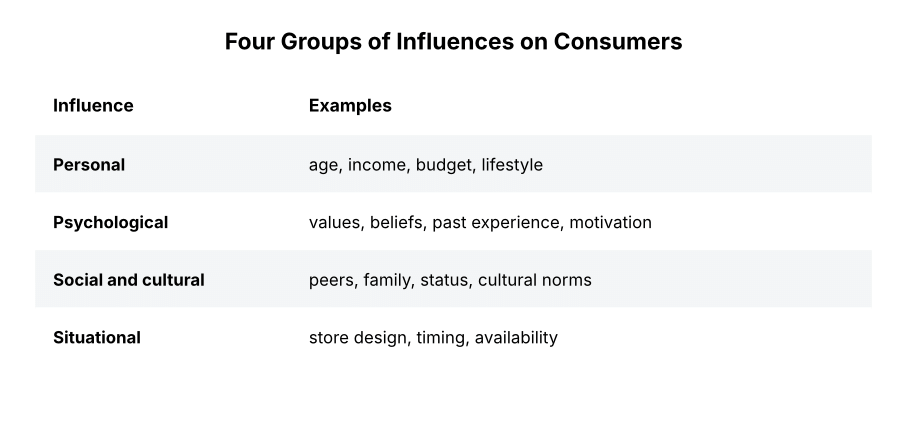
| Influence | Examples | How it works |
|---|---|---|
| Personal | Age, sex, education, income, budget, occupation, lifestyle | Shapes what a consumer needs, wants, and can afford |
| Psychological | Values, beliefs, perceptions, learning from past experience, motivations | Shapes attitudes toward products and willingness to buy |
| Social and cultural | Peers, family, social status, cultural norms, media | Shapes what seems acceptable, desirable, or appropriate |
| Situational | Store design (noise, lighting, organization), timing, availability | Creates temporary conditions that encourage or discourage buying |
Purchasing Patterns, Laws, and Technology
A purchasing pattern is a consumer’s typical routine for buying, including timing, frequency, and quantity. It depends on where a person lives and works, their income, and the patterns of family and friends.
- Laws regulate what consumers can buy and when and where. Consumer protection laws help people avoid fraudulent or unsafe products. When a product becomes harder to get, consumers often find substitute products.
- Technology makes new products accessible. The internet in the 1990s and smartphones in the 2010s changed how people shop, find information, and get entertainment.
Cialdini’s Seven Principles of Influence
Psychologist Robert Cialdini identified psychological factors that make people more likely to say yes to a request. Marketers build sales tactics on them.
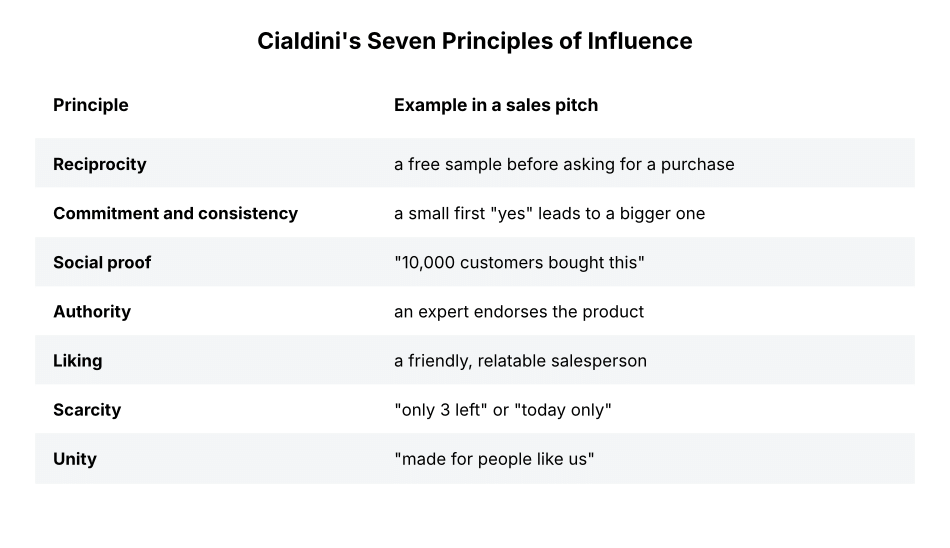
| Principle | Idea | Marketing tactic |
|---|---|---|
| Scarcity | Rare items seem more desirable | “Limited-time offer,” “only one left at this price” |
| Authority | People follow authority figures | Doctor or expert endorsements; highlighting credentials |
| Consensus | People follow social-group norms | Showcasing positive reviews so most people seem to like it |
| Liking | People are swayed by those they like or relate to | Ads featuring people who look and act like the target customer |
| Reciprocity | People feel obligated to return a favor | Free trials, samples, and gifts |
| Consistency | People repeat behavior that fits their self-image | “The choice of health-conscious shoppers” |
| Unity | People follow groups they feel part of | Exclusive online communities; inviting customers to cocreate products |
Consensus vs. unity is the tricky pair. Consensus is about following what most people do. Unity is about belonging to a specific group you identify with.
Worked Example: Evaluating a Sales Tactic
A new reusable water bottle brand targets high school athletes. It plans to give free bottles to five team captains at each school and invite buyers to an online “Hydration Crew” that votes on new colors.
- Principles used: Free bottles use reciprocity and liking, since captains are peers athletes relate to. The Hydration Crew uses unity.
- Strength: The tactics match the target customer’s social influences.
- Weakness: Nothing creates urgency. Adding a limited-edition team color would add scarcity.
Why does this matter? Task 2 of the Business Canvas Project asks you to develop a sales tactic drawing on these principles. As a consumer, recognizing them helps you slow down and make a rational choice when a big purchase is on the line.
Test-Taking Strategies
Mnemonic Devices and Memory Shortcuts
Remember the seven principles with “SALt CRUC”: Scarcity, Authority, Liking, Consensus, Reciprocity, Unity, Consistency. For influences, use “PPSS”: Personal, Psychological, Social, Situational.
Cross-Topic Connections
- Topic 2.1: Marketing to Customers covers the demographic and psychographic data behind personal and psychological influences.
- Topic 1.6: Business Ethics helps you judge when a persuasion tactic crosses an ethical line.
- Topic 1.3: PESTEL Factors introduces the legal and technological factors that reshape buying patterns.
- AP® Microeconomics Topic 1.6: Marginal Analysis and Consumer Choice models the rational side of buying decisions.
Common Question Formats
- An advertisement description asking which Cialdini principle it uses.
- A scenario asking which type of influence affected a purchase.
- A question asking how a new law or technology changed purchasing patterns.
Frequent Student Mistakes
- Mixing up consensus and unity.
- Labeling store lighting or music a psychological factor. It is situational.
- Assuming rational decisions are always better. They cost time and effort.
Test-Day Shortcuts
Look for the trigger word: “limited” means scarcity, “expert” means authority, “reviews” means consensus, “free” means reciprocity, “join” or “member” means unity.
Time Management Tips
The AP Business with Personal Finance Exam on May 4, 2027, is fully digital in Bluebook. About 12 to 15 multiple-choice items assess personal finance across Units 1 through 4. Spending decisions like the rational versus habitual comparison are prime material for those items.
Check for Understanding
Think you’ve got it? Complete the quiz below to make sure. Download your results at the end.