

Maximize your score with these resources:
- Albert.io AP® US History question banks
- Free AP® US History cheat sheets
- Free AP® US History score calculator
In 1947, a builder named William Levitt began turning potato fields on Long Island into 17,000 identical homes. Veterans could buy one with almost nothing down, thanks to federally backed mortgages. Within a decade, millions of Americans owned homes, cars, and televisions they couldn’t have imagined during the Depression. The postwar years brought the longest economic boom in American history, but its benefits didn’t reach everyone. Topic 8.4 covers what drove the boom and who was left behind.
This article covers Topic 8.4: Economy after 1945 in Period 8, 1945 to 1980. The topic asks you to explain the causes of postwar economic growth, how it reshaped where and how Americans lived and worked, and how its benefits were unevenly shared.
By the end, you should be able to:
- Explain the causes of the postwar economic boom.
- Describe the growth of suburbs and the Sun Belt.
- Explain how government policy shaped housing and migration.
- Identify groups excluded from postwar prosperity.

What We Review
Causes of the Boom
| Cause | Explanation |
|---|---|
| Pent-up demand | Americans had saved during the war, when rationing limited spending, and were ready to buy |
| Military spending | Cold War defense budgets funded aerospace, electronics, and research, creating a “military-industrial complex” |
| The GI Bill (1944) | Gave veterans low-interest home and business loans plus college tuition. About 8 million veterans used its education benefits. |
| Baby boom | About 76 million babies were born between 1946 and 1964, creating demand for homes, schools, and consumer goods |
| Global dominance | With Europe and Japan rebuilding, the U.S. produced roughly half the world’s manufactured goods by the late 1940s |
| Cheap energy and new technology | Inexpensive oil and advances in automation, computers, and plastics boosted productivity |
Suburbs and the Car
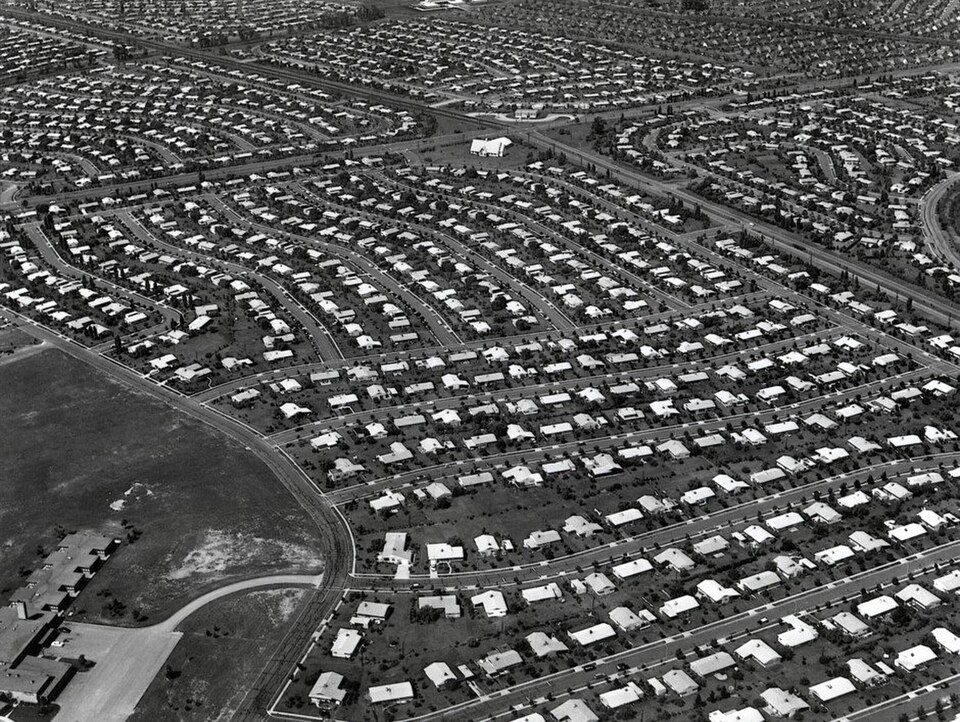
- Suburban growth: By 1960, about a third of Americans lived in suburbs. Mass-produced communities like Levittown made homeownership affordable.
- Federal Housing Administration (FHA): Backed long-term, low-down-payment mortgages, making buying cheaper than renting for many families.
- Federal-Aid Highway Act (1956): Funded 41,000 miles of interstate highways, encouraging commuting, trucking, and car culture.
- Consumer culture: Shopping centers, drive-in restaurants, and television advertising spread.
The Sun Belt
Millions of Americans moved to the South and Southwest, the Sun Belt.
- Defense plants and military bases in California, Texas, and Florida created jobs.
- Air conditioning made hot climates more livable.
- Lower taxes, weaker unions, and cheaper land attracted businesses.
This migration shifted population, and later political power, toward the South and West, a trend that shaped the rise of modern conservatism.
Changes in Work
- Shift to white-collar work: By 1956, white-collar workers outnumbered blue-collar workers for the first time.
- Unions at their peak: About a third of nonfarm workers belonged to unions in the mid-1950s. The AFL and CIO merged in 1955. Contracts brought rising wages, health insurance, and pensions.
- Corporate growth: Large corporations and “organization men” in gray flannel suits symbolized the era.
- Agribusiness: Mechanized farming meant fewer, larger farms and fewer farmworkers.
Who Was Left Out
| Group | Barriers to Prosperity |
|---|---|
| African Americans | Redlining by banks and the FHA denied mortgages in Black neighborhoods. Levittown and many suburbs banned Black buyers. Urban renewal often destroyed Black neighborhoods. |
| Rural and Appalachian poor | Mechanization and declining coal jobs left many regions behind |
| Mexican Americans | Low-wage farm labor and “Operation Wetback” (1954), a mass deportation campaign |
| American Indians | The termination and relocation policies moved many to cities, often into poverty |
| Inner cities | “White flight” to the suburbs drained tax revenue and jobs from urban centers |
In The Other America (1962), Michael Harrington estimated that 40 to 50 million Americans lived in poverty, a finding that helped inspire the War on Poverty.
Why does this matter? The postwar economy explains much of what followed in Period 8: suburban conformity, the civil rights movement’s focus on housing and jobs, the Great Society’s War on Poverty, and the Sun Belt’s political rise. On essays, pairing prosperity with exclusion shows the complexity graders reward.
Test-Taking Strategies
Mnemonic Devices and Memory Shortcuts
- “GI, FHA, highways.” The three federal policies behind suburban growth.
- “Boom babies, boom economy.” The baby boom drove demand.
- “Sun, bases, AC.” Why people moved to the Sun Belt.
Cross-Topic Connections
- Topic 7.12: Wartime savings and production set up the boom.
- Topic 8.5: Postwar prosperity shaped suburban culture and its critics.
- Topic 8.9: The Great Society tried to reach those left out of prosperity.
- Topic 6.10: The Gilded Age middle class offers a comparison with the postwar middle class.
Common Question Formats
- Stimulus MCQ. A Levittown advertisement or a highway map, and you identify the economic change it reflects.
- Causation SAQ. You explain two causes of postwar economic growth.
- Continuity and change SAQ. You explain how postwar prosperity changed or didn’t change life for African Americans.
- LEQ. You evaluate the extent to which postwar prosperity was shared by all Americans.
Frequent Student Mistakes
- Treating prosperity as universal. Redlining and poverty persisted.
- Ignoring government’s role. Federal programs drove suburban growth as much as the market did.
- Confusing the Sun Belt with the Rust Belt. The Sun Belt grew. The Rust Belt later declined.
- Calling unions weak in the 1950s. This was their peak.
Test-Day Shortcuts
- Spot “redlining.” It’s the key word for housing discrimination.
- Use Harrington. The Other America connects the 1950s to the Great Society.
- Link migration to politics. Sun Belt growth sets up Period 9’s conservatism.
Time Management Tips
- Multiple choice: Section IA has 55 questions in 55 minutes, about 1 minute each. Economic graphs often test the direction of a trend.
- Short answer: Section IB has 3 required questions in 40 minutes, roughly 13 minutes each. Pair a cause with a specific law or program.
- Essays: The DBQ gets 60 minutes, including a 15-minute reading period, and the single required LEQ gets 40 minutes. Balance prosperity evidence with exclusion evidence in a qualified thesis.
Check for Understanding
Think you’ve got it? Complete the quiz below to make sure. Download your results at the end.