

Maximize your score with these resources:
- Albert.io AP® US Government question banks
- Free AP® US Government cheat sheets
- Free AP® US Government score calculator
What is the Electoral College?
The Electoral College is one of the most distinctive features of American democracy — and one of the most reliably tested topics on the AP® US Government & Politics exam. Unlike most democracies, where the presidency is decided by a direct national popular vote, the United States uses an indirect system: voters choose electors, who then formally elect the president.
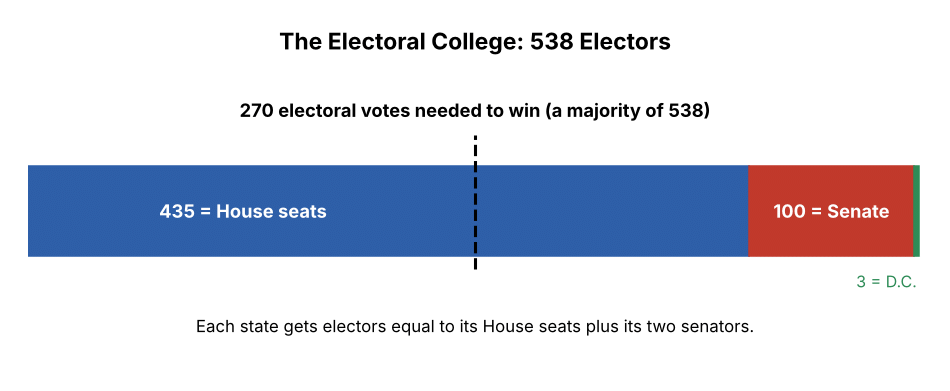
Here’s the core idea: a candidate doesn’t need to win the most votes nationwide. They need to win 270 of the 538 available electoral votes. That’s why it’s possible — and has happened — for a candidate to win the presidency while losing the popular vote.
Electoral College Origins
The Founders designed the Electoral College in Article II, Section 1 of the Constitution. They were skeptical of direct democracy — they worried that an uninformed public could be manipulated into choosing an unqualified candidate. The Electoral College was meant to filter popular will through a body of informed state-level leaders.
Key structural points:
- Each state receives a number of electors equal to its total congressional representation (House seats + 2 senators)
- The total number of electors is 538 (435 House + 100 Senate + 3 for D.C., per the 23rd Amendment)
- A candidate needs a majority — 270 electoral votes — to win the presidency
- The Constitution does not technically require electors to vote for their pledged candidate (faithless electors), though most states now have laws requiring it
Four times in U.S. history, the popular vote winner has lost the Electoral College:
| Year | Popular Vote Winner | Electoral College Winner |
|---|---|---|
| 1876 | Samuel Tilden | Rutherford B. Hayes |
| 1888 | Grover Cleveland | Benjamin Harrison |
| 2000 | Al Gore | George W. Bush |
| 2016 | Hillary Clinton | Donald Trump |
Effects of the Electoral College
Understanding the winner-take-all system is essential for this exam. In 48 of 50 states (all except Maine and Nebraska), the candidate who wins the state’s popular vote receives all of that state’s electoral votes. This creates several significant effects:
- Swing state focus: Candidates concentrate campaign spending and appearances in competitive states (Ohio, Florida, Pennsylvania, Wisconsin) where either party could win. Safe states like California (solidly Democratic) or Texas (solidly Republican) are largely ignored.
- Minority party voters are marginalized: A Republican in California and a Democrat in Texas effectively have no influence on the presidential outcome — all electoral votes go to the winner regardless.
- Small states get a disproportionate voice: Because every state gets at least 3 electoral votes (2 senators + at least 1 House seat), small states like Wyoming and Vermont are significantly over-represented relative to their population.
- Popular vote ≠ presidency: The winner-take-all system can produce outcomes where the presidency goes to the candidate with fewer total votes nationally.
How are Electoral College Votes Apportioned?

Electoral votes are reapportioned every 10 years following the Census, based on shifts in state population. States that gain population gain electoral votes; states that lose population lose them.
- Formula: Electoral votes = House seats + 2 (senators)
- Total: 538 electoral votes
- Majority needed: 270
- Most populous states dominate: California (~54), Texas (~40), Florida (~30), New York (~28)
- Least populous states get the minimum: 3 electoral votes each (Wyoming, Vermont, Alaska, etc.)
Mathematically, a candidate can win the presidency by carrying just the 12 most populous states — without winning a single other state. This is why population-heavy states are so strategically important, despite often being considered “safe” for one party.
Criticisms of the Electoral College
The AP exam frequently asks you to explain arguments for and against the Electoral College. Know both sides:
| Criticism | Defense |
|---|---|
| Candidates can win without a popular vote majority — undemocratic | Encourages candidates to build broad geographic coalitions, not just urban majorities |
| Swing state focus ignores most of the country | Federalist system: states, not individuals, should matter in presidential elections |
| Minority party voters in safe states have no voice | Small states retain influence they’d lose in a direct popular vote |
| Faithless electors can subvert voter intent | Most states now legally bind electors; faithless electors are historically rare |
The Electoral College can only be abolished through a constitutional amendment, which requires two-thirds of Congress and ratification by three-fourths of states. Swing states and small states both have strong incentives to block such an amendment — which is why reform efforts have consistently failed.
The Electoral College in Action
The mechanics of how the Electoral College actually works in practice:
- Electors are typically party loyalists selected by state parties. They meet at state capitols in December to cast their ballots.
- Sealed ballots are sent to Congress and opened by the Vice President (as President of the Senate) in January in a joint session of Congress.
- If no candidate reaches 270 (possible with a strong third-party candidate), the House of Representatives chooses the president from the top three electoral vote getters — with each state delegation casting one vote. A candidate needs 26 state votes to win.
- In that same scenario, the Senate chooses the vice president from the top two candidates, by simple majority.
A Sample Free Response Question
1. Describe the winner-take-all feature of the Electoral College.
2. Explain one way in which the winner-take-all feature of the Electoral College affects how presidential candidates from the two major political parties run their campaigns.
3. Explain one way in which the winner-take-all feature of the Electoral College hinders third party candidates.
4. Explain two reasons the Electoral College has not been abolished.
Here’s how to approach each part:
- Part 1: 48 states award all electoral votes to the state popular vote winner. Maine and Nebraska are the exceptions (congressional district method). No split — winner takes all.
- Part 2: Candidates focus on swing states. A Republican who wins Texas by 1 vote gets the same 40 electoral votes as one who wins by 2 million — so they invest time and money where the margin is competitive (Pennsylvania, Wisconsin, Arizona).
- Part 3: Third parties cannot win electoral votes unless they can outright win a state’s popular vote. Even a candidate with 20% national support is shut out of electoral votes if they can’t carry any state — making it nearly impossible to reach 270.
- Part 4: (a) Constitutional amendment is the only path — very difficult, requires 2/3 of Congress + 3/4 of states; swing states and small states both benefit from the current system. (b) Concerns that a direct popular vote would shift all campaign attention to high-population urban centers, marginalizing rural states.
Test-Taking Strategies
Mnemonics and Memory Shortcuts
- 538 = 435 + 100 + 3 (House + Senate + D.C.) — write this formula on your scratch paper at the start of the exam
- 270 to win — majority of 538 is 269.5, so 270 is the minimum
- “Winner-Take-All = Swing State Focus” — these two concepts are inseparable; one causes the other
- Maine and Nebraska are the exceptions — they split electoral votes by congressional district
Cross-Topic Connections
- Federalism: The Electoral College is a federalist institution — it gives states (not individuals) a role in selecting the president. Connect this to broader debates about state vs. federal power.
- Constitutional amendments: Any change to the Electoral College requires the amendment process (Article V). Know why this makes reform difficult.
- Third parties: The Electoral College reinforces the two-party system. Third parties can split the popular vote but rarely win electoral votes — connecting to why third parties struggle in the U.S.
- Voting behavior: The swing state dynamic affects voter turnout. Voters in safe states may feel their vote doesn’t matter — connecting to low turnout and voter apathy topics.
Common Question Formats
- FRQ scenario: “Using the Electoral College, explain why a candidate can lose the popular vote but win the presidency.” — describe the winner-take-all system and give a historical example (2000 or 2016).
- Comparison question: “Compare the effects of the Electoral College on major party candidates versus third party candidates.”
- Argument question: “Describe one argument for and one argument against the Electoral College.”
Frequent Student Mistakes
- Saying all states are winner-take-all — Maine and Nebraska are not. The exam has tested this exception.
- Confusing electors with senators/representatives — electors are separate people chosen by state parties, not elected officials themselves.
- Forgetting the 23rd Amendment — D.C. gets 3 electoral votes thanks to this amendment, bringing the total to 538.
- Saying the House chooses from the top two candidates — it’s the top three electoral vote recipients. The Senate chooses the VP from the top two.
Test-Day Shortcuts
- For any FRQ on the Electoral College, immediately write down: 538 total, 270 to win, winner-take-all (except ME and NE), swing states.
- If asked to critique the Electoral College, use the 2000 or 2016 election as your concrete example — the exam expects you to connect theory to real outcomes.
- The FRQ scoring rubric rewards precision: say “the candidate who wins the state’s popular vote receives all of that state’s electoral votes” rather than vague language like “they get all the votes.”
Check for Understanding
Think you’ve got it? Complete the quiz below to make sure. Download your results at the end.