

Maximize your score with these resources:
- Albert.io AP® US Government question banks
- Free AP® US Government cheat sheets
- Free AP® US Government score calculator
Congressional elections determine which representatives and senators will serve your district or state — and these elections are far more predictable, expensive, and incumbency-driven than most students realize. This article covers Topic 5.9: Congressional Elections (Learning Objective PRD-3.D), part of Unit 5: Political Participation, which accounts for 20-27% of the AP® US Government and Politics exam. You’ll encounter questions about why incumbents win at such high rates, how gerrymandering and redistricting reshape electoral landscapes, what makes House and Senate elections structurally different, and why the president’s party typically loses seats in midterm elections.
House vs. Senate Elections: Structural Differences
The Constitution creates fundamentally different electoral environments for the House and Senate, and these differences shape campaign strategy, incumbent safety, and electoral competitiveness.

| Feature | House of Representatives | Senate | Why It Matters |
|---|---|---|---|
| Constituency size | ~760,000 people per district | Entire state (2.5M to 40M+) | Smaller House districts mean representatives know constituents personally. Senate races demand statewide media campaigns. |
| Term length | 2 years | 6 years | House members are in permanent campaign mode; senators have breathing room but more voters to reach. |
| Campaign cost | $500K-$3M average | $3M-$30M+ (competitive races) | Senate races are far more expensive, limiting viable candidates. |
| Partisan volatility | Highly stable; incumbents win 90%+ | More competitive; incumbents win 75-85% | House incumbents are more insulated from national tides. |
| Redistricting impact | Direct and immediate; new districts every 10 years | Not affected by redistricting | Partisan gerrymandering can lock in House control for a decade. |
The Incumbency Advantage
Incumbent members of Congress win re-election at extraordinarily high rates: roughly 90% in the House and 75-85% in the Senate. The primary sources of the incumbency advantage:

- Franking privilege. Members of Congress can mail letters to constituents for free using their signature instead of postage — effectively free advertising throughout their term.
- Casework and constituent services. Incumbents have full congressional staff dedicated to helping constituents navigate federal bureaucracy, building goodwill and name recognition.
- Name recognition and media coverage. Incumbents are newsworthy. Local newspapers cover their votes, statements, and constituent events. Challengers are unknown to most voters.
- Fundraising advantage. PACs and interest groups donate to incumbents because incumbents have actual power. This fundraising gap translates directly to advertising and field operations.
- Favorable redistricting (House only). The party in power can draw House district lines to protect their incumbents. This dramatically reduces the number of truly competitive House races.
Redistricting and Gerrymandering
Every 10 years, after the decennial census, state legislatures redraw House district boundaries. Gerrymandering — the manipulation of district lines for partisan advantage — determines which party controls the House for the next decade.
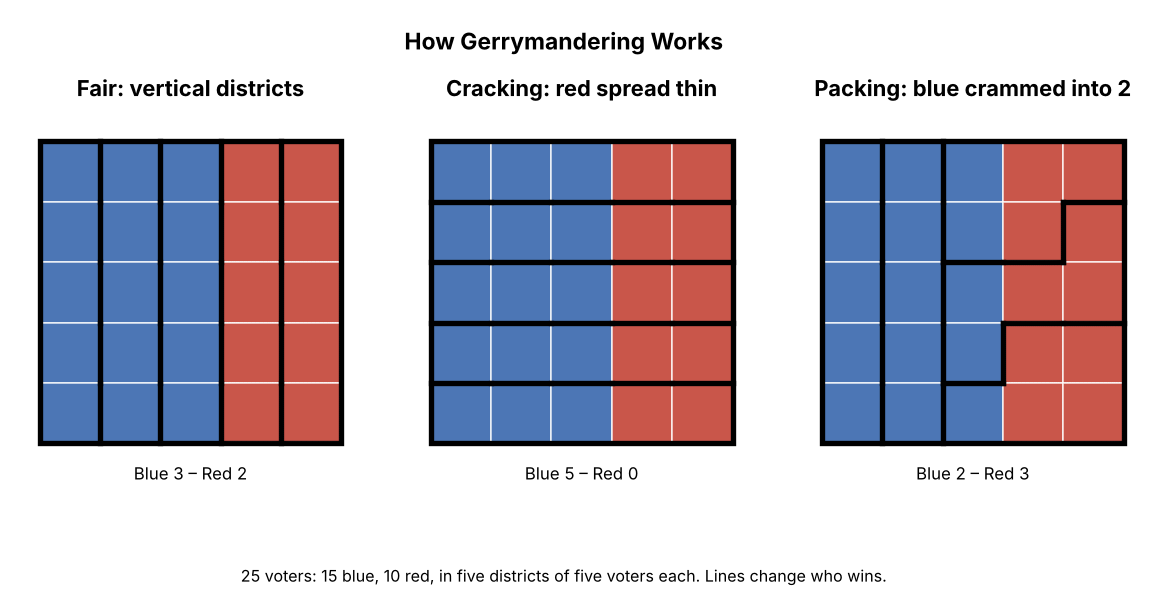
How gerrymandering works: Packing concentrates opposition voters into a small number of heavily opposition-leaning districts, “wasting” their votes. Cracking spreads opposition voters across many districts so they’re never a majority anywhere.
- Baker v. Carr (1962): The Supreme Court ruled that redistricting is justiciable — federal courts can hear challenges to district lines, opening the door to the “one person, one vote” standard set in later cases such as Wesberry v. Sanders and Reynolds v. Sims (1964).
- Shaw v. Reno (1993): The Court established that race cannot be the predominant factor in redistricting, even when the intent is to create an opportunity district for minority representation.
The Court has not struck down partisan gerrymandering itself, so the party in power can entrench its advantage mathematically.
Midterm Elections and Presidential Coattails
Midterm elections follow a striking and predictable pattern: the president’s party loses seats. The president’s party loses an average of 26 House seats and 4-5 Senate seats in a midterm election.
- Differential turnout. Presidential elections activate a broad coalition including younger, less-educated, and minority voters. In midterms, turnout drops most among these groups. The opposition party’s base turns out at higher rates proportionally.
- Approval and dissatisfaction. By year 2 or 3 of a presidency, approval typically declines. Voters who strongly opposed the president are highly motivated to vote against “his” party.
- No presidential coattails in midterms. In presidential elections, the president’s popularity directly boosts same-party candidates. In midterms, there is no presidential candidate on the ballot.
Money, PACs, and Media in Congressional Campaigns
- Campaign spending by office: House races range from $500K to $5M+. Senate races start at $3M and can exceed $30M in large, competitive states.
- Sources of money: Candidates raise money from individual donors, political parties, and super PACs. Super PACs emerged after Citizens United v. FEC (2010) and can raise unlimited money from corporations, unions, and wealthy individuals.
- PAC strategy: PACs donate overwhelmingly to incumbents because incumbents have proven power. This further entrenches the incumbency advantage.
Test-Taking Strategies
Mnemonic devices: For the incumbency advantage sources, use FCN — Franking, Casework, Name recognition. For midterm losses, use TAD — Turnout (differential), Approval (declining), no coattails (Dynamics different from presidential elections). For redistricting cases: Baker = 1962 (opened courts to challenges) and Shaw = 1993 (race can’t predominate).
Cross-Topic Connections
- Topic 5.1 (Voter Behavior) — understanding differential turnout in midterms
- Topic 2.1 (Congress: The Senate and the House) — structural differences explain why elections differ
- Topic 5.2 (Voter Turnout) — turnout directly determines who wins close races
Common Question Formats
- “Which of the following best explains why House incumbents win re-election at higher rates than Senate incumbents?” (Answer: smaller districts + gerrymandering)
- Scenario-based FRQs presenting midterm data and asking you to explain seat losses by referencing turnout, approval, or coattails.
Frequent Student Mistakes
- Confusing gerrymandering with redistricting — redistricting is neutral (required every 10 years); gerrymandering is the partisan manipulation of redistricting.
- Believing the midterm pattern applies uniformly; in reality, it’s a strong tendency that can be offset by extreme approval ratings.
- Claiming that money alone determines election outcomes. Incumbency advantage often trumps spending.
Time Management Tips
Congressional elections questions are usually straightforward once you’ve internalized the framework: House = stable (incumbency + gerrymandering), Senate = volatile (statewide electorate + national tides), Midterms = president’s party loses (differential turnout + declining approval). Spend 30-45 seconds identifying which framework applies, then use it to eliminate wrong answers.
Check for Understanding
Think you’ve got it? Complete the quiz below to make sure. Download your results at the end.