
Maximize your score with these resources:
- Albert.io AP® Art History question banks
- Free AP® Art History cheat sheets
- Free AP® Art History score calculator
Understanding how cultures interact through art is central to AP® Art History. From the Silk Road spread of Buddhism to the global impact of Japanese printmaking, the art of South, East, and Southeast Asia reveals how ideas, religious beliefs, and aesthetic traditions move across borders, blend with local traditions, and create entirely new artistic forms.
This article covers Topic 8.3: Interactions Within and Across Cultures in South, East, and Southeast Asian Art (Learning Objective INT-1.A). This topic appears frequently on the AP® Art History exam as both multiple-choice questions and free-response essays. You’ll be tested on your ability to identify specific artworks, explain the cultural exchanges that shaped them, and connect these exchanges to broader patterns of trade, religious conversion, and colonial influence.
By the end of this article, you’ll understand the major cultural transmission routes (Silk Road, maritime trade, colonial expansion), recognize key artworks that demonstrate cultural synthesis, and be prepared to analyze how cross-cultural contact shaped art from the 3rd century BCE to the 20th century.
Buddhism Across the Silk Road: Gandhara and Beyond
The spread of Buddhism from India to Central Asia, China, Japan, and Southeast Asia represents one of the most significant cultural exchanges in human history. Buddhism didn’t travel as a rigid doctrine — it adapted to local beliefs, merged with indigenous religions, and produced distinct artistic styles in each region it reached.
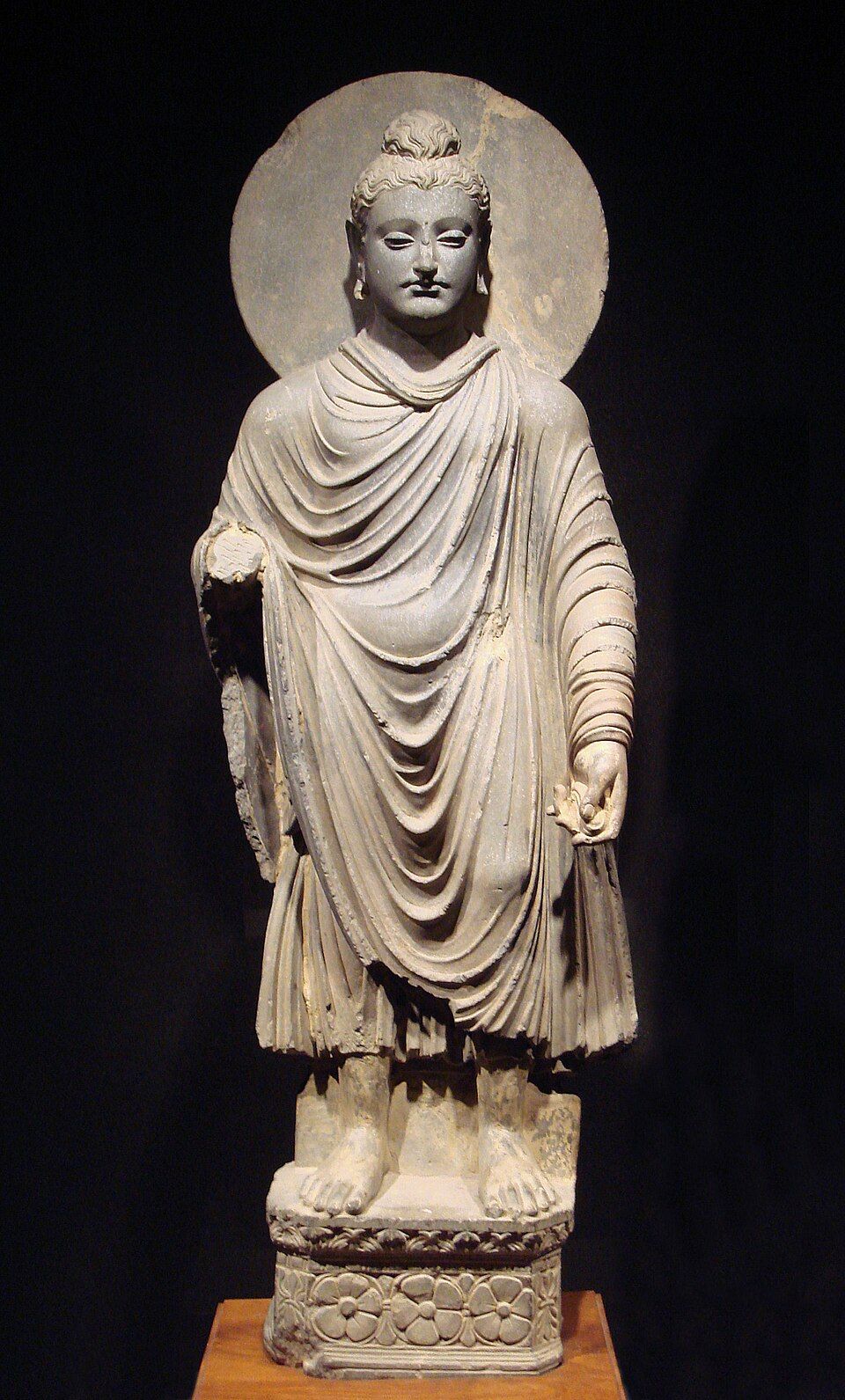
Gandhara art (1st-5th century CE) emerged in what is now Pakistan and Afghanistan at the intersection of the Hellenistic world (after Alexander the Great’s conquests) and the Indian Buddhist tradition. Gandharan sculptors blended Greek realism and anatomical precision with Buddhist iconography. Buddha statues from Gandhara show Greek idealized proportions, facial features, and drapery techniques applied to a Buddhist subject. This fusion was not accidental — it reflected the real movement of merchants, monks, and ideas along overland trade routes collectively known as the Silk Road.
- Greek influence on Gandharan Buddha statues — Buddha is depicted with idealized facial features, curly hair, and flowing robes that echo Greek sculpture. The seated Buddha’s posture and the naturalism of the human body reflect Hellenistic aesthetics rather than earlier purely symbolic representations.
- Why this matters — Gandhara art proves that cultural exchange was not one-directional. Buddhism wasn’t imposed on Greek-influenced regions; instead, Buddhist and Greek traditions merged because merchants, soldiers, and monks actually moved along these routes and brought their beliefs with them.
- Buddhist narratives in visual form — Gandharan relief panels depicted scenes from Buddha’s life (the Nativity, temptation, enlightenment, and death) in a narrative, sequential format. This storytelling approach influenced how Buddhism was visually represented as it spread further east.
As Buddhism traveled the Silk Road, it encountered different artistic traditions and religious contexts. In China, Buddhist art merged with Daoist and Confucian aesthetics. The result was a distinct Chinese Buddhist style visible in cave temples like those at Longmen, where Buddha statues become more serene and less anatomically Western, reflecting Chinese aesthetic preferences. This pattern — Buddhist form adapting to local visual culture — repeated throughout Asia.
Chinese Artistic Dominance and Its Influence on Japan and Korea
For over a millennium, China was the aesthetic and cultural center of East Asia. Japanese and Korean artists didn’t simply copy Chinese art — they absorbed its principles, adapted them to local contexts, and eventually developed their own recognizable styles. This relationship reveals how cultural influence works: it’s neither pure imitation nor pure independence, but a complex process of learning, adaptation, and innovation.
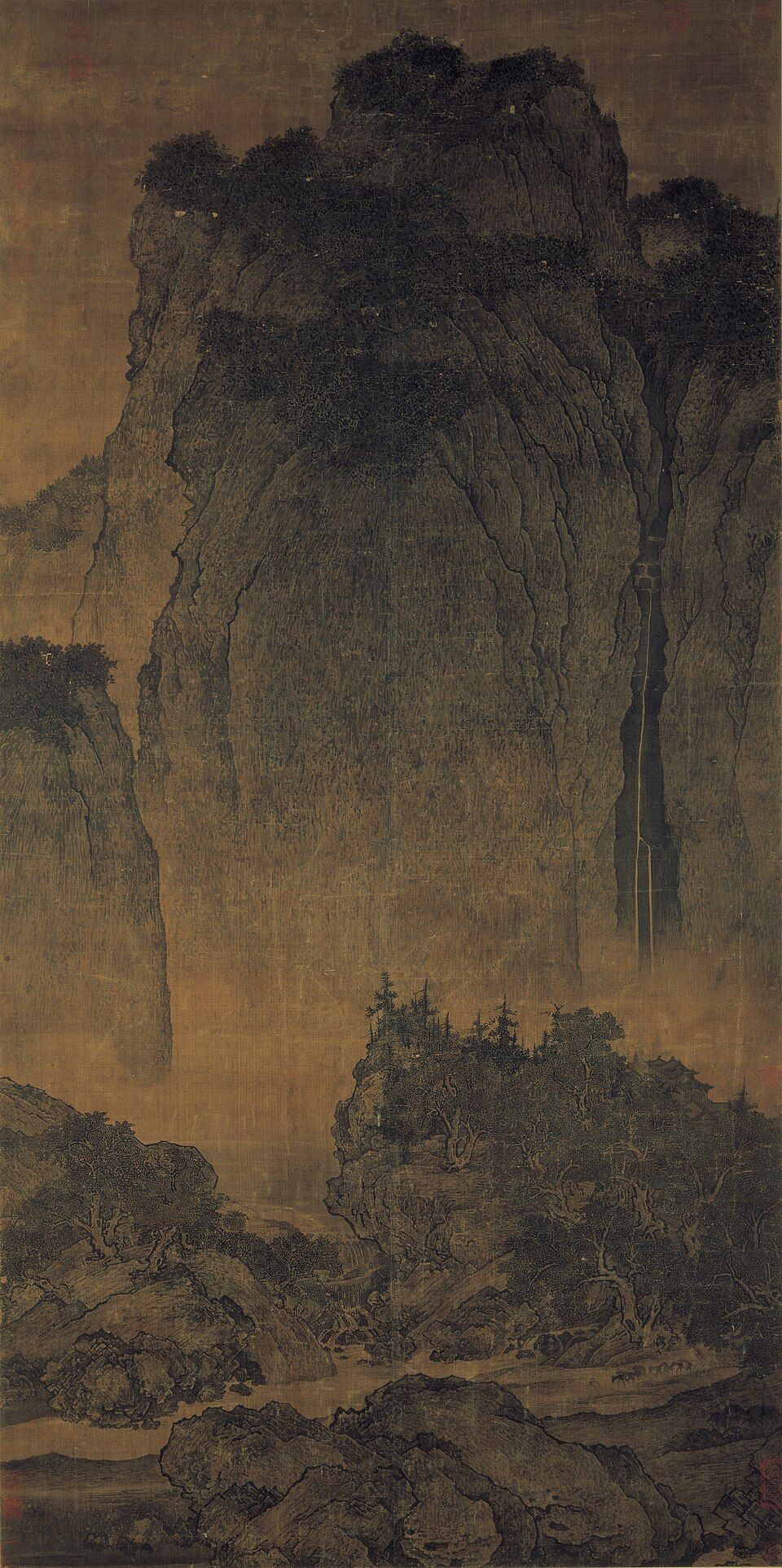
The Tang Dynasty (618-907 CE) represented the height of Chinese cosmopolitanism and artistic achievement. During this period, Japanese and Korean courts actively imported Chinese ideas, Buddhist texts, artistic techniques, and administrative systems. Young aristocrats and monks traveled to China to study.
| Art Form | Chinese Innovation | Japanese/Korean Adaptation | Why It Mattered |
|---|---|---|---|
| Landscape painting | Scholars developed monumental landscape painting with birds-eye perspective, atmospheric perspective, and philosophical symbolism. Mountains represented timelessness; water represented flow and change. | Japanese artists adopted the compositional principles and brush techniques but introduced their own subjects (Mount Fuji, native vegetation) and aesthetic preferences (more intimate scale, clearer foreground-background division in some works). | Landscape painting became the highest form of art in East Asia, valued for its philosophical depth rather than as mere decoration. The transmission of this genre elevated the status of painting across the region. |
| Calligraphy | Chinese scholars unified calligraphy with painting — both used brush and ink, both expressed the artist’s character and philosophy. Specific scripts (seal script, cursive script) carried prestige. | Korean and Japanese artists mastered Chinese characters and scripts but developed unique scripts (Korean hangul) and calligraphic styles. The practice remained central to elite education across East Asia. | Calligraphy became a test of cultivation and artistic sensitivity. Mastering Chinese writing systems was essential to participating in the elite intellectual culture of East Asia. |
| Ceramics | Chinese potters developed porcelain and celadon glazes of extraordinary refinement. These were luxury goods that commanded high prices in international trade. | Korean potters became renowned for their celadon wares, which some scholars argue surpassed Chinese examples in subtlety. Japanese potters developed their own ceramic traditions (raku ware, Imari porcelain). | Ceramic technology and aesthetics traveled along trade routes to the Islamic world and Europe. Chinese and Korean porcelain became one of Asia’s most valuable exports. |
The key insight is that Japan and Korea were not passive recipients. By the Heian period (794-1185), Japanese artists had synthesized Chinese influences with native preferences to create a distinctly Japanese aesthetic — more decorative, more attention to surface pattern, more integration of text and image. Korean celadon glazes achieved a reputation for beauty that rivaled or exceeded their Chinese counterparts.
Indianization of Southeast Asia: Religious and Artistic Synthesis
Indianization describes the process by which Indian religious ideas, artistic traditions, and administrative practices were adopted and adapted by Southeast Asian kingdoms from roughly the 1st century CE onward. Unlike the Silk Road spread of Buddhism, which involved merchant networks and missionary monks, Indianization was driven partly by trade but also by deliberate adoption of Indian models of kingship and Hindu-Buddhist religious syncretism.
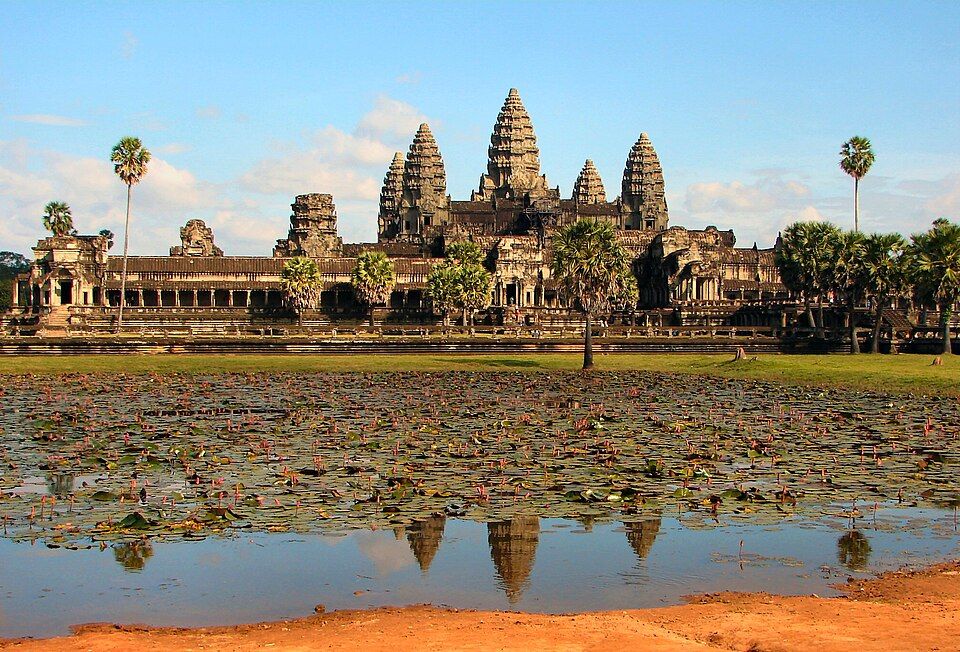
Southeast Asian elites were attracted to Indian civilization for practical and philosophical reasons: Hindu-Buddhist texts provided sophisticated frameworks for governance, Indian artistic traditions conveyed prestige and cosmopolitan status, and Indian merchants and Brahmin priests actively promoted Indian cultural practices. The result was not Indian colonialism but cultural synthesis — Southeast Asian states developed their own versions of Hindu-Buddhist art and governance.
- The Khmer Empire and Angkor (9th-15th centuries) — Khmer kings adopted Hindu and Buddhist ideas of divine kingship. Angkor Wat, the massive temple complex built by King Suryavarman II in the 12th century, combines Indian architectural principles (temple tower representing Mount Meru, the cosmic mountain) with Khmer stone carving techniques and iconographic innovations. The temple’s bas-reliefs depict Hindu epics (the Ramayana, the Mahabharata) alongside scenes of Khmer warfare and court life. This blend of Indian religious content with Khmer political messaging perfectly illustrates Indianization — the adoption of Indian religious frameworks to legitimize local power.
- The Borobudur (Indonesia, 8th century) — This massive Buddhist temple complex in Java represents the synthesis of Indian Buddhist architectural principles with Javanese stone carving. The structure mirrors Indian mandala designs and Buddhist cosmology, but the decorative reliefs show distinctly Javanese artistic styles. Over 500 Buddha statues and 2,600 relief panels tell Buddhist narratives, but the human figures reflect Indonesian aesthetic preferences — broader faces, different proportions than Indian Buddhas.
- Why Indianization mattered — Southeast Asian kingdoms gained access to prestigious religious and administrative systems without losing their independence. By adopting Hinduism and Buddhism, they could claim legitimacy as participants in a cosmopolitan, sophisticated civilization. But they adapted these traditions to fit local conditions, creating new artistic styles in the process.
Maritime Trade Networks and Artistic Exchange
By the 10th century, maritime trade routes had become as important as overland routes for cultural exchange. Ships carrying merchants, pilgrims, and goods moved between India, Southeast Asia, China, the Islamic world, and eventually Europe. These networks transmitted not just goods but ideas, technologies, and artistic styles.
Porcelain trade exemplifies how practical commerce drove aesthetic exchange. Chinese porcelain, especially the blue-and-white wares perfected during the Ming Dynasty (1368-1644), became a luxury good coveted in the Islamic world and Europe. Muslim merchants purchased Chinese porcelain and studied its techniques. Potters in Iznik (modern Turkey) and Safavid Persia created their own blue-and-white ceramics inspired by Chinese examples, adapting the style to Islamic calligraphic and geometric design traditions.
European demand for Chinese porcelain eventually drove Portuguese and Dutch merchants to establish direct maritime routes to Asia in the 15th-17th centuries. This competition intensified artistic exchange — Asian potters now faced European aesthetic demands and European designs for porcelain decoration. The result was new hybrid styles: Chinese porcelain decorated with European coats of arms, Japanese porcelain made to European specifications, and Southeast Asian ceramics blending multiple aesthetic traditions.
Why maritime trade mattered more than we often acknowledge — It’s easy to focus on overland Silk Road routes, but by the medieval period, seaborne trade was more reliable, more profitable, and moved more goods. Maritime networks connected the Indian Ocean (linking East Africa, India, and Southeast Asia), the South China Sea, and eventually the Atlantic and Pacific. This global trade system meant that artistic ideas traveled faster and reached more distant places than most historians initially assumed.
Mughal Painting and the Synthesis of Persian, Indian, and European Traditions
Mughal court painting (16th-18th centuries) represents perhaps the most deliberate and successful artistic synthesis in the AP® Art History curriculum. Mughal emperors in India, descendants of Central Asian conquerors, consciously drew on three artistic traditions: Persian miniature painting (a legacy of their Timurid ancestry), Indian Hindu artistic conventions, and European Renaissance techniques introduced through Jesuit missionaries and Portuguese traders.
The result was a new style that belonged fully to none of these traditions but drew strength from all three. Mughal paintings typically featured:
- Persian compositional structure and decorative detail — The use of flattened perspective, intricate patterning, gold leaf, and highly detailed surfaces reflects centuries of Persian miniature tradition.
- Indian subject matter and iconography — Mughal emperors commissioned paintings of Indian court life, Hindu epics, and animals of the Indian subcontinent. This represented a deliberate choice to root their dynasty in Indian soil despite their Central Asian origins.
- European shading and modeling techniques — Mughal painters learned European approaches to creating three-dimensional volume through shading and perspective. This gave their figures a physical presence that differs from purely Persian painting.
- Why this synthesis was politically significant — By commissioning paintings that blended Persian heritage, Indian subjects, and European techniques, Mughal emperors signaled their cosmopolitanism and their right to rule this diverse territory. The paintings themselves became arguments for why their mixed-heritage dynasty should govern India.
Mughal court painters worked closely with Jesuit missionaries who brought European prints and artistic concepts to the Mughal court. Emperor Akbar (1556-1605) explicitly encouraged this exchange, even commissioning paintings of Christian subjects alongside Hindu and Islamic scenes. This openness was not universal in the Islamic world, but it reveals how elite courts could deliberately curate cross-cultural artistic exchange for political and intellectual purposes.
Jesuit Influence and Global Art in the Early Modern Period
Jesuit missionaries (16th-18th centuries) were, alongside merchants, the primary agents of European artistic influence in Asia during the early modern period. Jesuits brought European prints, paintings, and Christian imagery to China, Japan, and the Philippines. They also brought European scientific and mathematical concepts — perspective, anatomy, architectural engineering — that influenced local artists.
In Japan, Jesuit influence was concentrated in the 16th-17th centuries before the shogunate expelled Christian missionaries and closed the country to most foreign contact. Japanese artists who studied with Jesuits learned European perspective and modeling techniques. Some of this influence persisted in Japanese art even after Christianity was suppressed.
In China, Jesuits had more lasting influence, particularly at the imperial court. Jesuit missionaries served as astronomers, mathematicians, and advisors to Chinese emperors. Jesuits like Matteo Ricci adapted to Chinese culture, mastered Confucian texts, and established themselves as valuable members of the imperial bureaucracy. This enabled them to introduce European art and science. Chinese court painters learned European perspective, anatomical accuracy, and architectural drawing techniques from Jesuit examples. Chinese artists synthesized these techniques with traditional Chinese painting, creating hybrid works.
The key point: Global artistic exchange in the early modern period was not a one-way flow from Europe to Asia. Asian artists selectively adopted European techniques when these served their purposes, integrated them with existing traditions, and created new styles that were neither purely European nor purely Asian.
Test-Taking Strategies
Mnemonic Devices and Memory Shortcuts
SILK ROADS SPREAD captures the major routes and consequences of cultural transmission:
- S — Silk Road (overland, Buddhist spread, Gandhara)
- I — Indianization (Southeast Asia adopts Hindu-Buddhist frameworks)
- L — Local adaptation (every region synthesizes, doesn’t just copy)
- K — Khmer and Khmer influences (Angkor, temple architecture)
- R — Routes shift from land to maritime (10th century onward)
- O — Overlapping traditions (multiple cultures influence simultaneously)
- A — Aesthetic synthesis (Mughal painting, Korean celadon, etc.)
- D — Direct contact matters (merchants, monks, missionaries, diplomats)
- S — Synthesis, not submission (local cultures adapt, not replace)
Cross-Topic Connections
Topic 8.1 (Early South Asian Art) — Topic 8.3 builds directly on your understanding of Hindu and Buddhist religious art. You need to recognize when Southeast Asian art adopts Indian iconography (Buddha statues at Borobudur) and when it adapts it (Khmer treatment of Hindu epics in stone relief).
Topic 8.2 (Early East Asian Art) — Understand the original Chinese landscape painting and calligraphy traditions before analyzing how Japan and Korea adapted them. Questions often ask you to compare Chinese and Japanese versions of the same art form.
Islamic Art — Blue-and-white porcelain connects to Islamic ceramic traditions. The exam might ask you to explain how Chinese porcelain influenced Islamic pottery OR how Islamic geometric and calligraphic design influenced Chinese artisans working for Islamic markets.
Topic 3.2 (Interactions Within and Across Cultures in Early European and Colonial American Art) — Both topics involve cultural collision. Just as Mughal art synthesizes multiple traditions, colonial-era American art shows European influence on Indigenous traditions. Expect comparison questions asking you to analyze different outcomes of cross-cultural contact.
Common Question Formats
Multiple-Choice Stimulus: A single artwork (e.g., a Gandharan Buddha statue or a Mughal miniature painting) with a description. Questions ask: “This artwork shows the influence of which two cultures?” or “Which of the following best explains the artistic style of this piece?”
Comparison Questions: Two artworks side-by-side (e.g., a Chinese landscape painting next to a Japanese landscape painting). Questions ask: “How does the Japanese artist adapt the Chinese compositional tradition?” or “Which cultural aesthetic preference is most evident in the Japanese version?”
Free-Response Essays: “Analyze how Buddhism shaped artistic production as it spread across Asia” or “Examine the role of trade networks in facilitating artistic exchange between Asia and the Islamic world.” These require you to identify multiple specific artworks and explain the mechanisms of cultural transmission (merchants, missionaries, political alliances, etc.).
Timeline Questions: “Which period saw the greatest influence of Jesuit missionaries on Asian art?” (Answer: 16th-17th centuries, with lasting effects in China into the 18th century.)
Frequent Student Mistakes
Mistake 1: Assuming cultural influence means replacement, not synthesis. Students often describe artworks as “Chinese art made in Japan” or “Indian art in Southeast Asia,” missing the point that local artists adapted traditions. The correct framing is synthesis — Borobudur is not an Indian temple built in Indonesia; it’s a Javanese Buddhist temple designed using Indian architectural principles and local craftsmanship. Correction: Always ask whether the artwork shows pure imitation or creative adaptation. Use language like “inspired by,” “adapted from,” and “synthesized with.”
Mistake 2: Forgetting that transmission requires physical contact. Students sometimes describe Buddhism spreading to China as if it floated across the ocean. Actually, it traveled along overland routes via monks, merchants, and texts. Similarly, European influence on Mughal art required Jesuit missionaries present at court. Correction: For any claim about cultural influence, be able to explain the mechanism — who carried the ideas, and how did they travel?
Mistake 3: Overestimating European influence, underestimating Asian agency. It’s tempting to frame the story as “Europe influenced Asia.” In reality, Asian courts and artists chose which European ideas to adopt. Chinese emperors commissioned European-influenced paintings alongside traditional Chinese paintings. Correction: Use language of “adoption,” “adaptation,” and “selective engagement” rather than “influence imposed” or “Western dominance.”
Test-Day Shortcuts
When you see a hybrid artwork (mixing two styles), ask three questions:
- What’s the primary tradition (the foundation)? Mughal painting is fundamentally Persian in structure.
- What’s the secondary tradition (the addition)? European techniques added three-dimensional modeling.
- Why did this synthesis happen? Mughal emperors wanted to show cosmopolitanism and connect to diverse populations they ruled.
For comparison questions, look for three levels of analysis:
- Form — Does the work use the original compositional structure or adapt it? (Japanese landscape often tightens Chinese compositions.)
- Content — What subjects does the adapted version emphasize? (Chinese landscapes feature Chinese mountains and philosophy; Japanese landscapes feature Mount Fuji and Shinto imagery.)
- Aesthetic preference — Does the new version change colors, scale, or level of detail? (Japanese versions often use brighter colors and more decorative surfaces than Chinese originals.)
Time Management Tips
For FRQs involving cross-cultural art, allocate 10 minutes to brainstorm 3-4 specific artworks you can cite, then outline which cultures influenced each. This prevents you from writing vague generalizations about “Asian art” for 45 minutes.
For MCQs with artwork stimuli, don’t spend time memorizing every detail. Instead, identify the fundamental artistic tradition first (Is this painting style fundamentally Islamic, Buddhist, or Confucian?), then look for the secondary influences. This narrows your answer choices immediately.
If a question asks about “cultural interaction” or “exchange,” it’s asking you to explain both directions — how one culture influenced another AND how the receiving culture adapted it. Take 30 seconds to ensure your answer includes both halves of that dynamic.
Check for Understanding
Think you’ve got it? Complete the quiz below to make sure. Download your results at the end.