

Maximize your score with these resources:
- Albert.io AP® Physics 2 question banks
- Free AP® Physics 2 cheat sheets
- Free AP® Physics 2 score calculator
Temperature and pressure aren’t abstract numbers on a thermometer or gauge — they’re direct consequences of molecular motion. Topic 9.1 appears on nearly every AP® Physics 2 exam, typically as a multi-part question asking you to connect microscopic molecular behavior to macroscopic measurable properties. This article covers the kinetic molecular theory framework, the relationship between temperature and kinetic energy, how molecular collisions create pressure, and the Maxwell-Boltzmann distribution — plus the exact strategies AP uses to test your understanding.
This article covers Topic 9.1: Kinetic Theory of Temperature and Pressure (Learning Objectives EOP-1.A, EOP-1.B, EOP-1.C). By the end, you’ll understand not just the equations but the reasoning behind them — which is exactly what the AP exam rewards.
The Kinetic Molecular Theory Framework
Kinetic molecular theory (KMT) provides a model for how gases behave at the molecular level. The theory rests on a small set of assumptions about ideal gases — and understanding these assumptions is critical for the exam because AP will ask you to identify when they break down.
- Gas particles are in constant, random motion. Molecules move in straight lines until they collide. This random motion is the source of both pressure (collisions with container walls) and temperature (the average kinetic energy of that motion). On the exam, this assumption matters when you encounter questions about how temperature affects molecular speed or why increasing volume decreases pressure at constant temperature.
- Gas particles have negligible volume compared to the container. We treat molecules as point particles. This works well for ideal gases at low pressure and high temperature but breaks down for real gases at high pressure — when particle volume becomes significant relative to container volume — or low temperature, when intermolecular forces matter. AP will ask you to explain why a real gas deviates from ideal behavior, and this is your answer.
- Collisions between particles and with container walls are perfectly elastic. Kinetic energy is conserved in collisions — no energy is lost to heat or vibration. This assumption lets you use energy conservation to connect molecular speeds to temperature without worrying about energy dissipation.
- There are no intermolecular forces except during collisions. Molecules don’t attract or repel each other until they physically collide. This is why real gases — especially at high pressure or low temperature — deviate from KMT predictions. Attractive and repulsive forces do exist, but KMT ignores them.
- The average kinetic energy of gas particles is directly proportional to absolute temperature. This is the most important assumption for the AP exam. It bridges the microscopic world (molecular speeds) and the macroscopic world (temperature). We’ll explore this relationship in depth below.
Why these assumptions matter: the AP exam tests your ability to recognize when KMT applies (ideal gases, moderate conditions) and when it breaks down (real gases, extreme conditions). If a question asks about a gas at very high pressure or very low temperature, you should immediately consider which KMT assumptions fail.
Temperature and Average Kinetic Energy
The central equation of kinetic molecular theory connects temperature to the average kinetic energy of gas molecules — the single most important relationship for Topic 9.1.
The relationship: KEavg = (3/2)kBT
Here kB is Boltzmann’s constant (1.38 × 10⁻²³ J/K) and T is absolute temperature in kelvins.
What this equation tells you:
- Temperature is a measure of average kinetic energy. Heating a gas increases the average kinetic energy of its molecules — they move faster, on average. This is why temperature must always be measured in kelvins on the AP exam: only the absolute temperature scale ensures that doubling temperature means doubling average kinetic energy.
- The factor 3/2 appears because gases are three-dimensional. Molecules can move in the x, y, and z directions, with each direction contributing (1/2)kBT to the total kinetic energy. This follows from the equipartition theorem, which states that each quadratic degree of freedom contributes (1/2)kBT to average energy. For AP purposes, remember the 3/2 factor — knowing why it’s there helps you retain it.
- Temperature = zero means zero kinetic energy. At absolute zero (0 K or −273.15°C), the equation predicts zero average kinetic energy. In reality, molecules have quantum zero-point energy and can’t reach absolute zero, but the equation remains a good approximation for real gases above a few kelvins.
- All gases at the same temperature have the same average kinetic energy. Whether it’s helium, nitrogen, or carbon dioxide — if they’re at the same absolute temperature, their molecules share the same average kinetic energy. But they don’t have the same average speed. Lighter molecules move faster on average, as we’ll see next.
Why this matters for the exam: AP loves relationship questions. “If you double the temperature of a gas, how does the average kinetic energy change?” (It doubles — KEavg is directly proportional to T.) “Two gases at the same temperature have the same average kinetic energy. Which has a higher average speed?” (The lighter one.) These questions test whether you understand the equation, not just whether you’ve memorized it.
Root-Mean-Square Speed and the Maxwell-Boltzmann Distribution
The average kinetic energy (3/2)kBT connects to average molecular speed, but the relationship isn’t as simple as you might expect. You need to distinguish between average speed and root-mean-square speed.
Root-mean-square speed is defined as vrms = √(3kBT/m), where m is the mass of one molecule. This is equivalently written as vrms = √(3RT/M), where M is molar mass in kg/mol and R is the gas constant.
Derivation insight: the root-mean-square speed comes directly from the average kinetic energy equation. If KEavg = (3/2)kBT and KE = (1/2)mv², then (1/2)mvrms² = (3/2)kBT. Solving for vrms gives the equation above. This derivation appears on the AP exam — often in questions asking you to “derive the relationship between temperature and molecular speed” or “explain why root-mean-square speed depends on temperature and molar mass.”
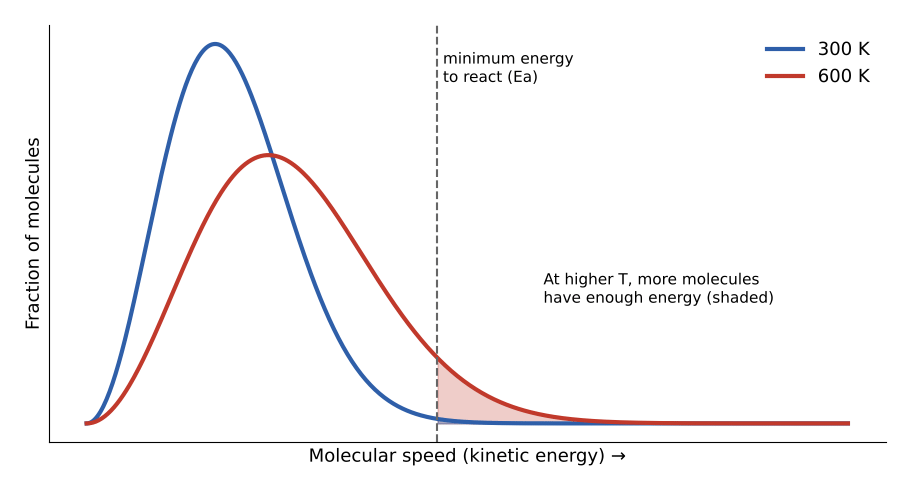
Key insight: not all molecules move at vrms. Some are slower, some faster. The Maxwell-Boltzmann distribution describes the probability of finding a molecule with any particular speed at a given temperature.
- The distribution is skewed, not symmetrical. More molecules cluster at lower speeds than at the rms speed, while the high-speed tail extends far into high velocities. At high speeds, a small increase in speed corresponds to a large change in kinetic energy; at low speeds, the same increase has a smaller effect. The distribution reflects this asymmetry.
- As temperature increases, the entire distribution shifts to higher speeds. The peak moves rightward and broadens — more molecules occupy the high-speed tail. This is why chemical reactions speed up dramatically with temperature: a larger fraction of molecules have the energy needed to overcome the activation energy barrier.
- Lighter molecules shift the distribution to higher speeds at constant temperature. Oxygen molecules (32 u) have a lower rms speed than hydrogen molecules (2 u) at the same temperature. This explains why hydrogen escapes from the upper atmosphere while oxygen remains — and why hydrogen and helium are rare in Earth’s atmosphere.
- The y-axis is probability density, not molecule count. A taller peak means molecules are more likely to have speeds near that peak. The area under the entire curve always equals 1.
Why Maxwell-Boltzmann matters: the AP exam uses this distribution to explain phenomena. Why does diffusion speed up with temperature? The distribution shifts to higher speeds. Why do lighter gases diffuse faster? Their distribution peaks at higher speeds. Why do reaction rates depend on temperature? The high-speed tail grows, and only fast-moving molecules have enough energy to react.
Pressure from Molecular Collisions
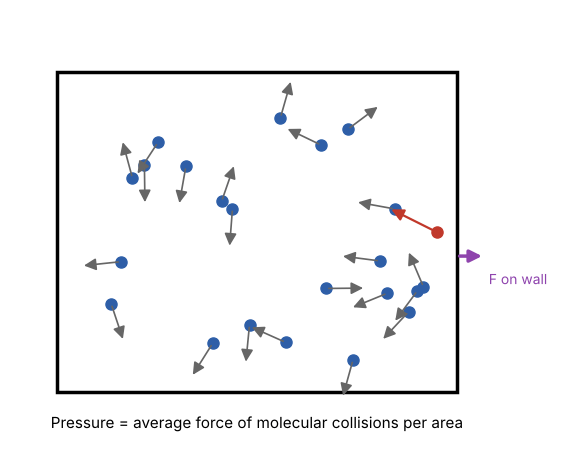
Pressure isn’t a fundamental property — it’s a consequence of billions of molecules colliding with container walls. Understanding this mechanism is essential for Topic 9.1.
The basic idea: each time a molecule hits the wall, it transfers momentum. Over time, trillions of collisions add up to a measurable force. Divide that force by the wall’s area, and you get pressure.
P = F/A (pressure is force per unit area)
The kinetic molecular theory derivation of pressure — which you don’t need to memorize but should understand conceptually — gives:
P = (1/3)ρ⟨v²⟩
where ρ is the gas density and ⟨v²⟩ is the mean square speed. In terms of number density n (molecules per unit volume):
P = (1/3)nm⟨v²⟩
This equation is rich with meaning:
- Pressure is proportional to number density (n). Double the number of molecules in the same volume and you double the pressure at constant temperature. More molecules mean more collisions per unit time per unit area — this is why the ideal gas law says P ∝ n.
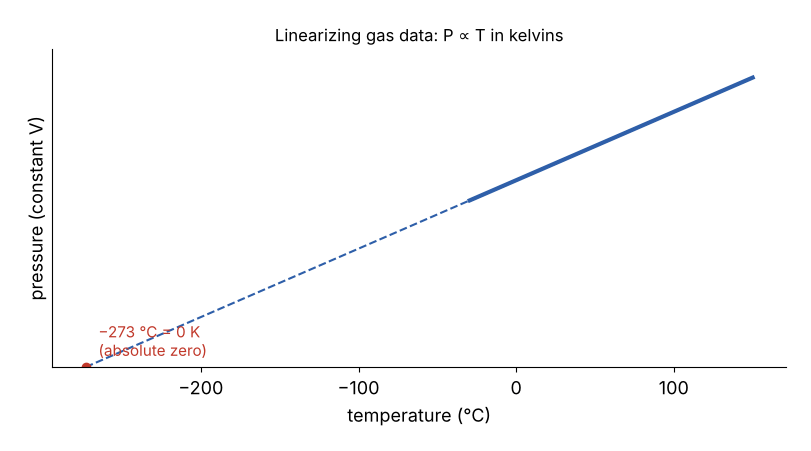
- Pressure is proportional to mean square speed. Since ⟨v²⟩ ∝ T (from the kinetic energy equation), pressure is proportional to temperature at constant volume. This is Gay-Lussac’s Law: P₁/T₁ = P₂/T₂ at constant volume. Higher-speed molecules collide harder and more frequently, increasing pressure.
- The factor 1/3 comes from geometry. Molecules move in all three dimensions, and on average only 1/3 of the kinetic energy contributes to pressure in any one direction.
What happens when you compress a gas? You decrease the volume, increasing the number density n. More molecules per unit volume means more collisions per unit time on the walls — pressure increases. This is Boyle’s Law: at constant temperature, P₁V₁ = P₂V₂.
What happens when you heat a gas at constant volume? You increase ⟨v²⟩, which is proportional to temperature. Molecules move faster, hitting the walls harder and more frequently — pressure increases. This is Gay-Lussac’s Law.
The AP exam will ask you to explain these everyday observations using molecular reasoning. “Why does air pressure increase as you heat a tire?” Your answer should reference how temperature increases the average speed of air molecules, increasing the force and frequency of their collisions with the tire walls, which increases pressure. This kind of mechanistic explanation scores full points.
Temperature and Molecular Mass: Speed Comparisons
One of the most common AP questions compares the speeds of different molecules. The key equation is vrms = √(3RT/M).
Notice that vrms is inversely proportional to the square root of molar mass. This has significant implications:
| Factor | Effect on RMS Speed | Example | Why It Matters |
|---|---|---|---|
| Increase temperature | Increases proportional to √T | A 4× increase in absolute temperature leads to a 2× increase in rms speed (√4 = 2) | Doubling the temperature in kelvins doesn’t double the speed — it increases it by a factor of ~1.41. AP tests whether you recognize this non-linear relationship. |
| Increase molar mass | Decreases proportional to 1/√M | CO₂ (44 g/mol) has an rms speed approximately √(44/2) ≈ 4.7 times slower than H₂ (2 g/mol) at the same temperature | Lighter gases like H₂ and He escape from planetary atmospheres because a larger fraction of their molecules (the high-speed tail) move fast enough to exceed escape velocity. Heavier gases like N₂ and O₂ stay. |
| Increase both T and M | Competing effects — increases with temperature, decreases with mass | Nitrogen at 300 K vs. 600 K: rms speed increases by √2 ≈ 1.41. Nitrogen at 300 K vs. oxygen at 300 K: nitrogen is slightly faster (molar mass 28 vs. 32). | AP will give you two gases at different temperatures and masses, ask which is faster, and expect you to use the equation to decide. |
The physical reason: all molecules at the same temperature have the same average kinetic energy. But kinetic energy is (1/2)mv². If a heavier molecule has the same kinetic energy as a lighter one, it must be moving slower — since m is larger, v must be smaller. This is why diffusion — the spreading of one gas through another — is faster for lighter molecules.
Test-Taking Strategies
Mnemonic Devices
Kinetic molecular theory has five core assumptions. Remember them with “MICE-F”:
- Molecules in constant random motion
- Intermolecular forces negligible (except during collisions)
- Collisions are elastic (energy conserved)
- Energy (average kinetic) proportional to temperature
- Forces and volume of molecules negligible compared to container
For KEavg = (3/2)kBT, remember “three halves” — 3/2 for three dimensions, one for each direction of motion. For comparing molecular speeds, the phrase “lighter = faster” captures the inverse relationship between molar mass and rms speed.
Cross-Topic Connections
Kinetic molecular theory reaches into several other AP® Physics 2 topics:
- Topic 9.2 (The Ideal Gas Law): PV = nRT is a direct consequence of KMT. If you understand the molecular basis for pressure (collisions) and temperature (average kinetic energy), the ideal gas law becomes intuitive rather than arbitrary. AP will ask you to derive or explain the ideal gas law using KMT arguments.
- Kinetic Energy and Internal Energy: The internal energy of an ideal gas is entirely kinetic — U = nCVT = (3/2)nRT for a monatomic gas. This directly uses the temperature–kinetic energy relationship.
- Real Gases: Real gases deviate from KMT predictions at high pressure and low temperature because KMT assumptions break down. Molecular volume becomes significant, and intermolecular forces matter. AP will ask you to explain real gas behavior through the lens of broken KMT assumptions.
- Diffusion and Effusion: Graham’s Law of effusion — lighter gases escape faster — follows directly from rms speed. The rate of effusion is proportional to 1/√M.
Common Question Formats
Topic 9.1 appears in these recurring formats on the AP exam:
- “Explain using kinetic molecular theory”: You’re given a scenario — a tire heats up when compressed, a gas expands when heated, a lighter gas diffuses faster — and asked to explain the mechanism using molecular reasoning. Your answer should reference molecular motion, collisions, kinetic energy, or speed. Example: “Explain why the pressure of a gas increases when the container is heated at constant volume.” Answer: “Heating increases the average kinetic energy and thus the rms speed of molecules. Faster-moving molecules collide with the walls with greater force and frequency, increasing momentum transfer per unit time and thus pressure.”
- Comparison questions with equations: “Which gas has a higher rms speed at the same temperature: CO₂ or H₂?” Use the rms speed equation and compare molar masses — H₂ is lighter, so it’s faster.
- Multi-step calculations: “A sample of nitrogen gas is at 300 K. If the temperature is increased to 900 K, by what factor does the rms speed increase?” Recognize that v₂/v₁ = √(T₂/T₁) = √(900/300) = √3 ≈ 1.73.
- Identify which KMT assumption is violated: “A gas is at extremely high pressure in a small container at near absolute zero. Which KMT assumption is most likely invalid?” Either the assumption that molecular volume is negligible (at high pressure, molecules take up significant space) or that intermolecular forces are negligible (at low temperature and high density, attractive forces dominate).
- Relating microscopic and macroscopic properties: “If you triple the number of molecules in a container while keeping volume and temperature constant, what happens to the pressure?” Use P = (1/3)nm⟨v²⟩ or the ideal gas law — tripling n triples the pressure.
Frequent Student Mistakes
These errors appear repeatedly on AP scoring reports for this topic:
- Mistake: “Temperature is the speed of molecules.” Temperature is proportional to average kinetic energy, which depends on speed — but temperature is not speed itself. Two gases can have the same temperature (same average KE) but very different speeds if they have different masses. Correction: “Temperature measures average kinetic energy. At the same temperature, lighter molecules move faster because their kinetic energy is the same but their mass is smaller.”
- Mistake: “All molecules in a gas move at the root-mean-square speed.” The rms speed is a calculated average — the Maxwell-Boltzmann distribution shows that molecules occupy a wide range of speeds. Correction: “The rms speed is the square root of the average of squared speeds. The Maxwell-Boltzmann distribution shows molecules spread across a range of speeds, with most near the distribution’s peak.”
- Mistake: “Doubling the temperature doubles the speed.” The rms speed is proportional to √T, not T — a non-linear relationship. Correction: “Doubling the absolute temperature increases the rms speed by a factor of √2 ≈ 1.41.”
- Mistake: “Pressure is caused by the weight of the gas.” While atmospheric pressure at Earth’s surface does result from the atmosphere’s weight, gas pressure in general comes from molecular collisions with container walls. A gas in zero gravity still exerts pressure. Correction: “Pressure results from momentum transfer during molecular collisions with container walls. More frequent and harder collisions mean higher pressure.”
- Mistake: Confusing average speed with rms speed. Three different “averages” exist: mean speed v̄ = √(8kBT/πm), rms speed vrms = √(3kBT/m), and most probable speed. The rms speed connects to kinetic energy. Correction: “Use vrms = √(3RT/M) for kinetic energy calculations because (1/2)mvrms² = (3/2)kBT.”
- Mistake: “A gas at absolute zero has zero pressure and zero volume.” KMT predicts zero average kinetic energy at 0 K, but real gases liquefy and solidify well before reaching that temperature — the theory breaks down. Correction: “KMT predicts zero kinetic energy at absolute zero, but real gases undergo phase changes at higher temperatures. KMT is valid only while the substance remains gaseous.”
Test-Day Shortcuts
These techniques save time on Topic 9.1 questions:
- For ratio problems, use proportionality. Instead of plugging in numbers, write vrms ∝ √T. If T → 4T, then vrms → 2vrms. This avoids unnecessary arithmetic and reduces errors.
- For “explain” questions, use a three-part template. (1) Name the property that changes (kinetic energy, speed, collisions). (2) Explain why it changes (temperature increases, volume decreases). (3) State the consequence (pressure increases). This structure earns points even if you miss some details.
- Recognize “KMT derivation” questions early. If a problem says “derive” or “show that,” it’s asking you to connect KEavg = (3/2)kBT to another equation (like the ideal gas law or rms speed). Write the connection step-by-step — you earn points for showing reasoning, not just the final answer.
- For Maxwell-Boltzmann questions, sketch the distribution. Drawing it and labeling what happens when temperature increases or when comparing molecules of different mass can trigger the right answer.
Time Management Tips
Topic 9.1 questions vary widely in difficulty — manage your time strategically:
- Multiple-choice conceptual questions (“Which gas has higher rms speed?”): 30–60 seconds. You either know the relationship or you don’t. If stuck, eliminate obviously wrong answers and move on.
- Calculation questions (“Calculate rms speed” or “By what factor does pressure increase?”): 2–3 minutes. Write the equation, substitute values, and solve. Show work for partial credit if your arithmetic is off.
- Explanation questions (“Explain why pressure increases when temperature increases”): 3–4 minutes. Write a clear, step-by-step explanation referencing molecular behavior. AP rewards specific, mechanistic reasoning.
- Derivation questions from first principles: Often worth 5+ points but can take 5–10 minutes. If confident, go for it. If uncertain, focus on key conceptual steps — partial derivation earns significant credit.
- If running low on time: Prioritize “explain using KMT” questions. These reward clear reasoning over calculations, and a well-written explanation can earn 4–5 points in a few minutes.
Check for Understanding
Think you’ve got it? Complete the quiz below to make sure. Download your results at the end.