
Maximize your score with these resources:
- Albert.io AP® Physics 2 question banks
- Free AP® Physics 2 cheat sheets
- Free AP® Physics 2 score calculator
Pump air into a bike tire and it gets firm. Leave a sealed bag of chips in a hot car and it puffs up. Take a balloon up a mountain and it grows. Each of these is the same law at work, a single equation that ties together a gas’s pressure, volume, temperature, and amount. On the AP® Physics 2 exam, that equation shows up in calculations, in graph questions, and in experimental design prompts where you have to linearize data.
This article covers Topic 9.2: The Ideal Gas Law in Unit 9, Thermodynamics. The topic asks you to relate the pressure, volume, temperature, and number of particles of an ideal gas, and to use those relationships to predict how a gas responds when one of them changes.
By the end, you should be able to:
- Use \(PV = nRT\) and \(PV = Nk_BT\) and pick the right form for a problem.
- Predict how pressure, volume, or temperature changes when the other quantities are held constant.
- Read and sketch pressure-volume (PV) diagrams for an ideal gas.
- Linearize gas-law data to find a physical constant from a graph.
The Two Forms of the Ideal Gas Law
An ideal gas is a model in which the particles are tiny compared with the distances between them and interact only through brief, elastic collisions. Real gases at ordinary temperatures and pressures behave very close to this model. The ideal gas law comes in two equivalent forms:
| Form | Counts Particles In | Constant |
|---|---|---|
| \(PV = nRT\) | Moles, \(n\) | \(R = 8.31\ \text{J/(mol·K)}\) |
| \(PV = Nk_BT\) | Individual particles, \(N\) | \(k_B = 1.38 \times 10^{-23}\ \text{J/K}\) |
The two constants are linked by Avogadro’s number: \(R = N_A k_B\), where \(N_A = 6.02 \times 10^{23}\) particles per mole. Both constants appear on the AP® Physics 2 equation sheet, so you don’t need to memorize them. You do need to know which form matches the information in the problem.
Units matter. Pressure must be in pascals (Pa), volume in cubic meters (m³), and temperature in kelvins (K). Two conversions come up often: \(1\ \text{L} = 1 \times 10^{-3}\ \text{m}^3\) and \(1\ \text{atm} \approx 1.01 \times 10^{5}\ \text{Pa}\). To convert Celsius to kelvins, add 273.
Worked Example
A container holds 2.0 mol of gas at 300 K in a volume of 0.050 m³. What is the pressure?
\(P = \dfrac{nRT}{V} = \dfrac{(2.0)(8.31)(300)}{0.050} \approx 1.0 \times 10^{5}\ \text{Pa}\)
That’s about one atmosphere, which is a useful reality check.
Holding Quantities Constant
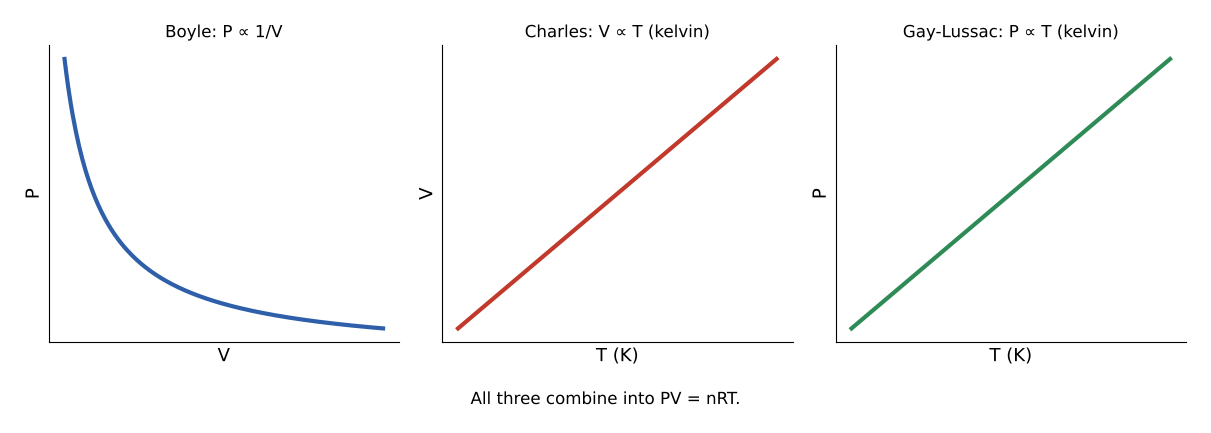
Most exam questions don’t give you every variable. Instead, they hold some quantities fixed and ask how the rest respond. For a fixed amount of gas, the ideal gas law rearranges to:
\(\dfrac{P_1V_1}{T_1} = \dfrac{P_2V_2}{T_2}\)
From there, each special case follows by canceling whatever stays constant.
| Held Constant | Relationship | Everyday Example |
|---|---|---|
| Temperature (isothermal) | \(P \propto \dfrac{1}{V}\) | Squeezing a sealed syringe slowly |
| Volume (isovolumetric) | \(P \propto T\) | A tire’s pressure rising on a hot day |
| Pressure (isobaric) | \(V \propto T\) | A balloon shrinking in a freezer |
| Temperature and volume | \(P \propto n\) | Pumping more air into a rigid tank |
Worked Example: A Warm Tire
A tire is at \(2.0 \times 10^{5}\ \text{Pa}\) at 280 K. After driving, the air inside reaches 310 K. Assume the volume stays constant. What is the new pressure?
\(P_2 = P_1 \dfrac{T_2}{T_1} = (2.0 \times 10^{5})\dfrac{310}{280} \approx 2.2 \times 10^{5}\ \text{Pa}\)
Notice that the temperatures had to be in kelvins. Using 7°C and 37°C would make the pressure appear to grow more than fivefold, which is clearly wrong.
Why does this matter? Proportional reasoning questions are some of the most common on the exam. A question might say “the temperature is doubled while the volume is halved” and ask for the new pressure. Write \(P = \frac{nRT}{V}\), plug in the factors, and get \(P_2 = \frac{2}{1/2}P_1 = 4P_1\). No numbers needed.
PV Diagrams
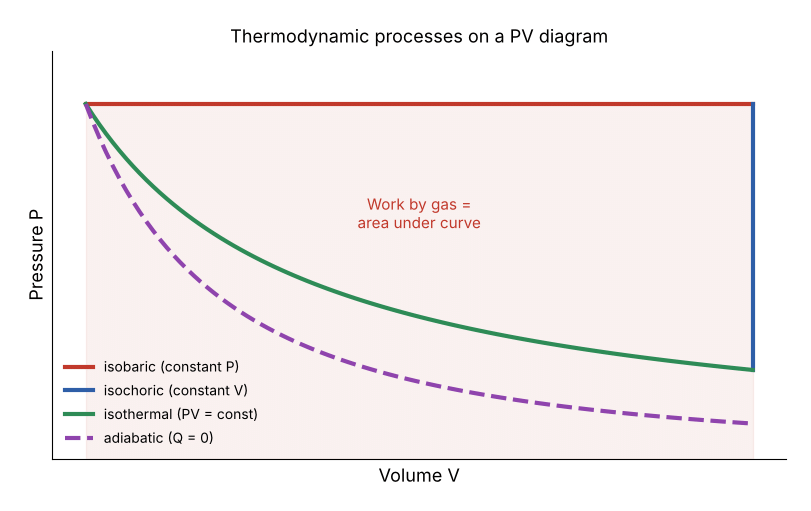
A pressure-volume diagram plots pressure on the vertical axis and volume on the horizontal axis. Every point on it is a state of the gas, and the temperature of that state is \(T = \frac{PV}{nR}\).
- Isotherms are curves of constant temperature. They’re hyperbolas, because \(PV\) is constant along each one. Isotherms farther from the origin represent higher temperatures.
- Isobaric processes are horizontal lines.
- Isovolumetric processes are vertical lines.
- Moving up and to the right on the diagram increases \(PV\), so the temperature rises.
The area under a PV curve equals the work done by the gas, which is the bridge to the first law of thermodynamics. See our review of the first law of thermodynamics for how that work enters the energy balance.
Linearizing Gas Data
The experimental design FRQ often asks you to turn a curved relationship into a straight line. Suppose a student measures the pressure of a trapped gas at several volumes, keeping the temperature constant. A graph of \(P\) against \(V\) curves, but a graph of \(P\) against \(\frac{1}{V}\) is a straight line through the origin:
\(P = (nRT)\dfrac{1}{V}\)
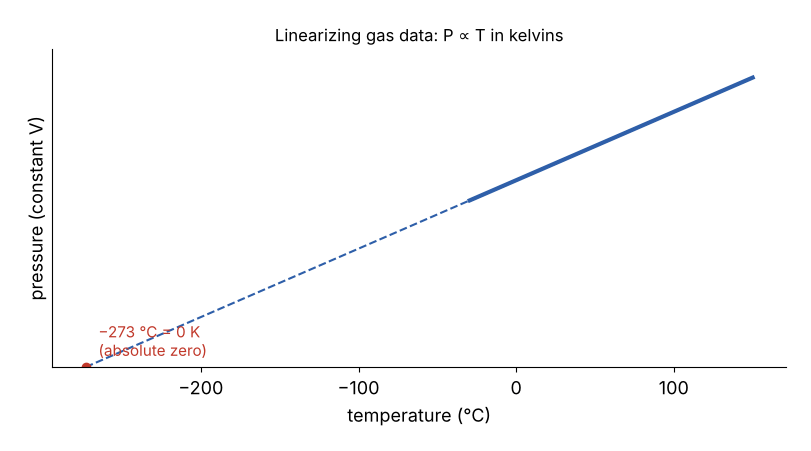
The slope of that line is \(nRT\). If the temperature is known, the slope gives the number of moles. In the same way, plotting \(P\) against \(T\) at constant volume gives a line with slope \(\frac{nR}{V}\). Extending that line to zero pressure crosses the temperature axis near \(-273^\circ\text{C}\), which is how absolute zero was first estimated.
Test-Taking Strategies
Mnemonic Devices and Memory Shortcuts
- “Kelvin or bust.” Every gas-law temperature must be in kelvins before you divide or multiply.
- “Pivnert.” Say \(PV = nRT\) out loud as one word so you never scramble the variables.
- “Up and right is hotter.” On a PV diagram, a state up and to the right has a larger \(PV\) product and a higher temperature.
Cross-Topic Connections
- Topic 9.1: Kinetic theory explains why the ideal gas law works. Pressure comes from particle collisions with the walls. See our review of kinetic theory of temperature and pressure.
- Topic 9.3: Thermal equilibrium means two gases in contact reach the same temperature.
- Topic 9.4: PV diagrams show the work done in each process of the first law.
- Topic 9.6: Entropy changes accompany free expansion, where volume increases with no work done.
Common Question Formats
- Ratio MCQ. Two quantities change by given factors, and you find the factor for the third.
- PV diagram MCQ. You rank the temperatures of several states or identify which process is isothermal.
- Experimental design FRQ. You describe how to collect pressure and volume data and which graph to plot to get a straight line.
- Translation between representations FRQ. You sketch a process on a PV diagram that matches a written description.
Frequent Student Mistakes
- Using Celsius. The ideal gas law only works with absolute temperature.
- Mixing liters with pascals. Liters must be converted to cubic meters when \(R = 8.31\ \text{J/(mol·K)}\) is used.
- Confusing \(n\) and \(N\). \(n\) is moles and pairs with \(R\). \(N\) is particle count and pairs with \(k_B\).
- Assuming a change in one variable doesn’t affect the others. In a sealed, flexible container, heating changes both volume and pressure unless one is held fixed.
Test-Day Shortcuts
- Solve symbolically first. Write the relationship with variables, then substitute ratios. It’s faster and avoids arithmetic slips.
- Check against one atmosphere. Everyday gases sit near \(10^5\ \text{Pa}\). An answer of \(10^{9}\ \text{Pa}\) signals a unit error.
- Label the axes of any graph you sketch. An unlabeled PV diagram rarely earns full credit.
Time Management Tips
- Multiple choice: Section I has 40 questions in 80 minutes, about 2 minutes each. Ratio questions should take under a minute, which buys time for data-heavy question sets.
- Free response: Section II has 4 questions in 100 minutes, roughly 25 minutes each. On experimental design parts, name the measured quantities, the equipment, and the graph before writing anything else.
- Keep the equation sheet open. The constants are given. Spend your time on setup, not recall.
Check for Understanding
Think you’ve got it? Complete the quiz below to make sure. Download your results at the end.