
Maximize your score with these resources:
- Albert.io AP® US History question banks
- Free AP® US History cheat sheets
- Free AP® US History score calculator
In 1880, a typical factory worker put in ten or more hours a day, six days a week, with no paid vacation, no workers’ compensation, and no guarantee the job would exist next month. Children as young as ten worked in textile mills and coal mines. Workers pushed back by organizing, striking, and sometimes fighting in the streets. Topic 6.7 covers how industrial capitalism changed work in America and how workers responded.
This article covers Topic 6.7: Labor in the Gilded Age in Period 6, 1865 to 1898. The topic asks you to explain how industrialization changed the American workforce, how workers organized to improve their conditions, and why many of their efforts met with limited success.
By the end, you should be able to:
- Describe working conditions in Gilded Age factories, mines, and railroads.
- Compare the major labor organizations of the period.
- Explain the causes and outcomes of major strikes.
- Analyze why government and business largely sided against organized labor.

What We Review
How Industrialization Changed Work
Before the Civil War, many Americans worked on farms or in small shops where skilled artisans controlled their own pace. After 1865, large factories and corporations transformed that world.
- Deskilling: Machines broke production into simple, repetitive tasks. Skilled craftsmen were replaced by cheaper, less skilled workers.
- Wage labor: Most workers no longer owned their tools or shops. They sold their time for wages and depended entirely on employers.
- Long hours and danger: Twelve-hour shifts were common in steel mills. Railroad and mining accidents killed thousands of workers every year.
- Women and children: Employers hired women and children for lower wages, especially in textile mills. By 1900, roughly 1.7 million children under 16 worked for wages.
- Wage cuts and instability: Economic depressions in 1873 and 1893 brought layoffs and pay cuts, with no unemployment insurance to soften the blow.
Labor Organizations Compared
| Organization | Founded | Membership | Goals and Methods | Fate |
|---|---|---|---|---|
| National Labor Union | 1866 | Skilled and unskilled workers, plus farmers | Eight-hour day, political reform | Collapsed after the Panic of 1873 |
| Knights of Labor | 1869 | Open to nearly all workers, including women and Black workers | Eight-hour day, end to child labor, worker cooperatives | Peaked near 700,000 members in 1886, then declined after Haymarket |
| American Federation of Labor (AFL) | 1886 | Skilled craft workers only | “Bread-and-butter” goals: higher wages, shorter hours, better conditions | Survived and grew under Samuel Gompers |
The contrast between the Knights of Labor and the AFL is one of the most tested comparisons in this topic. The Knights wanted to reshape the economy around cooperation. The AFL accepted capitalism and bargained for a bigger share of its profits. The AFL’s narrower approach helped it survive, but it left most unskilled, immigrant, women, and Black workers outside organized labor.
Major Strikes and Clashes
| Event | Year | What Happened | Result |
|---|---|---|---|
| Great Railroad Strike | 1877 | Wage cuts sparked a nationwide rail walkout | President Hayes sent federal troops. About 100 people died. |
| Haymarket Affair | 1886 | A bomb exploded at a Chicago rally for the eight-hour day | Eight anarchists were convicted and four were hanged, though no evidence tied them to the bomb. Public opinion turned against unions, hurting the Knights of Labor. |
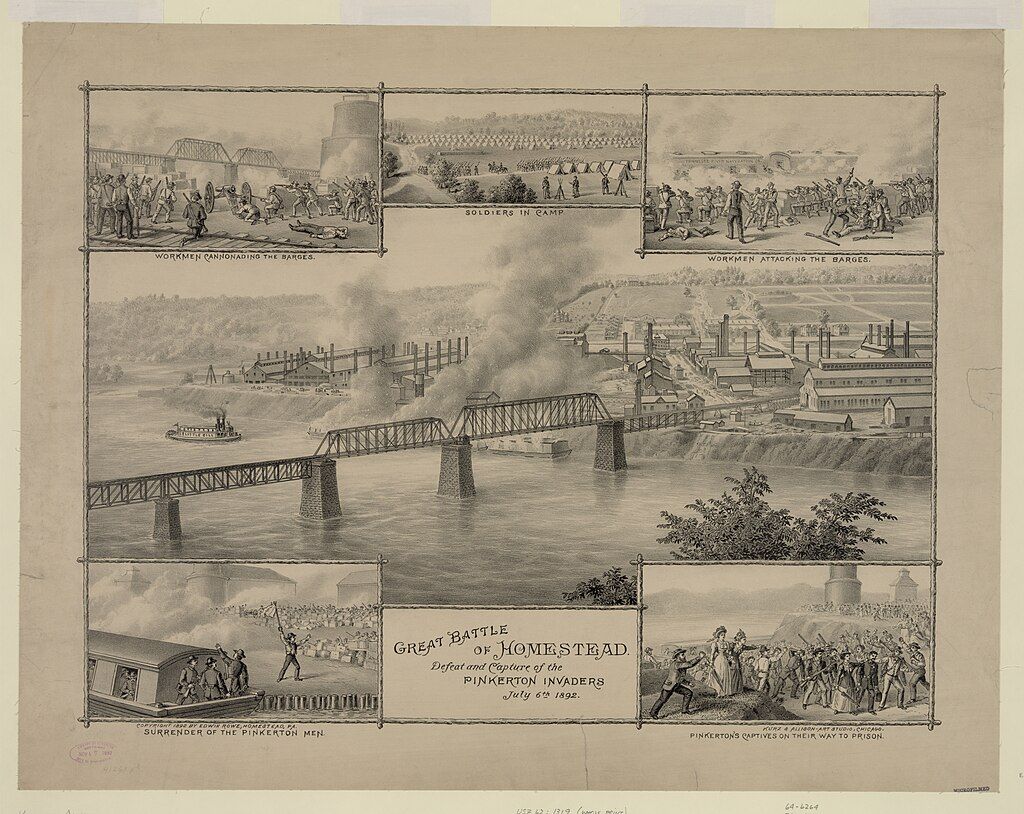
| Homestead Strike | 1892 | Steelworkers at Carnegie’s Pennsylvania plant fought Pinkerton guards | State militia broke the strike, and the union was crushed. |
| Pullman Strike | 1894 | Eugene Debs’s American Railway Union boycotted Pullman cars | A federal court injunction and federal troops ended the strike. Debs went to jail. |
Notice the pattern. In each major strike, state or federal power ended up on the side of employers. Courts issued injunctions against strikers, and governments sent troops to restore order. That pattern is central to explaining why labor gained relatively little in this period.
Why Labor Struggled
- Government support for business: Courts used the Sherman Antitrust Act of 1890 against unions more often than against monopolies. The Supreme Court upheld the Pullman injunction in In re Debs (1895).
- Divided workforce: Ethnic, racial, and skill differences made unity hard. Employers sometimes hired immigrants or Black workers as strikebreakers.
- Public fear of radicalism: After Haymarket, many middle-class Americans linked unions with anarchism and violence.
- Employer tactics: Blacklists, lockouts, and “yellow-dog” contracts, which made workers promise not to join unions, weakened organizing.
Why does this matter? Gilded Age labor history is a favorite source of evidence for DBQs and LEQs on industrialization. It supports arguments about continuity and change in working life, about the relationship between government and business, and about how reform movements grew in the Progressive Era. Have two strikes and two organizations ready to cite with specific details.
Test-Taking Strategies
Mnemonic Devices and Memory Shortcuts
- “Knights included, AFL selected.” The Knights welcomed almost everyone. The AFL took only skilled workers.
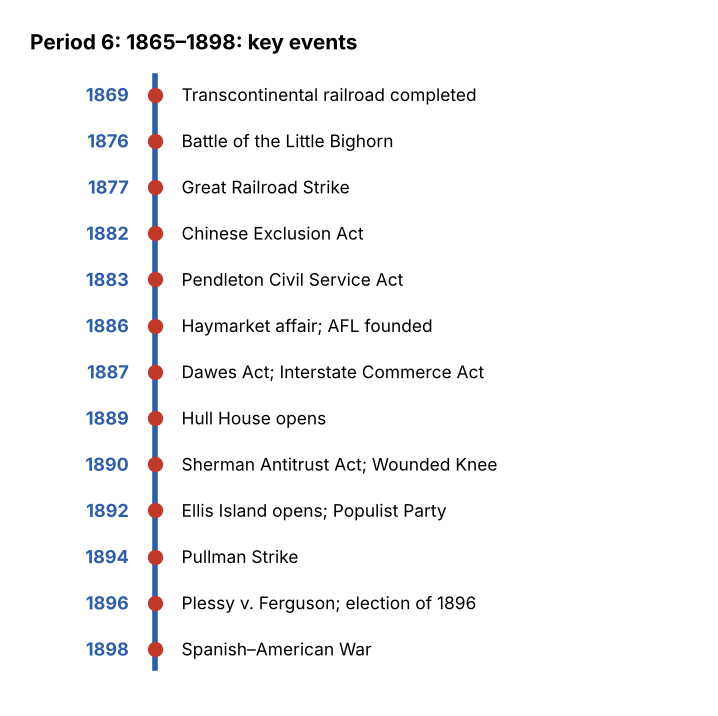
- “Rail, Hay, Home, Pull.” The four big clashes in order: 1877, 1886, 1892, 1894.
- “Bread and butter beats big dreams.” The AFL’s practical goals outlasted the Knights’ broader vision.
Cross-Topic Connections
- Topic 6.6: Corporate consolidation created the factories and mills where these struggles happened. See our review of the rise of industrial capitalism.
- Topic 6.8: New immigrants filled many of the lowest-paid industrial jobs.
- Topic 6.12: Debates over laissez-faire shaped how government responded to strikes. See our review of debates over the role of government.
- Topic 7.4: Progressive reformers later pushed for child labor laws and workplace safety. See our review of the Progressive Era.
Common Question Formats
- Stimulus MCQ. A cartoon or speech about a strike, and you identify its context or the author’s view.
- Comparison SAQ. You explain one similarity or difference between the Knights of Labor and the AFL.
- Causation SAQ. You explain why labor unions had limited success before 1900.
- DBQ or LEQ. You evaluate how industrialization changed the lives of American workers.
Frequent Student Mistakes
- Saying the AFL organized all workers. It focused on skilled craft workers.
- Blaming the Knights of Labor for Haymarket. The bomber was never identified. The Knights were hurt by association.
- Assuming the government stayed neutral. Federal and state governments repeatedly intervened against strikers.
- Mixing up Homestead and Pullman. Homestead was steel and Carnegie. Pullman was railroad cars and Debs.
Test-Day Shortcuts
- Look for the injunction. A source about courts ordering strikers back to work points to the Pullman Strike.
- Use specific numbers. Mentioning the Knights’ 700,000 members or the twelve-hour steel shift shows command of evidence.
- Link to the Progressive Era. Labor’s defeats in the 1890s help explain the reforms of the 1900s.
Time Management Tips
- Multiple choice: Section IA has 55 questions in 55 minutes, about 1 minute each. Read the source line first to anchor the date and author.
- Short answer: Section IB has 3 required questions in 40 minutes, roughly 13 minutes each. Answer each part in two or three focused sentences.
- Essays: The DBQ gets 60 minutes, including a 15-minute reading period, and the single required LEQ gets 40 minutes. Plan your thesis before you write a body paragraph.
Check for Understanding
Think you’ve got it? Complete the quiz below to make sure. Download your results at the end.