

Maximize your score with these resources:
- Albert.io AP® US History question banks
- Free AP® US History cheat sheets
- Free AP® US History score calculator
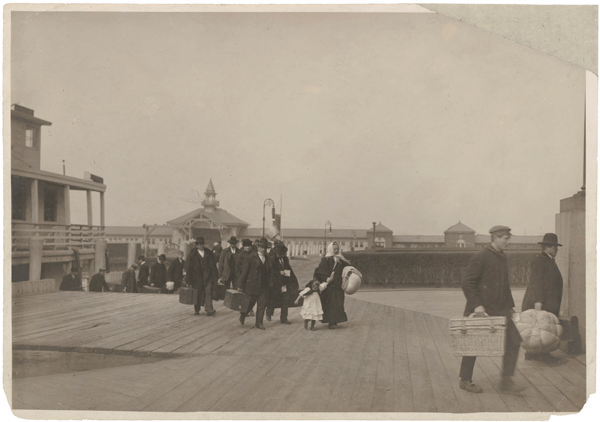
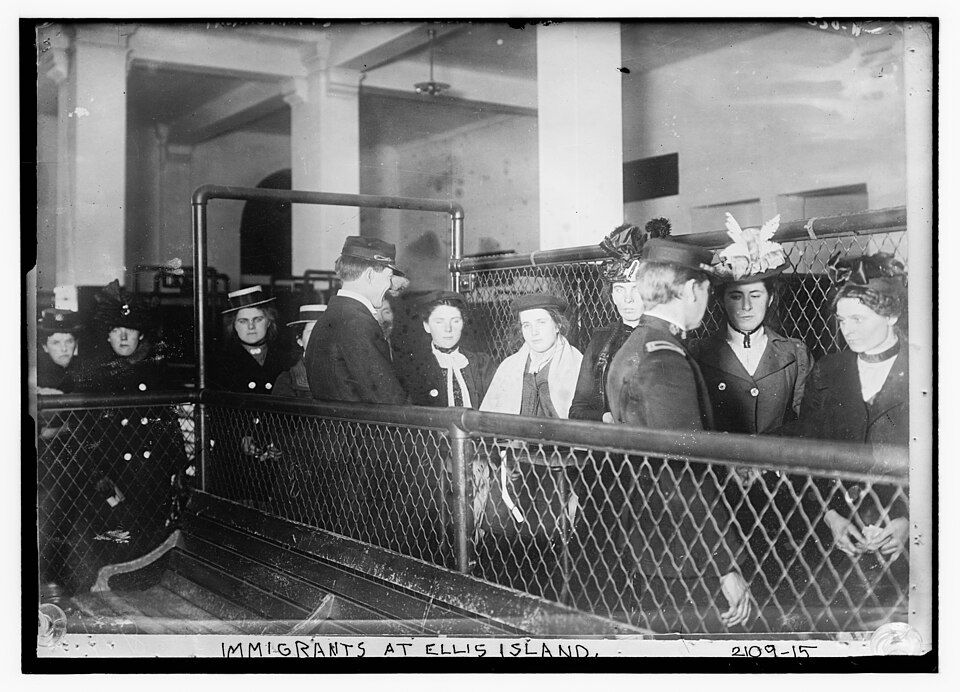
Between 1870 and 1900, about 12 million immigrants arrived in the United States. Many came through New York Harbor, past the newly built Statue of Liberty, and settled in crowded city neighborhoods where a single block might hold Italian, Yiddish, and Polish speakers. At the same time, millions of Americans left farms for factory towns, and many African Americans began leaving the South. Topic 6.8 covers who moved, why they moved, and how they changed American cities.
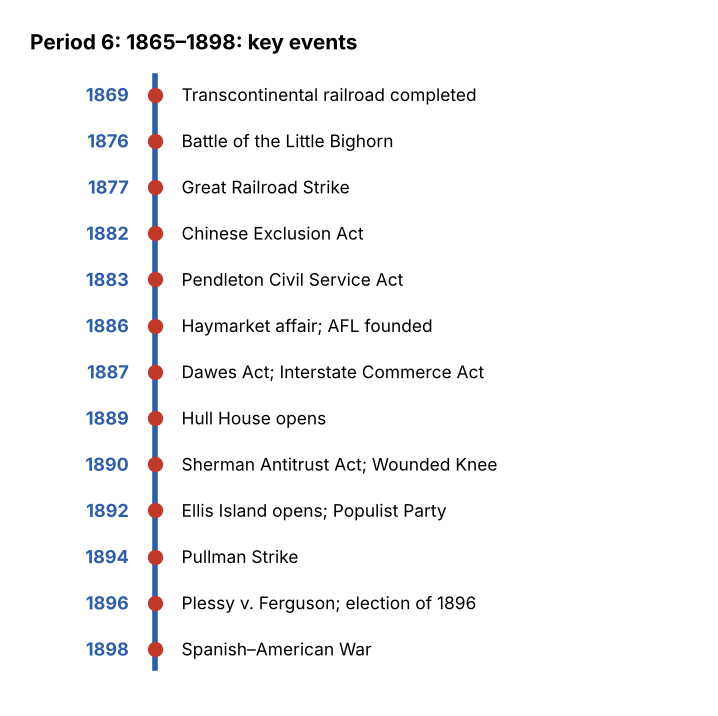
This article covers Topic 6.8: Immigration and Migration in the Gilded Age in Period 6, 1865 to 1898. The topic asks you to explain the causes and effects of immigration and internal migration during the Gilded Age, and how these movements reshaped American society and cities.
By the end, you should be able to:
- Distinguish “old” immigration from “new” immigration.
- Explain the push and pull factors that drove migration.
- Describe how immigrants and migrants changed American cities.
- Explain the role of urban political machines.

What We Review
Old vs. New Immigration
| Feature | “Old” Immigrants (before about 1880) | “New” Immigrants (about 1880 to 1920) |
|---|---|---|
| Main origins | Northern and Western Europe: Ireland, Germany, Britain, Scandinavia | Southern and Eastern Europe: Italy, Russia, Poland, Austria-Hungary, Greece |
| Religion | Mostly Protestant, plus Irish and many German Catholics | Mostly Catholic, Jewish, or Eastern Orthodox |
| Settlement | Farms in the Midwest as well as cities | Mostly industrial cities |
| Reception | Faced discrimination, especially the Irish | Faced stronger nativist hostility for language, religion, and poverty |
On the West Coast, immigrants from China, and later Japan, worked on railroads, in mines, and on farms. Chinese workers built much of the Central Pacific Railroad. Rising hostility led to the Chinese Exclusion Act of 1882, the first federal law to ban immigration based on nationality.
Push and Pull Factors
| Push Factors (reasons to leave) | Pull Factors (reasons to come) |
|---|---|
| Poverty and overpopulation in rural Europe | Industrial jobs in factories, mines, and mills |
| Religious persecution, such as pogroms against Jews in Russia | Religious freedom |
| Political unrest and forced military service | Democratic ideals and economic opportunity |
| Crop failures and falling farm prices | Cheap steamship fares and letters from relatives already in America |
Internal Migration
Immigrants weren’t the only people on the move.
- Rural to urban: Mechanized farming needed fewer workers, while factories promised steady wages. Millions of native-born Americans moved from farms to cities.
- African American migration: After Reconstruction, Jim Crow laws, sharecropping debt, and racial violence pushed some Black Southerners to move. Some “Exodusters” went to Kansas in 1879. Larger movement to Northern cities, the Great Migration, would come after 1910.
- Westward migration: Settlers continued moving west under the Homestead Act, often displacing American Indians.
Immigrants and the Growing City
By 1900, about 40% of Americans lived in cities. Immigration drove much of that growth.
- Ethnic neighborhoods: Immigrants clustered in enclaves like Little Italy or the Lower East Side, where they kept their languages, churches, newspapers, and mutual aid societies.
- Tenements: Overcrowded, poorly ventilated apartment buildings spread disease. Jacob Riis exposed these conditions in How the Other Half Lives (1890).
- Political machines: Organizations like New York’s Tammany Hall, led until the early 1870s by “Boss” William Tweed, traded jobs, housing help, and favors for immigrant votes. Machines provided real services but also ran on graft and corruption.
- Settlement houses: Reformers like Jane Addams, who founded Hull House in Chicago in 1889, offered English classes, childcare, and job training.
Why does this matter? Immigration in this period is a strong example of both change and continuity. The sources of immigrants changed dramatically, but nativist reactions repeated patterns from the 1840s and 1850s. On essays, you can use these migrations as evidence about urbanization, labor, political machines, and the roots of Progressive reform.
Test-Taking Strategies
Mnemonic Devices and Memory Shortcuts
- “North and West, then South and East.” Old immigrants came from Northern and Western Europe, new ones from Southern and Eastern Europe.
- “1882 shut the door.” The Chinese Exclusion Act was the first nationality-based ban.
- “Votes for favors.” The basic deal political machines offered immigrants.
Cross-Topic Connections
- Topic 6.7: Immigrants supplied much of the industrial workforce and sometimes served as strikebreakers.
- Topic 6.9: Nativism and assimilation pressures followed these arrivals. See our review of responses to immigration.
- Topic 4.6: Irish and German immigration in the 1840s sparked earlier nativist movements like the Know-Nothings.
- Topic 7.8: The 1920s quota laws sharply restricted new immigration. See our review of 1920s cultural and political controversies.
Common Question Formats
- Stimulus MCQ. A photograph by Jacob Riis or a political cartoon about Tammany Hall, and you identify its context.
- Comparison SAQ. You compare old and new immigrants in origin, religion, or reception.
- Causation SAQ. You explain one push factor and one pull factor.
- LEQ. You evaluate how immigration changed American cities between 1865 and 1898.
Frequent Student Mistakes
- Placing the Great Migration in the 1870s. The large Black migration north came mainly after 1910.
- Treating political machines as purely evil. They were corrupt, but they also provided real help to immigrants.
- Forgetting Asian immigration. Chinese immigrants and the 1882 Exclusion Act are core content.
- Mixing up Riis and Addams. Riis was a journalist and photographer. Addams ran a settlement house.
Test-Day Shortcuts
- Read religion and origin clues. A source mentioning Jewish or Italian newcomers points to new immigration.
- Connect push and pull. Strong answers name a cause in the home country and an attraction in the United States.
- Use urbanization statistics. “About 40% of Americans lived in cities by 1900” is concrete, specific evidence.
Time Management Tips
- Multiple choice: Section IA has 55 questions in 55 minutes, about 1 minute each. Questions come in sets on a shared source, so study the source once and answer the set.
- Short answer: Section IB has 3 required questions in 40 minutes, roughly 13 minutes each. Use one specific example per part.
- Essays: The DBQ gets 60 minutes, including a 15-minute reading period, and the single required LEQ gets 40 minutes. Group documents by theme, such as work, housing, and politics.
Check for Understanding
Think you’ve got it? Complete the quiz below to make sure. Download your results at the end.