
Maximize your score with these resources:
- Albert.io AP® US Government question banks
- Free AP® US Government cheat sheets
- Free AP® US Government score calculator
A president wants to implement climate policy, but Congress is split between Republicans who oppose carbon taxes and Democrats who demand them. The bureaucracy has authority under the Clean Air Act to regulate emissions from power plants. Courts have recently ruled on what the Clean Air Act actually permits. Which branch ultimately shapes climate policy? The answer: all three, in tension. This is Topic 2.15: Policy and the Branches of Government, and it’s about understanding how the separated system actually makes (or fails to make) policy.
This article covers Learning Objectives PMI-2.D and PMI-2.E, part of Unit 2, which accounts for 25-36% of your AP exam. You’ll learn the stages of the policy process, how each branch plays a distinct role, and how iron triangles, issue networks, and partisan gridlock determine which policies get made.
The Policy Process: From Idea to Implementation
Policy doesn’t appear fully formed. It moves through predictable stages, and understanding these stages helps you answer exam questions about how ideas become law.
- Agenda setting — A problem reaches public consciousness and politicians notice. Media coverage, crises, interest group advocacy, or electoral pressure can all raise a problem on the policy agenda. The problem must be seen as legitimate and solvable. After school shootings, gun violence becomes salient on the agenda. Before coverage, it’s ignored.
- Policy formulation — Lawmakers, bureaucrats, interest groups, and think tanks develop competing solutions. Congress writes different bill versions. Agencies propose regulations. Ideology, evidence, and interest group pressure collide. A Democrat might propose mental health funding to address gun violence; a Republican might propose armed security in schools.
- Adoption (or legitimation) — Congress passes a law, the president issues an executive order, or an agency adopts a regulation. This requires sufficient political support—majority votes in both chambers, enough votes to override a presidential veto, or legal authority for agency action. Without adoption, a policy remains a proposal.
- Implementation — The executive branch, particularly the bureaucracy, carries out the policy. Congress writes the law, but agencies decide how to interpret it, how much funding to allocate, and how strictly to enforce it. A law requiring environmental cleanup is worthless if the EPA lacks funding or political will to enforce it.
- Evaluation — Policymakers assess whether the policy achieved its goals. Did it reduce crime? Lower costs? Citizens, Congress, researchers, and bureaucrats all evaluate policy, often reaching different conclusions. Evaluation can lead to adjustments, continuation, or repeal.
These stages overlap and cycle. Failed implementation can send a policy back to formulation. Evaluation can shift the agenda toward a new problem. Policy is a process, not an event, which explains why changing policy is extremely hard.
Congress and the Legislative Process
Congress’s power appears simple: it writes the law. But the process reveals how difficult it is to create policy in a separated system with internal divisions.
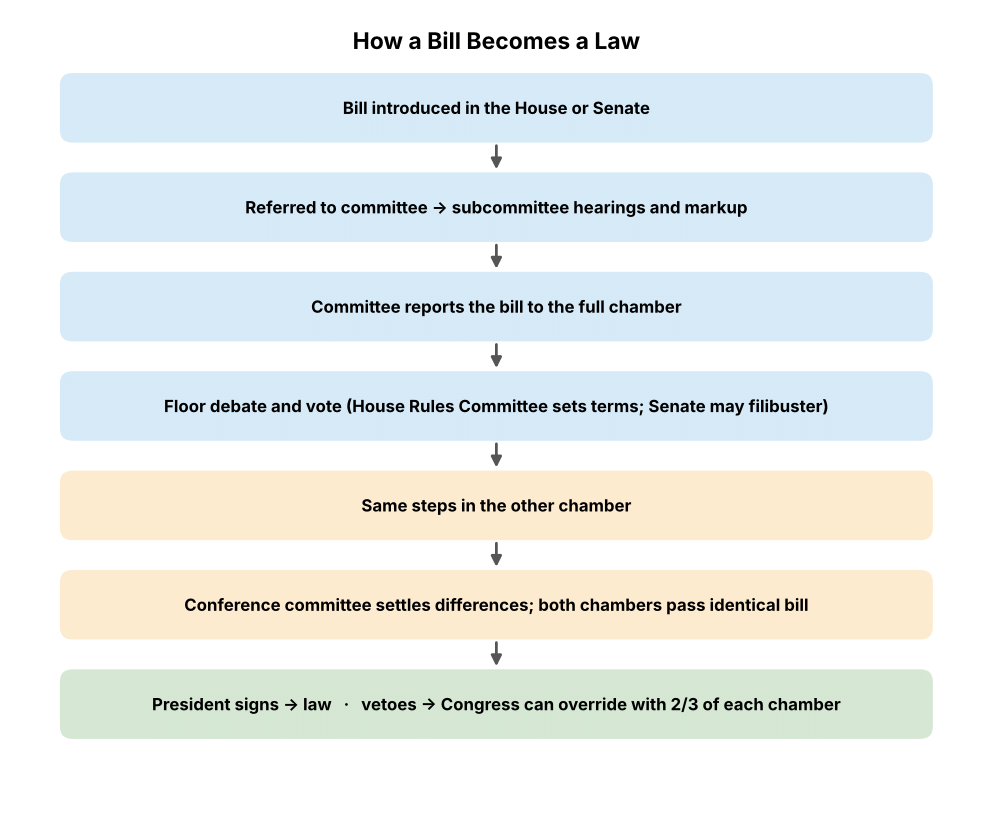
A member introduces a bill, which goes to committee for study and amendment, then to the full chamber for debate and voting. If both chambers pass it, the president can sign it (becoming law), veto it (requiring two-thirds majority in both chambers to override), or take no action. This deliberate slowness makes it hard for any faction to impose policy unilaterally.
Congress’s actual policy role depends on:
- Party discipline — If one party controls both chambers and the presidency, legislative productivity increases. If control is divided, gridlock often results. The majority leader controls the agenda and decides which bills get floor time. Without majority support, your bill dies.
- Committee power — Most bills die in committee. Committee chairs wield enormous power over policy in their domains. An energy committee chair can block renewable energy bills; a health committee chair shapes drug pricing legislation.
- Leadership and agenda control — The Speaker of the House and Senate Majority Leader set the agenda and control floor time. They determine which bills reach a vote and how much debate occurs. This is legislative power in its most concrete form.
- Special interest influence — Congress writes detailed policies tailored to interest group demands. Tax breaks for specific industries, subsidies for certain crops, regulations protecting incumbent companies—these represent billions of dollars in policy outcomes shaped by lobbyists and campaign donors.
Congressional power is real but requires building coalitions, managing disagreement, and surviving elections. A controversial vote can cost a member their seat.
Presidential Power and Executive Policy
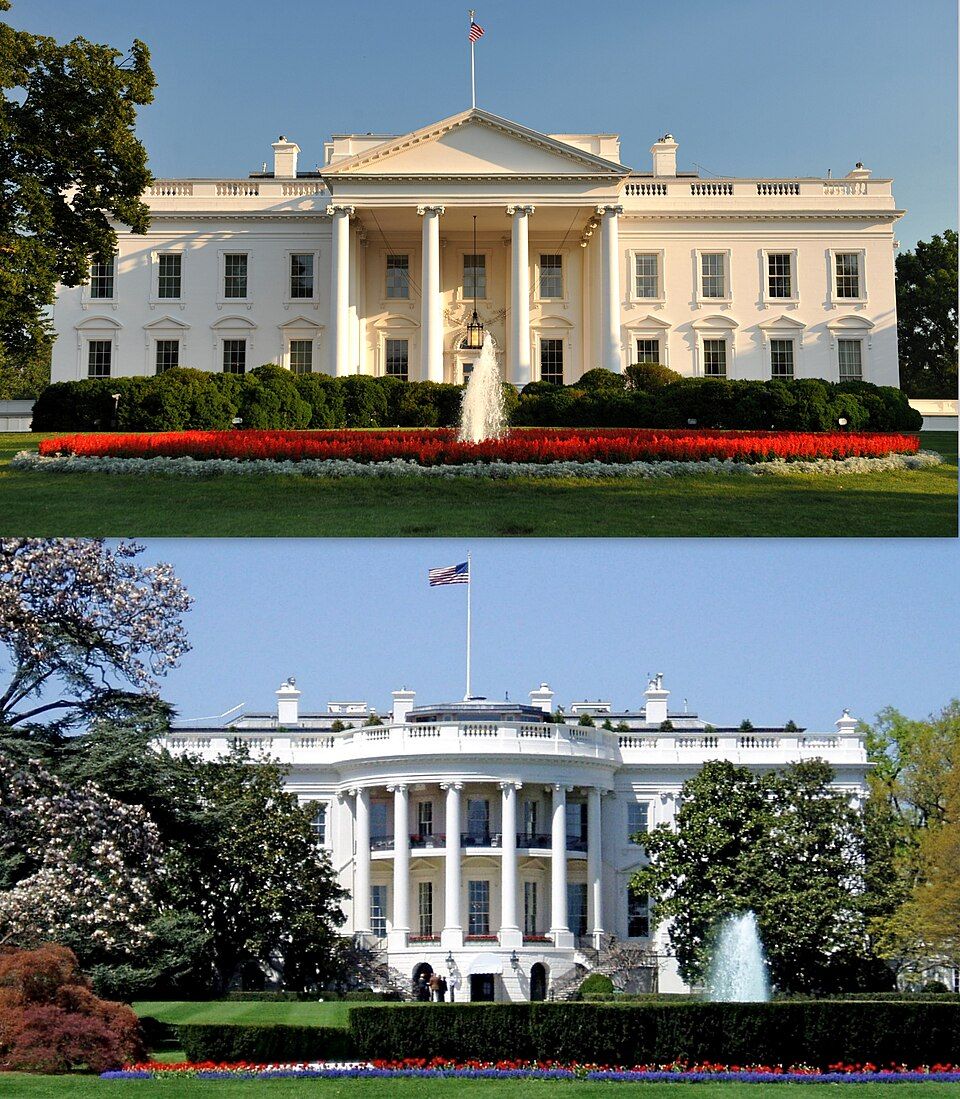
Presidents shape policy not just by signing or vetoing bills, but by exercising executive authority directly. Modern presidents have multiple levers to drive policy without waiting for Congress.
| Presidential Tool | Mechanism | Constraints | Example |
|---|---|---|---|
| Executive Order | Direct presidential command applying to federal agencies. No congressional approval needed. Based on delegated authority from previous laws. | Can be challenged in court. Congress can defund implementation. Successor president can reverse it. Limited to interpreting existing law, not creating new law. | Biden’s student loan forgiveness, a Department of Education action under the HEROES Act (struck down in Biden v. Nebraska, 2023). Trump’s travel ban (upheld after challenge). Obama’s executive action deferring deportation. |
| Regulatory Action | President directs agencies to issue regulations implementing laws. Agencies conduct rulemaking with public comment. Has force of law. | Must follow Administrative Procedure Act. Subject to judicial review. Congress can overturn rules legislatively. Successor president can reverse course. | EPA regulation of greenhouse gases. FDA approval standards. OSHA workplace safety rules. |
| Appointment Power | President appoints cabinet secretaries, agency heads, and judges (with Senate confirmation). These appointees implement the president’s policy vision. | Senate must confirm most positions. Removals may be limited by statute. Senate can block unacceptable nominees. | Appointing a conservative EPA administrator who weakens environmental regulation. Nominating a pro-union Labor Secretary. Judicial appointments that shift courts ideologically. |
| Budget Authority | President proposes a budget controlling how money is spent. Priorities set here shape policy outcomes. | Congress must appropriate funds. Cannot reprogram major spending without congressional approval. | Border wall funding requests. Spending on climate initiatives. Economic stimulus during recessions. |
| Foreign Policy | President directs foreign policy, negotiates treaties, commands military, directs intelligence agencies. Broad latitude in national security matters. | Treaties require Senate ratification. Congress funds military and agencies. Congress declares war, though presidents have expanded war powers. | Withdrawal from international agreements. Trade wars and tariffs. Military intervention decisions. |
Why does presidential power matter? Because Congress is slow and often gridlocked, while the president can act quickly. When Congress won’t pass climate legislation, a president implements it through EPA regulation. When Congress won’t raise wages for federal contractors, a president directs it. Presidents have learned to maximize executive authority because waiting for Congress often means nothing gets done.
Presidential power has real limits, though. Courts can strike down executive actions. Congress can defund them or pass legislation overturning them. The next president can reverse them. On the exam, distinguish between constitutional authority (does the president have the power to do this?) and political sustainability (can this action survive court challenge, congressional opposition, and transitions to new administrations?).
Courts and Policy Interpretation
Courts don’t make policy traditionally—they don’t pass laws or appropriate budgets. But their power to interpret laws and strike down unconstitutional actions shapes policy profoundly.
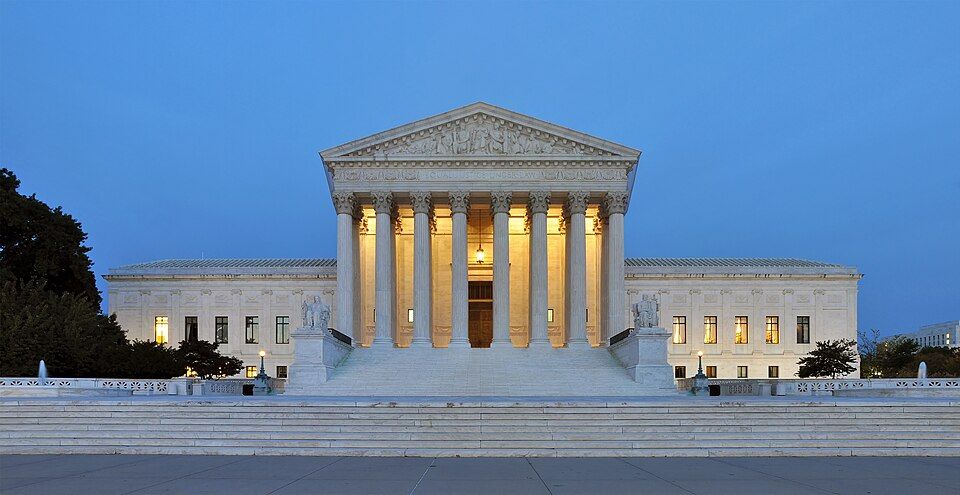
- Judicial review — The Supreme Court can declare a law unconstitutional, invalidating it nationwide. When the Court in NFIB v. Sebelius (2012) upheld the ACA’s individual mandate as a tax but limited the Medicaid expansion, it shaped healthcare for millions. When courts block executive orders, they prevent policies from taking effect. One judge can temporarily halt a policy affecting the entire country pending appeal.
- Statutory interpretation — Courts interpret what Congress meant by a law. If text is ambiguous, courts must decide. Broad interpretations expand policy; narrow ones limit it. Courts decided whether Title VII applies to gender identity and sexual orientation, shaping policy without new legislation.
- Constitutional constraints — By interpreting the Constitution, courts set limits on all three branches. The Commerce Clause, Second Amendment, equal protection—interpretations shape policy across government.
- Enforcement and remedies — Courts order agencies to implement policy differently. School desegregation orders didn’t just strike down segregation; they required specific remedies. Environmental lawsuits force EPA compliance. Courts enforce policy through monitoring and penalties.
Courts are passive institutions—they wait for cases to be brought. They cannot propose policy. But interpretations of statutes and the Constitution set boundaries for what the other branches can do. Which judges sit on the bench matters enormously for policy.
Iron Triangles and Issue Networks
The three branches don’t exist in isolation. They interact with interest groups, corporations, think tanks, and professional organizations. These relationships determine which policies get adopted and how they’re implemented.
The iron triangle consists of three mutually supporting groups:
- Congressional committees — Committees with jurisdiction over a policy area (agriculture, energy, defense). Committee members often have strong ties to the industries they regulate.
- Executive agencies — Bureaucrats implementing policy and providing expertise. They work closely with the same interest groups and committees for years or decades.
- Interest groups and industry — Organizations representing businesses, unions, professions, or causes. They lobby Congress and agencies, provide campaign donations, and influence policy direction.
These groups form mutually beneficial relationships: Congress passes legislation favoring an industry, the agency implements it in industry-friendly ways, and the industry donates to supporting members. Everyone wins—except the general public. The agriculture iron triangle (congressional agriculture committees, the USDA, and farming organizations) has protected farm subsidies for decades. The defense iron triangle sustained high military spending. The tobacco iron triangle delayed regulation.
Issue networks are looser and more fluid. They include academics, journalists, think tanks, advocacy groups, and government officials with expertise in a policy area (climate change, education, criminal justice). These networks generate ideas, conduct research, advocate for change, and sometimes achieve it. They’re more open to new ideas than iron triangles. A climate network might include both progressives and conservatives debating reform approaches.
Both structures explain why changing policy is hard even when the public wants change. Entrenched interests profit from the status quo and have resources to block reform.
Divided Government and Gridlock
When one party controls the presidency and Congress, legislation moves faster. In divided government—when different parties control different branches—policymaking stalls dramatically.
How divided government causes gridlock:
- The president and Congress want incompatible policies. Neither will compromise significantly because base voters oppose it.
- The Senate minority can use the filibuster to block bills without 60 votes. This is a powerful veto point.
- Courts can block executive action if the other party has appointed judges. Democratic presidents’ regulations can be blocked by Republican-appointed judges, and vice versa.
- Public opinion splits along party lines, making compromise politically risky. A member who compromises risks a primary challenge.
During divided government, policy change slows. Instead, branches battle over judicial appointments, use executive orders and agency regulation to advance agendas unilaterally, and blame each other for gridlock. The 2011-2012 period produced almost no major legislation. The 2019-2020 period similarly saw limited legislative productivity.
Even unified government doesn’t guarantee success. Moderate and liberal Democrats might disagree on policy; conservative and moderate Republicans might disagree. Presidents have limited political capital and must prioritize which fights to wage.
Policy Domains and Branch Influence
Different policy areas activate different branches and actors. Recognizing these patterns helps you understand policy questions.
| Policy Domain | Primary Branch | Key Actors | Typical Constraints |
|---|---|---|---|
| Domestic Policy (education, welfare, crime, infrastructure) | Congress initiates; president and agencies implement | Congressional committees, state and local officials, advocacy groups | Federalism limits national control. States implement many programs. Public opinion constrains choices. |
| Economic Policy (taxes, spending, regulation) | Congress controls taxation and spending; president shapes regulatory policy | Congressional budget committees, Treasury, Federal Reserve, business groups, labor unions | Federal Reserve independence limits control. Congress must appropriate funds. International markets constrain. |
| Foreign Policy (diplomacy, military, trade, sanctions) | President dominates, but Congress controls funding and declares war | State Department, Defense Department, CIA, Congress | Congress can defund military action. Courts rarely intervene. International law and allies matter. |
| Social/Moral Policy (abortion, same-sex marriage, drug legalization) | Courts often have final say; Congress and states legislate | Courts, Congress, state legislatures, advocacy groups | Courts enforce constitutional limits. States retain significant authority. Constitutional amendments are very difficult. |
| Regulatory Policy (environment, labor, consumer protection) | Congress sets framework; agencies implement and refine | Congressional committees, regulatory agencies, industry groups, advocacy organizations | Courts review agency rules. Congress can override legislatively. Agencies have discretion within statutory limits. |
No single branch dominates all policy areas. Congress has the strongest role in taxation and budgets; the president in foreign policy; courts in constitutional interpretation. The policy domain determines which branch matters most.
Test-Taking Strategies
Mnemonics and memory shortcuts: Remember the five policy process stages with A-FAIE: Agenda setting, Formulation, Adoption, Implementation, Evaluation. This sequence helps organize any policy question: Where is this policy in the process? What actors matter at this stage?
For branch roles, use C-P-C: Congress legislates, President executes, Courts constrain. This is your baseline. Then layer complexity: Congress controls money; president dominates execution and foreign policy; courts have final say on constitutionality.
Cross-topic connections: This topic directly connects to:
- Structures, Powers, and Functions of Congress (Topic 2.2) — How Congress’s organization determines which policies advance.
- Expansion of Presidential Power (Topic 2.6) — Why presidents increasingly use executive orders when Congress won’t act.
- The Bureaucracy (Topic 2.12) — How agencies implement policy and often shape it through rulemaking.
- The Judiciary (Topic 2.8) — How courts strike down laws and interpret statutes, constraining other branches.
Common question formats: Expect scenarios where a policy dispute arises and you must identify which branch resolves it (usually courts through judicial review, or Congress through legislation/defunding). Expect questions describing a policy at a specific stage and asking what happens next. Expect comparisons of divided versus unified government and effects on specific policies. Expect questions on how iron triangles or issue networks influence outcomes. Expect data on executive orders versus legislative victories showing political environment.
Frequent student mistakes: First, students overcomplicate presidential power. The president can issue executive orders, but Congress can defund them, courts can strike them down, or the next president can reverse them. Presidential power is real but limited.
Second, students assume Congress is always most powerful. Congress is slow, internally divided, and gridlocked. Presidents have learned to work around Congress through regulation and executive orders. Formal power (Congress makes law) differs from practical power (presidents often shape policy faster through execution and regulation).
Third mistake: forgetting federalism. Many policies are shared between federal government and states. Federal law might set a floor, but states can exceed it. State and local governments often implement federal policy with discretion.
Test-day shortcuts: When you see a policy question, immediately ask: What stage is this policy in? Which branch has power at this stage? What actors try to block or advance it? Are we in unified or divided government? These questions narrow answers quickly.
Time management tips: Policy questions often include scenario-based stimuli (news articles, charts of executive orders, court rulings). Skim fast for dates, political context (who controls what), and the problem described. Connect to policy process stages. Focus on political control and which branch/actor matters, not every detail in the stimulus.
Check for Understanding
Think you’ve got it? Complete the quiz below to make sure. Download your results at the end.