
Maximize your score with these resources:
- Albert.io AP® US Government question banks
- Free AP® US Government cheat sheets
- Free AP® US Government score calculator
When the Constitution went to the states for ratification in 1787, it had no list of individual rights. That gap nearly sank it. Opponents refused to support a stronger national government without written protections for speech, religion, and the rights of the accused. The first ten amendments, known as the Bill of Rights, were the price of ratification. On the AP® U.S. Government and Politics exam, this topic opens Unit 3 and sets up every civil liberties case that follows.
This article covers Topic 3.1: The Bill of Rights in Unit 3, Civil Liberties and Civil Rights. The topic asks you to explain why the Bill of Rights was added and how it limits the power of government.
By the end, you should be able to:
- Explain the debate between Federalists and Anti-Federalists over adding a bill of rights.
- Describe what each of the first ten amendments protects.
- Explain the difference between civil liberties and civil rights.
- Explain why the Bill of Rights originally limited only the national government, and how that changed.
Why the Constitution Needed a Bill of Rights
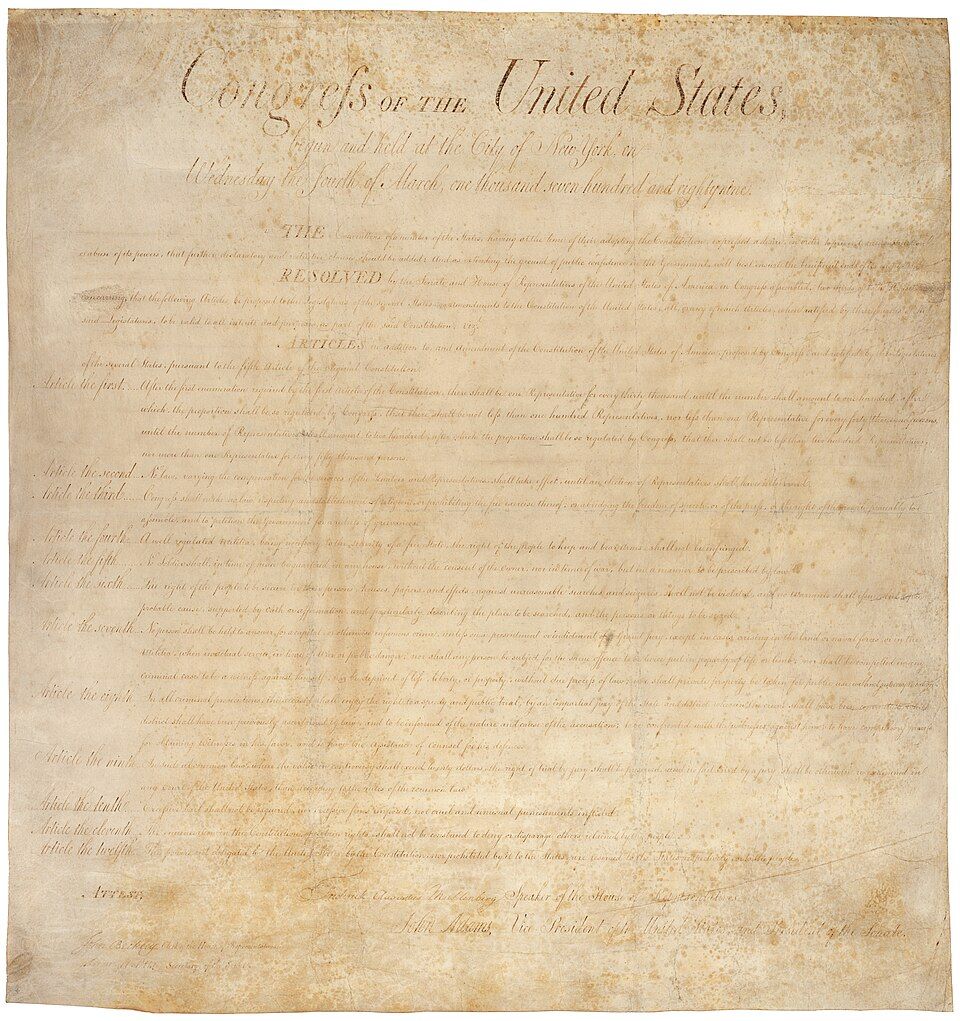


The fight over ratification split the country into two camps, and the Bill of Rights was one of their sharpest disagreements.
- Anti-Federalists feared that a powerful national government would trample individual liberty. Several state constitutions already had bills of rights, and they wanted the same protections against the new federal government. George Mason, who wrote Virginia’s Declaration of Rights, refused to sign the Constitution partly because it lacked one.
- Federalists argued a bill of rights was unnecessary. The national government had only the powers the Constitution listed, so it had no authority to restrict speech or religion in the first place. Some went further and argued that listing rights could be dangerous, since it might suggest that any right left off the list wasn’t protected.
Alexander Hamilton made the Federalist case in Federalist No. 84:
For why declare that things shall not be done which there is no power to do? Why, for instance, should it be said that the liberty of the press shall not be restrained, when no power is given by which restrictions may be imposed?
The Anti-Federalists won the argument in practice. Several states, including Massachusetts and Virginia, ratified the Constitution while recommending amendments, and Federalists promised to add them. James Madison, who had once doubted that written guarantees would do much good, took the lead in the first Congress. He introduced his proposals in June 1789. Congress sent twelve amendments to the states that September, and ten were ratified by December 1791.
One of the two that failed eventually made it. An amendment delaying congressional pay raises until after the next election was finally ratified in 1992 as the 27th Amendment, more than 200 years after Madison proposed it.
Why does this matter? The Bill of Rights was a political compromise that helped win over skeptics of the Constitution. It connects directly to the ratification debate in Unit 1. If a question asks why the Bill of Rights was added, the answer is the Anti-Federalists’ demand for protection against a stronger national government.
What the First Ten Amendments Protect
The Bill of Rights protects civil liberties, meaning freedoms that government cannot take away. Most of these amendments limit what government can do to you. You don’t need to memorize the text word for word, but you do need to know which amendment covers which right.
| Amendment | What It Protects | Key Case or Example |
|---|---|---|
| First | Religion (establishment and free exercise), speech, press, assembly, petition. | Engel v. Vitale (1962), Tinker v. Des Moines (1969) |
| Second | The right to keep and bear arms. | McDonald v. Chicago (2010) |
| Third | No forced quartering of soldiers in private homes. | A response to British practices before the Revolution. |
| Fourth | No unreasonable searches and seizures. Warrants require probable cause. | Evidence from an illegal search can be excluded at trial. |
| Fifth | Due process, no self-incrimination, no double jeopardy, grand juries, just compensation for property taken. | The source of “pleading the Fifth.” |
| Sixth | Speedy and public trial, impartial jury, right to a lawyer, right to confront witnesses. | Gideon v. Wainwright (1963) |
| Seventh | Jury trial in many civil cases. | Applies in federal court. |
| Eighth | No excessive bail or fines, no cruel and unusual punishment. | Central to debates over the death penalty. |
| Ninth | Listing some rights doesn’t deny others kept by the people. | Madison’s answer to the Federalist worry about an incomplete list. |
| Tenth | Powers not given to the national government are reserved to the states or the people. | Cited in federalism cases like United States v. Lopez. |
Three groups make the list easier to remember:
- Freedoms of expression and belief (First). These get their own topics in Unit 3. Start with our reviews of freedom of religion and freedom of speech.
- Rights of the accused (Fourth, Fifth, Sixth, Eighth). Four of the ten amendments protect people suspected or accused of crimes. The Framers had seen British authorities search homes with general warrants and hold trials without juries.
- Structural protections (Ninth and Tenth). These don’t list specific freedoms. They protect unlisted rights and the powers of the states.
Civil Liberties vs. Civil Rights
Unit 3 covers two related ideas, and the exam expects you to keep them straight.
| Civil Liberties | Civil Rights |
|---|---|
| Freedoms protected from government interference. | Protections from unequal treatment based on group characteristics like race or sex. |
| Mainly found in the Bill of Rights. | Mainly based on the Fourteenth Amendment’s Equal Protection Clause and laws like the Civil Rights Act of 1964. |
| Government is told what it can’t do. | Government is often told what it must do to ensure equal treatment. |
| Example: a student’s right to wear an armband in protest. | Example: the right to attend a desegregated school. |
How the Bill of Rights Limits Government
Three ideas explain how the Bill of Rights works in practice.
It Limits Government, Not Private Parties
The First Amendment begins “Congress shall make no law.” The Bill of Rights restricts government action. A private employer that fires someone for a social media post hasn’t violated the First Amendment, though other laws might apply. A public school that punishes a student for peaceful protest may have.
It Originally Applied Only to the National Government
In Barron v. Baltimore (1833), the Court held that the Bill of Rights restricted only the federal government. States could limit speech or deny jury trials without violating it. That changed after the Fourteenth Amendment (1868) barred states from depriving anyone of liberty without due process. Over the 20th century, the Court used that clause to apply most of the Bill of Rights to the states, one right at a time, a process called selective incorporation. McDonald v. Chicago (2010), for example, applied the Second Amendment to state and local gun laws. You can read more in our review of selective incorporation.
Rights Aren’t Absolute
Courts balance individual liberty against other interests like public safety and national security. In Schenck v. United States (1919), a required case, the Court upheld the conviction of a man who distributed leaflets urging resistance to the World War I draft. Justice Oliver Wendell Holmes wrote that speech creating a “clear and present danger” could be punished, comparing it to falsely shouting fire in a crowded theater. Later cases narrowed that test, but the principle holds: most rights have limits, and the Court decides where they fall.
Why does this matter? Nearly every Unit 3 question asks you to balance a right against a government interest. Knowing that the Bill of Rights limits government, applies to states through incorporation, and has limits of its own gives you the framework for all of them.
Test-Taking Strategies
Mnemonic Devices and Memory Shortcuts
- “RAPPS” for the First Amendment. Religion, Assembly, Press, Petition, Speech.
- “4-5-6-8, the accused’s slate.” The Fourth, Fifth, Sixth, and Eighth Amendments protect people in the criminal justice system.
- “9 keeps rights, 10 keeps powers.” The Ninth protects unlisted rights of the people. The Tenth protects reserved powers of the states.
- “Liberties limit, rights require.” Civil liberties limit what government can do. Civil rights often require government to act to ensure equal treatment.
Cross-Topic Connections
- Topics 1.3 and 1.5: The Federalist and Anti-Federalist debate over ratification explains why the Bill of Rights exists. See our review of government power and individual rights.
- Topic 3.7: Selective incorporation applies these amendments to the states through the Fourteenth Amendment.
- Topics 3.2 through 3.9: Each amendment gets deeper treatment in later topics, from religion and speech to the rights of the accused and privacy.
- Topic 1.7: The Tenth Amendment is the textual basis for reserved powers in federalism.
Common Question Formats
- Amendment identification MCQ. A scenario describes a police search, a jury trial, or a religious practice, and you name the amendment involved.
- Quote-based MCQ. A passage from Federalist No. 84 or an Anti-Federalist essay asks which side of the bill of rights debate the author took.
- SCOTUS comparison FRQ. Required Unit 3 cases like Schenck, Engel, Tinker, and Gideon are compared with non-required cases involving the same amendment.
- Argument essay. Prompts about balancing liberty and order use the Bill of Rights, and often a required case, as evidence.
Frequent Student Mistakes
- Thinking the Bill of Rights was part of the original Constitution. It was added in 1791, after ratification, as a compromise with the Anti-Federalists.
- Applying the First Amendment to private companies. The Bill of Rights restricts government. A private business isn’t bound by it in the same way.
- Saying the Bill of Rights always applied to the states. It didn’t until the Fourteenth Amendment and selective incorporation. Barron v. Baltimore is the case that says so.
- Confusing the Ninth and Tenth Amendments. The Ninth is about rights retained by the people. The Tenth is about powers reserved to the states or the people.
Test-Day Shortcuts
- Find the actor. If the stimulus involves a private company or individual, the Bill of Rights probably doesn’t apply directly. If it involves a government official, it does.
- Look for state action. A question about a state law limiting a right is testing incorporation as well as the right itself.
- Balance first, decide second. For any rights question, identify the right and the government’s interest before looking at the answer choices.
Time Management Tips
- Multiple choice: Amendment identification questions should take 30 seconds each once you’ve memorized the table. Bank the time for longer Unit 3 case scenarios.
- SCOTUS comparison FRQ: Spend about 20 minutes. Name the amendment and the required case’s holding in your first sentences, then focus on the comparison.
- Argument essay: When arguing about liberty and order, pick one required case as your main evidence and use the Bill of Rights or Federalist No. 84 as your second piece.
Check for Understanding
Think you’ve got it? Complete the quiz below to make sure. Download your results at the end.