

Maximize your score with these resources:
- Albert.io AP® US Government question banks
- Free AP® US Government cheat sheets
- Free AP® US Government score calculator
The Two Religion Clauses
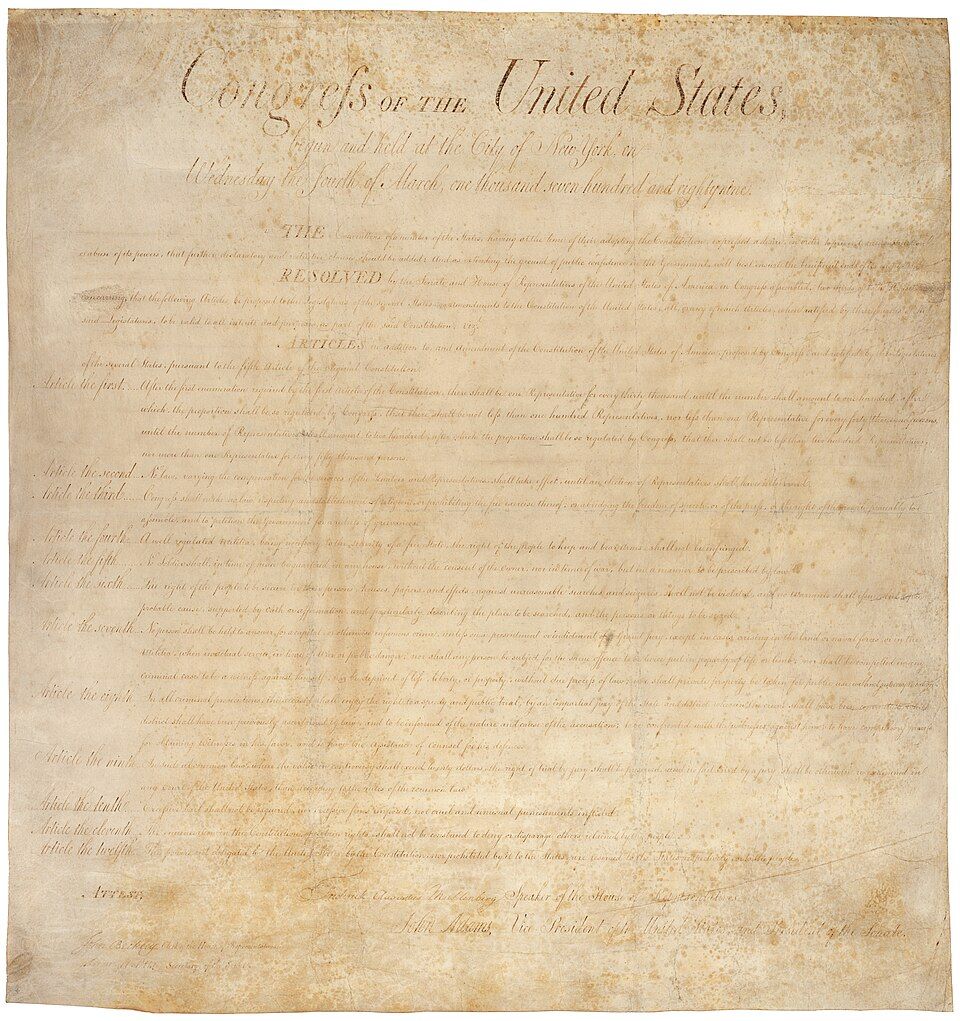
The First Amendment’s 16 words on religion have generated more Supreme Court litigation than almost any other constitutional text: “Congress shall make no law respecting an establishment of religion, or prohibiting the free exercise thereof.” You need to understand how courts interpret each clause, what the leading cases hold, and where the law stands on school prayer and religious exemptions.
Two distinct prohibitions:
- Establishment Clause: Prevents government from favoring religion
- Free Exercise Clause: Prevents government from burdening religion
These clauses sometimes pull in opposite directions. Courts have spent decades trying to balance them.
The Establishment Clause: Separation of Church and State
The Establishment Clause forbids government from establishing an official religion or favoring religion over non-religion. Supreme Court interpretation has evolved significantly since the 1960s.
Engel v. Vitale (1962): Official school prayer violates the Establishment Clause, even when the prayer is nonsectarian and participation is voluntary. The Court reasoned that government sponsorship of prayer violates separation of church and state, regardless of student choice. This struck down a New York program where schools led students in a brief, generic morning prayer.
Abington School District v. Schempp (1963): Extended Engel by prohibiting required Bible reading in public schools. The Court held that both the Establishment Clause and Free Exercise Clause required schools to be religiously neutral. Even Bible reading without theological commentary violated neutrality because it promoted religion over non-religion.
Core principle: Government cannot use its coercive power or resources to advance religion.
Lemon v. Kurtzman (1971): Articulated the test dominating Establishment Clause law for 50 years. A law violates the Establishment Clause if it fails ANY prong:
- The law must have a secular purpose.
- The law’s primary effect must not advance or inhibit religion.
- The law must not create excessive government entanglement with religion.
The Lemon test made government funding of religious institutions very difficult. Even neutral programs incidentally benefiting religious schools faced strict scrutiny. Teachers in religious schools couldn’t be reimbursed for salaries or materials by the state, even if they taught secular subjects, because reimbursement entangled government with religion.
Important note: In Kennedy v. Bremerton School District (2022), the Court abandoned the Lemon test in favor of an approach based on historical practices and understandings. The conservative majority is moving toward historical approaches and more permissive treatment of religion. Expect this area to continue changing significantly.
The Free Exercise Clause: Religious Liberty Against Government Burden
The Free Exercise Clause prevents government from burdening an individual’s religious practice. The key question: What counts as a burden, and when can government restrict religious exercise?
Employment Division v. Smith (1990): A neutral, generally applicable law does not violate the Free Exercise Clause even if it incidentally burdens religious practice. Oregon banned peyote use across the state as a drug enforcement matter. Native American Church members challenged the ban as burdening their religious practice, which included sacramental peyote use. The Court held that the Free Exercise Clause does not provide an exemption from neutral laws.
The Smith test is deferential to government: Government can restrict religious exercise as long as the restriction is neutral and generally applicable. A law targeting religion (or its effects) faces strict scrutiny, but a law that happens to burden religion while pursuing a neutral purpose does not.
Sherbert v. Verner (1963): Came before Smith and held that government restrictions on religious practice must satisfy strict scrutiny: they must serve a compelling government interest and be narrowly tailored to achieve that interest. Under Sherbert, states must provide exemptions from otherwise applicable rules to accommodate religious practice, unless the exemption would undermine a critical government interest.
RFRAs changed the game: Many states and Congress disliked Smith and passed Religious Freedom Restoration Acts (RFRAs) that restored the Sherbert test. These laws require government to show a compelling interest before burdening religious practice. The federal RFRA applies to federal action; state RFRAs apply to state and local action.
Wisconsin v. Yoder (1972): Shows Sherbert’s power. Wisconsin required school attendance until age 16, but the Amish refused public school because secular education conflicted with Amish religious values and lifestyle. The Court held that Wisconsin’s interest in education was not compelling enough to override the Amish Free Exercise claim. The Amish exemption was justified because they had alternative education in their community and their livelihood didn’t require state-school credentials.
The Tension Between the Clauses: Accommodation vs. Neutrality
The two religion clauses create an interpretive tension. The Establishment Clause suggests government should not favor religion. The Free Exercise Clause suggests government should accommodate religion. These principles can conflict.
The core tension: Consider religious exemptions from neutral laws. If government exempts religious practitioners from a generally applicable rule (like vaccine requirements or flag salutes), does that violate the Establishment Clause by giving special treatment to religion? Or does refusing the exemption violate the Free Exercise Clause by burdening religion?
Current approach: The Court generally favors accommodation when asked to balance the clauses. Religious exemptions from neutral laws do not violate the Establishment Clause because they do not establish religion or favor religion over non-religion. They simply excuse religiously motivated non-compliance. However, the Court has sometimes held that certain accommodations go too far.
Boerne v. Flores (1997): The Court struck down the federal RFRA as applied to state and local governments because Congress exceeded its enforcement power under Section 5 of the Fourteenth Amendment. The ruling turned on the limits of congressional power, not the Establishment Clause; RFRA still applies to federal action.
Current debates: Religious exemptions from vaccine mandates, contraceptive coverage under health plans, and transgender policies in religious schools all arise from this Establishment Clause vs. Free Exercise Clause tension. The Court has moved toward protecting religious liberty more aggressively in recent years, making the accommodation view ascendant.
Incorporation: Making the Religion Clauses Apply to States
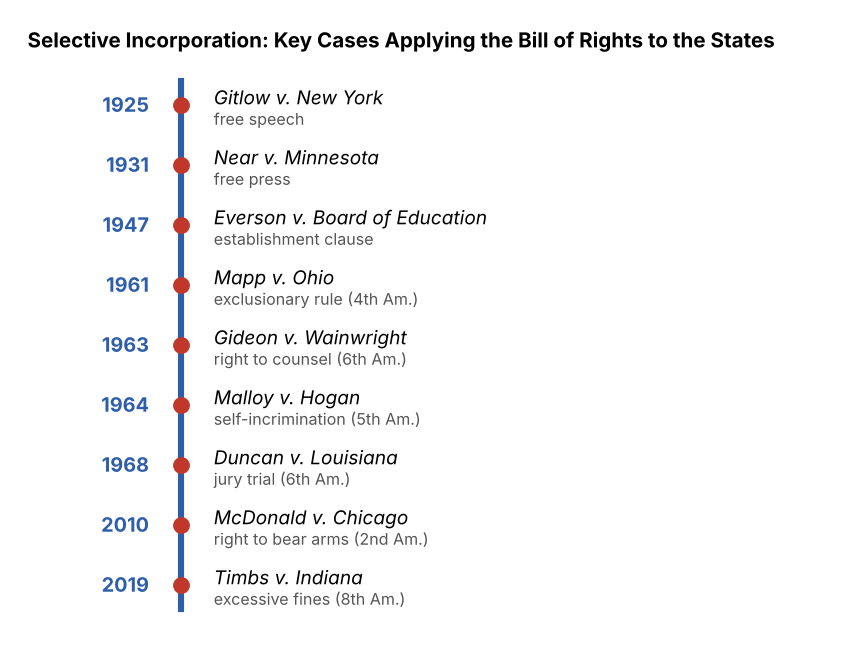
The First Amendment originally applied only to Congress. States were free to establish churches or restrict religious exercise. The 14th Amendment’s Due Process Clause incorporates most of the Bill of Rights, making it applicable to the states.
Key incorporation cases:
- Everson v. Board of Education (1947): Incorporated the Establishment Clause
- Cantwell v. Connecticut (1940): Incorporated the Free Exercise Clause
Why incorporation matters: It prevents states from using their power to establish official religions or discriminate against religious minorities. Without incorporation, states could have maintained official churches. With incorporation, all states must provide religious liberty and maintain some separation of church and state, though the extent is contested.
Key Cases Summary
| Case | Year | Clause | Holding |
|---|---|---|---|
| Engel v. Vitale | 1962 | EC | Official school prayer violates Establishment Clause |
| Abington v. Schempp | 1963 | EC | Required Bible reading in schools violates Establishment Clause |
| Sherbert v. Verner | 1963 | FEC | Strict scrutiny required when law burdens religious practice |
| Cantwell v. Connecticut | 1940 | FEC | Incorporated Free Exercise Clause to states |
| Wisconsin v. Yoder | 1972 | FEC | Amish exemption from compulsory education satisfies Free Exercise Clause |
| Lemon v. Kurtzman | 1971 | EC | Three-part test for Establishment Clause (secular purpose, primary effect, entanglement) |
| Employment Division v. Smith | 1990 | FEC | Neutral laws don’t violate Free Exercise Clause even if they burden religion |
| Boerne v. Flores | 1997 | EC/FEC | Congress exceeded its Fourteenth Amendment enforcement power by applying RFRA to the states |
Test-Taking Strategies
Mnemonic: “EC vs. FEC” for the Two Religion Clauses
- EC = Establishment Clause: What government CANNOT PROMOTE (no establishment)
- FEC = Free Exercise Clause: What government CANNOT RESTRICT (no burden)
EC is about preventing government favoritism toward religion. FEC is about preventing government restriction of religion.
Cross-Topic Connections for the AP Exam
Religion clause questions often pair with:
- Federalism and incorporation (how much power do states have over religion?)
- Individual rights and civil liberties (how far does religious freedom extend?)
- Separation of powers (what’s Congress’ role vs. the judiciary?)
When you see a question about state power to regulate religion, ask first: “Is this incorporated to the states via the 14th Amendment?” If yes, the state is subject to the same test as federal government.
Common AP Question Formats
- Determine whether a government action violates Establishment Clause or Free Exercise Clause
- Analyze case facts and apply the Lemon test (secular purpose, primary effect, entanglement)
- Analyze whether a law is neutral and generally applicable (Smith test)
- Free Exercise questions often involve exemptions: Can government force someone to participate in an activity conflicting with their religion?
- Establishment Clause questions often involve funding: Can government fund religious schools or reimburse religious institutions for services?
Student Mistakes to Avoid
- Mistake 1: Confusing the two clauses. EC is about what government cannot promote. FEC is about what government cannot restrict. They address different government actions.
- Mistake 2: Misremembering the Lemon test. The three prongs are (1) secular purpose, (2) primary effect, (3) entanglement. Study the order.
- Mistake 3: Thinking Smith overruled Sherbert entirely. Smith replaced Sherbert for Free Exercise cases involving neutral laws, but Sherbert still applies when a law targets religion, and many state RFRAs have restored the Sherbert standard.
- Mistake 4: Assuming exemptions always violate the Establishment Clause. They do not. Exemptions from neutral laws are usually considered accommodations, not establishments.
Quick Question Flow on Test Day
For Free Exercise questions: First ask: “Is this law neutral and generally applicable?” If yes, apply Smith (government wins). If no (law targets religion), apply strict scrutiny (likely government loses unless it has a compelling interest). If a state has a RFRA, apply strict scrutiny.
For Establishment Clause questions: Ask: “Does the law have a secular purpose AND does its primary effect not advance religion?” If both yes, apply entanglement test. If law funds religious schools or creates entanglement, it likely fails Lemon. Watch for recent developments that may weaken Lemon.
Time Management
- Free Exercise questions can be decided quickly with Smith framework: one key question often determines the answer
- Establishment Clause questions require more analysis, but Lemon gives you a road map
- Memorize the three Lemon prongs and apply them systematically
- You’ll handle most questions efficiently once you recognize these patterns
Check for Understanding
Think you’ve got it? Complete the quiz below to make sure. Download your results at the end.