

Maximize your score with these resources:
- Albert.io AP® US Government question banks
- Free AP® US Government cheat sheets
- Free AP® US Government score calculator
The First Amendment stands as one of the most misunderstood and litigated protections in the Constitution. Students often think it provides absolute protection for all speech, but the Supreme Court has spent over a century carving out limits and defining which speech the government can regulate. For AP® US Government and Politics, you need to understand not just what the First Amendment says, but how courts interpret it through landmark cases and competing principles. This review covers the protected and unprotected categories of speech, the key Supreme Court cases you’ll encounter on the exam, and the constitutional tests courts use to evaluate speech restrictions. By the end, you’ll know exactly what the exam writers expect when they ask about First Amendment freedoms and Supreme Court interpretations (CON-3.B).
What the First Amendment Actually Says (and Doesn’t Say)
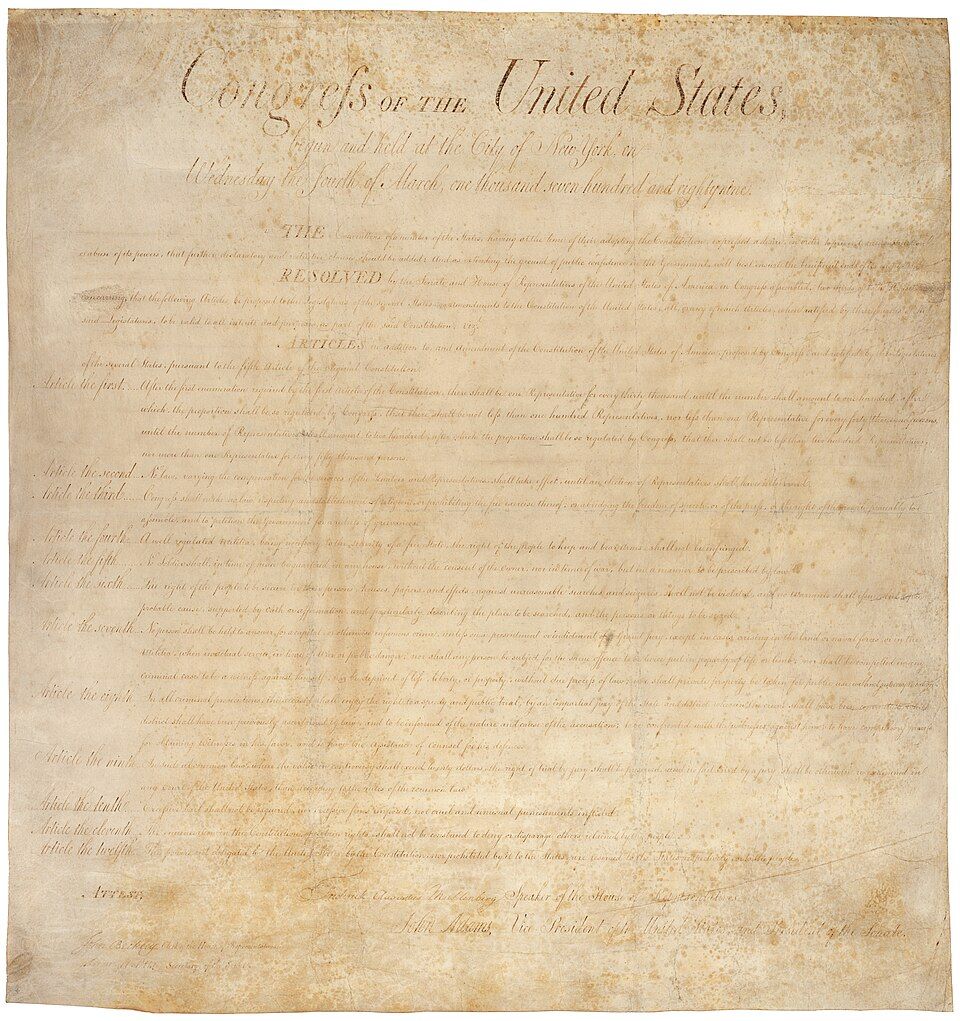
The First Amendment text is deceptively brief: “Congress shall make no law respecting an establishment of religion, or prohibiting the free exercise thereof; or abridging the freedom of speech, or of the press; or the right of the people peaceably to assemble, and to petition the Government for a redress of grievances.” Notice the specific language: “Congress shall make no law…abridging the freedom of speech.” This seems absolute, but the Supreme Court has never treated it that way. Instead, courts ask two critical questions about any speech restriction: Is this speech protected at all? If so, what level of government scrutiny applies to regulating it?
The reason courts don’t treat the First Amendment as absolute comes down to competing interests. You can’t yell “fire” in a crowded theater to cause panic, and you can’t threaten to kill the President. The government has legitimate interests in national security, public safety, and protecting individuals from harm. Your job is to understand where courts draw the line between speech the government can restrict and speech it cannot.
Protected Speech: Categories the First Amendment Shields
Political speech receives the strongest protection. Elections, debates about policy, criticism of government officials, and advocacy for change are all core First Amendment activities. Courts apply strict scrutiny to any government attempt to restrict political speech, meaning the government must prove a compelling interest and narrow tailoring. This is why negative campaign ads, even false and inflammatory ones, generally receive protection.
Symbolic speech is non-verbal communication that conveys a specific message. Wearing an armband to protest a war, burning a flag, or refusing to salute the flag all constitute symbolic speech if they carry political meaning. The Supreme Court recognizes symbolic speech as protected under the First Amendment, though the protection depends on context and government intent.
Offensive speech is protected, even when it deeply offends many people. The Supreme Court has consistently ruled that government cannot ban speech simply because people find it vulgar, crude, or morally offensive. If courts could restrict offensive speech, political discourse and artistic expression would collapse into a narrow band of inoffensive platitudes.
Unprotected Speech: What the Government Can Restrict
Not all speech receives First Amendment protection. The Supreme Court recognizes several categories of unprotected speech where government can impose restrictions without violating the First Amendment.
Obscenity is one narrow category. Courts use the three-part Miller test (developed in Miller v. California, 1973) to identify obscene material: the average person applying contemporary community standards would find the work appeals primarily to prurient interest; the work depicts sexual conduct in a patently offensive way; and the work lacks serious literary, artistic, political, or scientific value. Obscenity is rare in modern litigation, but the category exists as a theoretical limit on protection.
True threats can be restricted. If someone makes a genuine threat of violence against a specific person or group, government can punish that speech without violating the First Amendment. The key is genuineness: the speaker must intend the statement as a threat, and a reasonable listener would understand it as such. Courts distinguish true threats from hyperbole or strong rhetoric.
Incitement to imminent lawless action is unprotected when speech directly incites immediate illegal conduct. This replaces an older standard and is much more protective of speakers. Under the Brandenburg test (covered below), speech is unprotected only if the speaker (1) intends to incite lawless action, (2) the speech is likely to incite such action, and (3) the lawless action is imminent.
Defamation (false statements of fact that damage someone’s reputation) can be restricted. However, public figures must prove the speaker acted with “actual malice” (knowledge of falsity or reckless disregard for truth). Private figures have an easier burden. This balance protects robust public debate while providing some recourse for those harmed by lies.
Fighting words can be restricted. In Chaplinsky v. New Hampshire (1942), the Supreme Court defined fighting words as “personally abusive epithets which, when addressed to the ordinary citizen, are likely to provoke physical confrontation.” If your speech is so directly provocative that it’s likely to cause immediate physical retaliation, the government can punish it.
Landmark Supreme Court Cases: What You Must Know
The AP exam heavily tests Supreme Court cases on speech rights. Here are the cases you absolutely need to master:
| Case | Year | Holding | Why It Matters for AP |
|---|---|---|---|
| Schenck v. United States | 1919 | Speech can be restricted if it creates a clear and present danger of bringing about substantive evils that Congress has a right to prevent. The government can punish speech that threatens national security during wartime. | Introduced the “clear and present danger” test, which dominated First Amendment law for 50 years. The “fire in a crowded theater” language came from this case. You need to know this test was replaced by the Brandenburg test. |
| Tinker v. Des Moines | 1969 | Students have First Amendment rights in school. The school can only restrict student speech if it causes substantial disruption or invades others’ rights. Wearing black armbands to protest the Vietnam War was protected symbolic speech. | This is the leading case on student speech rights. The phrase “students do not shed their rights at the schoolhouse gate” is iconic. Expect questions about when schools can limit student expression. |
| Brandenburg v. Ohio | 1969 | The imminent lawless action test replaces clear and present danger. Speech advocating lawlessness is protected unless the speaker intends to incite imminent lawless action and the speech is likely to produce such action imminently. | This is the modern standard for incitement. It’s far more protective of speakers than Schenck. The test has three prongs: intent, likelihood, and imminence. You’ll use this to evaluate speech cases. |
| New York Times v. United States | 1971 | Prior restraint is unconstitutional. The government cannot prevent publication of the Pentagon Papers even on national security grounds. There is a heavy presumption against prior restraint. | This case defines the government’s limited power to stop speech before it happens. Know that the government bears an extremely heavy burden to justify prior restraint. This case protects investigative journalism and whistleblowers. |
| Texas v. Johnson | 1989 | Flag burning is protected symbolic speech. Even though many find it deeply offensive, the government cannot ban it based on the content of the message (opposition to government policy). | Demonstrates that offensive symbolic speech is protected. Shows courts apply strict scrutiny to content-based restrictions. Illustrates the tension between protecting expression and community values. |
Each of these cases represents a different principle: Schenck and Brandenburg address incitement; Tinker covers student rights; New York Times addresses prior restraint; Texas v. Johnson covers symbolic speech. When you see a fact pattern on the exam, ask which principle it implicates, then apply the relevant test.
Content-Neutral vs. Content-Based Restrictions
Courts make a sharp distinction between restrictions based on the content of speech and restrictions based on when, where, or how speech occurs. This distinction determines how hard the government must work to justify the restriction.
Content-based restrictions are laws that single out certain ideas or messages for disfavor. A ban on “anti-government speech” or “communist propaganda” is content-based. Courts apply strict scrutiny to these restrictions: the government must prove a compelling interest and the restriction must be narrowly tailored to serve that interest. In practice, content-based speech restrictions almost always fail strict scrutiny. Texas v. Johnson is a clear example: Texas tried to ban flag desecration because of the message it sends, and the Court struck it down.
Content-neutral restrictions regulate speech based on the time, place, or manner of expression, without reference to the message. A law that says “no demonstrations in the park between midnight and 6am” is content-neutral; it applies equally to protests against the government and protests against corporations. Courts apply intermediate scrutiny to content-neutral restrictions: the government must show a significant interest unrelated to suppressing speech and the restriction must be narrowly tailored to serve that interest. Content-neutral restrictions are more likely to survive than content-based ones.
Prior Restraint and the Presumption Against Government Censorship
Prior restraint is government action that prevents speech before it occurs. New York Times v. United States is the cornerstone case here. The government tried to prevent the New York Times from publishing classified documents about the Vietnam War, arguing national security required stopping publication. The Supreme Court ruled that prior restraint is presumed unconstitutional, and the government bears an extremely heavy burden to justify it. The government did not meet that burden in that case, even with national security at stake.
The reason courts so strongly disfavor prior restraint relates to democratic theory. If government can prevent speech before it happens, it can suppress dissent, criticism, and uncomfortable truths. Allowing punishment after speech occurs gives citizens notice and lets courts review the facts; prior restraint gives neither. This principle protects whistleblowers, investigative journalists, and anyone challenging government policy.
On the AP exam, if you see a scenario involving government trying to prevent publication or a speaker from appearing, immediately think “prior restraint.” Apply the principle that such restrictions are presumed unconstitutional.
Symbolic Speech and the Message Question
Symbolic speech requires two elements: the conduct must be expressive (intended to convey a specific message), and viewers must likely understand it as expressing that message. Flag burning in Texas v. Johnson satisfied both: burning the flag was intended to protest government policy, and viewers understood it that way.
Courts ask a critical follow-up question: Is the government restricting the conduct because of the message it conveys (content-based) or for some other reason (content-neutral)? If Texas banned flag burning because it offends people or because the state dislikes the message of protest, that’s content-based and triggers strict scrutiny. Texas v. Johnson analyzed it exactly that way, and the Court found the restriction unconstitutional.
Compare this to a hypothetical: if Texas banned flag burning because the ashes harm air quality (a content-neutral environmental reason unrelated to the message), courts might apply intermediate scrutiny and uphold it. The exam often tests whether you can distinguish content-based from content-neutral restrictions in symbolic speech cases.
Test-Taking Strategies
1. Mnemonics and Memory Shortcuts
Remember the categories of unprotected speech: obscenity, true threats, incitement, defamation, and fighting words. For Brandenburg, remember the three prongs as “ILI”: Intent, Likelihood, Imminence. For the Miller test on obscenity, remember “PSV”: Prurient interest (judged by contemporary community standards), Sexual conduct depicted in a patently offensive way, Value (lack of).
2. Cross-Topic Connections
First Amendment speech rights connect to several other AP Government topics. Relate speech to elections (campaign finance and speech); relate it to civil rights (whether First Amendment protections apply equally to all groups); relate it to federalism (state vs. federal power to restrict speech); and relate it to the judicial process (how courts apply different scrutiny levels). If a question involves both First Amendment and another topic, look for connections in the constitutional principle involved.
3. Common Question Formats
Expect fact pattern questions: “A student wears a shirt with a vulgar political slogan to school. Can the school ban it?” (Apply Bethel School District v. Fraser (1986): schools may restrict lewd or vulgar student speech without showing substantial disruption; for non-vulgar political messages, apply Tinker.) “The government seeks to prevent a newspaper from publishing leaked information about foreign policy.” (Apply New York Times: prior restraint presumed unconstitutional.) “A protester burns a flag during a demonstration against police brutality.” (Apply Texas v. Johnson: symbolic speech, content-based restriction, likely unconstitutional.) You might also see questions asking you to compare cases or apply a test to a new scenario.
4. Frequent Student Mistakes
Mistake 1: Assuming the First Amendment is absolute. Students often think any speech restriction is unconstitutional. The correct response: the First Amendment protects most speech, but unprotected categories (obscenity, true threats, incitement, defamation, fighting words) exist, and the government can apply content-neutral time/place/manner restrictions.
Mistake 2: Confusing the clear and present danger test with the Brandenburg test. The exam loves this. Schenck (1919) set the clear and present danger standard, but Brandenburg (1969) replaced it with imminent lawless action. If you use Schenck’s test, you’re wrong. Always cite Brandenburg for modern incitement cases.
Mistake 3: Treating offensive speech as unprotected. Students see a fact pattern with vulgar or deeply offensive speech and think the government can ban it. Wrong. Offensive speech is protected. The government cannot restrict speech because people find it objectionable. This is a core AP distinction.
5. Test-Day Shortcuts
If a question involves government trying to stop speech before it occurs, immediately think “prior restraint.” If it involves offensive but non-violent speech, the answer is almost certainly “protected.” If it involves symbolic speech, ask whether the government’s reason is content-based or content-neutral. If you see Brandenburg facts (speech inciting immediate lawless action), apply the three-prong test in order: intent, likelihood, imminence. All three must be present for the speech to be unprotected. If a case involves students in school, cite Tinker and the “substantial disruption” standard.
6. Time Management Tips
For free-response questions on First Amendment cases, organize around the key test or principle, not the facts. Spend 20 seconds identifying which test applies (Brandenburg, prior restraint, etc.), then spend the rest of your time applying it to the facts. Don’t retell the case facts; instead, explain how the principle or test answers the question. If you have limited time, identify the constitutional issue first (“This question is about incitement”), state the test (Brandenburg), and then apply it. That structure gets you most of the points even if you run out of time.
When comparing multiple cases, use a two-column approach: list the test/principle for each case, then show how they differ. For example, “Schenck used clear and present danger; Brandenburg used imminent lawless action.” This format is fast and clear.
Check for Understanding
Think you’ve got it? Complete the quiz below to make sure. Download your results at the end.