

Maximize your score with these resources:
- Albert.io AP® Microeconomics question banks
- Free AP® Microeconomics cheat sheets
- Free AP® Microeconomics score calculator
Price elasticity of supply (PES) measures how responsive producers are to price changes. If producers dramatically increase output when prices rise, supply is elastic. If they barely change output despite price increases, supply is inelastic. This distinction shapes everything from agricultural markets to manufacturing, and the AP exam tests it relentlessly across both multiple-choice and free-response questions.
This article covers Topic 2.4: Price Elasticity of Supply from Unit 2 — Supply and Demand (20-25% of exam weight) and directly addresses Learning Objective MKT-3.F: Calculate and interpret price elasticity of supply. You’ll learn the PES formula, how to classify elasticity (elastic, inelastic, unit elastic, perfectly elastic, perfectly inelastic), what determines elasticity, and how elasticity affects real-world market outcomes. After reading, you’ll know exactly what the exam expects and how to recognize PES in every format it appears.
The Price Elasticity of Supply Formula and Classification
Price elasticity of supply is calculated using the same percentage-change framework as price elasticity of demand, but applied to quantity supplied rather than quantity demanded. The formula is:
\(\text{PES} = \frac{\% \text{ change in quantity supplied}}{\% \text{ change in price}}\)
Breaking this down step-by-step:
- Calculate the percentage change in quantity supplied: \(\frac{Q_2 – Q_1}{Q_1} \times 100\)
- Calculate the percentage change in price: \(\frac{P_2 – P_1}{P_1} \times 100\)
- Divide the first result by the second. The sign will almost always be positive (because price and quantity supplied move in the same direction on the supply curve).
Why this matters: The AP exam frequently asks you to calculate PES given two price-quantity combinations, then interpret the result. You must be fluent in both the math and the language of elasticity.
Once you’ve calculated PES, classify it using these ranges:
| Classification | PES Value | What It Means | Real-World Example |
|---|---|---|---|
| Perfectly elastic | PES = ∞ (infinity) | Producers are willing to supply any quantity at exactly one price. A tiny price increase causes quantity supplied to increase infinitely; a tiny price decrease causes it to drop to zero. | Agricultural commodities in highly competitive global markets (wheat, corn). Producers will only sell at the world market price. |
| Elastic | PES > 1 | Quantity supplied responds significantly to price changes. A 1% price increase leads to more than a 1% increase in quantity supplied. | Consumer electronics. A 10% price increase can drive a 20% expansion in production and market entry. |
| Unit elastic | PES = 1 | Quantity supplied changes proportionally to price. A 1% price increase causes a 1% increase in quantity supplied. | Some manufactured goods where production capacity is moderately flexible. |
| Inelastic | 0 < PES < 1 | Quantity supplied is not very responsive to price changes. A 1% price increase leads to less than a 1% increase in quantity supplied. | Oil extraction, mining, specialty goods requiring fixed assets. It takes time and capital to increase output. |
| Perfectly inelastic | PES = 0 | Quantity supplied does not change regardless of price. The supply curve is vertical. Producers will supply exactly the same amount at $5 as at $50. | Land (fixed supply), historical artifacts, immediate short-run supply in highly specialized markets. |
Why elasticity classification matters for the exam: The AP test often presents a scenario and asks you to identify whether supply is elastic or inelastic, then predict what happens to total revenue or consumer welfare. For instance: “If a technology allows producers to rapidly scale production, is supply likely to be elastic or inelastic?” The answer requires understanding what each term actually means in context, not just memorizing the definitions.
The Five Key Determinants of Price Elasticity of Supply
PES isn’t arbitrary. It depends on five specific factors that the exam expects you to recognize and apply. These determinants explain why some industries have elastic supply and others inelastic.
- Time horizon. The most critical determinant. In the immediate short run, supply is nearly always inelastic because producers cannot quickly adjust production. A farmer cannot harvest more wheat next week just because the price spiked. Over months or years (long run), supply becomes more elastic as firms invest in new equipment, hire workers, or enter the market. The AP exam frequently tests your understanding of short-run versus long-run elasticity — always pay attention to the time frame mentioned in the question.
- Availability of productive resources (inputs). If the inputs needed to produce a good are abundant and easy to obtain, supply is more elastic. For example, software has highly elastic supply because adding digital copies costs almost nothing. Conversely, if key inputs are scarce, expensive, or require specialized skills, supply is inelastic. Rare earth minerals have inelastic supply because mining capacity is limited and takes years to expand.
- Storage capacity and shelf life. Goods that can be stored without deterioration have more elastic supply. Producers can hold inventory and release it when prices rise. Perishable goods (fresh fish, produce) have inelastic supply because they cannot be stored economically for extended periods. If the harvest arrives and prices drop, fishermen cannot simply wait months for prices to recover.
- Production complexity and capital requirements. Goods requiring simple, low-cost production processes have elastic supply. A baker can quickly bake more loaves if demand rises. Goods requiring expensive, specialized equipment or long lead times have inelastic supply. Building a new semiconductor factory takes years and billions of dollars, so chip makers cannot rapidly increase production in response to a price spike.
- Number of competing producers and ease of market entry. If many firms can easily enter an industry with low start-up costs, supply is elastic. Conversely, if there are few producers and high barriers to entry, supply is inelastic. Smartphone manufacturing has barriers (capital investment, technical expertise, supply chains) that limit how quickly new competitors can scale up, making supply relatively inelastic despite the technology industry’s rapid evolution.
Exam application: Free-response questions often describe an industry and ask you to explain whether supply is elastic or inelastic. Your answer must reference one or more of these five determinants. For example: “Explain whether the supply of craft beer is elastic or inelastic in the short run.” A strong answer would say: “In the short run, craft beer supply is inelastic because breweries operate at fixed capacity and cannot quickly expand production. They would need to build new facilities, which takes time and capital investment.” Notice how this directly references the production complexity and time horizon determinants.
How Price Elasticity of Supply Affects Market Outcomes
PES doesn’t exist in a vacuum. It directly influences what happens to prices, quantities, revenues, and consumer/producer welfare when demand shifts. Understanding these connections is essential for the exam’s multi-step scenario questions.
Scenario: Demand increases (curve shifts right). The outcome depends on whether supply is elastic or inelastic:
- If supply is elastic (producers can quickly increase output): Quantity increases significantly, price increases modestly, and consumers get closer to their desired quantity. Producer revenue often increases.
- If supply is inelastic (producers cannot quickly increase output): Quantity increases only slightly and prices spike dramatically. Producer revenue increases, because both price and quantity rise. This is a classic exam question type.
Real-world example: When housing demand increased in the 2000s, housing supply was inelastic (zoning restrictions, construction timelines, limited land). Prices skyrocketed. In contrast, when smartphone demand surged in the early 2010s, supply eventually became more elastic as manufacturers ramped up production, and prices stabilized. The different elasticity outcomes shaped very different market histories.
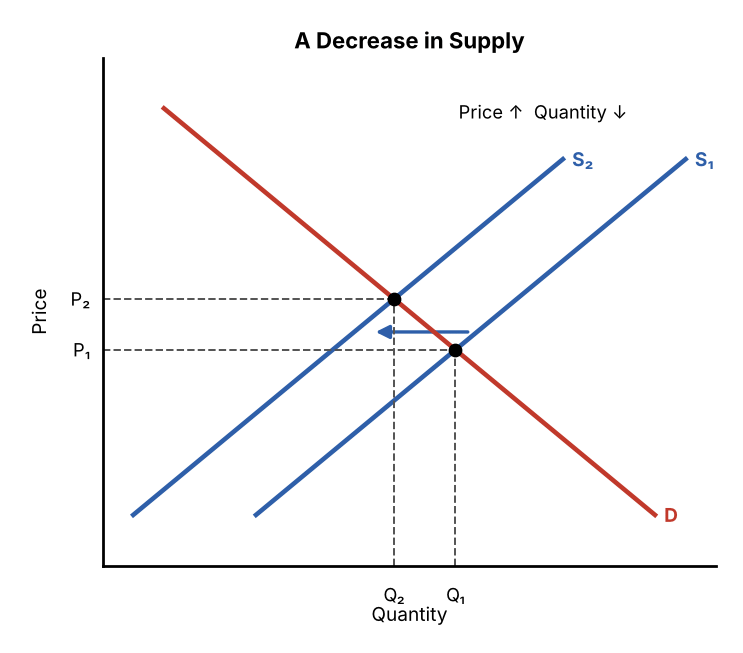
Scenario: Supply decreases (curve shifts left). This reveals why elasticity matters for equilibrium:
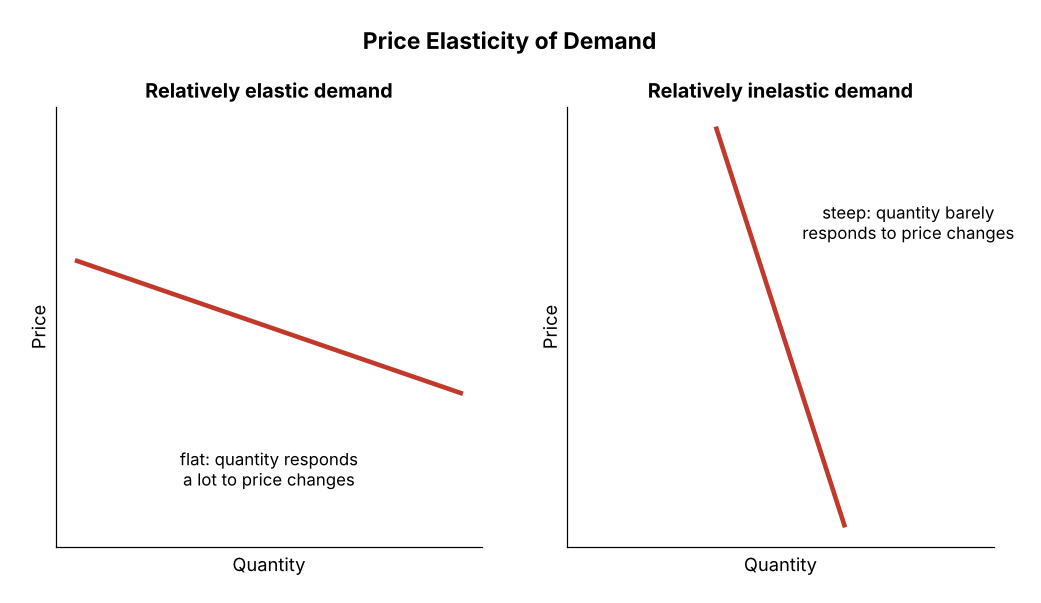
- If demand is elastic (consumers are price-sensitive): A supply decrease causes prices to rise modestly, and quantity demanded drops significantly. The market sees both fewer items sold and higher prices.
- If demand is inelastic (consumers are not very price-sensitive): A supply decrease causes prices to rise, but quantity demanded barely falls. Consumers pay much more for nearly the same quantity. This is common in essential goods like gasoline or prescription medications.
Why this matters for the exam: AP questions often ask you to predict the direction and magnitude of price and quantity changes when supply or demand shifts. Your answer must account for both the direction of the shift and the elasticity of the other curve. A complete answer uses elastic/inelastic language: “Because oil demand is inelastic (consumers need fuel regardless of price), a supply reduction due to conflict in the Middle East causes prices to rise sharply while quantity demanded remains relatively stable.”
Perfectly Elastic and Perfectly Inelastic Supply in Context
These two extremes deserve special attention because they appear on the exam as both theoretical concepts and practical applications.
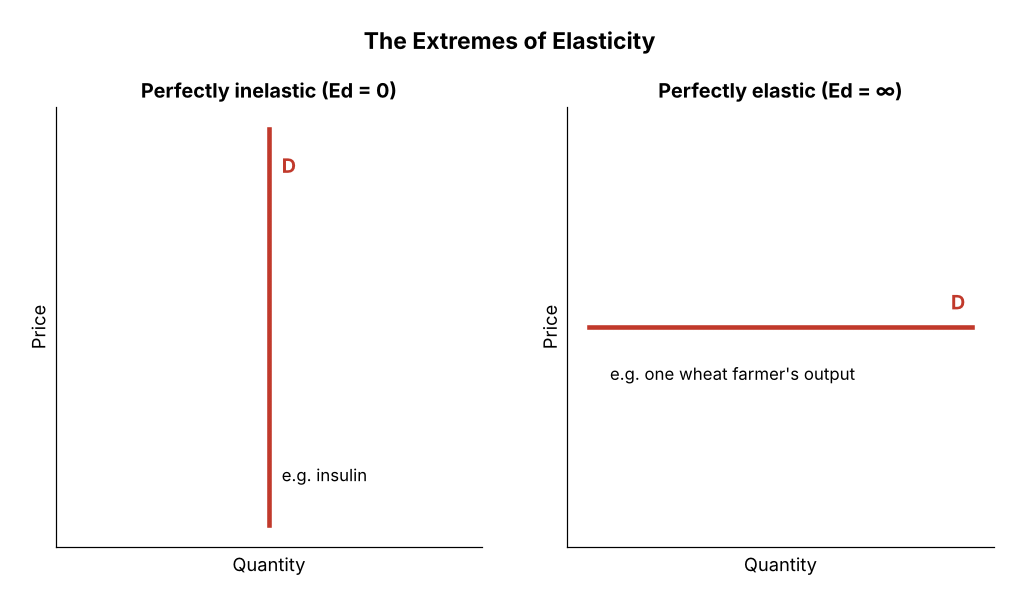
Perfectly elastic supply (PES = ∞, horizontal supply curve at one price): This occurs when producers are willing to supply unlimited quantities at a specific price, but will supply zero at any lower price. In practice, this happens in highly competitive industries where firms are price-takers (they accept the market price and cannot influence it). Agricultural commodities and standardized goods in global markets approximate this. If the world price of wheat is $5 per bushel, farmers will grow as much as they can and sell at that price. If it drops to $4, many will exit wheat production entirely.
When demand increases in a perfectly elastic supply market, quantity increases dramatically, but price remains constant. This is the opposite of perfectly inelastic supply. The exam tests your ability to recognize when a market fits this description.
Perfectly inelastic supply (PES = 0, vertical supply curve): This occurs when quantity supplied does not change regardless of price. Land is the textbook example—there is only so much land available, and no price increase will create more of it. Rare paintings, vintage wines from specific vineyards, and historical artifacts also have perfectly inelastic supply.
When demand increases in a perfectly inelastic market, quantity stays the same, but price rises to whatever level clears the market. This explains why a rare Picasso painting or a bottle of 1947 Château d’Yquem can sell for astronomical prices—supply is fixed, demand varies, and prices absorb all the adjustment. The exam may ask you to explain why prices are so high for certain goods; perfectly inelastic supply is often the reason.
Common Mistakes and Misconceptions About Price Elasticity of Supply
The AP exam targets these frequent student errors:
- Confusing PES with price elasticity of demand (PED). They use the same formula, but PES measures producer responsiveness while PED measures consumer responsiveness. Students often mix them up in free-response answers. Remember: supply curves slope upward (positive relationship between price and quantity supplied), so PES is positive. Demand curves slope downward, so PED is negative. The exam will penalize you if you treat them as interchangeable.
- Assuming all goods have the same elasticity in the short and long run. This is wrong. Nearly everything is inelastic in the very short run and becomes more elastic over time as producers invest and adjust. A crude oil refiner cannot instantly double capacity, but over five years, new refineries can be built. Failing to consider the time horizon is a common free-response error.
- Forgetting that elasticity depends on context, not just the good itself. The supply of concert tickets is perfectly inelastic (capacity is fixed), but the supply of recorded concerts is elastic (digital production is cheap). The same experience, different elasticity. The exam tests whether you understand the underlying reason for elasticity, not just the label.
- Miscalculating PES using the wrong formula or base. Some students use the midpoint method (which gives the same answer as the point method for small changes). Others incorrectly use absolute changes instead of percentage changes. When calculating: always use percentages, and double-check your arithmetic. The exam often includes calculation questions where a single arithmetic error ruins the entire answer.
- Ignoring the implications for total revenue. When supply is inelastic and price rises, total revenue earned by producers clearly increases. But students often forget to account for the cost of production. Higher prices don’t automatically mean higher profit if input costs also rose. The exam may ask: “If a tariff raises the price of imported steel, and domestic steel supply is inelastic, do domestic steel producers definitely earn higher profits?” The answer is “not necessarily” because costs matter too.
Test-Taking Strategies
Mnemonic Devices and Memory Shortcuts
Use CREST to remember the five determinants of elasticity: Capital requirements and production complexity, Resource availability, Ease of storage, Short run vs. long run (time horizon), Total number of producers (barriers to entry). If a question asks why a particular industry’s supply is elastic or inelastic, run through CREST and identify which factor applies.
Remember PES > 1 = Elastic, PES < 1 = Inelastic using this: “Greater than one means the response is greater than the stimulus.” A 10% price increase causes a 15% quantity increase (PES = 1.5, elastic) — the quantity response is bigger. A 10% price increase causes a 3% quantity increase (PES = 0.3, inelastic) — the quantity response is smaller.
Cross-Topic Connections
Price elasticity of supply connects directly to three other topics the exam loves to link:
- Topic 2.2 (Determinants of Supply): Those determinants (technology, input prices, expectations, number of firms) also influence PES. A technological advance that lowers production costs makes supply more elastic. This is a favorite multi-topic question.
- Topic 2.6 (Market Equilibrium): When demand shifts, whether price or quantity changes more depends on the elasticity of supply. The exam tests this in multi-step scenarios where you must identify the elasticity and then predict equilibrium changes.
- Topic 2.6 (Consumer and Producer Surplus): Elasticity of supply affects the distribution of surplus between consumers and producers. When supply is inelastic and demand increases, most of the gain goes to producers (they capture surplus through higher prices). Understanding this connection is essential for free-response questions on welfare and policy.
Common Question Formats
Watch for these exact question types on the exam:
- “Calculate PES and classify it.” You’ll receive two price-quantity pairs, calculate the percentage changes, divide, and classify as elastic/inelastic/unit elastic. Show all work. One calculation error cascades.
- “Explain why the supply of [good] is elastic/inelastic in the [short/long] run.” Reference at least one of the five determinants. Simply saying “production is complex” is not enough; explain why that complexity makes supply inelastic.
- “If demand increases and supply is inelastic, predict the effect on equilibrium price and quantity.” You must answer both parts: price increases (definitely), quantity increases (but by less than if supply were elastic). Explain why.
- “Which industry has more elastic supply: agriculture or oil refining?” Expect to justify your answer using determinants. Oil refining requires massive capital investment (inelastic), while agriculture can often increase output faster (more elastic in the medium run, despite weather unpredictability).
- “How does a price ceiling or price floor affect an inelastic supply market?” When supply is inelastic, price controls create shortages (ceiling) or surpluses (floor) because quantity supplied barely responds. This is a favorite integration question.
Frequent Student Mistakes
Mistake 1: Confusing inelastic supply with unresponsive demand. Inelastic supply means “producers don’t change quantity much when price changes.” It says nothing about whether consumers want the good. A student might say: “Gold supply is inelastic because people don’t want it.” Wrong. Gold supply is inelastic because mining more is expensive and time-consuming, not because demand is low. The correction: “Gold supply is inelastic because extracting additional gold requires significant capital investment and geological exploration; quantity supplied is not very responsive to price changes.”
Mistake 2: Saying supply is inelastic because demand is high. Supply elasticity depends on producer flexibility, not consumer desire. A student might write: “Concert ticket supply is elastic because tickets are in high demand.” Wrong. Concert supply is inelastic because venue capacity is fixed, period. Demand being high is irrelevant. The exam rewards students who separate the concepts cleanly.
Mistake 3: Assuming long-run supply is always elastic. Usually true, but not always. Some goods (land, natural resources with fixed deposits) are inelastic even in the long run. If a question asks about long-run elasticity, don’t assume elastic automatically. Evaluate using the five determinants.
Test-Day Shortcuts
For calculation questions: Use the midpoint method (average the two quantities, average the two prices) if the price change is large. It’s slightly slower but often more accurate than the point method. Always keep two decimal places to avoid rounding errors.
For scenario questions: Draw a quick supply-and-demand graph. Mark the original equilibrium, sketch the shift (usually demand in rightward, supply leftward), and then sketch supply either steep (inelastic) or flat (elastic). This visual forces you to think about what happens to price and quantity before you write. Many students make mistakes by jumping straight to words without visualizing.
For multi-part questions: Write “supply is inelastic because…” or “supply is elastic because…” before you try to predict equilibrium. Naming the elasticity first anchors your reasoning and reduces the chance of a logical misstep.
Time Management Tips
On the AP exam, a single-definition question (“define price elasticity of supply”) should take 30 seconds maximum. If you’re writing more than two sentences, you’re over-explaining.
Calculation questions typically take 2-3 minutes if you’re confident in the formula. Don’t second-guess yourself halfway through. If you make an error, note it and move on — partial credit rewards the work you do show.
Multi-step free-response questions about elasticity usually require 4-5 minutes. Spend 1 minute identifying which determinants or scenario apply, 1 minute sketching a graph, 2 minutes writing your explanation, and 1 minute reviewing for logical consistency. This structure prevents rambling and improves clarity.
If you encounter a PES question embedded in a larger question about tariffs, taxes, or price controls, handle the elasticity part first (identify whether elastic/inelastic), then apply it to the policy. The elasticity assessment is the foundational step; everything else flows from it.
Check for Understanding
Think you’ve got it? Complete the quiz below to make sure. Download your results at the end.