
Maximize your score with these resources:
- Albert.io AP® Business with Personal Finance question banks
- Free AP® Business with Personal Finance score calculator
Remember fidget spinners? In early 2017 they were everywhere, sold at gas stations and toy stores, then within a year they had nearly vanished. Other products, like basic white sneakers or blue jeans, stay popular for decades because their makers keep adjusting. Every product passes through a life of its own: an idea, a launch, a period of growth, and eventually a slowdown. Topic 2.4 follows that journey, from how a product is developed to how its marketing shifts as competition heats up.
This article covers Topic 2.4: Product in Unit 2, Marketing. The topic asks you to describe the six stages of product development, develop an MVP and value proposition, create and evaluate branding, and explain how marketing changes across the product life cycle.
By the end, you should be able to:
- List and describe the six stages of product development in order.
- Explain product-market fit and write a value proposition.
- Describe branding, brand identity, and why some customers prefer generic products.
- Match marketing strategies to each stage of the product life cycle.
The Six Stages of Product Development
Product development is creating or improving a product through research and iteration.
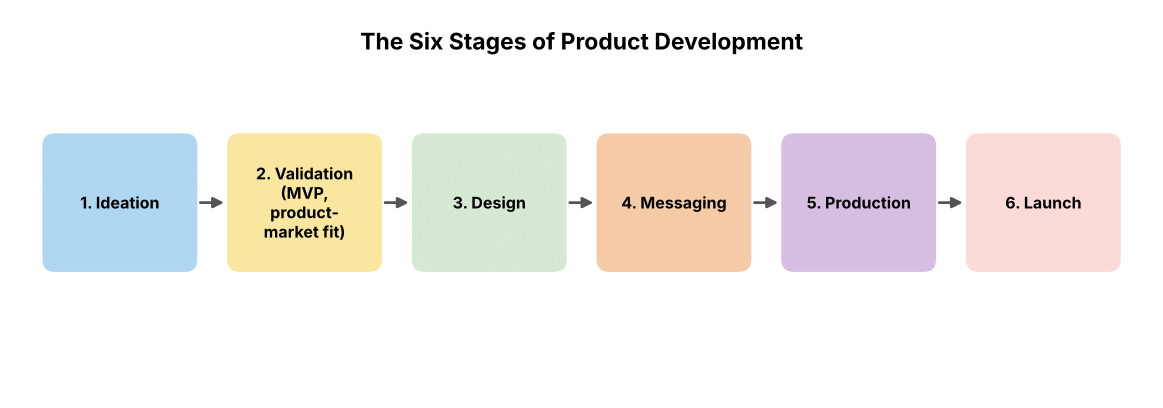
| Stage | Focus |
|---|---|
| 1. Ideation | Generating ideas through market research, technical R&D, and brainstorming |
| 2. Validation | Testing ideas with potential customers, often with an MVP, to check for product-market fit |
| 3. Design | Sourcing materials, prototyping, estimating costs, and setting key features such as functionality, user experience, size, color, and quality |
| 4. Messaging | Building the marketing strategy, including the value proposition and product positioning |
| 5. Production | Building the product with design feedback and matching production to demand |
| 6. Launch | Taking orders, distributing the product, and marketing to the target segment |
Product-market fit occurs when customer demand is sufficient to generate profit. That goes a step beyond problem-solution fit from Topic 1.1, which only asks whether the product addresses a real need.
Value Propositions and Positioning
A value proposition explains three things, based on market research:
- Who the product is meant to serve.
- What problem or need it addresses.
- How it is superior to alternatives.
Example: “For busy high school athletes (who), our 10-minute meal-prep kits deliver balanced pre-game meals (what), with more protein and less prep time than grocery-store options (how).”
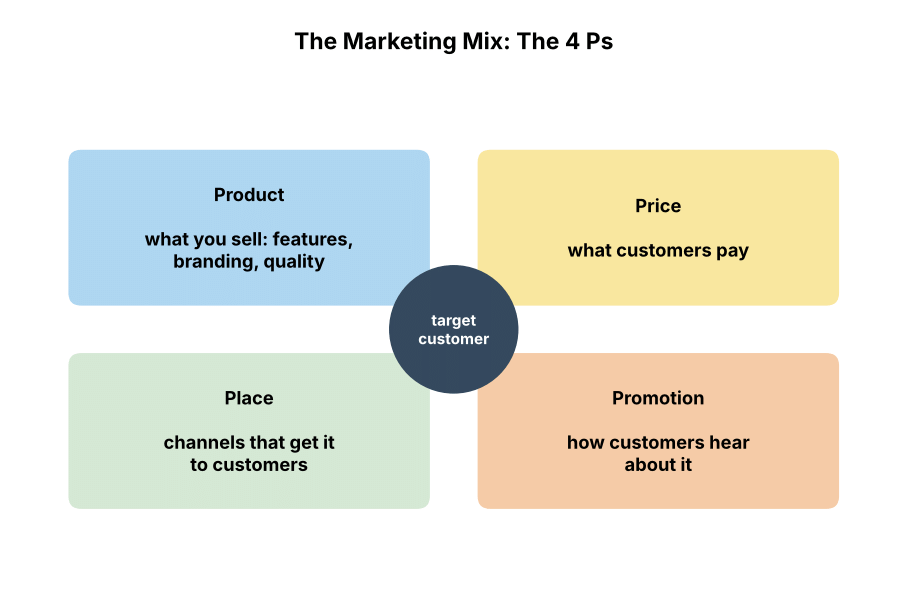
Product positioning strategies shape how customers perceive the product relative to rivals, such as “the premium choice” or “the best value.”
Branding
Branding develops an identity for a business or product to distinguish it from competitors, raise awareness, and build loyalty.
- Businesses build brand identity around their vision and value proposition. A company promising fast delivery might use a logo that suggests speed.
- Identity is conveyed through a name, idea, term, symbol, design, or a combination, often protected by trademark.
- Businesses may also sell generic products, because some customers care more about cost savings than branding.
The Product Life Cycle
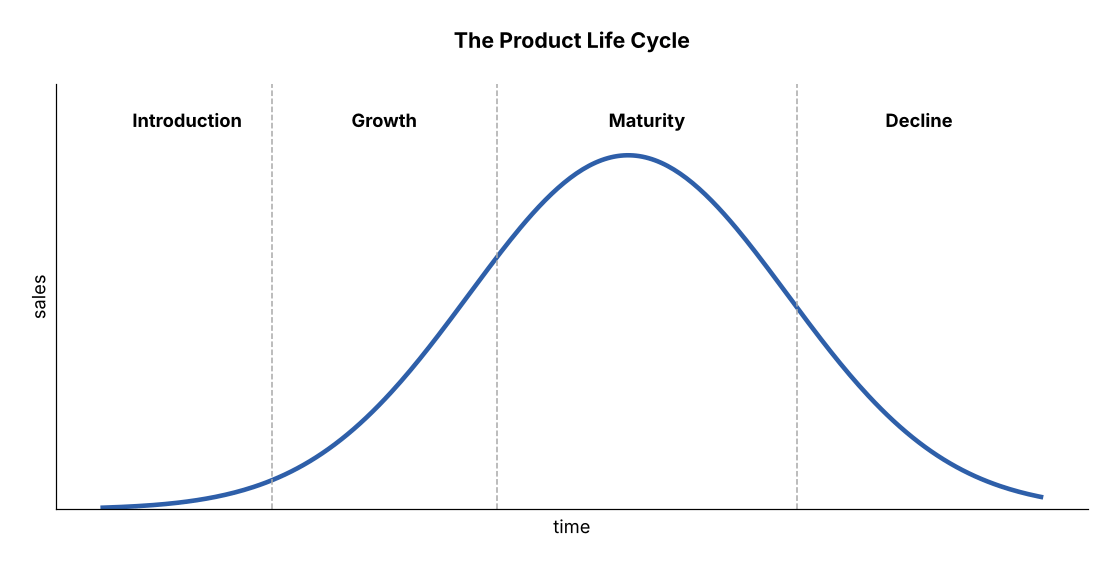
| Stage | Sales and revenue | Marketing focus |
|---|---|---|
| Introduction | Low | Raise brand awareness to generate initial demand |
| Growth | Rising at an increasing rate; competitors enter | Differentiate from rivals, improve quality, promote the brand, advertise |
| Maturity | Flatten in a saturated market | Build brand loyalty to retain share through differentiation, lower prices, and innovation |
| Decline | Falling as customers switch to rivals or substitutes | Cut costs or redesign; the product may be discontinued |
Worked Example: Identifying the Stage
A wireless earbud brand’s unit sales over five years were 10,000; 40,000; 120,000; 130,000; and 128,000.
- Years 1 to 3: Sales grow faster each year (+30,000, then +80,000). That is the growth stage, and rivals likely entered.
- Years 4 to 5: Sales flatten near 130,000. The product has reached maturity.
- Recommended strategy: Build loyalty with a trade-in program, consider a lower-priced model, and innovate with new features such as better noise cancellation.
Why does this matter? Task 5 of the Business Canvas Project asks you to develop an MVP, a value proposition, and a brand identity. Free-response questions may give you sales data and ask you to name the life cycle stage and recommend a strategy.
Test-Taking Strategies
Mnemonic Devices and Memory Shortcuts
For the six development stages, remember “I Very Definitely Make Products Last”: Ideation, Validation, Design, Messaging, Production, Launch. For the life cycle, “Introduce, Grow, Mature, Decline” maps to “Aware, Differentiate, Retain, Cut.”
Cross-Topic Connections
- Topic 1.4: How Do Business Ideas Originate? introduces the MVP used in the validation stage.
- Topic 2.3: Market Research supplies the insights behind ideation and value propositions.
- Topic 1.8: Supply Chains covers the production process set during the production stage.
- Topic 1.5: Vision explains the vision that shapes brand identity.
Common Question Formats
- A development activity asking which of the six stages it belongs to.
- A sales trend asking which life cycle stage the product is in.
- A statement asking whether it is a complete value proposition.
Frequent Student Mistakes
- Confusing problem-solution fit with product-market fit. Product-market fit requires enough demand for profit.
- Calling flat sales “decline.” Flat is maturity; falling is decline.
- Writing a value proposition that skips how the product beats alternatives.
Test-Day Shortcuts
For life cycle questions, check the direction and speed of sales: low means introduction, speeding up means growth, flat means maturity, and falling means decline.
Time Management Tips
The AP Business with Personal Finance Exam on May 4, 2027, is fully digital in Bluebook. Section I allows 70 minutes for 60 multiple-choice questions. Sales-trend questions are fast if you jot the year-to-year changes before reading the answer choices.
Check for Understanding
Think you’ve got it? Complete the quiz below to make sure. Download your results at the end.