
Maximize your score with these resources:
- Albert.io AP® Physics C: Mechanics question banks
- Free AP® Physics C: Mechanics cheat sheets
- Free AP® Physics C: Mechanics score calculator
Attach a pen to a mass bouncing on a spring and pull a strip of paper past it at a steady speed. The pen traces a smooth, repeating wave: a sine curve. That curve holds everything you need to know about the motion: how far the mass moves, how often it repeats, and where it started. Topic 7.3 is about reading and writing that information as equations and graphs, and using calculus to move between position, velocity, and acceleration.
This article covers Topic 7.3: Representing and Analyzing SHM in Unit 7, Oscillations. The topic asks you to describe simple harmonic motion with sinusoidal functions, relate position, velocity, and acceleration through derivatives, and interpret graphs of oscillating systems.
By the end, you should be able to:
- Write the position of an oscillator as a sinusoidal function of time.
- Identify amplitude, angular frequency, period, and phase constant.
- Derive velocity and acceleration by differentiating position.
- Interpret and sketch graphs of position, velocity, and acceleration.
The Position Equation
The position of a simple harmonic oscillator is:
\(x(t) = A\cos(\omega t + \phi)\)
| Symbol | Name | Meaning |
|---|---|---|
| \(A\) | Amplitude | Maximum displacement from equilibrium |
| \(\omega\) | Angular frequency | \(\omega = 2\pi f = \dfrac{2\pi}{T}\), in rad/s |
| \(\phi\) | Phase constant | Sets where the cycle starts at \(t = 0\) |
| \(T\) | Period | Time for one full cycle |
For a mass-spring system, \(\omega = \sqrt{k/m}\). For a small-angle pendulum, \(\omega = \sqrt{g/L}\).
Choosing Sine or Cosine
- Released from rest at \(x = +A\): use \(x = A\cos(\omega t)\), so \(\phi = 0\).
- Starting at equilibrium moving in the \(+x\) direction: use \(x = A\sin(\omega t)\), which equals \(A\cos(\omega t-\pi/2)\).
- Any other start: find \(\phi\) from the initial position and velocity.
Velocity and Acceleration
Differentiate position with respect to time:
\(v(t) = \dfrac{dx}{dt} = -A\omega\sin(\omega t + \phi)\)
\(a(t) = \dfrac{dv}{dt} = -A\omega^2\cos(\omega t + \phi) = -\omega^2 x\)
That last result, \(a = -\omega^2 x\), is the defining feature of SHM. The acceleration is always proportional to displacement and points back toward equilibrium.
| Position | Velocity | Acceleration |
|---|---|---|
| \(x = \pm A\) (turning points) | Zero | Maximum magnitude, \(\omega^2 A\), pointing toward equilibrium |
| \(x = 0\) (equilibrium) | Maximum magnitude, \(\omega A\) | Zero |
Worked Example
A 0.50 kg mass on a spring with \(k = 200\) N/m is pulled to \(x = 0.10\) m and released from rest.
- \(\omega = \sqrt{200/0.50} = 20\) rad/s, so \(T = \dfrac{2\pi}{20} \approx 0.31\) s.
- Position: \(x(t) = 0.10\cos(20t)\) m.
- Maximum speed: \(v_{\max} = A\omega = (0.10)(20) = 2.0\) m/s.
- Maximum acceleration: \(a_{\max} = A\omega^2 = (0.10)(400) = 40\ \text{m/s}^2\).
Reading the Graphs
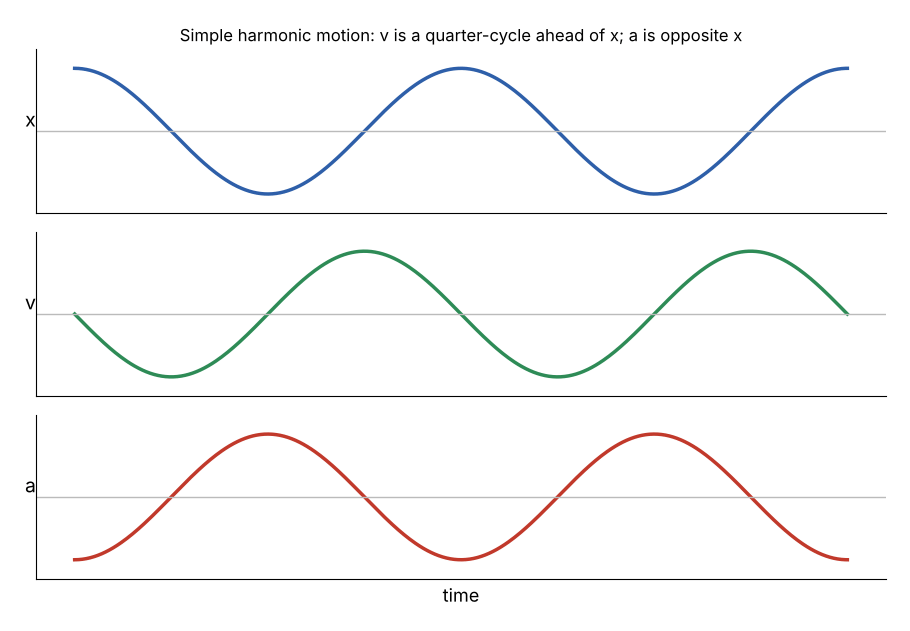
The three graphs have the same period but are shifted in time.
- Velocity is the slope of the position graph. It’s zero at the peaks and troughs of position and largest where position crosses zero.
- Acceleration is the slope of the velocity graph. Its graph is the position graph flipped upside down and scaled by \(\omega^2\).
- Velocity leads position by a quarter cycle, and acceleration is half a cycle out of phase with position.
Worked Example: From a Graph
A position graph shows peaks at \(\pm 0.05\) m, with one full cycle every 0.40 s, and starts at \(x = 0\) going up.
- \(A = 0.05\) m, \(T = 0.40\) s, and \(\omega = \dfrac{2\pi}{0.40} \approx 15.7\) rad/s.
- Equation: \(x(t) = 0.05\sin(15.7t)\) m.
- Maximum speed: \(A\omega \approx 0.79\) m/s, which occurs at \(t = 0\), 0.20 s, 0.40 s, and so on.
The Differential Equation of SHM
Newton’s second law for a spring gives \(m\dfrac{d^2x}{dt^2} = -kx\), or:
\(\dfrac{d^2x}{dt^2} = -\omega^2 x\)
Any system whose equation of motion takes this form undergoes simple harmonic motion with angular frequency \(\omega\). That’s how you identify SHM in new situations, such as a physical pendulum or a floating object bobbing in water.
Why does this matter? SHM questions often give you a graph or an equation and ask you to extract amplitude, period, maximum speed, or maximum acceleration. On FRQs you may need to differentiate \(x(t)\), sketch matching velocity or acceleration graphs, or show that a system satisfies \(\frac{d^2x}{dt^2} = -\omega^2 x\). Practice moving between all three representations.
Test-Taking Strategies
Mnemonic Devices and Memory Shortcuts
- “Ends stop, middle zooms.” Speed is zero at the turning points and greatest at equilibrium.
- “Acceleration mirrors position.” \(a = -\omega^2 x\).
- “A, A omega, A omega squared.” Maximum position, speed, and acceleration.
Cross-Topic Connections
- Topic 7.1: The restoring force defines SHM. See our review of simple harmonic motion.
- Topic 7.2: Period and frequency depend on \(k\), \(m\), \(g\), and \(L\). See our review of springs and pendulums.
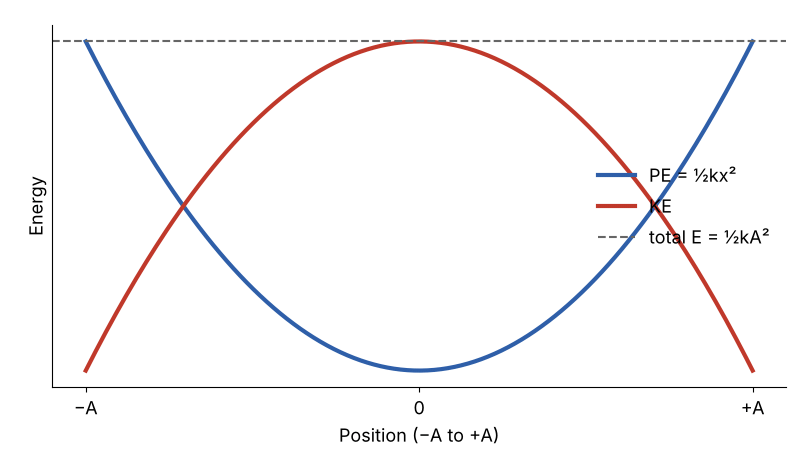
- Topic 7.4: Energy trades between kinetic and potential forms. See our review of energy of simple harmonic oscillators.
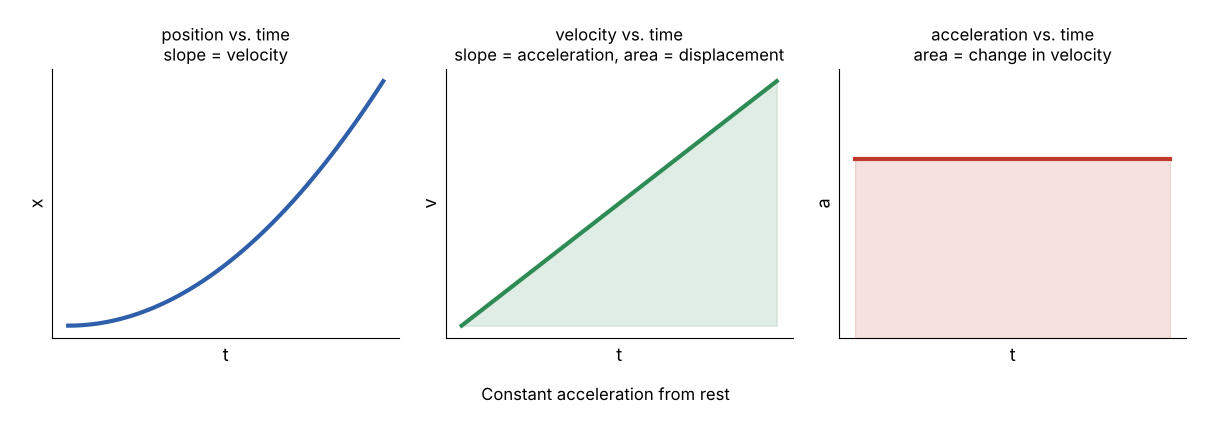
- Topic 1.3: Slopes of motion graphs give velocity and acceleration. See our review of representations of motion.
Common Question Formats
- Graph MCQ. You read the amplitude and period from a position graph.
- Phase MCQ. You pick the correct equation for given initial conditions.
- Maximum value MCQ. You find the maximum speed or acceleration.
- Translation FRQ. You sketch velocity and acceleration graphs that match a given position graph.
Frequent Student Mistakes
- Confusing \(\omega\) and \(f\). \(\omega = 2\pi f\).
- Calculator in degree mode. SHM equations use radians.
- Putting maximum speed at the turning points. Speed is zero there.
- Dropping the negative sign. Acceleration always points opposite displacement.
Test-Day Shortcuts
- Read the period from repeated features. Measure peak to peak, or across several cycles for accuracy.
- Sketch slopes. Draw velocity by tracking where the position slope is steepest and zero.
- Look for \(-\omega^2 x\). If acceleration is proportional to negative displacement, it’s SHM.
Time Management Tips
- Multiple choice: Section I has 40 questions in 80 minutes, about 2 minutes each. Graph-reading questions take seconds once you know \(A\) and \(T\).
- Free response: Section II has 4 questions in 100 minutes, roughly 25 minutes each. Align graphs vertically so their time axes match.
- Show the derivative. Write each differentiation step to earn method credit.
Check for Understanding
Think you’ve got it? Complete the quiz below to make sure. Download your results at the end.