
Maximize your score with these resources:
- Albert.io AP® Human Geography question banks
- Free AP® Human Geography cheat sheets
- Free AP® Human Geography score calculator
Geographers ask the same two questions about everything they study: where is it, and why is it there? Spatial concepts are the vocabulary for answering those questions. They show up on almost every AP® Human Geography exam, often as the first step in a free-response question that asks you to “define” or “describe” before you “explain.” If you can use these terms precisely, you’ll pick up easy points across all seven units.
This article covers Topic 1.4: Spatial Concepts in Unit 1, Thinking Geographically. The topic asks you to define the major concepts geographers use to describe spatial relationships: absolute and relative location, space, place, flows, distance decay, time-space compression, and pattern.
By the end, you should be able to:
- Distinguish absolute location from relative location and give an example of each.
- Explain the difference between space and place.
- Define flows, distance decay, and time-space compression, and connect them to real examples.
- Describe common spatial patterns such as clustered, dispersed, and linear distributions.
Location: Absolute and Relative
Every place on Earth has a location, but geographers describe it in two different ways.
| Concept | Definition | Example |
|---|---|---|
| Absolute location | An exact position on Earth’s surface, usually given in latitude and longitude or a street address. | The Eiffel Tower sits at about 48.86° N, 2.29° E. |
| Relative location | A place’s position in relation to other places or features. | Chicago is on the southwestern shore of Lake Michigan, about 800 miles west of New York. |
Absolute location never changes. Relative location can. When the Panama Canal opened in 1914, ports on both coasts of the Americas became far closer to each other by sea, even though none of them moved. Relative location explains why a place matters. A city at the mouth of a river, on a major highway, or near a border crossing gains importance from its connections.
Two related terms help here. Site describes the physical characteristics of a place itself, like its landforms, climate, and water supply. Situation describes its location relative to other places. Site is about what’s there. Situation is about what’s around it. These ideas return in Unit 6 when you explain why cities grow where they do.
Space and Place
In everyday speech, “space” and “place” mean almost the same thing. In geography they’re different.
- Space is the physical gap or area between things. Geographers study how people, objects, and activities are arranged across space and how far apart they are. A map of where grocery stores sit across a city is a study of space.
- Place is a specific location that has meaning because of its physical and human characteristics. A place has a name, an identity, and a “feel.” Times Square, your hometown, and a local park are places. The people who live there attach memories, values, and emotions to them, which geographers call a sense of place.
Why does this matter? The distinction tells you what kind of answer an FRQ wants. A question about the distribution of hospitals is a question about space, so talk about arrangement and distance. A question about why a neighborhood has a strong identity is a question about place, so talk about the human and physical characteristics that give it meaning.
Flows, Distance Decay, and Time-Space Compression
These three concepts describe how places interact with each other. They’re closely connected, and exam questions often combine them.
Flows
Flows are the movements of people, goods, money, information, and ideas between places. Migration is a flow of people. Trade is a flow of goods. Remittances, the money migrants send home, are a flow of capital. Social media posts moving across the world in seconds are flows of information. Flows link places into networks, and the strength of those links helps explain why some places grow and others decline.
Distance Decay
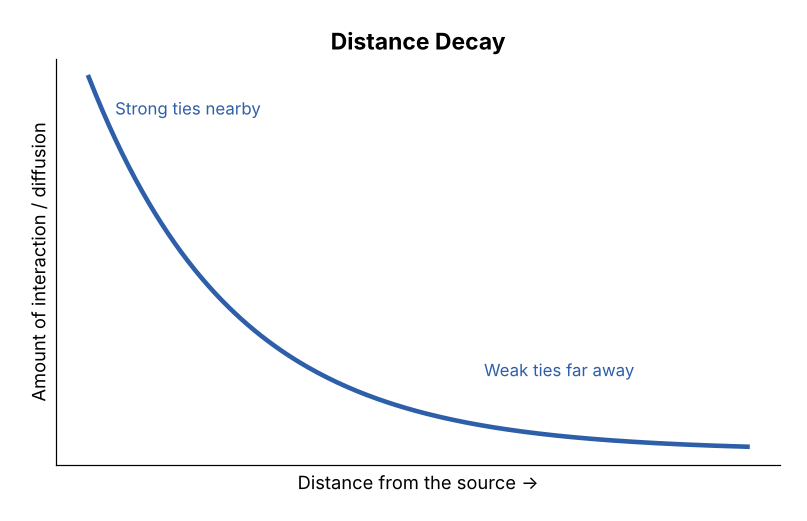
Distance decay is the idea that interaction between two places declines as the distance between them increases. You probably visit the grocery store down the street more often than one across town, and you know more about the next town over than a town 500 miles away. Geographer Waldo Tobler summarized the idea in what’s known as the First Law of Geography:
Everything is related to everything else, but near things are more related than distant things.
Distance decay happens because of the friction of distance: the time, cost, and effort it takes to overcome space. The gravity model, which predicts interaction based on population size and distance, builds directly on this idea. See our review of the gravity model.
Time-Space Compression
Time-space compression is the shrinking of the effective distance between places because of improvements in transportation and communication. Geographer David Harvey popularized the term. In 1800, a trip across the Atlantic took weeks by sailing ship. Today it takes about seven hours by plane, and a video call takes no time at all.


Time-space compression weakens distance decay without eliminating it. People still interact most with nearby places, but they can now form strong connections with distant ones. A software company in Bangalore can serve clients in New York in real time. A fashion trend can move from Seoul to São Paulo in days.
| Concept | Core Idea | Quick Example |
|---|---|---|
| Flows | Movement between places. | Migrants sending money home from the U.S. to Mexico. |
| Distance decay | Interaction drops as distance grows. | Most shoppers at a mall live within a short drive. |
| Time-space compression | Technology makes distant places feel closer. | Live-streaming a concert to fans on every continent. |
Patterns: How Things Are Arranged
Pattern is the geometric arrangement of objects in space. Describing a pattern is often the first thing an FRQ asks you to do with a map. The common patterns are:
- Clustered (agglomerated). Objects are grouped close together. Tech companies in Silicon Valley and car dealerships along one stretch of road are clustered. Clustering often happens because businesses benefit from being near suppliers, workers, or each other.
- Dispersed (scattered). Objects are spread out across an area. Farmhouses on the Great Plains are dispersed because each sits on its own large parcel of land.
- Linear. Objects are arranged in a line, usually along a river, road, coastline, or railroad. Towns along the Nile River follow a linear pattern because the river provides water and transportation.
- Random. Objects show no clear arrangement. True randomness is rare in human geography, which is why geographers look for the process behind a pattern.
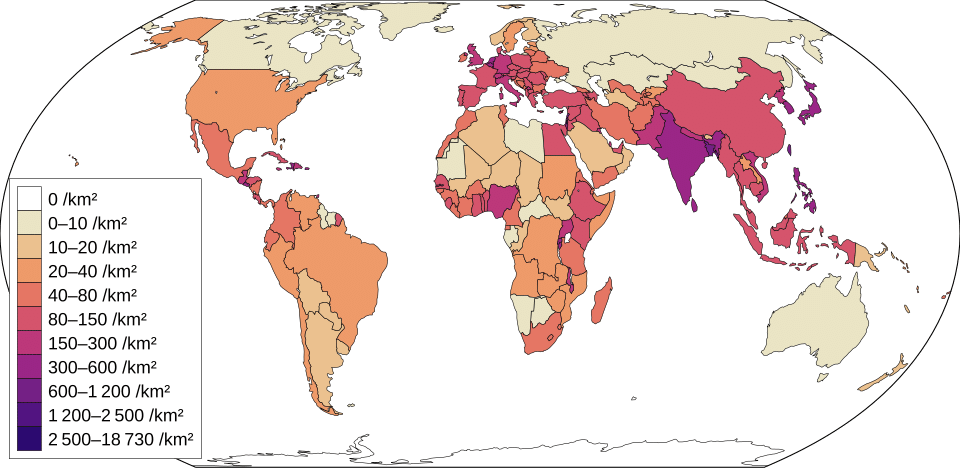
Pattern is related to two other measures you will use all year. Density is how many objects are in a given area. Distribution is how they’re spread across that area. Two regions can have the same density with very different distributions, one clustered in a single city and the other spread evenly.
Why does this matter? The exam rarely stops at “identify the pattern.” It asks you to explain why the pattern exists. When you see a clustered pattern, think about what draws things together: resources, transportation, or the benefits of being close. When you see a linear pattern, look for the river, road, or coast behind it.
Test-Taking Strategies
Mnemonic Devices and Memory Shortcuts
- “Absolute is an address, relative is a relationship.” Absolute location is fixed coordinates. Relative location describes connections to other places.
- “Site is the spot, situation is the setting.” Site covers physical features of the place itself. Situation covers its surroundings.
- “Space is empty, place is personal.” Space is about arrangement and distance. Place is about meaning and identity.
- “Decay grows with distance; compression shrinks it.” Distance decay says interaction fades with distance. Time-space compression says technology reduces that effect.
Cross-Topic Connections
- Topic 1.1: Maps are the main tool for showing location and pattern. See our review of introduction to maps.
- Topic 1.6: Patterns look different at different scales. A pattern that looks clustered nationally may look dispersed locally. See our review of scales of analysis.
- Topic 3.4: Distance decay explains why contagious diffusion weakens farther from the hearth, and time-space compression explains how ideas now spread almost instantly. See our review of types of diffusion.
- Topic 2.10 and Unit 7: Migration and trade are flows, and the gravity model predicts their strength.
Common Question Formats
- Definition MCQ. A description of a place, such as “a city at the confluence of two rivers,” asks whether it describes site or situation, absolute or relative location.
- Map-based MCQ. A dot map shows the distribution of a feature, and you identify the pattern as clustered, dispersed, or linear.
- FRQ with a stimulus. A map or chart shows flows, such as migration or trade. You define a concept in Part A, then explain how distance decay or time-space compression affects the flow in later parts.
- Scenario MCQ. A question describes a company serving overseas customers online and asks which concept it illustrates. The answer is time-space compression.
Frequent Student Mistakes
- Using “space” and “place” interchangeably. On the exam they aren’t synonyms. Place carries meaning and identity; space is about arrangement and distance.
- Thinking relative location never changes. New canals, highways, and airports change a place’s relative location without moving it.
- Saying time-space compression eliminates distance. It reduces the effect of distance. Most interaction is still local, and distance decay still applies.
- Stopping at the pattern. “The pattern is clustered” earns little credit alone. Explain the process that produced the cluster.
Test-Day Shortcuts
- Look for coordinates or addresses. Any mention of latitude, longitude, or a street address signals absolute location.
- Look for the words “near,” “between,” or “connected to.” These signal relative location or situation.
- Match the technology to the concept. Planes, the internet, and container ships in a stimulus usually point to time-space compression.
Time Management Tips
- Multiple choice: You have 60 minutes for 60 questions, so aim for about a minute each. Definition questions on this topic should take 30 seconds, which buys time for map-based questions elsewhere.
- Free response: You have 75 minutes for three FRQs, about 25 minutes each. “Define” and “describe” parts usually need only one or two precise sentences. Save your time for the “explain” parts, where you need to connect the concept to a cause or effect.
- Use the vocabulary. Writing “distance decay” or “time-space compression” by name shows the reader you know the concept and takes no extra time.
Check for Understanding
Think you’ve got it? Complete the quiz below to make sure. Download your results at the end.