
Maximize your score with these resources:
- Albert.io AP® Human Geography question banks
- Free AP® Human Geography cheat sheets
- Free AP® Human Geography score calculator
Diffusion is one of the most powerful forces shaping human geography. Every day, new ideas, technologies, and cultural practices spread across the globe. Understanding how they spread, where they start, and why they take root in some places but not others is central to the AP® Human Geography curriculum. Diffusion explains everything from why languages cluster in certain regions to how a pandemic travels across continents, and it connects directly to cultural geography, urbanization, migration, and globalization.
This guide covers every diffusion type you need for the exam, with real-world examples that make each type concrete and test-taking strategies to help you identify and apply diffusion concepts under time pressure.
What Is Diffusion?
Diffusion is the spread of ideas, innovations, diseases, cultural traits, and other phenomena from a hearth (the point of origin) across space and time. Think of the hearth as ground zero. When something originates in one place, it doesn’t appear everywhere at once—it spreads through processes that geographers have identified and categorized.
Diffusion explains cultural patterns, economic development, disease spread, technological adoption, and globalization. When a free-response question asks why a religious practice is concentrated in one region, or how a technology spread across different countries, you’re analyzing diffusion. It also connects to cultural regions (diffusion creates the boundaries of cultural regions) and migration patterns (relocation diffusion is driven by movement of people).
The Three Main Types of Diffusion
The AP® exam focuses on three major categories of diffusion, each operating through different mechanisms and creating different geographic patterns.
1. Relocation Diffusion
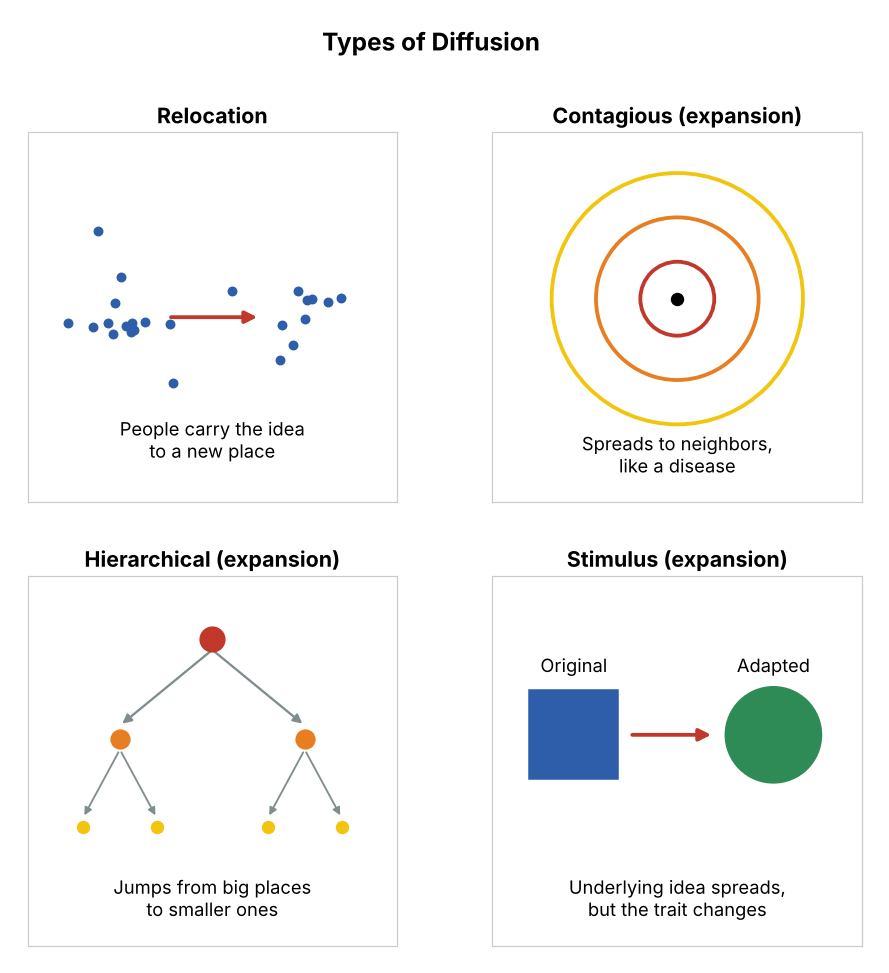
Relocation diffusion happens when people physically move from one place to another, carrying their culture, ideas, and practices with them. The spread doesn’t happen through communication or influence at a distance—the people themselves move, and their cultural practices move with them.
When Irish immigrants arrived in the United States in the 1800s, they brought Catholic traditions, specific foods, and community structures. These practices didn’t spread through Americans learning about Irish culture from afar—they spread because Irish people settled in Boston and New York and maintained their traditions. Irish-American culture became embedded in those cities through direct relocation.
The spread of Islam in the 7th and 8th centuries involved both military conquest and migration of Arab peoples into North Africa, the Middle East, and parts of Europe. The religion spread partly through relocation of Muslim populations who established new communities and maintained Islamic practices in adopted homelands.
Key characteristics of relocation diffusion:
- Requires physical movement of people
- Creates distinct cultural clusters (ethnic enclaves, diaspora communities) in new locations
- Often replicates cultural hearths in new places
- Can leave cultural gaps in the place of origin if migration is significant
2. Expansion Diffusion
Expansion diffusion is different: an idea, innovation, or cultural practice spreads outward while remaining strong in its original hearth. The core area keeps the cultural trait while it also spreads to surrounding and distant areas. Expansion diffusion has three subtypes that the exam tests your ability to distinguish.
Hierarchical Diffusion
Hierarchical diffusion follows established power structures and social hierarchies. Ideas and trends spread from nodes of authority and influence downward through the social system. The classic pattern flows from major cities to smaller cities to towns to rural areas, following economic and political power structures.
Fashion is the textbook example. New clothing trends start in fashion capitals like New York, Paris, or Milan. From these centers of influence, styles spread to major fashion retailers in secondary cities, then to suburban malls, and eventually to small-town stores. A trend starting on a Paris runway might appear in high-end New York boutiques within weeks, regional department stores within months, and small-town shops a year later.
Technology adoption follows hierarchical patterns too. New smartphone features roll out to early adopters (often wealthier, more educated users in major cities) before spreading to broader populations. Administrative policies from state or federal governments typically flow downward through regional offices to local agencies.
Why does this pattern matter? It shows how power structures and economic inequality shape the timing and sequence of innovation adoption. Not everyone gets new ideas at the same time—the hierarchy determines the sequence.
Contagious Diffusion
Contagious diffusion spreads through direct contact and proximity, like a disease moving through a population. It doesn’t follow hierarchies—it spreads from person to person, place to place, based on proximity and interaction. The closer you are to the source, the faster you’re affected.
The COVID-19 pandemic illustrates contagious diffusion clearly. The virus spread to places with direct human contact to outbreak areas. Countries with tight travel connections to early outbreak centers saw cases first—those long-distance jumps along travel routes are actually hierarchical (network) spread. Within communities, though, the virus spread contagiously from person to person through close contact, regardless of economic hierarchy.
Language diffusion often follows contagious patterns. Languages spread to neighboring areas through daily contact and trade. Slang and linguistic innovations also spread contagiously—a term starts in one neighborhood and spreads to adjacent neighborhoods through friendship networks before jumping to distant cities.
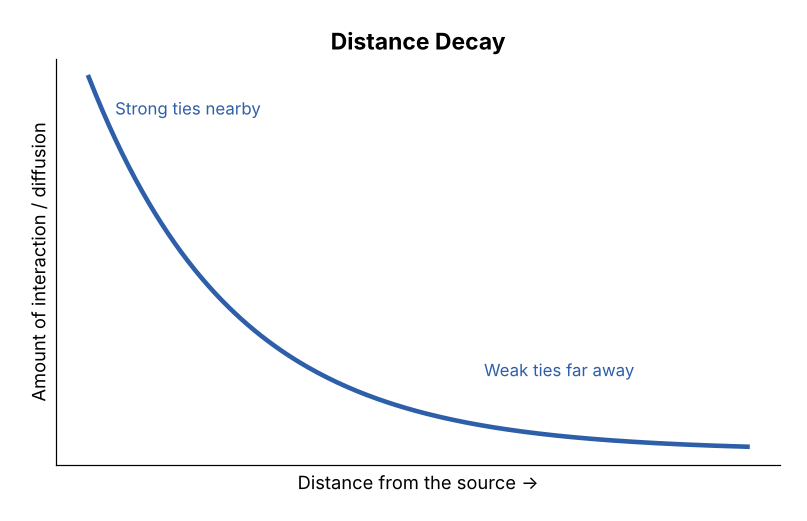
Key principle: time-distance decay. The strength of diffusion weakens with distance and time. Things closer to the source spread faster. Things farther away take longer to arrive, or may never arrive at all.
Stimulus Diffusion
Stimulus diffusion occurs when the underlying idea or concept spreads but the specific form adapts to local conditions and cultures. The core innovation is adopted, but modified to fit local needs, preferences, and resources.
McDonald’s is the classic example. The idea of fast-food restaurants spread globally, but local implementations adapted menus to local tastes. In India, beef is avoided for religious reasons, so McDonald’s serves chicken and vegetarian options. In Japan, rice bowls and noodle dishes appear on the menu. In the Middle East, halal meat is used. The concept of fast food spread (the stimulus), but the specific form varied by place (the diffusion with adaptation).
Religion shows stimulus diffusion too. Christianity spread globally but took different forms in different regions. In Latin America, Catholic practices merged with indigenous traditions. In sub-Saharan Africa, Christian churches incorporated traditional music and worship styles. The core religion diffused; how it’s practiced varies significantly.
Technology also spreads through stimulus diffusion. Mobile banking started in developed countries but spread to Africa in adapted forms. M-Pesa in Kenya pioneered mobile money transfer in a way that fit local infrastructure and economic conditions—the idea spread, but the implementation was locally innovative.
The key distinction: stimulus diffusion is not relocation (people moving) and not simple expansion (the original thing spreading unchanged). It’s adoption of an idea with significant local modification.
Time-Distance Decay and Barriers to Diffusion
Two forces shape how diffusion actually happens: time-distance decay and barriers.
Time-Distance Decay
Time-distance decay means diffusion weakens with both distance and time. The farther you are from a source, and the longer you wait, the less likely a trait will reach you in its original form—or reach you at all.
A new music genre starting in one city reaches nearby cities first through radio, streaming, and traveling musicians. Cities 500 miles away hear it later. Cities 2,000 miles away might not encounter it for years. The effect diminishes with distance. This principle explains why cultural regions exist—traits cluster near their origin points because time-distance decay creates geographic gradients of adoption.
Barriers to Diffusion
Barriers slow or stop diffusion entirely. They can be physical, cultural, or political:
- Physical barriers: Mountains, oceans, deserts, and forests limit travel and communication. Before modern transportation, a mountain range could isolate populations for centuries. Languages and cultures on opposite sides of mountain ranges often developed distinctly because physical isolation limited contact.
- Cultural barriers: Religious beliefs, language differences, and social norms block diffusion. A technology conflicting with religious values won’t spread in religiously conservative regions. Language differences create information barriers. Social norms around dietary practices can prevent certain traits from spreading.
- Political barriers: Governments can block diffusion through laws and censorship. China’s “Great Firewall” limits the diffusion of certain information and ideas. Immigration laws restrict relocation diffusion. Trade restrictions limit the spread of goods and associated cultural practices.
How Technology Is Changing Diffusion Patterns
Globalization and digital technology are reshaping how diffusion works. Some patterns are accelerating; others are being disrupted.
Social media enables rapid hierarchical diffusion that bypasses traditional urban hierarchy. An influencer with millions of followers can broadcast a trend to a massive audience instantly, hitting rural Montana and New York City on the same day. Traditional distance barriers matter less when digital networks ignore geography.
Global supply chains enable stimulus diffusion at scale. A product designed in one country can be manufactured in another, adapted for local markets, and distributed worldwide within months. Companies engineer adoption rather than waiting for contagious spread through local contact.
Political censorship creates new barriers to information diffusion even in globally connected environments. Language barriers persist online despite improving translation tools. Cultural preferences still shape which ideas spread even when transmission is nearly free. And interestingly, relocation diffusion remains powerful—diaspora populations stay connected to homeland cultures through technology, which can slow cultural assimilation and maintain distinct cultural clusters even in globally connected environments.
Summary Comparison Table
| Diffusion Type | Mechanism | Pattern | Real-World Example | Exam Keyword |
|---|---|---|---|---|
| Relocation | Physical movement of people | Cultural traits concentrate in migrant settlement areas | Irish communities in Boston; Chinese communities in San Francisco | “people moved,” “migration,” “settled” |
| Hierarchical | Spreads through authority structures and urban hierarchy | Major cities first, then secondary cities, then rural areas | Fashion trends from Paris to NYC to suburbs; government policies flowing downward | “large cities first,” “authority,” “trickled down” |
| Contagious | Direct contact and proximity | Spreads outward from source; weakens with distance | COVID-19 spread; slang in neighborhoods; language to adjacent regions | “nearby first,” “contact,” “proximity” |
| Stimulus | Idea spreads but takes on local forms | Concept reaches many places; specific implementations vary | McDonald’s adapted menus; Christianity in different regions; M-Pesa mobile banking | “adapted,” “modified,” “local version” |
Test-Taking Strategies
Diffusion questions appear in both multiple choice and free response. The most common errors are confusing types—so precision matters more than breadth here.
1. Use the Quick Identification Framework
Train yourself to identify diffusion type instantly from key phrases. If you see “people physically moved” = relocation diffusion. If you see “adapted/modified to local culture” = stimulus diffusion. If you see “major cities first, then smaller cities” = hierarchical diffusion. If you see “spread to nearby areas first” or “spread like a disease” = contagious diffusion. Building this instant recognition system saves critical time on multiple choice and orients your free-response answers immediately.
2. Don’t Confuse Hierarchical with Contagious
This is the most common student error. Hierarchical follows power and authority structures—it can skip geographically distant places if those places are high in the social hierarchy. Contagious follows proximity and contact regardless of power. A fashion trend hitting a rural but wealthy area before a large but lower-status city is hierarchical. A disease spreading to neighboring villages before distant cities is contagious. Read carefully for these structural cues before committing to a type.
3. Identify Barriers in Every Diffusion Scenario
Exam questions often ask why something diffused to some places but not others. The answer almost always involves a barrier. Physical barriers (mountains, oceans), cultural barriers (religious restrictions, language), or political barriers (censorship, immigration law)—always identify the specific barrier and explain its mechanism. Generic “barriers exist” earns no points; “the mountain range created physical isolation that prevented linguistic diffusion to adjacent valleys” earns full credit.
4. Connect Diffusion to Time-Distance Decay Explicitly
When analyzing any diffusion pattern, mention distance effects. If something spread uniformly everywhere simultaneously, that’s unusual and worth noting. Usually, proximity matters—closer places adopt first. In free response, write statements like: “The practice spread most rapidly to neighboring cities due to time-distance decay, with rural areas adopting the practice years later and with lower rates of adoption.” This explicit connection to geographic principles elevates your answer.
5. Link Diffusion Types to Other AP Units
Diffusion connects to almost every other AP® Human Geography unit. Relocation diffusion is tied to migration patterns (Unit 2). Hierarchical diffusion follows the urban hierarchy you study in Unit 6. Contagious diffusion explains disease spread, which connects to population patterns (Unit 2). Stimulus diffusion explains cultural variation under globalization (Unit 3). When free response questions ask you to connect concepts across units, diffusion is often the bridge. “The urbanization of Southeast Asia follows hierarchical diffusion patterns, as innovations flow from primate cities like Bangkok to secondary cities before reaching rural areas” earns cross-unit credit.
6. Provide Specific, Geographic Examples
Vague examples lose points. Don’t write “cities spread trends to rural areas.” Write “fashion trends originating in New York and Paris diffused hierarchically to secondary cities like Houston and Denver before reaching smaller markets—a pattern reflecting the U.S. urban hierarchy in which those coastal cities dominate cultural production.” Specificity demonstrates understanding; vagueness demonstrates memorization. Build a bank of at least two concrete examples per diffusion type.
7. Recognize That Multiple Types Can Occur Simultaneously
Real-world diffusion often involves multiple types operating at once. Islam spread through both relocation diffusion (migration of Muslim populations) and hierarchical diffusion (adoption by rulers spreading it to subjects) and stimulus diffusion (local adaptations creating distinct regional Islamic practices). When a question asks you to explain a complex diffusion pattern, consider whether multiple types are at work and describe each mechanism. This depth signals mastery.
Check for Understanding
Think you’ve got it? Complete the quiz below to make sure. Download your results at the end.