

Maximize your score with these resources:
- Albert.io AP® US History question banks
- Free AP® US History cheat sheets
- Free AP® US History score calculator
What We Review
Taxation Without Representation: The Spark of American Resistance
Between 1763 and 1775, a single principle transformed loyal British colonists into revolutionaries: taxation without representation. The phrase captured something deeper than a complaint about money—it expressed the conviction that a government loses its legitimacy when it imposes laws on people who have no voice in making them. For the AP exam, you need to understand not just what Britain taxed, but why colonists saw each tax as a constitutional crisis.
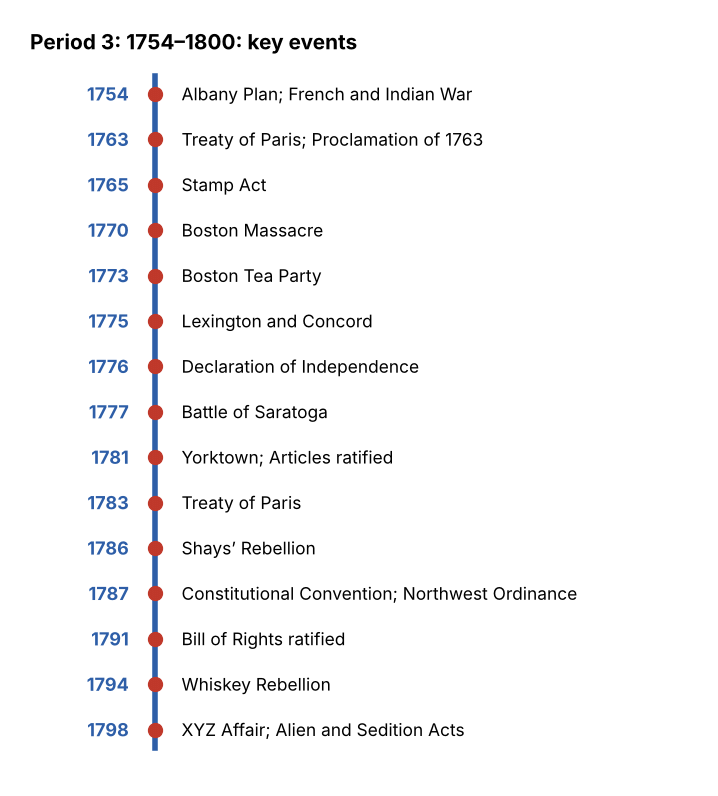
This topic sits at the heart of AP® US History Period 3, connecting directly to CED Topics 3.3, 3.4, and 3.5. The exam tests this concept heavily through stimulus-based questions featuring political cartoons, pamphlet excerpts, and legislative records.
Background: British Imperial Struggles and Colonial Control
The French and Indian War (1754–1763) doubled Britain’s national debt. Parliament decided the colonies should help pay for the 10,000 troops stationed in North America. The result was a series of revenue-raising measures that colonists experienced as an unprecedented assault on their constitutional rights.
| Act | Year | What It Taxed | Why It Mattered |
|---|---|---|---|
| Sugar Act | 1764 | Sugar, molasses, and imported goods | Tightened enforcement; used admiralty courts (no jury trials) for prosecution |
| Stamp Act | 1765 | All printed materials—newspapers, legal documents, playing cards | First direct internal tax on colonists; touched nearly everyone |
| Townshend Acts | 1767 | Glass, paper, paint, lead, tea | Revenue used to pay royal governors directly, removing colonial assemblies’ power of the purse |
| Tea Act | 1773 | Gave East India Company monopoly on colonial tea sales | Reinforced Parliament’s right to tax; triggered the Boston Tea Party |
The Constitutional Core Issue: Colonists had no elected representatives in Parliament. Britain argued colonists were “virtually represented.” Colonists rejected this entirely—150+ years of self-government through colonial assemblies had taught them that only representatives you elect have the right to tax you.
The Stamp Act Was the Flashpoint:
- It was universal: This direct tax touched lawyers, printers, tavern owners, and ordinary citizens—unlike trade regulations affecting mainly merchants.
- It was unprecedented: Parliament had never before imposed a direct internal tax on the colonies.
- It coordinated colonial response: For the first time, colonists from different colonies united against a common policy through the Stamp Act Congress (1765).
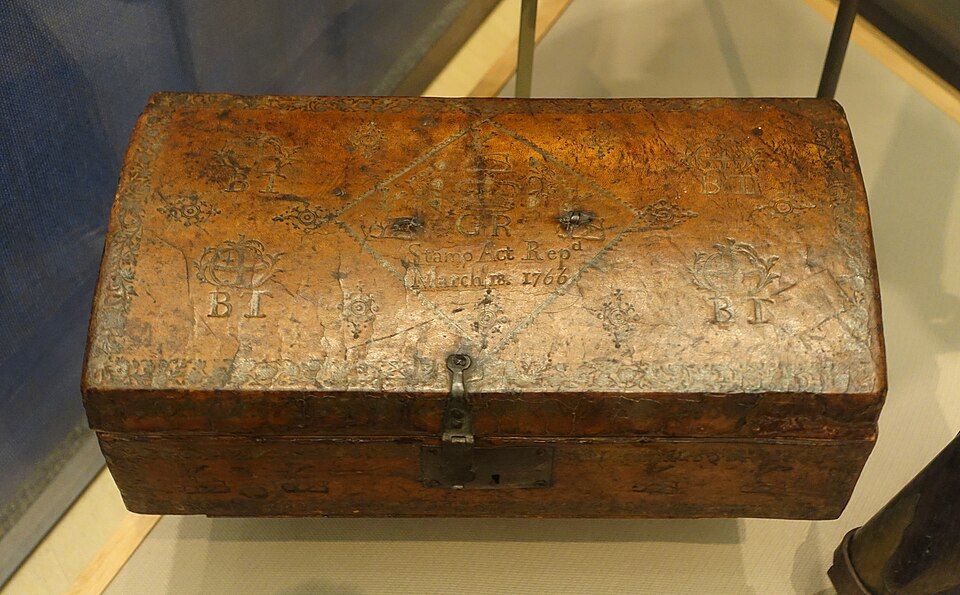
The Deceptive “Victory”: Parliament repealed the Stamp Act in 1766, but simultaneously passed the Declaratory Act, asserting its right to legislate for the colonies “in all cases whatsoever.” The crisis was deferred, not resolved.
Colonial Arguments Against British Taxes
- English constitutional rights: Colonists pointed to the Magna Carta (1215) and the English Bill of Rights (1689) as proof that taxation required the consent of representatives.
- Enlightenment philosophy: John Locke’s theory of natural rights gave colonists a deeper framework. If government exists to protect property, then seizing property (through taxes) without consent violates the social contract itself.
- Colonial self-governing tradition: For over 150 years, colonial assemblies had controlled local taxation and spending. Bypassing these assemblies destroyed a functioning political system.
Colonial Leadership and Grassroots Resistance
The resistance succeeded because it connected elite political leadership with mass popular action.
Elite Leadership: Benjamin Franklin lobbied Parliament in London. Samuel Adams organized Boston’s resistance networks and pioneered the Committees of Correspondence. Patrick Henry mobilized public opinion through powerful rhetoric.
Grassroots Power: The Sons of Liberty—shopkeepers, craftsmen, sailors, and laborers—organized protests, enforced boycotts, and made tax collection physically impossible. Women organized spinning bees to produce homespun cloth, replacing boycotted British textiles.
The Boston Tea Party and Escalating Crisis
The Boston Tea Party (December 1773) illustrates how grassroots action drove the imperial crisis:
- Parliament passed the Tea Act, granting the East India Company a monopoly on colonial tea sales.
- The Boston governor refused to let tea ships leave without unloading. Colonists faced a choice: accept the tea (and the principle behind it) or act.
- On December 16, members of the Sons of Liberty dumped 342 chests of tea into Boston Harbor.
- Parliament responded with the Coercive Acts: closing Boston Harbor, revoking Massachusetts’s charter of self-government, and quartering troops in colonial homes.
- Instead of isolating Boston, the punishment united the colonies. The First Continental Congress met in September 1774.


The Pattern the AP Exam Tests: Each British attempt to assert control provoked a colonial response that deepened resistance and broadened participation. The cycle of action → overreaction → radicalization is the engine of the Revolutionary crisis.
Mobilization During Economic Hardship and British Military Presence
After 1773, British military occupation and economic punishment transformed colonial resistance from elite politics into mass mobilization.
- Committees of Correspondence: Networks pioneered by Samuel Adams coordinated resistance across colony lines, sharing news and organizing boycotts. These functioned as the first American political network.
- Economic self-sufficiency: Women’s spinning bees and household boycotts were both practical and symbolic. Producing homespun cloth reduced dependence on British imports while demonstrating commitment to the cause.
- Material support: Families donated food, money, and supplies to support local militias and relieve besieged Boston. This collective sacrifice built shared American identity.
- Militia preparation: Local militias began stockpiling weapons and drilling. The “minutemen” of Massachusetts were ready to fight on a moment’s notice.
Quick Reference Vocabulary Chart
| Term | Definition | AP Exam Connection |
|---|---|---|
| Taxation Without Representation | The principle that colonists should not be taxed by a legislature with no elected representatives | Core concept of Period 3; appears constantly in stimulus-based MCQs and SAQs |
| Stamp Act (1765) | First direct internal tax on colonists; required tax stamps on all printed materials | The exam’s go-to example for explaining how taxation provoked coordinated colonial resistance |
| Townshend Acts (1767) | Taxes on imported goods used to pay royal officials, bypassing colonial assemblies | Shows how Britain tried to undermine colonial self-governance |
| Sons of Liberty | Colonial protest organization of artisans, merchants, and laborers who enforced boycotts and organized demonstrations | Connects elite ideology to grassroots action |
| Boston Tea Party (1773) | Destruction of 342 chests of British tea in Boston Harbor to protest the Tea Act | Illustrates the escalation cycle: colonial protest → British overreaction → broader resistance |
| Coercive/Intolerable Acts (1774) | Punitive laws closing Boston Harbor, revoking Massachusetts’s self-government, quartering troops | Turning point that unified colonial resistance and led to the First Continental Congress |
| Committees of Correspondence | Colonial communication networks that coordinated resistance across colony borders | Early example of intercolonial unity; precursor to Continental Congress |
| Virtual Representation | British argument that all Parliament members represented all subjects, including colonists | Know why colonists rejected this argument |
| Declaratory Act (1766) | Parliament’s assertion of authority to legislate for colonies “in all cases whatsoever” | Shows that Stamp Act repeal was not a British concession on principle |
Test-Taking Strategies
Mnemonic: STAMP
Remember Sugar Act → Taxation (Stamp Act) → Acts of defiance (boycotts, Sons of Liberty) → Massachusetts crisis (Tea Party, Intolerable Acts) → Political unity (Continental Congress). Use this sequence to organize your thoughts when you see questions about “escalating tensions” or “colonial resistance over time.”
Cross-topic connections the AP exam tests:
- Period 3 → Period 3 (Same Period): Taxation without representation connects directly to the Enlightenment (Locke’s social contract) and the Declaration of Independence. Colonists didn’t learn about natural rights from books—they learned them by fighting for representation.
- Period 3 → Period 4: The Whiskey Rebellion (1794) shows the new American government facing its own taxation challenge. Farmers resisted a federal excise tax—and the federal government successfully enforced it, unlike Britain. This contrast reveals how the new republic handled internal dissent differently.
- Period 3 → Period 7: The suffrage movement used “taxation without representation” to argue that women who paid taxes but couldn’t vote were in the same position as pre-Revolutionary colonists.
Common question formats:
- Stimulus-Based MCQs: Identify whether the source supports or opposes colonial taxation, then connect it to broader concepts. Look for key phrases: “rights of Englishmen,” “representation,” “property cannot be taken without consent.”
- SAQs: Use specific examples (Sons of Liberty, Stamp Act Congress, boycotts) rather than vague generalizations. Connect each example to a broader concept.
- LEQs: Organize chronologically and show how each act increased the scope and coordination of resistance. Stamp Act Congress (1765, nine colonies) → Committees of Correspondence (1772+, all colonies) → First Continental Congress (1774, twelve colonies).
Frequent student mistakes:
- Saying colonists opposed “all taxes” — they accepted taxes levied by their own colonial assemblies. The issue was who had the right to tax, not whether taxes should exist.
- Treating the Boston Tea Party as the start of resistance — organized resistance began with the Stamp Act in 1765, eight years earlier.
- Ignoring women and ordinary people — mention spinning bees, consumer boycotts, and the Sons of Liberty alongside elite figures.
- Confusing the Stamp Act repeal with a British surrender — Parliament repealed the tax but passed the Declaratory Act asserting continued authority.
Test-day shortcuts:
- “Internal” vs. “external” taxes? → The Stamp Act was the first internal (direct) tax, which is why it provoked stronger reaction than trade duties.
- Declaratory Act mentioned? → It shows Parliament never conceded the principle, even when it repealed specific taxes.
- Townshend Acts specifically mentioned? → Emphasize that they paid royal governors directly, removing colonial assemblies’ power of the purse. Existential threat to self-government, not just another tax.
- Boston Tea Party as turning point? → It was the escalation that unified colonies fully. The Coercive Acts’ punishment of Massachusetts made other colonies see themselves in Boston’s predicament.
Time management: Taxation questions are high-frequency. If you encounter a stimulus-based question, identify the core argument quickly (representation? property rights? constitutional precedent?) and match it to the relevant concept. For longer essays, use the STAMP mnemonic to organize your argument chronologically.