

Maximize your score with these resources:
- Albert.io AP® US History question banks
- Free AP® US History cheat sheets
- Free AP® US History score calculator
What We Review
The American Revolution: AP® US History Review
The American Revolution transformed thirteen British colonies into an independent nation. Understanding how the colonists defeated the powerful British Empire is crucial for AP® US History. Victory depended on military strategy, visionary leadership, ideological commitment, and crucial foreign assistance. This review examines the key factors that enabled the underdog Patriots to achieve their revolutionary goal.
British Advantages vs. Colonial Disadvantages
| Factor | Britain | American Colonies |
|---|---|---|
| Army | Professional, well-trained troops with established tactics | Volunteer militia and Continental Army; limited training |
| Navy | World’s most powerful fleet; controlled the Atlantic | No navy; relied on privateers and French naval support |
| Finances | Wealth to hire Hessian mercenaries and sustain long war | Chronic shortages of supplies, food, weapons, and pay |
| Political support | Significant Loyalist support in every colony | Population divided; about one-third Loyalist |
| Strategic advantages | Global empire providing resources and reinforcements | Home terrain knowledge; ideological motivation; distributed population |
Colonial Military Organization: Militias and the Continental Army
Local Militias
Local volunteer military groups composed of ordinary colonists—farmers, craftsmen, merchants—trained to respond to emergencies.
Their Role:
- Guerrilla warfare expertise: Knew terrain intimately; used hit-and-run tactics and surprise attacks
- Quick mobilization: Could respond rapidly to threats in their region
- Supply disruption: Harassed British supply lines and cut off isolated garrisons
- Psychological advantage: Constant casualties from nighttime raids eroded British morale
The Continental Army (Established 1775)
| Aspect | Details |
|---|---|
| Commander | George Washington, appointed Chief General; unified command across colonies |
| Purpose | Conduct organized warfare; fight major battles; maintain continuous army presence |
| Typical Strength | 8,000–15,000 men at any given time (British forces often 30,000+) |
| Major Challenges | Supply shortages, desertions, low pay, harsh conditions (especially Valley Forge 1777–1778) |
Militias harassed British forces through constant small-scale attacks and supply disruptions. The Continental Army engaged in major pitched battles, preventing quick British victory and maintaining army survival. Their combined effect made it economically and militarily costly for Britain to maintain occupation.
George Washington’s Leadership
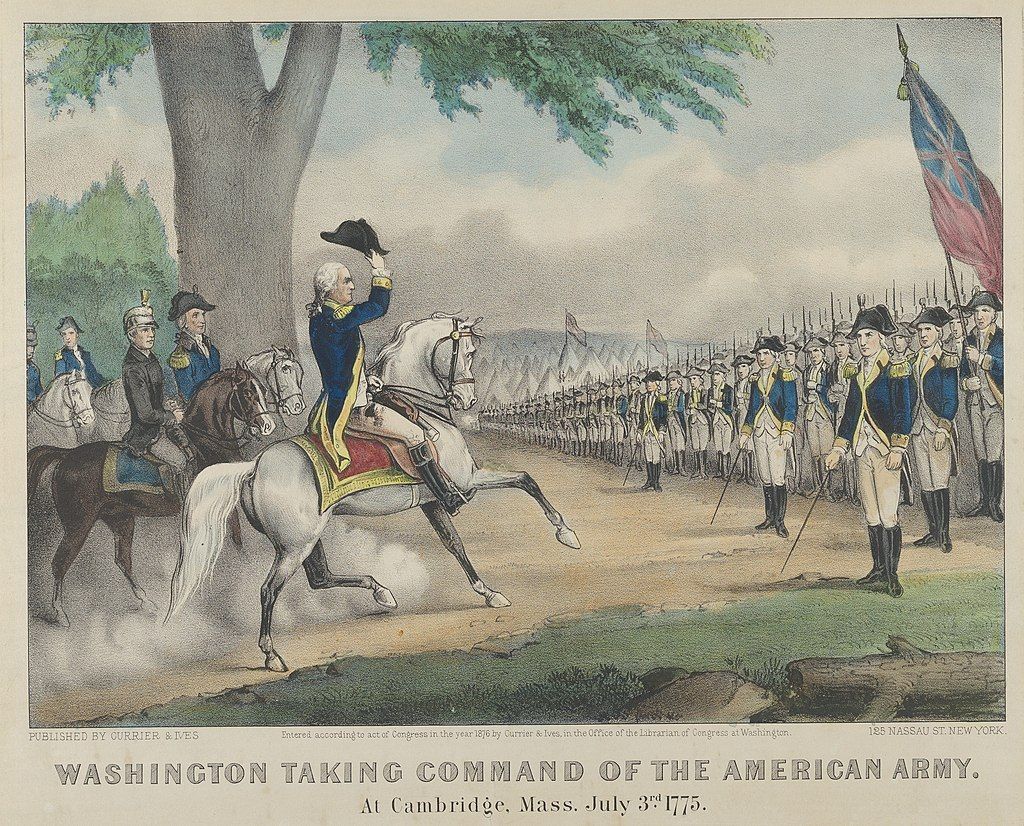
George Washington’s leadership was critical to American victory. His essential qualities included relentless determination (refusing to surrender despite devastating setbacks), prudent strategy (avoiding fights he couldn’t win while prioritizing army survival), and moral authority (holding the army together through the harshest winters).

Washington’s Crossing of the Delaware (December 1776)
By late 1776, the Patriot cause was collapsing: recent defeats, low morale, expiring enlistments, high desertion. Washington led approximately 2,400 troops across the ice-choked Delaware River on December 25, 1776. Dawn attack on December 26 at Trenton, New Jersey destroyed a Hessian garrison, capturing nearly 1,000 troops with minimal American losses.
This battle shattered the myth of British invincibility, sparked renewed morale, and encouraged re-enlistments. Washington followed with victory at Princeton, demonstrating tactical brilliance under extreme pressure.
Ideological Commitment and Enlightenment Principles
The Declaration of Independence (July 4, 1776)
Core Philosophical Arguments:
- Natural Rights: Drawing on John Locke, the Declaration asserts all people possess unalienable rights to life, liberty, and the pursuit of happiness
- Government by Consent: Governments derive their power from “the consent of the governed” and exist to protect natural rights
- Right to Rebellion: When government becomes destructive of rights, the people have the right to “alter or abolish it”
The Declaration unified the colonies around shared ideological purpose, provided clear moral justification for independence, appealed to foreign allies (especially France), and inspired independence movements globally for centuries.
The Battle of Saratoga (September–October 1777): Diplomatic Turning Point
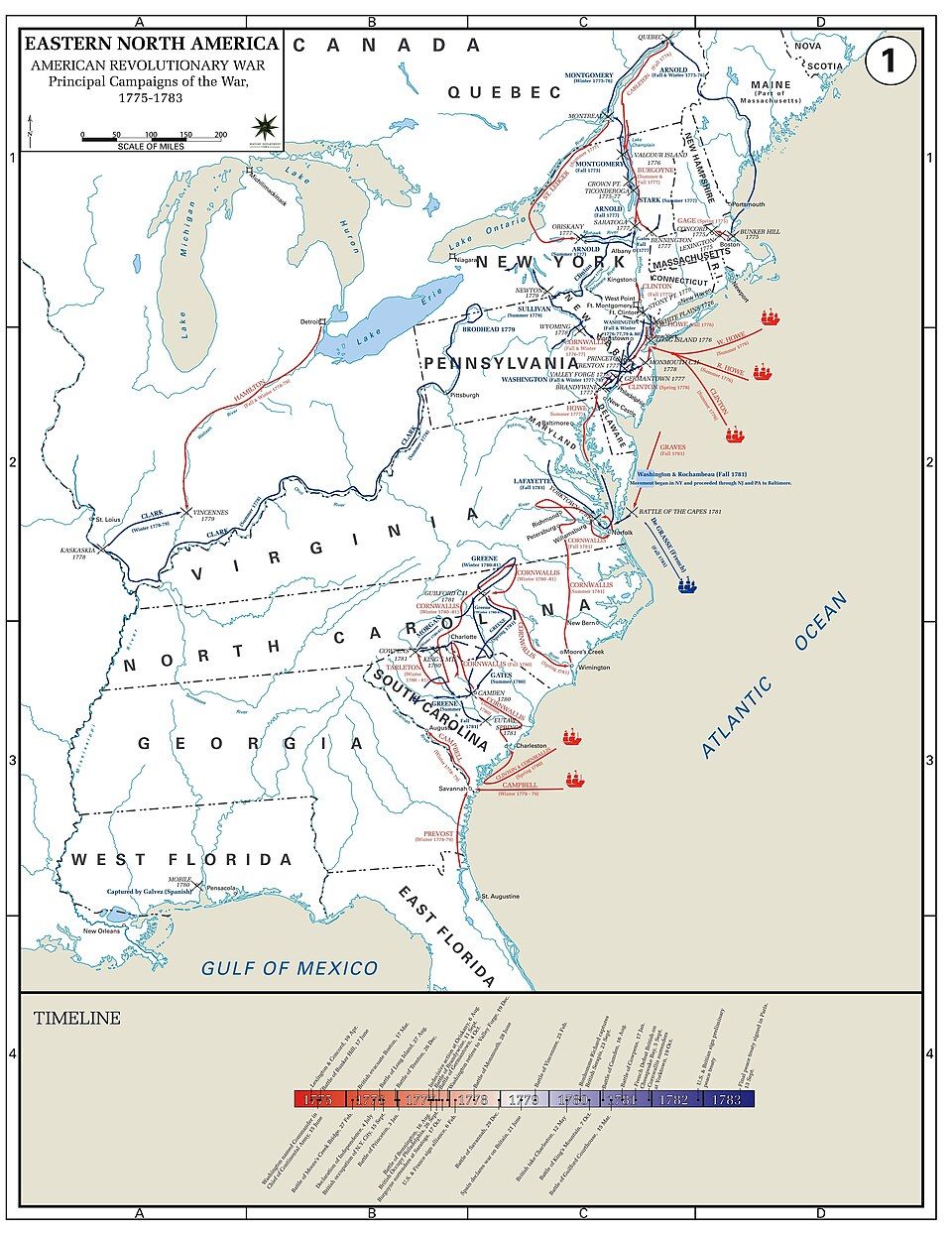
Saratoga marked the moment when the American Revolution shifted from a colonial rebellion to a viable international conflict. British General Burgoyne aimed to move south from Canada to isolate New England, but American forces under Gates and Arnold used terrain to gradually surround his army. On October 17, 1777, over 5,000 British troops surrendered — the first major defeat of a British army in the war.
Why Saratoga Changed Everything:
- Convinced France that American victory was possible — before Saratoga, France viewed the rebellion as likely to fail
- Led France to formally ally with the United States in 1778, committing military forces and resources
- Brought French army units, naval power, and 6,000+ troops to the American cause
- Demonstrated that British forces could be defeated by Americans working with local militia
Foreign Assistance: The Critical Factor
| Country | Military Aid | Financial Aid | Strategic Impact |
|---|---|---|---|
| France | Army units, navy ships, officers, supplies | Loans and grants; financed American supply chains | Decisive; without French navy at Yorktown, Americans could not win |
| Spain | Fought British in Caribbean and Florida | Loans and supplies | Distracted British resources from American theaters |
| Netherlands | Privateers, indirect support | Loans and facilitating trade | Supplied Americans; competed with British commercial interests |
The Treaty of Alliance with France (February 1778) formally committed French military and naval forces. France would not negotiate peace separately from the United States. French financial support sustained American operations when domestic resources failed.
The Battle of Yorktown (October 1781): Final Victory
British General Cornwallis moved to Yorktown, Virginia to establish a secure naval base. Washington and French General Rochambeau combined approximately 16,000 troops and marched to Virginia, surrounding Cornwallis’s 7,000 troops. French Admiral de Grasse moved the French fleet into the Chesapeake Bay, preventing British ships from evacuating or resupplying Cornwallis. After weeks of bombardment, Cornwallis surrendered on October 19, 1781, with over 7,000 British and German troops captured.
British morale collapsed after the loss of an entire army. The Treaty of Paris (1783) officially recognized American independence.
Quick Reference Vocabulary Chart
| Term | Definition |
|---|---|
| Continental Army | Official army of the thirteen colonies led by George Washington; fought major battles |
| Militia | Local volunteer military groups using hit-and-run tactics and guerrilla warfare |
| Loyalists | Colonists who remained loyal to Britain during the Revolution (roughly one-third of colonists) |
| Hessians | German mercenaries hired by Britain to fight in America |
| Natural Rights | Fundamental rights (life, liberty, pursuit of happiness) held by all people; drawn from John Locke |
| Consent of the Governed | Principle that government power comes from the people and requires their approval |
| Battle of Saratoga (1777) | American victory that convinced France to formally ally with the United States |
| Treaty of Alliance (1778) | Formal agreement between the United States and France to jointly fight Britain |
| Battle of Yorktown (1781) | Final major battle; British surrender that ended the war |
| Treaty of Paris (1783) | Peace treaty recognizing American independence and ending the Revolutionary War |
Test-Taking Strategies
Mnemonics and memory shortcuts:
- “Washington + Militia + Ideology + France = Victory” — the four factors of American victory. If an essay asks why Americans won, hit all four.
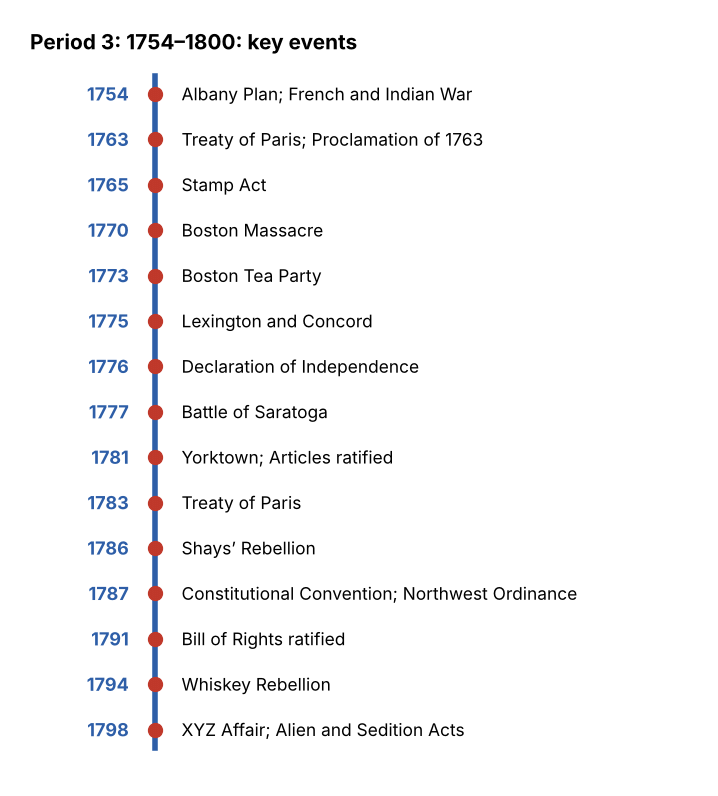
- “1776, 1777, 1778, 1781” timeline anchor: 1776 = Declaration + Trenton revives the cause; 1777 = Saratoga turns the war; 1778 = France formally joins; 1781 = Yorktown ends it. Know these four dates and you can answer most Revolution questions.
- “Saratoga = Diplomacy, Yorktown = Victory” — Saratoga brought French alliance (diplomatic turning point); Yorktown forced surrender (military turning point). Know the difference.
Cross-topic connections the AP exam tests:
- Enlightenment → Declaration: The Declaration draws explicitly on Locke’s philosophy of natural rights. Questions often link Enlightenment ideas to Revolutionary ideology.
- Revolution → French Revolution: American success inspired French revolutionaries. French support of America caused French financial crisis, contributing to the French Revolution itself.
- Revolution → Slavery and Native Americans: The Revolution occurred while slavery and Native American dispossession continued. This contradiction shaped early American politics and eventually caused the Civil War.
- Revolution → Early Republic: Washington became president; the Revolution established principles that shaped early party conflicts over federal power (Federalist vs. Democratic-Republican).
Common question formats:
- “Why did the colonies defeat Britain despite military disadvantages?” Answer: militia tactics, Washington’s leadership, ideological commitment, and French aid. Hit all four.
- “What was the significance of the Battle of Saratoga?” Answer: First major British defeat; convinced France to formally ally with America; turned rebellion into international war Britain could not win.
- “How did foreign assistance change the Revolutionary War?” Answer: France brought military forces, navy, and financial resources; without France, American victory would have been nearly impossible (Yorktown proves it).
- Stimulus MCQs: A source about Valley Forge or Trenton tests morale and leadership. A source about Saratoga tests foreign alliance causes. Identify the context first.
Frequent student mistakes:
- Thinking Americans won easily or inevitably — the war was close and could have gone either way without French support
- Underestimating the importance of foreign aid — France was decisive, not supplementary. Without the French navy at Yorktown, Cornwallis escapes
- Forgetting about Loyalists — roughly one-third of colonists remained loyal to Britain; this was partly a civil war
- Overemphasizing militias — the Continental Army was essential for coordinated warfare; militias alone could not defeat Britain
- Separating ideology from military factors — the Declaration and Enlightenment ideas motivated soldiers and justified sacrifice
Test-day shortcuts:
- For essays on why Americans won: one paragraph each on (1) military strategy, (2) Washington’s leadership, (3) ideological commitment, (4) French assistance. This covers all major factors.
- Saratoga vs. Yorktown: Saratoga = diplomatic turning point (secured French commitment). Yorktown = military turning point (forced British to surrender).
- Declaration of Independence questions: identify (1) natural rights language, (2) consent of the governed, (3) list of grievances against the King. One sentence each = complete answer.
Time management: If short on time, prioritize the four-factor framework (military, leadership, ideology, foreign aid) and the timeline (1776–1778–1781). These cover 80% of Revolution exam questions.