
Maximize your score with these resources:
- Albert.io AP® Business with Personal Finance question banks
- Free AP® Business with Personal Finance score calculator
An income statement is like a video of a business over a year: money flowing in, money flowing out. A balance sheet is a photograph. It freezes one moment, say December 31, and shows everything the business owns, everything it owes, and what is left over for the owners. Lenders look at that photo to decide whether a business can pay its bills next month. Households have a version of it too, called net worth. Topic 3.7 shows you how to build and read both.
This article covers Topic 3.7: The Balance Sheet and Net Worth in Unit 3, Part 2, Business Finance and Accounting. The topic asks you to determine and describe the components of a balance sheet, interpret it, and describe the purpose of personal net worth.
By the end, you should be able to:
- State the balance sheet equation and explain each side.
- Classify assets by liquidity and liabilities by due date.
- Use a balance sheet to judge net worth, working capital, and debt.
- Calculate household net worth and explain how lenders and planners use it.
The Balance Sheet Equation
A balance sheet compares a business’s assets with its liabilities and owners’ equity at a specific point in time. The balance sheet equation, also called the fundamental accounting equation, is:
\(\text{assets}=\text{liabilities}+\text{owners}^{\prime}\text{ equity}\)
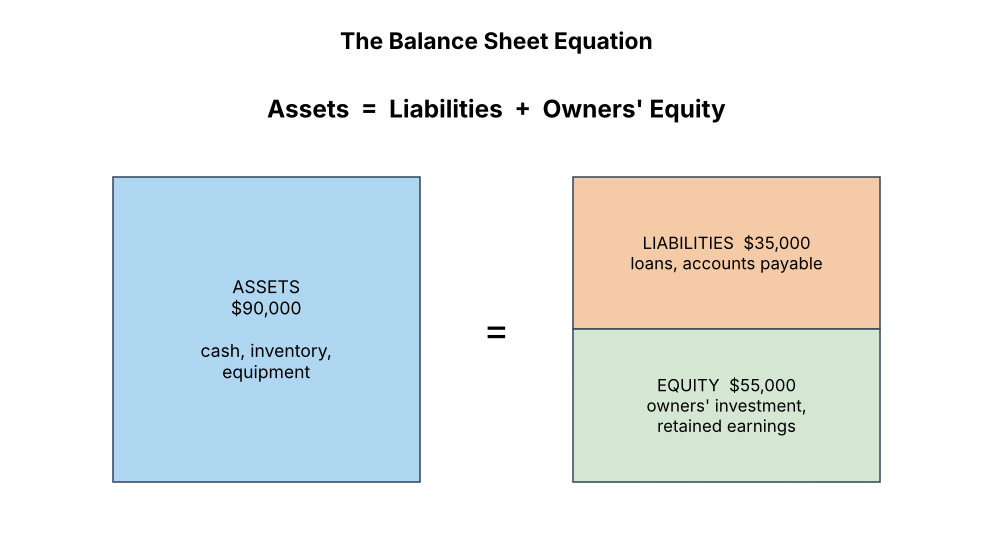
Balance sheets usually show comparable snapshots, such as the end of the same quarter in previous years.
Assets: Grouped by Liquidity
Liquidity is how easily an asset can be turned into cash.
| Asset group | Liquidity | Examples | Purpose |
|---|---|---|---|
| Current | High | Cash, short-term investments, accounts receivable (money customers owe the business), inventory | Fund day-to-day operations |
| Long-term | Lower | Fixed assets such as production plants; long-term investments | Run business operations |
| Intangible | Not physical | Patents, brand names, trademarks | Represent potential revenue |
Liabilities and Owners’ Equity
| Liability group | Due | Examples |
|---|---|---|
| Current | Within one year | Accounts payable (money the business owes suppliers), short-term debt, this year’s payments on long-term debt, accrued (unpaid) operating expenses |
| Long-term | Beyond one year | Mortgages, bank loans, long-term bonds |
Owners’ equity is the business’s net worth: assets minus liabilities. It often consists of stock and retained earnings, the cumulative profits not paid out as dividends.
Receivable vs. payable: Receivable is money coming in (an asset). Payable is money going out (a liability).
Reading a Balance Sheet
Owners, managers, lenders, and investors use the balance sheet to check three things:
- Positive net worth: Do assets exceed liabilities?
- Working capital: Do current assets meet or exceed current liabilities, so the business can fund daily operations?
- Debt level: Is debt comparable to similar businesses?
If a business cannot access enough current assets to keep operating, its owners may shut it down or pursue bankruptcy, a legal process to liquidate assets, eliminate or repay debts, and either close or reorganize under legal supervision.
Worked Example: A Bike Shop’s Balance Sheet
| Assets | Liabilities and equity | ||
|---|---|---|---|
| Cash | $15,000 | Accounts payable | $12,000 |
| Accounts receivable | $5,000 | Short-term loan | $13,000 |
| Inventory | $30,000 | Long-term bank loan | $40,000 |
| Equipment and building | $70,000 | Owners’ equity | ? |
| Total assets | $120,000 | Total | $120,000 |
- Owners’ equity: Liabilities total \(12{,}000+13{,}000+40{,}000=\$65{,}000\), so equity is \(120{,}000-65{,}000=\$55{,}000\). Net worth is positive.
- Working capital: Current assets are \(15{,}000+5{,}000+30{,}000=\$50{,}000\). Current liabilities are \(12{,}000+13{,}000=\$25{,}000\). Current assets comfortably exceed current liabilities.
- Caution: $30,000 of current assets is inventory. If bikes sell slowly, cash could get tight even though the numbers look healthy.
Personal Net Worth
Household net worth adds all assets, including savings, investments, property, and personal possessions, and subtracts all liabilities. A family with a $250,000 home, $30,000 in savings, and $20,000 in possessions, owing $180,000 on a mortgage and $15,000 on a car, has net worth of \(300{,}000-195{,}000=\$105{,}000\).
- Lenders may ask for household net worth on a loan application.
- Consumers and financial planners use it to judge whether there are enough savings to retire.
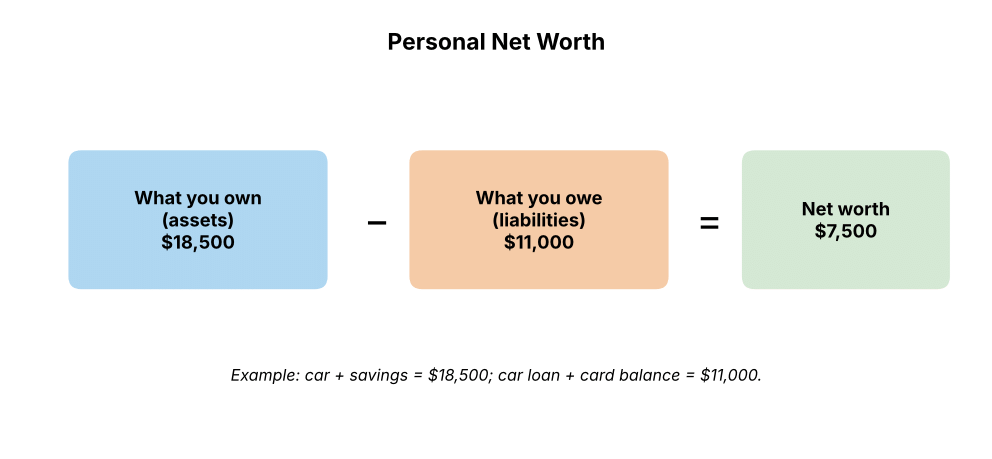
Why does this matter? Free-response Question 2 can give a household’s financial data and goals. Calculating net worth is often the first step.
Test-Taking Strategies
Mnemonic Devices and Memory Shortcuts
“A = L + E” always balances. “Receivable = Receive cash; Payable = Pay cash.” Income statement = video; balance sheet = photo.
Cross-Topic Connections
- Topic 3.6: The Income Statement produces the profits that become retained earnings.
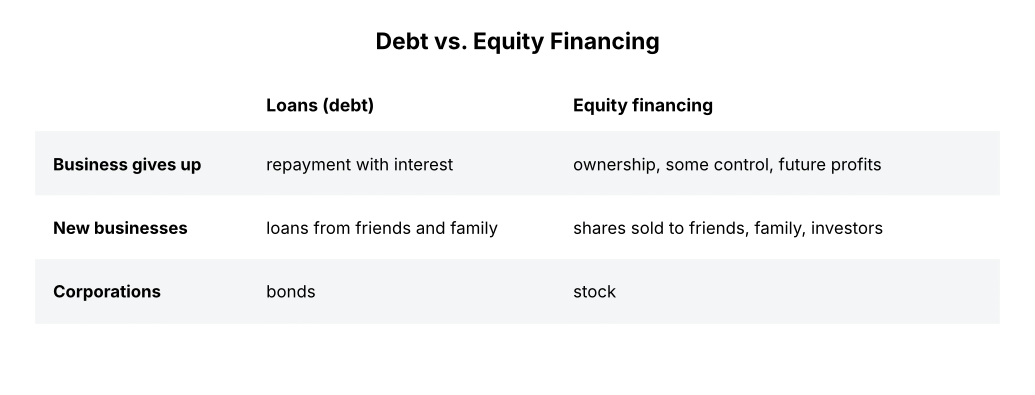
- Topic 3.5: Financial Capital explains the loans, bonds, and stock on the right side of the equation.
- Topic 3.2: Borrowing, Credit, and Debt covers personal liabilities and bankruptcy for individuals.
- Topic 3.3: Accounting and Financial Management introduces assets, liabilities, and owners’ equity.
Common Question Formats
- A balance sheet with one missing value, solved with the equation.
- An item asking whether it is a current, long-term, or intangible asset.
- A question asking whether a business has enough working capital.
Frequent Student Mistakes
- Listing accounts payable as an asset.
- Treating a balance sheet as covering a whole year. It is one moment.
- Forgetting intangible assets like patents and trademarks.
Test-Day Shortcuts
For working capital questions, ignore everything long-term. Compare only current assets with current liabilities.
Time Management Tips
The AP Business with Personal Finance Exam on May 4, 2027, is fully digital in Bluebook, and calculators are permitted. Total each side of a balance sheet once and check that they match before answering. A mismatch tells you that you misread a number.
Check for Understanding
Think you’ve got it? Complete the quiz below to make sure. Download your results at the end.